The Unsettling Nature of Genetic Algorithms
Why is this AI ML meme funny?
Level 1: Not a Real Baby
Think of it like a silly misunderstanding. Imagine a baker at a cupcake shop says, “I’m going to mutate our original cupcake recipe and send out a child cupcake.” 😲 All the customers would probably gasp and think, “What on Earth is a child cupcake? That sounds horrible!” They’re picturing some strange science experiment with baby cupcakes. But what did the baker really mean? Simply that he’s going to change the recipe a bit and make a new flavor of cupcake (which he playfully called a “child” of the original). In the baker’s mind, that was totally normal to say because he was thinking about recipes and variations, not actual children. This meme is funny for the same reason: the computer program (or programmer) is casually talking about mutating and returning a child, but it’s not a real child at all. It’s just making a new piece of data by changing an old one. Everyone else who hears it without that context feels shocked, like those confused cupcake customers, because it sounds like something monstrous. In the end, the joke is that it’s all a big mix-up between how something sounds in plain English and what it really means in computer language. When we realize no actual kid (or dragon, or cupcake) is being harmed – it’s just nerdy jargon – we can laugh at how bizarre it came across!
Level 2: Genetic Algorithm 101
Let’s break down what’s going on in simpler terms. A genetic algorithm (GA) is a type of problem-solving method in computer science that is inspired by natural evolution. It’s part of the broader family of AI/ML techniques that use trial-and-error (with a dash of “survival of the fittest”) to find good solutions. The basic idea is: if you have a bunch of possible solutions to a problem, you treat them like a “population” of creatures. Each solution has some “genes” (in programming, this just means it’s described by certain parameters or data). Now, you want to make better solutions over time, kind of like breeding for a better racehorse or plant hybrid. The algorithm will evaluate how good each solution is using a fitness function (think of it as a score or report card for each candidate). Then it will take the better solutions and use them to create new ones. How? Either by combining two solutions (that’s called crossover, analogous to parents having a child together) or by copying one solution but tweaking it randomly – that second method is called mutation.
So in a GA, to mutate means to change a solution a little bit at random. And a child refers to the new solution that comes out after you mutate a parent solution (or after you combine parents). There’s no actual baby or living creature – these are all just pieces of data. For example, imagine you have a solution represented by a list of numbers [2, 5, 8, 3] (that could represent anything: say recipe ingredients, robot settings, whatever the problem is). A mutation might randomly add 1 to the second number and subtract 2 from the last number, giving [2, 6, 8, 1]. That new list [2,6,8,1] is the child – it’s like the “offspring” of the original solution after a random change. The hope is that maybe this new child solution is better (tastier recipe, more efficient robot, etc.), but the algorithm will test it (compute its fitness) to decide if it should stick around for future rounds.
Now, why does the phrase “mutate and return child” show up? In code, you often write functions to perform these operations. A function might take a solution (the parent) as input, do the mutation operation, and then output the new solution (the child). If we were writing pseudo-code or a comment, we might literally say: “Mutate the parent and return the child.” In fact, some programming libraries or frameworks for genetic algorithms use very similar names. It’s a very straightforward description of what the code does. For someone working on evolutionary_computation, that line is as ordinary as saying “add and return the sum” in basic math code.
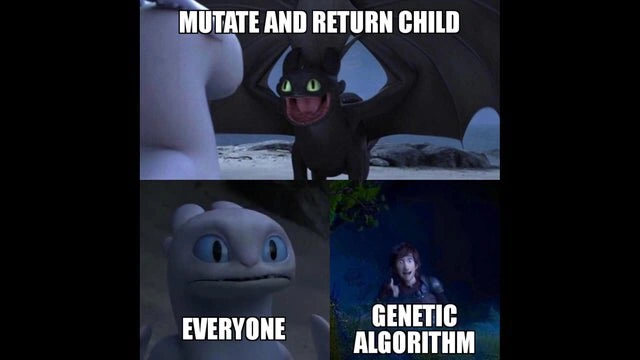
The meme shows how this very normal ML phrase looks to the uninitiated. It uses characters from the animated movie How to Train Your Dragon as a humorous metaphor. The top panel has Toothless, the black dragon, with a goofy grin. Next to him, in bold white meme-text, it says “MUTATE AND RETURN CHILD”. This is presenting that phrase boldly, as if Toothless (or the person he represents) is casually suggesting it. In the context of the meme’s caption, Toothless is essentially the one dropping that line in a pull request comment. Why Toothless? Because he’s known to be a bit playful and unpredictable – a fitting stand-in for the genetic algorithm or the ML engineer who isn’t aware (or isn’t concerned) that their jargon sounds crazy. The bottom-left panel shows the Light Fury (the white dragon) with a stunned, wide-eyed expression. The text under her says “EVERYONE”. She symbolizes all the other developers or readers who see “mutate and return child” and are taken aback. They’re basically thinking, “Wait… what did I just read? Mutate and do what with a child?!?” The bottom-right panel has a human character (that’s Hiccup from the movie, albeit shown in a dark, blurry way) labeled “GENETIC ALGORITHM”. So the format is: Toothless (our sneaky dragon friend) says the shocking line, everyone is shocked, and then we reveal it’s actually the genetic_algorithm (personified) behind this situation. In other words, the Genetic Algorithm is the “person” making that comment, and it doesn’t find it strange at all – it’s literally built to do that!
Now, what’s a PR comment mentioned in the title? PR stands for Pull Request. In software development, when you finish some changes to the code, you open a Pull Request to merge those changes into the main codebase. Teammates then review your code – they can leave comments on specific lines or overall suggestions. A “PR comment” is just feedback or a note left by a reviewer or the author on the code changes. So the title is playfully imagining someone writing a comment in a code review that says “mutate and return child,” as if it’s no big deal. The joke is that in any normal project’s PR, seeing a comment like that would make everyone pause and go, “Umm... excuse me?”
This meme falls into both AIHumor and AlgorithmHumor because it’s specifically joking about a machine learning algorithm concept. It also touches on CS_Fundamentals because genetic algorithms are a fundamental technique taught in computer science and optimization courses – though usually, professors are careful to explain the terminology to avoid exactly this kind of misunderstanding! The reason it’s funny is pretty universal: it’s the contrast between technical meaning and everyday meaning. Technically, “mutate and return child” is just saying “make a new solution by tweaking an old one and give it back.” But in everyday language, it sounds like “mutate a child and give it back,” which is something out of a sci-fi thriller or a witch’s spell book.
By understanding that context, we can appreciate the joke. The genetic algorithm doesn’t involve any real dragons or children – just code doing what it’s supposed to do. The meme cleverly uses the dragon characters to amplify the drama of misunderstanding. If you’re new to this concept, now you know: in computing, mutate often just means change data, and child can mean a result or a subordinate data element. So, no need to call any authorities – it’s all just nerdy talk! Once you get that, the meme transforms from a puzzling phrase into a funny little insight about how quirky tech language can be.
Level 3: How to Train Your Algorithm
For an experienced developer or ML engineer, the humor in this meme hits close to home. It’s poking fun at domain-specific jargon cropping up in places like code reviews and causing double-takes. The title sets the scene: “Genetic algorithm casually drops a ‘mutate and return child’ PR comment.” Imagine you’re reviewing a pull request on GitHub for a new feature that uses a genetic algorithm. You scroll through the code changes and suddenly see a function name or comment that literally says “mutate and return child.” If you’re familiar with genetic algorithms, you nod and think “Yep, that’s the mutation operator creating a new offspring – looks fine.” But if you’re not in on this particular AIHumor nuance, your eyebrows hit the ceiling. Did your colleague’s code just suggest mutating children? Everyone outside the ML bubble is momentarily alarmed. The meme brilliantly captures this reaction with the How to Train Your Dragon images: the middle panel labeled “EVERYONE” shows the Light Fury dragon utterly stunned, wide-eyed in shock. That’s every developer in the room who isn’t an evolutionary computation geek, reacting to this out-of-context snippet.
Meanwhile, the top panel has Toothless (the black dragon) grinning mischievously while stating “MUTATE AND RETURN CHILD” in bold text. Toothless represents the person or entity completely comfortable with this frightening-sounding instruction – in this case, that’s the Genetic Algorithm itself (or the ML specialist). He’s as cheerful as a developer pushing a commit that says child = mutate(parent) as if it’s the most normal thing in the world. The bottom-right panel reveals “GENETIC ALGORITHM” as the identity of the figure in the dark (a blurred Hiccup from the movie). This implies that it’s the algorithm (or the coder wielding it) that’s proposing this strange operation, lurking like a mysterious creature that normal folks find a bit scary. The humor is that the algorithmic mindset is so different from the everyday developer mindset that it might as well be a dragon or a forest-dwelling enigma to others.
In real software team scenarios, this kind of thing actually happens. MachineLearningHumor often comes from these culture clashes. One team’s routine technique is another team’s nightmare phrasing. A gen-alg specialist might leave a code comment like, “Here we mutate the parent individual and return the child for the next generation,” thinking nothing of it. A stressed project manager skimming the diff might do a double-take: “We... do WHAT to a child?!” It’s all about context. Within an AI research group, everyone knows child means “new data derived from old data” and mutate means “randomly tweak some parameters.” But drop those words in a general Slack channel or a pull request visible company-wide, and you might spark some confused chatter or nervous jokes about calling child services for your codebase. 😅
The meme’s text, “mutate and return child,” is funny because it’s so blunt and clinical. It reads like a short to-do note in code, similar to something you’d see in a code review comment or a commit message. That casual tone juxtaposed with the dramatic wording is comedic gold for those of us who have been around odd code terminology. It reminds experienced devs of other times when programming jargon sounds inadvertently horrific or absurd. Consider some classic examples from core development and CS_Fundamentals:
- We routinely say we need to “kill” a process (meaning stop it from running), and if it doesn’t terminate properly it might become a “zombie” process. To a non-dev, that sounds like a Halloween horror story, but it’s standard ops talk.
- In UNIX-like systems, there’s a
fork()call that creates a child process from a parent process – yes, operating systems have been casually talking about parent and child processes for decades. If one of those parents exits before the child, we get an “orphan” process. It’s normal technical lingo, albeit borrowed from family terminology. - Even in everyday OOP design, we use terms like “child class” and “inheritance.” Tell someone that “the child inherits properties from the parent” out of context and they might think you’re discussing a will, not a program!
What’s great (and slightly devious) about this meme is how it leverages a wholesome, family-friendly movie reference (How to Train Your Dragon) to underline a very geeky joke. Toothless’s cheeky grin is the perfect avatar for that ML engineer or algorithm saying “heh, nothing personal, let’s just mutate the kid.” The Light Fury’s aghast face stands in for our collective gasp when hearing something so outlandish in a code review. And the human in the dark (Hiccup, here emblematic of the algorithm’s mastermind) shows that behind the curtain, it’s really just this genetic_algorithm doing its job in the shadows – not a malicious villain, just an optimization routine that happens to sound like one. Seasoned developers love this kind of humor because it’s a shared wink at how bizarre our work can sound. We’ve all had moments where we needed to explain to a colleague, “No, no, don’t worry – we’re not actually harming anything! It’s just how the algorithm works.” The meme takes that scenario to the extreme in the funniest way. In essence, AlgorithmHumor like this feeds on the contrast between literal meaning and intended meaning. Those in the know find it hilarious that such a frightening phrase is completely innocuous in context, while those out of the loop validate the joke by reacting with legitimate confusion or concern. It’s a comedic snapshot of interdisciplinary communication in tech: the AI_ML folks speaking their evolutionary lingo, and everyone else momentarily thinking they’ve unleashed a dragon.
Level 4: Simulated Darwinism
At the most technical tier, this meme alludes to the inner workings of evolutionary computation – specifically a genetic algorithm. In such algorithms, solutions to a problem are treated like living organisms evolving over time. The phrase “mutate and return child” is essentially describing a core evolutionary operator in code: take a parent solution, apply a random mutation to it, and produce a new solution (an “offspring” or child) as the result. This is literally how genetic algorithms iterate toward better solutions. They maintain a population of candidate solutions, select one or more parent solutions (often favoring the “fittest” according to some evaluation metric), and then generate new candidates by mixing or mutating those parents. The new candidates – the children – are variations of their parents, hopefully inheriting the good traits (or in code terms, good parameter values) with some random tweaks for novelty. Over many generations, the population “evolves” better and better solutions by keeping the strong candidates and discarding weaker ones.
From a theoretical standpoint, this process is a stochastic search through a so-called fitness landscape. Mutation is crucial because it introduces randomness, helping the search escape local optima and explore new regions of the solution space. The algorithm doesn’t “know” anything in a human sense – it relies on random variation plus a survival-of-the-fittest strategy to gradually improve solutions. Researchers in AI/ML have formalized these ideas since the 1970s (John Holland’s work is foundational, linking Darwinian principles to computer algorithms). In practice, you might represent each solution’s “genome” as a string of bits, numbers, or other data structures, and a mutation operator will flip some bits or perturb some values. The code for this could look as routine as a simple function call:
def mutate_and_return_child(parent):
child = copy.deepcopy(parent) # clone the parent solution (preserve original)
for gene in child.genome:
if random.random() < mutation_rate:
gene.value = random_variation(gene.value) # introduce a small random change
return child # return the mutated child solution
In a real genetic algorithm library, you’ll find functions akin to the pseudocode above. This snippet literally mutates a parent individual and returns the child individual, just as the meme’s text says. Seen purely in algorithmic terms, there’s nothing nefarious here – the child is just a data structure (often an object or array) derived from the parent’s data, and mutation is just altering some of that data. It’s an elegant and powerful idea: by simulating evolution inside the computer, we can solve complex optimization problems. But the terminology is undeniably colorful. The field of evolutionary computation deliberately borrows biological terms — chromosomes, genes, crossover, mutation, fitness, selection — to describe what the code is doing. This mapping to biology makes the algorithms easier for researchers to reason about, but it also leads to quirky phrases in code. A seasoned machine learning engineer will instantly recognize “mutate and return child” as an innocent step in a genetic algorithm’s lifecycle. However, outside this context, it reads like a line from a mad scientist’s experiment log! The humor of the meme lies exactly in this contrast: the phrase is a perfectly routine, even dry, description of an algorithm’s function, yet phrased in plain English it sounds comically ominous. In summary, at this deep-dive level, the meme is shining light on how AI/ML algorithms like genetic algorithms anthropomorphize computation with biological metaphors. It’s a reminder that under the hood of that one-liner joke is a whole world of CS fundamentals – from Darwinian theory analogs to randomized search heuristics – all encapsulated in a snippet of code that says, unblinkingly, “mutate and return child.”
Description
A four-panel meme using the 'Toothless Presents Himself' format from the movie 'How to Train Your Dragon'. In the top-left panel, the black dragon Toothless is shown doing a bizarre, goofy courtship dance, with the caption 'MUTATE AND RETURN CHILD'. In the bottom-left panel, the white Light Fury dragon looks on with an expression of confusion and disgust, captioned 'EVERYONE'. In the bottom-right panel, the human character Hiccup is hiding in the bushes, giving an encouraging thumbs-up, with the caption 'GENETIC ALGORITHM'. The meme humorously personifies the process of a genetic algorithm, where the chaotic and seemingly random 'mutation' of a solution (Toothless's dance) is viewed as strange by outsiders ('Everyone'), but is a deliberate and encouraged part of the process for the algorithm itself (Hiccup). It's a niche joke for those familiar with evolutionary computation concepts
Comments
7Comment deleted
A genetic algorithm is just a glorified brute-force search with a fancy, nature-inspired name that makes it sound like you know what you're doing when you're just randomly flipping bits and hoping for the best
Somewhere in the codebase there’s a function called `offspring = parent.mutate()` that still hasn’t passed the ethics review
After 20 years of explaining genetic algorithms to junior devs, I've realized the real mutation happens to my will to live when someone suggests we just increase the population size to fix convergence issues
The classic genetic algorithm footgun: when your mutation function has the side effect of making everyone in the population point to the same memory address. You think you're evolving a diverse population toward optimal fitness, but you've actually just implemented 'Borg Assimilation as a Service' - one mutation to rule them all. It's the algorithmic equivalent of a zombie apocalypse, except instead of brains, it's consuming your population diversity, and your convergence graphs look suspiciously like a flatline. Pro tip: deep copy your chromosomes, or prepare for the heat death of your solution space
Genetic algorithms: Mutate parents, birth abominations - because random search was too honest about its garbage offspring
Only in evolutionary computation can mutateAndReturnChild(parent1, parent2, rngSeed) ship with “elitism” enabled and nobody files an HR ticket
Only in evolutionary computation does mutate_and_return_child() pass code review with an LGTM - nondeterminism, elitism, and selection pressure are documented features