The Senior Developer's Mantra: The Best Refactor is Deletion
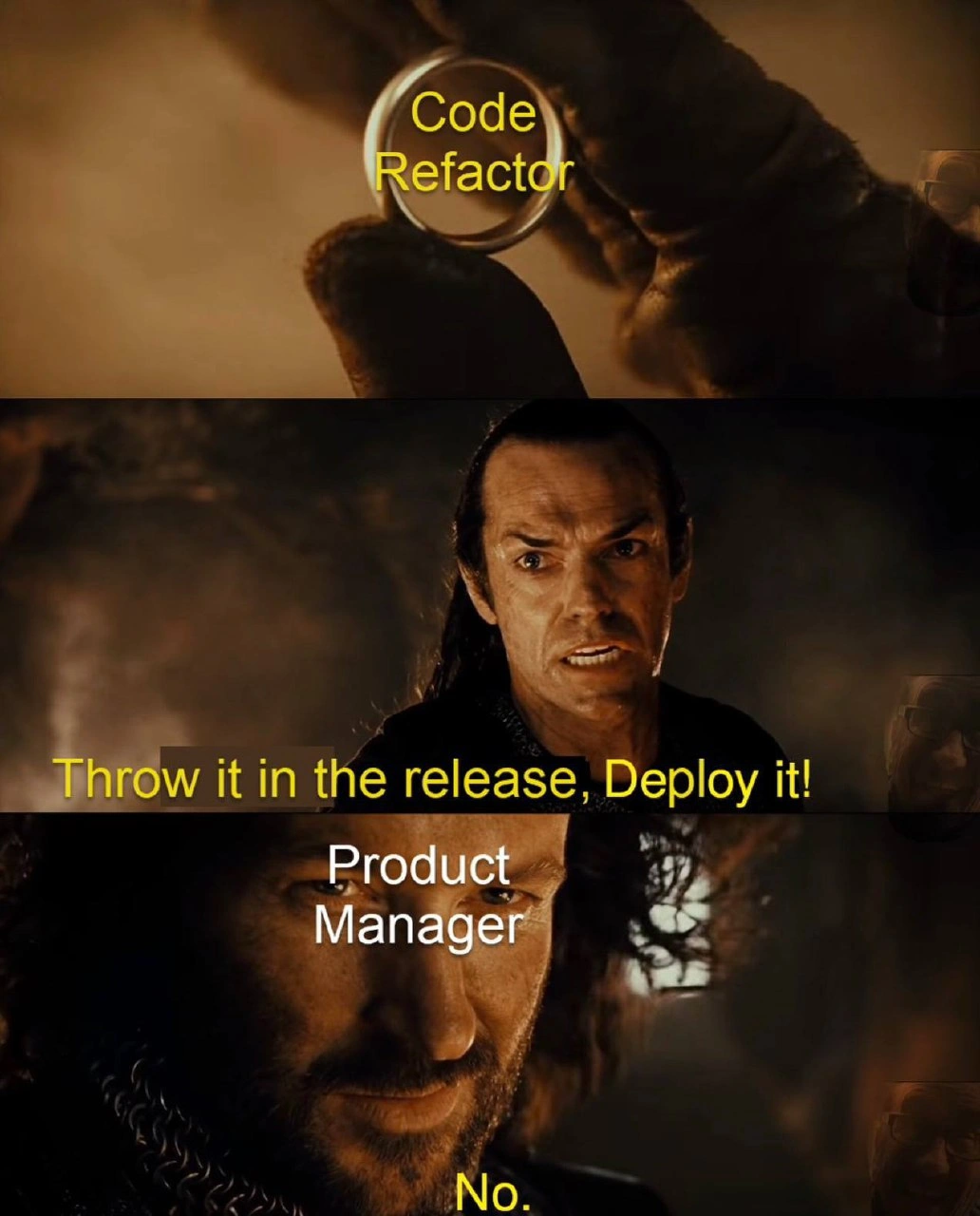
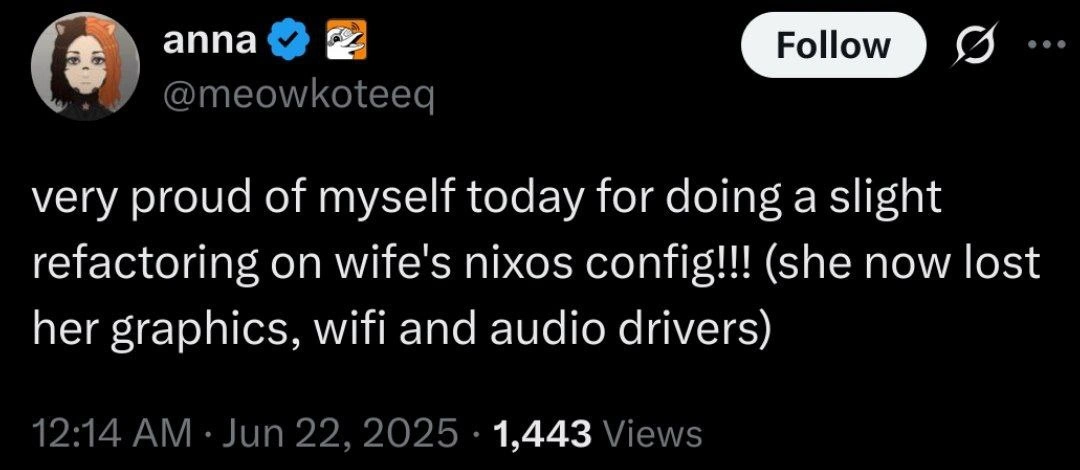
Why is this Refactoring meme funny?
Level 1: Less Toys, Less Mess
Imagine you have a big toy box that’s overflowing with toys, many of which you don’t even play with anymore. They’re just taking up space and making it hard to find the toys you do love. One day, you decide to clean up. You pick out all those toys that are broken or that you’ve outgrown and you remove them from the box. Suddenly, your toy box is much emptier. Now it’s so easy to find your favorite action figure or doll, and there’s no huge mess to sort through every time. In this little story, deleting code is like removing the unused toys. The meme is saying that the best way to tidy up a messy collection (of toys or code) is to simply get rid of the bits you don’t need. It’s funny because it sounds like an extreme solution – instead of organizing or fixing the toys, just throw them out! – but often it really does make things so much simpler. Fewer toys, less mess. Fewer lines of code, less chance of things going wrong. That’s the whole joke: sometimes the easiest way to solve a big messy problem is to remove the source of the mess entirely.
Level 2: Less Code, Fewer Bugs
Now let’s break this meme down in more beginner-friendly terms. The tweet in the image states, “the best refactor is to delete the code.” A refactor is when developers restructure or clean up existing code without changing what it does for the user. It’s like tidying your room – you’re organizing and improving, not getting new stuff. A PR (pull request) is a package of code changes a developer submits for review. So a “refactor PR” means a set of changes focused on improving code quality/style rather than adding new features. Usually, refactoring might mean renaming variables, splitting a big function into smaller ones, or simplifying a complex algorithm. But this meme jokes that the ultimate way to improve messy code is just… delete it altogether!
Why would deleting code ever be “the best” way? This is where some classic Clean Code principles come in. There’s a saying among developers: “less code = fewer bugs.” Every line of code we write is another place a mistake could be hiding. If a part of the software isn’t needed (maybe it’s an old feature nobody uses or some redundant logic), removing that code can instantly eliminate any bugs it had and any confusion it caused. Think about it: code that isn’t there can’t misbehave or break. This idea aligns with the principle YAGNI – “You Aren’t Gonna Need It.” YAGNI encourages programmers not to add code or features just because “one day it might be useful.” If that day never comes, all that extra code is just clutter. Deleting such not-needed code is like cleaning out stuff in your house that you never use. Another related principle is KISS – “Keep It Simple, Stupid” (the term sounds rude, but it’s an old tongue-in-cheek acronym). KISS reminds developers to design systems in the simplest way that works. If a section of code is doing something in an overly complicated way (maybe a 500-line solution for a problem that could be solved in 50 lines, or with a built-in library function), then simplifying or removing the complex part will make the whole project easier to understand and maintain. In many cases, it’s actually easier to maintain a smaller codebase than a large one. This tweet basically doubles down on those principles: the simplest, cleanest code is no extra code at all.
Let’s decode the joking reference to git rm -rf. Git is a version control system – basically a tool that programmers use to keep track of code changes. With Git, you normally add and modify files, but you can also remove them. git rm is the command to remove a file from the repository (so it schedules the file to be deleted in the next commit). The flags -r (recursive) and -f (force) make it remove entire directories and bypass confirmations – it’s a quick way to delete a lot of files at once. It’s similar to the scary rm -rf command in Unix/Linux that force-deletes files/directories on your computer without mercy. So when we say a PR is basically one big “git rm -rf commit,” we mean the change is predominantly deleting a bunch of files or code en masse. In plainer terms, imagine a code change where instead of adding new stuff, the developer removed thousands of lines of code across many files. It’s like going into a messy library and throwing out whole sections of useless books. It’s bold! The context_tags like delete_code_refactor and kill_it_with_fire_commit convey that boldness: “kill it with fire” is a playful expression developers use meaning completely destroy the problematic thing. Here, the problematic thing is some chunk of code, and the solution is to torch it out of the codebase. 🔥
Why would a code removal PR happen? One scenario: Overengineering. That’s when developers built something more complicated than necessary. Perhaps the team added a fancy subsystem for future flexibility that the product ended up not needing. All that code just hangs around, making the project harder to understand, and might even introduce bugs or slow things down. Another scenario: Technical debt cleanup. Technical debt is a metaphor for the consequence of quick-and-dirty decisions in code. Just like financial debt, it “interest”: the cost of maintaining and working around that messy code increases over time. At some point, it’s better to pay off the debt by cleaning up or refactoring. Sometimes paying off technical debt means deleting an old module entirely and rewriting a simpler version, or realizing that feature wasn’t worth the complexity. Removing code is a direct way to cut that debt – akin to cutting up a credit card to stop incurring more charges.
It’s also worth noting that version control (like Git) gives developers courage to delete code. Since Git keeps a history of every file, if we delete something and later discover we actually needed it, we can retrieve it from an earlier commit. This safety net means we don’t have to hoard unused code “just in case” – a trap many newer devs fall into. (Ever seen huge blocks of code commented out with a note “might need later”? That’s clutter too, and Git history is a better place for it.) With a tool like Git, doing a big deletion refactor is not irreversible. We can confidently prune the codebase, knowing anything truly important can be resurrected from history if needed.
The punchline that “the best refactor is deletion” is also a bit of DeveloperHumor about how we measure progress. Non-engineers might assume a productive programmer writes tons of new code. But experienced devs often take pride in reducing a codebase’s size. There’s even a facetious metric sometimes joked about: counting lines removed. If you ever hear a programmer say “I made a -500 line change today,” they’re bragging about deleting 500 lines of unnecessary code while maybe adding very few or none. It means they made things simpler. A codebase with fewer lines (that achieves the same functionality) is usually easier to read and has a smaller surface for bugs. It’s like having a shorter, clearer recipe for a dish – fewer steps where something can go wrong. This aligns with DeveloperProductivity in a deep way: productivity isn’t just about speed of writing code, it’s also about the quality and longevity of the code. Removing code that isn’t needed can save countless hours in the future that would have been spent debugging or updating that code. That’s super productive if you think in the long term!
So, in summary, this meme jokes that an advanced skill in programming is knowing when you can just throw code away instead of endlessly polishing it. It’s funny because it’s a bit counter-intuitive at first – newbies expect refactoring to always mean adding better code. But often, less is more. The tweet resonates with developers who have been through painful refactoring sessions and frustrating maintenance of over-complicated systems. It’s a humorous reminder that sometimes the cleanest, highest-quality code is what you don’t write. Every line you successfully eliminate is one less line to confuse a teammate or crash in production. This is why a refactor PR that’s a “giant git rm -rf” can be met not with horror, but with applause from other developers. It means someone had the clarity and courage to simplify the codebase in the most direct way possible. As the meme implies, you don’t get much cleaner or simpler than zero lines of code doing the job!
Level 3: Occam’s Codebase
At the highest technical perspective, this meme channels a core truth of seasoned software engineering: simplicity is supreme. It’s a nod to applying Occam’s razor to programming – if a piece of code isn’t truly needed, the simplest and most elegant solution is to remove it entirely. In complex systems, every additional function or class introduces more points of failure. Veteran developers have learned that each line of code is a liability as much as an asset. No line can crash or leak memory if it doesn’t exist! This darkly humorous wisdom is summed up by the tweet’s bold claim: “the best refactor is to delete the code.” It’s funny because it sounds extreme – refactoring is supposed to mean improving code structure, not annihilating it – yet we all know of monstrosities in the codebase that would indeed be better lost than fixed.
This perspective echoes famous clean coding maxims like KISS (Keep It Simple, Stupid) and YAGNI (You Aren’t Gonna Need It). If past developers had followed those principles, perhaps we wouldn’t face giant blocks of useless or over-complicated code begging to be purged. The tweet coming from a high-profile tech leader (Greg Brockman, known in the AI and dev community) gives it extra punch – it’s like an industry sage cheekily endorsing the ultimate solution for messy code. And judging by the hundreds of likes and retweets visible, this notion resonates strongly with experienced engineers: it’s equal parts joke and hard-earned wisdom. We’ve all seen a 500-line utility or an entire microservice that solved no real problem or a feature nobody used. In those cases, a fearless refactor PR that deletes file after file is greeted with virtual high-fives. Reviewers love seeing a diff that’s mostly red deletions, symbolizing that the codebase’s TechnicalDebt just got lighter. Each deleted line is one less bug or maintenance headache down the road. After all, to quote a popular adage in software design:
“Perfection is achieved not when there is nothing more to add, but when there is nothing left to take away.”
This “scorched earth” style of refactoring is extreme, but it highlights a critical senior-level insight: less code, done wisely, means fewer problems. In practice, such a refactor isn’t done recklessly. A seasoned dev will verify that the code marked for deletion truly isn’t needed – maybe it’s dead code that isn’t called anywhere, a feature flagged off for years, or an over-engineered module replaceable by a simpler library. Once sure, they’ll happily git rm -rf that chunk out of the repository. (For the uninitiated, git rm -rf is the Git command to force-remove files or directories – basically a nuclear option to wipe out code in one commit.) This meme perfectly captures the catharsis of those “kill_it_with_fire” commits where you burn away the cruft. It’s the ultimate code cleanup: no code, no complexity. As paradoxical as it sounds, deleting code can vastly improve CodeQuality and DeveloperProductivity. There are fewer lines to read, less logic to mentally juggle, and zero chance that anyone will ever have to wake up at 3 AM to fix a bug in code that isn’t there. It’s the Zen of software engineering – achieving code nirvana by subtraction instead of addition.
To someone with a long career in code, that punchline hits home because it’s so true. We chuckle, recalling times we spent days trying to untangle a gnarly function, only to realize the best fix was ripping it out completely. It’s humor drawn from the battlefield of legacy systems and OverEngineering nightmares. The tweet’s minimalist one-liner is both a joke and a mantra: sometimes the RefactoringNeeded isn’t to rewrite the code, but to hit delete and let it vanish. In senior circles, developers even brag about negative line count diffs (“I removed 2000 lines today, dare I say the codebase is better for it!”). It’s a proud achievement to simplify like that. So this meme takes a quintessential senior developer stance and delivers it with deadpan brevity. We laugh because it overturns the usual expectation (“refactor means polish the code”) with an unexpectedly ruthless solution (“just drop it in /dev/null”). It’s funny, a bit sarcastic, and deeply satisfying to anyone who’s waded through a swamp of pointless code. In the end, the joke lands because it carries a grain of undeniable technical truth: the Cleanest Code is no code at all. And as every grizzled coder knows, when a codebase’s RefactoringPain gets unbearable, sometimes the boldest, smartest move is simply to “nuke it from orbit” – delete the damn thing and start fresh or live without it.
Description
A screenshot of a tweet from Greg Brockman, co-founder of OpenAI, with the Twitter handle @gdb. The tweet, displayed in white text on a black background, contains the concise and profound statement: 'the best refactor is to delete the code'. Below the text, engagement metrics show significant interaction, indicating the sentiment resonates widely within the tech community. This piece of advice is considered a core tenet of senior-level software engineering. It posits that the most effective way to improve code quality, reduce complexity, and eliminate technical debt is not to restructure or rewrite code, but to remove it entirely. This implies that the feature the code supports may be unnecessary, over-engineered, or solved by a simpler, existing solution. It's a powerful statement about prioritizing simplicity and challenging the assumption that more code equals more value
Comments
11Comment deleted
The junior engineer proudly announces they've added 500 lines of code. The senior engineer proudly announces they've deleted 1000. The principal engineer has prevented the meeting that would have generated the feature request in the first place
Architects know the fastest way to hit five-nines is to ship /dev/null to prod
After 20 years in tech, you realize the most valuable PR is the one with the most red lines - because the only code that never breaks is the code that doesn't exist. Somewhere, a principal engineer is nodding while deleting their entire microservices architecture
Ah yes, the 10x engineer's secret weapon: achieving negative lines of code. While junior devs measure productivity by commits added, seasoned architects know the real art is in what you *don't* build. Every line deleted is one less line to debug at 3 AM, one less dependency to update when the next CVE drops, and one less thing to explain during the architecture review. It's the Marie Kondo approach to software engineering - if that code doesn't spark joy (or revenue), thank it for its service and `git rm` it into oblivion. The best part? Your code coverage percentage goes up automatically
Deleting code is the only refactor guaranteed to reduce cyclomatic complexity without a single regression
My highest-ROI refactor was a -3,842 LOC PR - on-call got quieter, CVEs vanished, and the architecture diagram finally fit on one slide
Best PR I ever shipped was literally 'git rm -r'; reviewers loved the reduced cognitive load and attack surface, and the only regression was the LOC dashboard
Finally good clean code advices Comment deleted
clean and clear Comment deleted
When I delete my code, Sonar says there are fewer bugs and code smells :) Comment deleted
Every program has at least one bug and can be shortened by at least one instruction -- from which, by induction, one can deduce that every program can be reduced to one instruction which doesn't work. Comment deleted