Skip to content
DevMeme
5114 of 7435
The Walled Gardens of Discord: A Critique of Modern Internet Communities
DevCommunities Post #5598, on Oct 20, 2023 in TG

The Walled Gardens of Discord: A Critique of Modern Internet Communities

Why is this DevCommunities meme funny?

Level 1: Not on Google

Imagine you have a big book of answers that everyone in the world can read. That was like the old public forums on the internet – a giant library where if one kid solved a tricky puzzle, they’d write it in the book so everyone else could read it later. Now imagine one day a new cool hangout spot opens – a treehouse club where kids chat and share answers only with their friends who are inside. It’s fun to be in the club, but there’s a catch: nothing said in the treehouse gets written down in the big book. So if you weren’t in the treehouse when they talked about the puzzle, you’ll never know the answer. Later, you go looking in the library for that answer and… it’s not there anymore. You’d have to somehow get into that secret club and hope someone remembers the solution. Frustrating, right? That’s what this meme is joking about. It’s like saying: “Thanks a lot, Discord, for taking all the answers out of the public library and hiding them in private chats!” It’s funny in a sad way because everyone who’s tried to Google a question and found nothing can relate – the answer might exist, but it’s locked away in a place Google can’t see. The meme is basically a sarcastic way of saying that hiding answers in closed groups makes the whole internet feel a bit like a bunch of secret clubs instead of one big helpful place for everyone.

Level 2: Where Did My Answers Go?

For a newer developer, let’s break down why this meme points fingers at Discord and mourns the loss of open forums. Discord is a popular online chat platform (originally for gamers, now used by all sorts of tech communities) where people gather in Discord servers – basically private chat rooms – to talk about their project or interest. If you’ve joined a Discord server for a programming language or an open-source tool, you know it’s great for quick help: you ask a question and someone might answer in minutes. Forums, on the other hand, are websites (like classic message boards or Q&A sites) where people post questions or topics and others reply over time. The big difference is searchability. Anything posted on a public forum is usually indexed by Google and other search engines. That means if someone solved a tricky bug on a forum in 2015, you (as a random Googler in 2023) can still find that discussion and benefit from it without ever logging in or even knowing that forum beforehand. This is a huge deal for developer learning and troubleshooting – it’s how a lot of us learned and solved problems by basically piggybacking on the shared knowledge of the internet.

Now, with chat platforms like Discord (or Slack, Telegram, etc.), those Q&A exchanges happen in semi-closed environments. Many Discord servers are invite-only or at least not automatically indexed by Google. This creates a “knowledge silo” effect: information gets stuck inside that community. If you’re not a member of that Discord or you weren’t online when the discussion happened, you miss out. For example, say you run into an error using a library, and someone in the library’s Discord server did figure out a fix last week. If you search the web, you might find nothing (because the answer was never posted publicly) or maybe you find a vague reference like “ask in our Discord”. Essentially, the answer exists, but it’s behind a closed door. You’d have to join that specific Discord server, hope there’s a searchable history for new members, and then dig through chat logs. That’s a far cry from just clicking a Stack Overflow link. So the meme is highlighting the frustration developers feel: “I can’t just Google my problem anymore, I have to sift through Discord chats or ask again.”

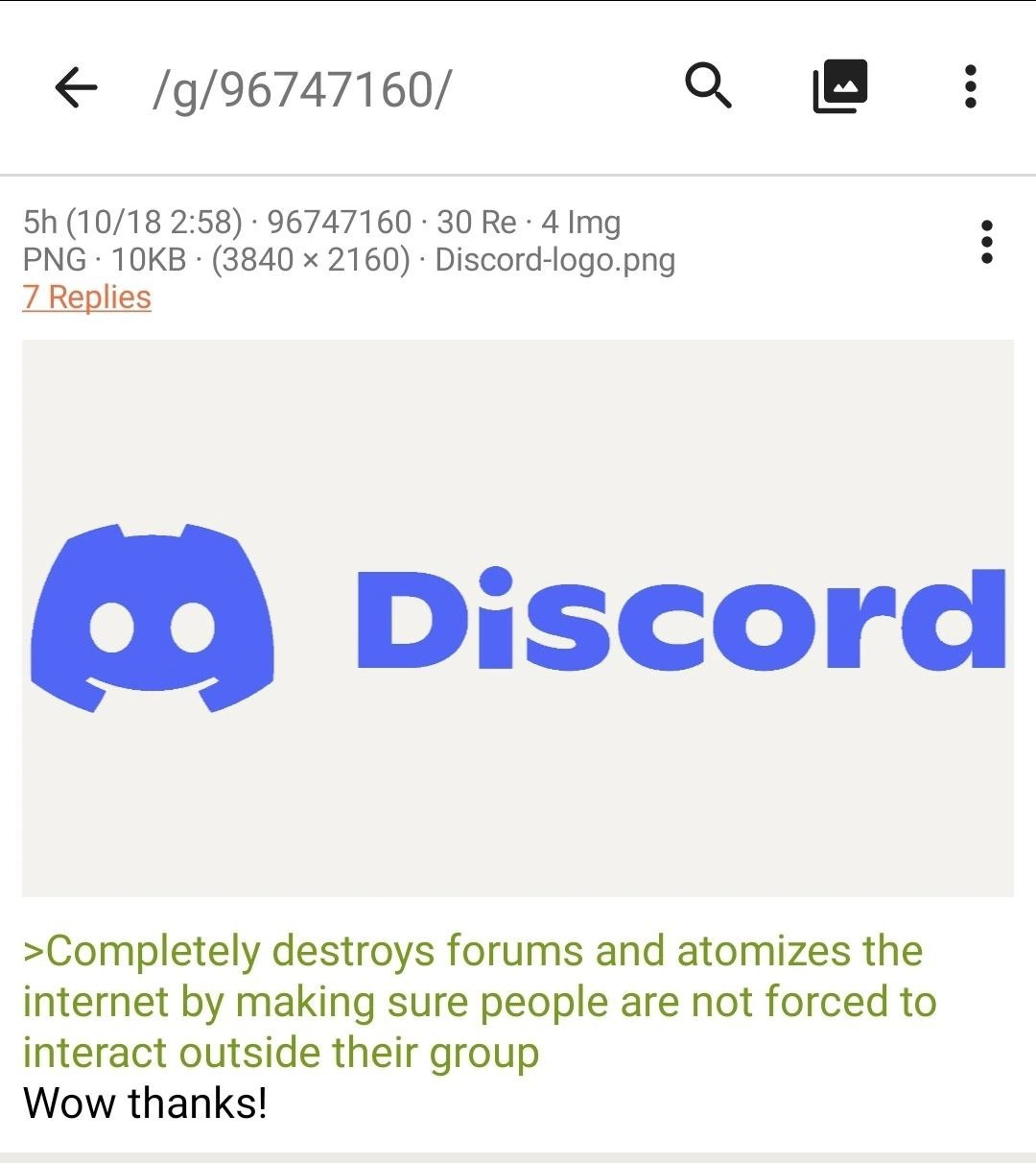
The green text in the meme imitates the quoting style from imageboards (like 4chan’s tech board /g/ where this was posted). It says, “making sure people are not forced to interact outside their group”. In simpler terms, it’s complaining that Discord encourages tech tribalism – people sticking to their own tight community – instead of sharing knowledge broadly. In an open forum, you might have all sorts of folks chiming in, and anyone on the internet can stumble on the conversation later. In a closed community chat, only the people in that “tribe” see the info, and outsiders are left in the dark. This “atomizes the internet”, meaning it breaks the big, connected web of information into tiny isolated pockets. Think of each Discord server as its own little island of content. If you’re not island-hopping (joining every server), you won’t see what happens there. The meme sarcastically says “Wow thanks!” to Discord, implying that this outcome is actually not good at all (nobody really is thankful for it).

Let’s also clarify why communities use Discord despite this downside, because a junior dev might wonder. Discord offers a slick user experience: real-time chat, voice channels, easy setup, fun features like reactions and bots. Running a traditional forum can be more work – you need to host it, moderate posts, deal with spam, and it’s slower paced. Many modern devs find it more engaging to discuss in a fast-moving chatroom. So, communities migrate to these collaboration tools for convenience and engagement. Developer Experience inside the Discord (for those who join) can actually be nice – you feel part of a community and can get help interactively. The trade-off, and what this meme is bitter about, is the developer experience for everyone else on the outside. If you weren’t online or aren’t a member, you effectively lose access to the knowledge. Imagine being a new developer trying to troubleshoot an error: you hit search and nothing comes up because all the discussions are locked in Discord. It’s frustrating and time-consuming. Instead of finding an answer in 2 minutes, you end up joining a new server, introducing yourself, and asking a question that maybe was answered last week. It can make you feel like you’re always one step behind the “in-group” who were there when the knowledge was shared.

In summary, the meme is calling out the downside of Discord vs forums. Open forums = questions and answers that anyone can find later (good for building a public knowledge base). Discord servers = quick chat among a closed group, great for immediate help but bad for leaving a trail for others. The tags like walled_garden_chat, indexability_concerns, and knowledge silos all point to this idea: that knowledge on Discord is stuck behind walls and not indexed by search engines, which is a conscious design or at least a consequence of how Discord works (it’s a closed platform). So if you’ve ever felt annoyed that you couldn’t find an answer by searching and someone said “oh, they answered that in the Discord”, this meme is basically voicing that exact annoyance in a humorous way. It’s a bit of an inside joke among developers about how our once open, searchable internet of knowledge is kind of eroding into fragmented chat groups. As a junior dev, it’s useful to know why some seniors groan about “Discord killing forums” – it’s not just nostalgia, it’s about preserving that open knowledge-sharing culture that helped all of us learn and solve problems faster.

Level 3: 404: Forum Not Found

The meme’s sarcastic "Wow thanks!" encapsulates a veteran developer’s frustration with Discord and similar walled garden chat platforms supplanting open forums. In the past, public forums, mailing lists, and Q&A sites (think early Stack Overflow or classic phpBB boards) served as a globally indexable knowledge base for programmers. You could Google an error message or a weird bug and likely find a decade-old thread where someone had the same issue and a kind soul posted a solution. That’s because those forums were open and searchable, essentially a public library of solutions. But now many dev communities have migrated to real-time chat servers (Discord, Slack, et al.), where conversations happen in closed rooms. The “Completely destroys forums and atomizes the internet” line critiques how this shift atomizes knowledge into isolated Discord servers – each community’s answers get trapped in its own little silo. The result? A scattering of knowledge silos hidden behind invite links and login screens, instead of a shared, searchable repository on the open web.

This is a classic case of community fragmentation fueled by convenience. Spinning up a Discord server is easy: no need to moderate a forum site, no worries about SEO or spam, and you get nifty features like roles, emojis, and voice chat. It’s great for fostering tight-knit online communities and quick collaboration on projects. But the downside is ephemeral knowledge: valuable troubleshooting tips scroll off into oblivion or get buried in message history, effectively invisible to anyone outside that group. Unlike a well-organized forum thread or a StackExchange Q&A, a Discord conversation is here-now, gone-tomorrow – even if the server retains history, an outsider searching the web won’t know it exists. This is the “searchability_loss” the meme points out. The meme’s green text is basically saying: “Thanks, Discord, for making sure people only talk in their cliques, so nobody is forced to share knowledge globally.” It’s a tongue-in-cheek way of blaming Discord for a knowledge accessibility 404 error – the answers exist, but you can’t find them unless you’re in the right server at the right time.

From a Developer Experience (DX) perspective, this trend is maddening. Developers rely on quick searches to debug issues. When a problem’s solution lives in a Discord chat log instead of a public forum, it’s effectively off the grid. You might see a tantalizing hint like “I think someone solved this on the Discord server,” which is the dev equivalent of hearing about an ancient scroll locked away in a vault. If you’re lucky enough to get an invite to that Discord (and it’s not expired), you then have to use Discord’s clunky search (assuming you even have access to that channel’s history) or ask the question again – a wasteful repetition of effort. Seasoned devs have an almost allergic reaction to repeating solved problems (the DRY principle: “Don’t Repeat Yourself” applies to knowledge too!). So, having to answer the same question every week in chat because there’s no canonical, Googleable answer feels like going backwards. It’s as if we traded a knowledge base for a never-ending stream of ephemeral chatter. No wonder the meme drips with sarcasm: the situation is too real for those who have spent late nights scouring the internet, only to find that the solution was discussed in a Discord channel they weren’t part of.

Historically, we’ve seen a pendulum swing in tech communities. In the BBS and Usenet era, information was somewhat scattered, but still open to read if you could connect. The early web forums and wikis were a golden age of open knowledge sharing – everything was indexed by search engines, creating a global brain of developer know-how. That’s how “Google-fu” became an essential dev skill. But now, with the rise of Discord servers and other collaboration tools that prioritize private, real-time communication, we’ve drifted into what some call the new Dark Age of Knowledge. It’s not that the knowledge isn’t there, it’s that it’s locked behind vendor-controlled black boxes (hello vendor_lock_in_chat). It’s ironic: the tech industry that built the search engines and open protocols is now voluntarily shoving its collective wisdom into siloed chat apps that search bots can’t penetrate. This tech tribalism (everyone hunkered down in their own Discord tribe) has real consequences. It reduces cross-pollination of ideas and makes the internet feel smaller and more partitioned. When each niche framework or library only solves issues in its private chat, we lose the big indexed tapestry of shared knowledge that propelled software development forward. In a cynical twist, Discord’s very name evokes discordance in the free flow of information – a far cry from the harmony of an open forum where anyone can benefit from anyone else’s Q&A. So the meme humorously “thanks” Discord for this state of affairs: it’s thanking the arsonist for the fire. Slow clap.

On a systemic level, this pattern persists because of incentives and convenience. Many community managers choose Discord because it boosts engagement – people check in daily, discussions flourish in real-time, and it’s great for bonding. Forums can seem outdated or too slow-paced for the current generation of devs who grew up on chat. Community and culture trends show that new developers often expect an interactive space, not a dusty forum. Meanwhile, searchability and long-term knowledge curation are nobody’s immediate responsibility – after all, the Discord model works for now to get quick help. It’s only months or years later, when someone new asks “Has anyone ever encountered X bug?” for the twentieth time, that the cost of not having a searchable archive becomes apparent. By then, the knowledge is effectively trapped. This is akin to losing institutional memory in a company when everyone who knew the answer left – except here people are still around, but the answers live in countless chat logs rather than a shared FAQ. In summary, the meme is a rallying cry (or rather a dry laugh-cry) over how developer communities inadvertently traded the open, searchable forums of old for shiny chat platforms, and in doing so, they fragmented and atomized the once-cohesive internet knowledge pool. It strikes a chord with senior engineers who remember when “just Google it” was the ultimate troubleshooting hack – and realize that advice is becoming less useful when everything is hidden in Discord DMs and private channels. The pain is real, the sarcasm is justified, and the meme’s dark humor nails that sentiment: Thanks, modern tech community, for reinventing the wheel – and putting it behind a login screen.

Description

A screenshot of a post from the 4chan /g/ (Technology) board, featuring the Discord logo prominently at the center. Below the logo, a user has written a critical comment in the site's characteristic 'greentext' format: '>Completely destroys forums and atomizes the internet by making sure people are not forced to interact outside their group'. This is followed by a sarcastic 'Wow thanks!'. The post laments the shift from open, searchable web forums to closed, ephemeral chat communities on platforms like Discord. The core argument is that this 'atomization' has created knowledge silos, where valuable discussions and solutions to problems are locked away and not indexed by search engines, representing a net loss for the public knowledge base of the internet. For senior developers, this resonates deeply, as they recall an era where forums served as invaluable, persistent archives for troubleshooting and learning


Comments

23
Anonymous ★ Top Pick The answer to your hyper-specific legacy code bug exists. It was shared once, in a now-deleted channel on a defunct Discord server, by a user named 'B1t_M4st3r_69'. The link in Google's search result is, of course, an expired invite
  1. Anonymous ★ Top Pick

    The answer to your hyper-specific legacy code bug exists. It was shared once, in a now-deleted channel on a defunct Discord server, by a user named 'B1t_M4st3r_69'. The link in Google's search result is, of course, an expired invite

  2. Anonymous

    Amazing - now every time a junior asks why our build fails on Tuesdays, the answer is buried in a 90-day-old Discord scrollback that only the bot remembers

  3. Anonymous

    Remember when Stack Overflow answers were indexed by Google instead of being locked behind 47 different Discord servers where the same question gets asked daily because the search function is about as reliable as a MongoDB transaction in 2012?

  4. Anonymous

    Discord successfully solved the 'too many people can Google my forum post and learn from my mistakes' problem by ensuring every solution now dies in a private server that requires an invite, three role assignments, and reading 47 channels of off-topic memes before you can ask why your build is failing

  5. Anonymous

    Forums: ACID transactions for discourse. Discord: eventual consistency across sharded guilds - good luck querying cross-server history

  6. Anonymous

    Moving community support from forums to Discord is the microservice pattern for knowledge - horizontally scalable 'ask-again' traffic, zero SEO, and a bus factor equal to whoever controls #archives

  7. Anonymous

    We decoupled the open web into thousands of invite‑only event streams; retrieval complexity upgraded from O(1) Google to O(n) scrollback with eventual permission consistency

  8. @theodolu 2y

    Wrong pic

  9. Алексей 2y

    ?

  10. Алексей 2y

    dont get it really

  11. @webeaver 2y

    but this is not the only way, just another one of

  12. @deerspangle 2y

    The worst damn application around atm

    1. @endisn16h 2y

      thats like the description of every big corpo application btw

      1. @deerspangle 2y

        Yeah, only in as much as the big social medias are all fragmenting and destroying the Web, I guess. The number of projects getting rid of docs and moving all docs and support to discord, which cannot be indexed by search engines, or archived.. Is a dire situation

    2. @angeerr 2y

      they've been marketing nitro so fucking agressively lately and its annoying af

  13. @viktorrozenko 2y

    Wrong. People are naturally tribalistic and our apps simply monetise on that

    1. dev_meme 2y

      if you see a gorilla riding a bicycle while in a circus, do you assume bicycles are preferred gorilla's mode of transportation?

      1. @viktorrozenko 2y

        Are you saying that humans are not tribalistic naturally? Because if so, then where did all the wars and racism come from?

  14. @angeerr 2y

    there were few good changes but overall i wish discord just reverted to its 2018-19 state

    1. @deerspangle 2y

      I wish it reverted to its 2010 state

  15. @callofvoid0 2y

    wtf ?

  16. @callofvoid0 2y

    ah you again

  17. @decide_later 2y

    spoofHWIDs() takes several hundred lines or is imported from somewhere else, so it's not that simple, right?

Use J and K for navigation