Skip to content
DevMeme
711 of 7435
The Perfectly Secure Project
CodeQuality Post #807, on Nov 11, 2019 in TG

The Perfectly Secure Project

Why is this CodeQuality meme funny?

Level 1: Nothing to Break

Imagine you have a toy that you’re afraid might break. One way to make sure it never breaks is to never take it out of the box and never play with it at all. 🤷 That way, nothing bad can happen to it – but, of course, you also don’t get to use or enjoy the toy. This meme is joking about the same idea with computer programs. It says the safest, most reliable app is one that doesn’t even exist because if you don’t make anything, nothing can go wrong. It’s funny because it’s true in a silly way: a program with no code can’t have bugs or crash – there’s literally nothing to break. But it’s also obvious that such a “program” doesn’t do anything useful at all. It’s like saying the best way to win a game is not to play, or the best way to keep a glass from breaking is to not have a glass. We laugh because it’s an over-the-top solution: it avoids all the hard problems by just giving up on the problem completely. Developers find it humorous and a bit relatable – sometimes when they’re super frustrated with tricky bugs, the idea of a project with zero problems (because it has zero code) feels like a cheeky little dream. It’s a lighthearted reminder that, in trying to make software perfect, we shouldn’t forget the simplest solution: do only what’s truly needed… and you can’t get any simpler than doing nothing!

Level 2: No Code, No Bugs

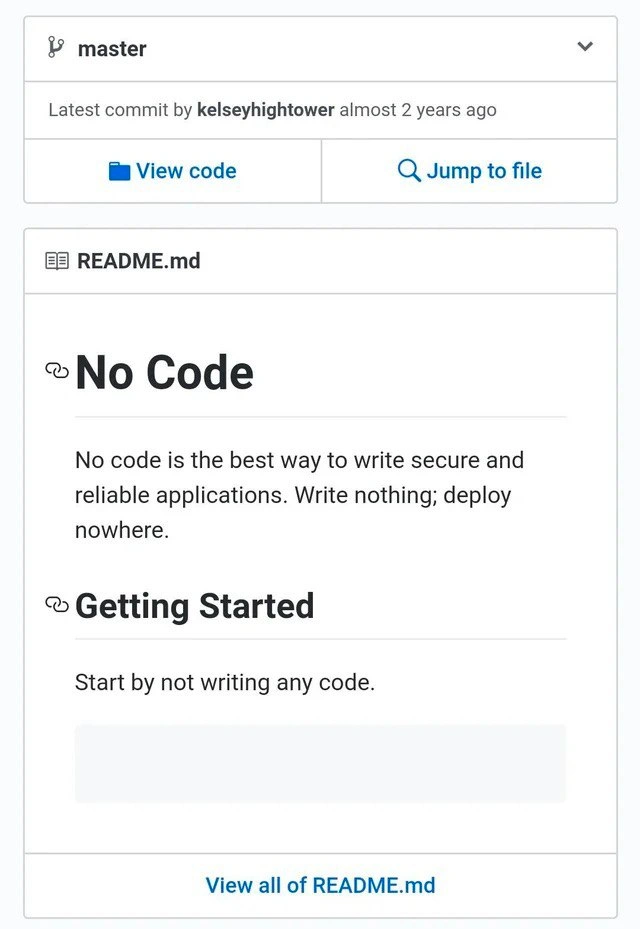
At first glance, this looks like a normal GitHub repository page – it has a master branch label, a “Latest commit” line, and a big View code button – but the twist is that the only file shown is a README.md. A README is usually a text file that describes the project and gives instructions. Here, the README boldly states that the project has “No Code.” In fact, it instructs you on how to get started: “Start by not writing any code.” 😄 It’s a pretty clear joke: if you don’t write any code, you won’t create any bugs or deploy any broken apps. The phrase “Write nothing; deploy nowhere.” is crafted to sound like typical tech documentation (like a quick-start guide), but instead of telling you how to run the app, it’s telling you there is no app.

This meme riffs on a well-known developer adage: “No code = no bugs.” It’s reminding us that every line of code we add can introduce mistakes or bugs. By having zero lines of code, the project has zero bugs by definition. In software development, there’s a principle called YAGNI, which stands for “You Aren’t Gonna Need It.” This principle advises programmers not to build features or write code for things until it’s absolutely needed. For example, if you’re making a simple calculator app, you shouldn’t start adding a complex scientific graphing module just in case – because you likely aren’t going to need it. Over-enthusiastic developers sometimes ignore this advice and end up with a bloated, over-engineered system (meaning it’s far more complicated than required). This GitHub repository gag takes YAGNI to the extreme: apparently we didn’t need anything, so we built nothing at all! It’s poking fun at OverEngineering by showing the opposite approach. Instead of adding dozens of unnecessary features, it adds zero features. Instead of prematurely optimizing things, it optimizes everything by not coding anything. (There’s a famous saying, “Premature optimization is the root of all evil,” meaning if you try to make your code super efficient before you even know what parts matter, you often just complicate things. Here, there’s no optimization needed when there’s no code — problem solved!).

The screenshot also hints at security and reliability concerns in a humorous way. In cybersecurity, people talk about an attack surface – that’s basically all the parts of a system that could be attacked or go wrong. Think of it like all the doors and windows into a house; more doors and windows mean more places a burglar could get in. In software, every feature, every open port, every piece of code is like a “door” that could have a vulnerability. If you have no code running, your app’s attack surface is virtually zero – there are no doors or windows for bad guys to even try! That’s why the README joke claims this approach makes applications secure and reliable: with nothing running, there’s nothing to hack and nothing to crash. It’s the only app that can’t ever go down, because it’s not even running on any server (hence “deploy nowhere”). Of course, in real life we need our programs to actually do things, so we have to accept some risk. But the joke exaggerates the “less is more” philosophy: the less code you have, the fewer chances for things to go wrong.

This meme is very RelatableDeveloperExperience for programmers who have been through real-world headaches. Every developer has experienced times when some feature they wrote caused endless trouble, or some huge system was built but never used by anyone. It can make you wonder, “What if we hadn’t written that code at all?” This GitHub repo is like a sarcastic answer: life would be easier if we just didn’t write any code! It’s also a jab at the recent trend of NoCodePlatforms – tools that let people create apps or websites without writing traditional code, using visual interfaces or templates. Those platforms still have code behind the scenes (someone wrote the software that provides the building blocks), but they aim to let users solve problems with minimal coding. Here, the meme imagines the ultimate no-code platform: one where there truly isn’t any code whatsoever. It’s a parody, saying the project is “achieving flawless delivery with zero lines committed.” In other words, it “delivers” a product with perfect quality by literally having nothing delivered. For a newcomer, it’s important to understand this is satire – in reality, you can’t have a useful program without writing any code. But it highlights a real lesson: keep things as simple as possible. Don’t write code just to feel productive – write code because you need to solve a specific problem. And if a piece of code isn’t needed, leaving it out is actually the most productive (and safe) thing you can do. After all, no one ever had to fix a bug in code that doesn’t exist!

Level 3: Write Nothing, Break Nothing

This repository is the tongue-in-cheek pinnacle of README-driven development – where the documentation isn’t just first, it’s the only thing. The screenshot shows a GitHub project with zero code and a deadpan README.md declaring: “No code is the best way to write secure and reliable applications. Write nothing; deploy nowhere.” It’s a satirical nod to every senior developer’s hard-earned wisdom that every new line of code is a potential new bug. Seasoned engineers often joke that the only truly bug-free, perfectly secure code is no code at all. Here, that joke is made concrete: the project literally contains nothing but instructions not to build anything. It’s the ultimate implementation of the YAGNI principle (“You Aren’t Gonna Need It”) – taken to absurd extremes. Instead of just avoiding unneeded features, this repo suggests you avoid all features. Why solve problems with thousands of lines of clever code when you can solve every problem by writing zero lines and having zero code failures? This is minimalism pushed to its logical limit: no code means no flaws, no downtime, and no angry 3 AM incident alerts. It’s like an alternate universe DevOps nirvana where if you write nothing, you break nothing.

Under the sarcasm, there’s a dark truth experienced developers know too well. Every function, every microservice, every moving part in a system is a point of potential failure – what security experts call an attack surface. We’re taught to shrink that surface to reduce risk. Well, you can’t get a smaller attack surface than empty. 😈 This secure_by_absence philosophy means hackers can’t exploit a vulnerability that doesn’t exist, and users can’t file bug reports on features that were never written. An app with no code has no security holes, no performance bottlenecks, and needs no scaling – it’s infinitely fast and always up because, frankly, there's nothing to crash. (As the meme implies, if you deploy nowhere, you’ll never get a pager alert for a downed service.) The humor here plays on the Sisyphean quest for perfect uptime: after countless all-nighters trying to keep real systems stable, the idea of a system that is guaranteed not to fail (by virtue of not existing) is a bittersweet joke only battle-scarred ops and developers truly appreciate.

This meme also skewers our industry’s obsession with CodeQuality metrics and elaborate processes. We preach writing clean, simple code – well, what’s cleaner or simpler than no code? 😅 Linters, code reviews, unit tests, integration tests – they all return with a perfect bill of health when there’s nothing to check. There are 0 lint errors, 0 code smells, and a cyclomatic complexity of 0. In fact, this project would make any compliance or QA team ecstatic: it’s automatically passing all static analysis because there’s nothing to analyze. It’s even GDPR-compliant by default (it collects all no user data, after all). The repository’s last commit is by kelseyhightower – a respected engineer known for Kubernetes expertise – which is a little in-joke itself (an Easter egg for those in the know). Seeing his name on the “Latest commit” gives the whole thing extra geek cred, as if even a tech guru has blessed this radical approach. In reality, of course, it’s a satire of over-engineering and PrematureOptimization. We’ve all seen projects sinking under the weight of features nobody asked for and optimizations nobody needed. By contrast, this empty repo achieves infinite code quality with zero development effort. It’s the ultimate anti-OverEngineering statement: the YAGNI principle taken so far that the best solution to a problem is to not write any software unless it’s absolutely necessary. The humor hits home for any dev who’s spent days untangling needless complexity – it playfully suggests the only truly flawless delivery is deploying nothing at all.

Description

A screenshot of a GitHub repository README.md file. The top of the image shows the branch is 'master' and the 'Latest commit by kelseyhightower almost 2 years ago'. The README has two main sections. The first is titled 'No Code', with the text: 'No code is the best way to write secure and reliable applications. Write nothing; deploy nowhere.' The second section is 'Getting Started', which says: 'Start by not writing any code.' This is a satirical take on software development, created by well-known technologist Kelsey Hightower. The joke resonates deeply with senior engineers, as it humorously points to the ultimate truth that every line of code written introduces potential bugs, security vulnerabilities, and maintenance overhead. The only perfectly unhackable and unbreakable system is one that doesn't exist
Comments

7
Anonymous ★ Top Pick This is the only project that has ever passed a security audit with zero findings. It also has the lowest maintenance cost of any system ever deployed
  1. Anonymous ★ Top Pick

    This is the only project that has ever passed a security audit with zero findings. It also has the lowest maintenance cost of any system ever deployed

  2. Anonymous

    Finally achieved zero defect density, zero CVEs, and infinite scalability - turns out /dev/null makes a fabulous production cluster

  3. Anonymous

    Finally, a framework with zero breaking changes between versions and perfect backwards compatibility forever

  4. Anonymous

    This is Kelsey Hightower's legendary 'No Code' repository - the only framework with zero CVEs, 100% test coverage, and infinite scalability. It perfectly embodies the senior engineer's realization that the most maintainable code is the code you never write. No dependencies to update, no breaking changes, no technical debt, and it passes every security audit. The ultimate expression of YAGNI taken to its logical extreme: if you don't need it, don't build it. Deploy nowhere, break nothing

  5. Anonymous

    We finally hit 99.999% availability, zero CVEs, and a $0 cloud bill - turns out the most powerful feature flag is requirements := nil

  6. Anonymous

    SRE approved: change‑failure rate 0%, MTTR undefined, and the error budget rolls over because the entire platform is a README

  7. Anonymous

    Zero services means zero outages - the distributed system's holy grail of perfect availability

Use J and K for navigation