Even bad code is "useful" when it’s the cautionary tale in review
Why is this CodeQuality meme funny?
Level 1: Bad Example, Good Lesson
Imagine you tried to build a toy tower, and it collapsed into a big mess. You might feel pretty bad that it fell down. But then, all your friends saw it and learned why it fell – maybe the blocks at the bottom were uneven. Now they know not to stack blocks that way. In a funny way, your broken tower became useful because it taught everyone what not to do when building theirs.
That’s exactly what this joke is about. It’s saying: even if you do something wrong, you’re not totally useless – people can still learn from your mistake. It’s like a friend joking with you after your tower fell, “Hey, you’re not useless… we can always use you as an example of how not to build a tower!” 😜 It sounds mean, but it’s meant in a friendly, teasing way. It makes us laugh because it’s a silly twist: usually we encourage someone by saying “You can be a good example,” but here we flip it and say “You can be a bad example (and that’s still helpful)!”
So the big idea is simple: mistakes can teach lessons. Even a bad attempt shows everyone else a way that doesn’t work, and that’s valuable. It’s a funny way to cheer someone up after a failure, by pointing out the bright side – however small that bright side is. In the end, we laugh because we’ve all been that person with the wobbly tower (or messy task), and it’s nice to remember that even our goof-ups can have a silver lining.
Level 2: Learning from Mistakes
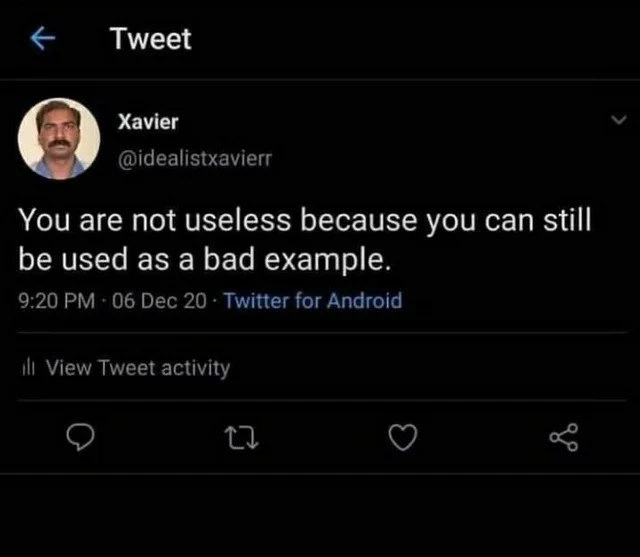
This meme is basically a screenshot of a tweet (displayed in dark mode UI, with white text on a black background – a style programmers love to use to be gentle on the eyes). The tweet, from a user named “Xavier,” says: “You are not useless because you can still be used as a bad example.” It’s a one-liner, a kind of sarcastic motivation that’s very popular in developer humor circles. On the surface, it reads like an inspirational quote – telling someone they have value – but then it twists: your value is being the bad example. It’s like a techie way of saying, “Hey, at least your failure can teach others something!” The tone is sarcastic (mocking in a friendly way), and that’s exactly why developers find it funny yet painfully true.
Now, think about a code review scenario. A code review is when developers check each other’s code before it gets merged (added) into the main project. It’s a quality checkpoint. Colleagues add comments like, “Hey, this function is too complicated,” or “This naming is confusing,” or “This part could be a security risk.” The goal is to maintain high code quality – meaning code that is clean, understandable, efficient, and follows best practices (the right ways to solve problems). But sometimes in a review, you encounter truly bad code. We’re talking about code that’s hard to read, maybe full of bugs or weird solutions. It’s doing things in a very wrong or wacky way – often called a bad practice or an anti-pattern. An anti-pattern is like a common mistake that many people make, which we know causes trouble. (It’s the opposite of a design pattern, which is a common good solution.)
When such bad code shows up, the review can turn into a mini-lesson. The team might say, “Okay everyone, let’s go through this and see what not to do.” It’s a bit embarrassing for whoever wrote it, but it ends up helping the whole team learn. For example, imagine a developer submits a piece of code that works, but in a really roundabout and fragile way. During the review, a senior dev might point out: “This is an example of what not to do – it fixes the immediate problem but introduces five new problems. Let’s discuss how we can do it better.” That’s basically using someone’s code as a negative example. The code itself isn’t going into production (not without changes, anyway), but its flaws are highlighted so everyone understands the pitfalls.
This tweet-meme captures that dynamic in a nutshell. It humorously implies: Even if you feel your contribution to the project is terrible, hey, at least it can serve as a lesson for others. In developer culture, we often joke about our own mistakes once the dust has settled. If you’ve ever pushed a change that broke something, you probably got some good-natured teasing like, “Thanks for showing us what not to do!” It’s part of the culture of learning from mistakes. Good teams have a blameless approach – they don’t attack the person, but they do dissect the bad code so the team improves. And yes, sometimes that dissection is done with a bit of dry humor to soften the blow.
It’s also worth noting how relatable this is for anyone starting out in coding. Every new programmer writes clumsy code at first – that’s how you learn. Maybe you write a function that is 200 lines long doing five different things (been there!), and a reviewer gently tells you about the principle of “single responsibility” (each function should do just one thing). In that moment, you might feel useless or think “I really messed up.” But your code isn’t useless – it’s useful to you and others because it shows why that principle exists. You see first-hand why a 200-line mega-function is hard to maintain. Your teammates see an example that they can reference later: “Remember when we had that huge function? Let’s avoid doing that.” So your mistake becomes a teaching tool. That’s the silver lining the meme is pointing out.
The humor also comes from the format: a simple tweet that delivers a punchline. Developer Twitter is full of these tongue-in-cheek truths. The context tags here like sarcastic_motivation and code_review_feedback are basically describing this exact vibe – a snarky pep talk you might hear after a tough code review. “Sure, your code blew up the build, but look on the bright side: now we have a great example for the Wiki of what not to do!” It sounds mean, but it’s usually said with a smile because every developer has been in those shoes. In fact, hearing this means you’re officially part of the club – you contributed to the team’s library of cautionary tales. Congratulations? 😅
And yes, the visual being a tweet screenshot is a common meme style. Dark mode, a witty one-liner, and the familiar Twitter interface – it’s instantly recognizable. Developers love dark mode (it’s easier on the eyes during late-night coding sessions), and many dev jokes get shared on Twitter, so this format resonates. It feels like a fellow programmer’s late-night thought that got a bunch of likes and retweets for being so on-point. The fact that it’s a tweet also adds a bit of irreverence – it’s informal, off-the-cuff, and meant to be shared around for a quick laugh.
In summary, at this level: the meme is explaining that mistakes in code can be educational for everyone. Bad code is not a total waste; it at least shows others what pitfalls to avoid. It’s a funny, slightly brutal way to remind us that we’re all learning. If you’re a junior dev, don’t be discouraged by a tough code review. Remember this meme and think, “Okay, my code might be a bad example right now, but that just means I – and my team – can learn from it. It still has a purpose.” That’s the hidden upbeat message beneath the sarcasm. In the world of software, even failures move us forward.
Level 3: Cautionary Code Tales
In the senior developer’s corner of the world, this meme hits like a bitter truth wrapped in a joke. Code reviews – those sacred rituals where we scrutinize each other’s commits – often turn into impromptu lessons on code quality. And nothing delivers a lesson quite like an anti-pattern unraveled in real time. The tweet’s text, “You are not useless because you can still be used as a bad example,” could practically be a team mantra after a gnarly review. It’s the kind of dark humor passed around in late-night deploys: a reminder that even a disastrous pull request has educational salvage value.
Any experienced dev has a war story or two about a merge request so horrifyingly bad that it became legendary. Perhaps someone introduced a clever convoluted singleton that brought down half the microservices. Or maybe an overeager junior wrote a 500-line function called doStuff() that does all the stuff (and then some). That PR gets dissected in front of everyone — not to shame the author (well, maybe a tiny bit of good-natured ribbing), but to say “Let’s never do that again.” There’s genuine shared trauma and relatable pain in those moments. It’s funny because it’s true: the code was awful, but at least it united the team in a collective facepalm and a lesson learned.
This kind of humor lands because it satirizes real code review pain points. We preach “blame the code, not the coder,” but when a piece of code is truly bad, it takes on a life of its own. It becomes that negative example seniors reference in architecture discussions: “We must avoid another ExampleGate situation.” Companies have internal wikis or slides with titles like “Common Bad Practices to Avoid,” often populated with snippets of past fiascos. These wretched examples live on infamy to illustrate why certain guidelines exist. In other words, even rotten code provides value as a “how-not-to” case study. It’s a bit like the programming equivalent of urban legends – cautionary tales passed down to scare newbies straight.
Let’s be honest, this tweet’s flavor of sarcasm is a coping mechanism. When you’ve been on-call at 3 AM because someone’s sloppy patch caused an outage, you either laugh or cry. Veterans choose laughter (tinged with sarcasm) to survive the madness. The meme also pokes at the idea of sarcastic motivation: telling a teammate “Don’t feel bad, you served as a perfect example… of what not to do.” It’s mean and supportive at the same time – a special kind of dev team tough love. Senior engineers have a dark sense of humor from years of debugging nightmares and reviewing scary code. We chuckle at this tweet because we’ve lived it: one person’s bad commit can save the rest of us from making the same mistake. In the twisted ecosystem of developer culture, even failure is useful – if only to prevent bigger failures.
To put it in context, here are some classic “bad example” scenarios that industry veterans love to recount during code review post-mortems:
- Spaghetti Code: Functions and modules so tangled and intertwined that no one can follow the logic. It’s the poster child for poor design. We keep a printout of that
masterpiecemess to remind ourselves why structured architecture matters. - Copy-Paste Programming: 10 duplicates of the same code block in one file. Why reuse or refactor when you can have ten times the maintenance headaches? It’s an anti-pattern we joke about, but also a cautionary tale on the importance of DRY (Don’t Repeat Yourself).
- Hard-Coded Secrets: That one commit where someone left an AWS key or database password right in the code. 😱 It triggered a security scramble, and ever since, onboarding docs include this shining bad example to warn new hires: never ever do that.
- “Works on My Machine” Hacks: The code that passes tests only on the original author’s laptop because of a local configuration or three. In review, it became clear the dev had patched things in the most brittle way. Now it’s cited whenever someone says “but it works for me!” – a gentle reminder to think beyond one’s own environment.
Each of these bad practices became an internal meme of its own, much like the tweet. We laugh at the absurdity, but we’re also nodding because we’ve all seen code that could make a junior dev cry (or a senior dev drink). The humor is a bonding experience. It reassures us that screwing up is part of the journey, as long as we learn from it. After all, the CodeQuality guidelines we hold dear today were often written in the blood (and tears) of yesterday’s mistakes. So when we say “even bad code is useful as a cautionary tale,” we’re acknowledging a fundamental truth in software development: every fiasco is an opportunity to get better – or at least an opportunity to get a good laugh in retrospect.
Description
Dark-mode screenshot of a Twitter post. The tweet, shown from user “Xavier @idealistxavierr,” reads: “You are not useless because you can still be used as a bad example.” Below the text are timestamp details “9:20 PM · 06 Dec 20 · Twitter for Android,” the “View Tweet activity” link, and the standard reply, retweet, like, and share icons. The user’s avatar is blurred for anonymity. Technically, the meme riffs on code quality discussions - when your merge request becomes the team’s anti-pattern showcase during code review - highlighting how poor implementations still provide educational value. It satirizes developer culture, code review dynamics, and the notion of learning from mistakes
Comments
9Comment deleted
Your 4k-line God class isn’t a failure - it’s the living artifact we wheel out during onboarding to justify every rule in the coding-standards doc
This is what your architecture diagram becomes after the third 'temporary workaround' makes it to production - not completely broken, just perfectly positioned to teach future engineers what not to do when they inherit your legacy monolith
Every codebase keeps one module nobody deletes - not because it works, but because onboarding needs a 'before' picture
Every senior engineer has that one commit from 2015 that's now immortalized in the 'Common Pitfalls' section of the team wiki - complete with a permalink and a Slack emoji named after it. It's not technical debt; it's a teaching moment with compound interest
Our blameless postmortems are great - we never name names; we just link your PR under “Anti‑patterns” in the onboarding wiki and call it knowledge reuse
Even a 500-line main() function has its place: forever in slide decks labeled 'What Not To Do'
In this org, nothing’s wasted - if your microservice dies under load, it gets promoted to the canonical anti-pattern in the onboarding deck
Xavier spitting facts again Comment deleted
🙃🤙 Comment deleted