Skip to content
DevMeme
1290 of 7435
The Ultimate Bug-Free Coding Strategy
Bugs Post #1444, on Apr 29, 2020 in TG

The Ultimate Bug-Free Coding Strategy

Why is this Bugs meme funny?

Level 1: No Work, No Mistakes

Think about it this way: you can't lose a game if you never play. If you stay on the sidelines, you won't make any mistakes on the field. But you also won't score any points or have any fun. The meme is using that same kind of logic. It's saying a programmer who never writes any code will never create a bug by mistake. That's true, but if they don't write code, they won't make anything useful either. It's a silly idea that makes us laugh because we know you have to try (and sometimes mess up) to actually achieve something.

Level 2: Less Code, Fewer Bugs

In software, a bug is a mistake or error in the code that makes a program act in unexpected ways. Improving code quality means reducing these mistakes and making the code cleaner and more reliable. One thing new developers learn is that the more code you write, the more chances there are to create a bug by accident. This meme jokes that if the programmer writes no code at all, then there will be no new bugs. It's like a cheeky formula for perfection: no code = no mistakes.

Of course, if you don't write any code, you also don't add any features or functionality. So it's not a serious solution (your boss wouldn't be impressed with an empty app!), but it highlights a real lesson: simplicity is key. Keeping code simple and only writing what you need means there's less that can go wrong. There's a common saying in programming: "the best code is the code you don't have to write." It reminds developers not to add fancy extras or unnecessary complexity. For example, beginners might get excited and write a bunch of extra functions they think they'll need, only to find those added parts introduce bugs. Seasoned devs follow the idea of YAGNI (which stands for "You Aren't Gonna Need It") — meaning don't write code for a feature you don't need right now. Every extra line is a potential coding mistake, so skipping unneeded code can actually improve quality.

This meme also reflects a bit of procrastination humor among coders. We've all felt that nervous hesitation to push a change, worried it might break something. The meme basically says, "hey, if I'm too lazy to code today, at least I won't create new bugs!" It's a playful way to admit that sometimes not coding can seem safer than diving in and possibly messing up. New developers can relate to the relief of seeing a program finally run without errors — and the tongue-in-cheek thought that maybe the easiest way to avoid errors is to not change anything. In short, it's a classic piece of coding humor that mixes a grain of truth (fewer changes mean fewer bugs) with an obviously impractical extreme (zero coding).

Level 3: Zero Code Zen

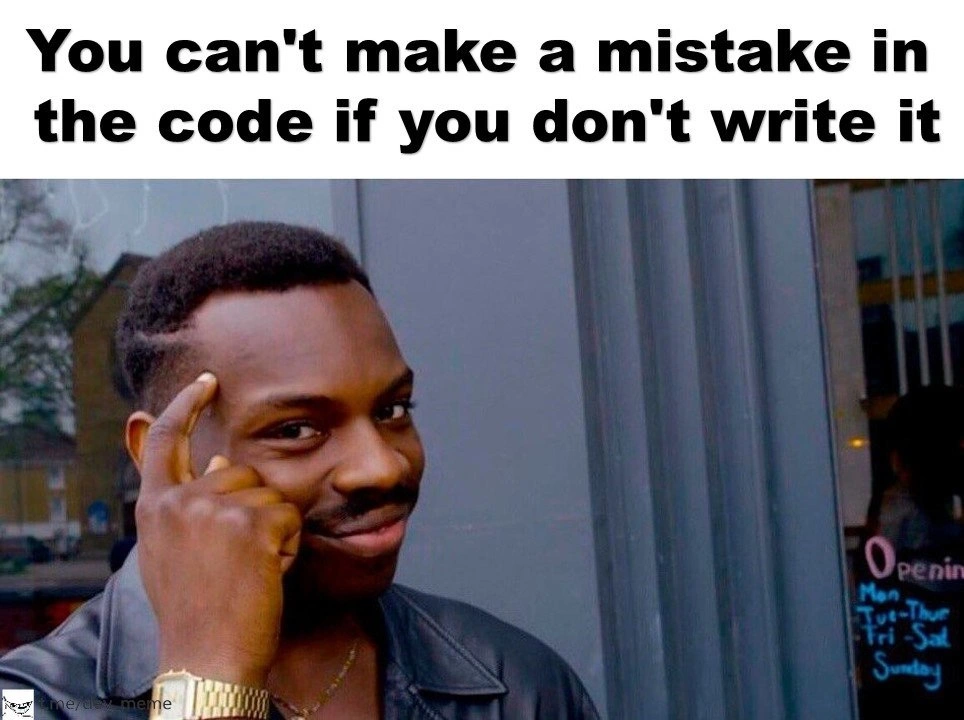
"You can't make a mistake in the code if you don't write it."

This meme repurposes the classic Roll Safe template to deliver some tongue-in-cheek programming wisdom. In the image, the man tapping his temple is implying he’s found a clever strategy: have zero lines of code to achieve zero bugs. He’s effectively proposing a zero bug strategy: if there's no code, there are no bugs by definition. Seasoned developers recognize an ironic truth here. Every new line of code is a new opportunity for a bug. By this extreme logic, writing nothing becomes an infallible quality plan. It's a comedic take on the idea that the best code is no code at all – a minimalist philosophy often passed around in software circles with a grain of truth. In fact, this twist is a staple of developer humor: it's technically correct, which makes programmers smirk, yet obviously not a serious strategy for real work.

Of course, professional engineers also see the catch: if you ship nothing, you deliver no features and solve no problems. In a real project, developer productivity isn't measured by the absence of bugs alone; you have to actually create software! But the humor spotlights a common situation in software development: sometimes the safest change is not changing anything. After slogging through late-night debugging sessions or wrestling with a legacy codebase, it's tempting to joke that if we never touched the code, nothing would break. That's basically procrastination humor disguised as a coding tip – an avoidance as quality control strategy. Obviously it's impractical, but it sure feels safe when you're firefighting production issues.

This quip also riffs on an actual engineering principle: keep things simple. Code quality tends to degrade with every unnecessary complication. Seasoned devs know that each additional module, function, or if statement can introduce new edge cases or bugs. There's even a tongue-in-cheek way to frame it mathematically: if
$$ \text{bugs} \propto \text{lines_of_code}, $$
then setting $\text{lines_of_code} = 0$ yields $\text{bugs} = 0$. It's a facetious formula, but it carries a reminder that a smaller codebase means fewer interactions to go wrong. This meme nails that concept with a laugh: no code, no chance for error.

The Roll Safe pose makes it extra relatable. It's as if the guy is saying, "Look at me, I've solved software reliability by doing nothing at all!" It's a wink to every developer who has joked about freezing feature development just to stabilize a system. The image resonates because we've all had those moments of wishing we could freeze time, stop writing new code, and avoid creating new bugs. It's a playful way to cope with the fact that writing software is hard and bugs in software are inevitable. In essence, the meme gives a sarcastic tip that echoes a real best practice (write less, simpler code) by pushing it to an absurd extreme. And as any jaded engineer will tell you with a smirk, "you can't introduce a bug in code that doesn't exist."

Description

This meme features the popular 'Roll Safe' or 'Think About It' guy format. A Black man with a sly, knowing smile is pointing to his temple with his index finger. He is wearing a black leather jacket and a gold watch is visible on his wrist. The background is a non-descript urban setting. Above the image, white text on a black background reads, 'You can't make a mistake in the code if you don't write it'. A small watermark for 't.me/dev_meme' is visible in the bottom left corner. The meme uses faulty logic to present a humorous solution to a common developer problem. The technical joke is that the safest way to avoid introducing bugs, regressions, or new issues into a codebase is to simply not write any code at all. This resonates with senior developers who have experienced the fragility of legacy systems or the pressure of 'zero-bug' policies, where the fear of breaking something can lead to inaction or extreme risk aversion. It's a satirical take on avoiding problems by avoiding work
Comments

7
Anonymous ★ Top Pick My manager asked for a feature with zero regressions. I delivered an empty pull request and told him it was the purest implementation of the 'do no harm' principle
  1. Anonymous ★ Top Pick

    My manager asked for a feature with zero regressions. I delivered an empty pull request and told him it was the purest implementation of the 'do no harm' principle

  2. Anonymous

    The most fault-tolerant service in our stack is still the feature that’s been “awaiting product clarification” for three quarters - zero lines, zero incidents, twelve nines

  3. Anonymous

    After 20 years in the industry, I've finally achieved 100% code coverage, zero bugs, and perfect uptime - by convincing management that our most stable system is the one we haven't built yet. The quarterly metrics look fantastic

  4. Anonymous

    This meme perfectly captures the senior engineer's ultimate realization: after years of debugging production incidents at 3 AM, refactoring legacy spaghetti code, and explaining to stakeholders why 'just a small change' broke everything, you discover the most reliable code is the code that doesn't exist. It's the architectural pattern that never fails - the Null Object pattern taken to its logical extreme. Zero lines of code means zero cyclomatic complexity, 100% test coverage (of nothing), and infinite uptime. The real 10x engineer move is convincing management that the feature isn't actually needed

  5. Anonymous

    We hit 99.999% reliability by migrating the feature to PowerPoint - bug density per LOC is unbeatable when LOC=0

  6. Anonymous

    Senior dev refactor mastery: rm -rf src/* && git commit -m 'Zero regressions achieved' - eternally scalable

  7. Anonymous

    Guaranteed zero Sev-1s this quarter: we adopted PowerPoint-Driven Development - no deploys, no incidents, immaculate SLIs

Use J and K for navigation