Coding Alone vs. Coding Under Observation
Why is this CodeQuality meme funny?
Level 1: On Best Behavior
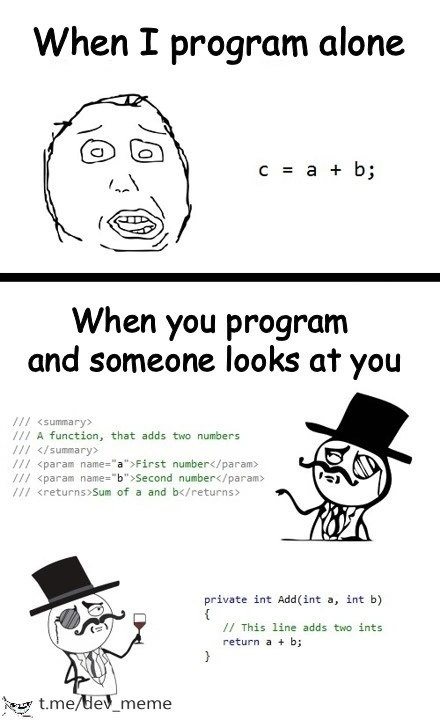
It’s like doing something casually versus doing it properly when someone is watching. Imagine you’re drawing a picture at home by yourself – you might doodle quickly with scratches and not worry about the mess. Now imagine your teacher or a friend is watching you draw. Suddenly, you sit up straight and try to draw every line perfectly, even explaining what you’re doing: “This part is the sun, and I’m coloring it yellow.” You go from a quick doodle to a full art class demonstration! In the same way, this meme shows a programmer acting extra fancy when they have an audience. Alone, the programmer just quickly writes the answer (a + b and done). But when someone’s peeking, they turn into a very polite gentleman of coding – adding lots of explanation and formality, like using big words and good manners at the dinner table. It’s funny because we recognize that feeling: we all try to be on our best behavior when we know we’re being watched. The meme exaggerates it, showing that even adding two simple numbers becomes a huge, formal task if someone else is looking, just like how you’d suddenly mind your manners and speak in full sentences if a teacher or parent is paying attention. The heart of the joke is that the programmer wants to look good and not sloppy, so they go over the top – and that contrast is what makes us laugh.
Level 2: Summaries and Summations
Let’s break down what’s happening in this meme. In the top panel, we see the simplest code ever: c = a + b;. That’s literally just adding two variables and storing the result in c. No frills at all – bare-bones programming. There’s no function, no comment, nothing. It’s the kind of line you might write in a quick script or a scratchpad when nobody else will ever see your code. Now compare that to the bottom panel: when someone else is watching, the developer suddenly writes a full function with elaborate XML documentation comments. Those green lines starting with /// and tags like <summary> are a C# style of code comments used to generate documentation. They’re intended to explain what a method does, its parameters (<param name="a">First number</param> describes the first input) and its return value (<returns>Sum of a and b</returns>). Here, the developer wrote a private int Add(int a, int b) method to perform the same addition as before, but now it’s wrapped in layers of explanation. The code itself is neatly formatted and even includes an inline comment // This line adds two ints, explicitly narrating the obvious operation. This is funny because normally a programmer wouldn’t comment such an obvious line – we expect code to be somewhat self-explanatory (and a + b is about as clear as it gets!). But the observer_effect_coding is in full swing: with a colleague glancing over, the author goes into excessive_comments mode to impress or avoid criticism. The bottom image’s character – the classy rage-comic gentleman with a monocle and top hat – symbolizes how the coder feels the need to act “like a sir”: very proper, following all the formal coding conventions as if demonstrating high society etiquette in code form. This is a relatable scenario in DeveloperExperience: many of us write quick-and-dirty code when working alone, but if we’re doing pair programming or know someone will read our code (like in a code review or on GitHub), we suddenly adhere to every best practice we’ve heard of. We add documentation comments, choose more descriptive variable names, and generally clean things up. In the meme, the contrast is extreme (from one plain line to a fully documented method) to make it humorous. It highlights DocumentationHumor – the joke that we sometimes write documentation only to show others we did it, not because that particular line truly needed it. It’s poking fun at how writing even a simple addition becomes an opportunity to demonstrate one’s code quality awareness when an audience is present. The tags like CodeComments and CodeQuality come into play here: comments and documentation are part of writing quality code, but doing it to this extent for a trivial function is comically over-the-top. For a junior developer, it’s also educational: you can see the difference between quick scripting code and production-style code. The production-style (especially in strongly-typed languages like C# or Java) often involves writing clear functions with documentation so that any other programmer (or your future self) can understand what’s going on. However, the meme is showing an exaggerated case to make us laugh. The truth is, you usually want to document why complex code does something or any non-obvious details, rather than stating what the code is doing when it’s as straightforward as adding two numbers. And indeed, many experienced devs would actually avoid redundant comments like “This adds two ints” because it’s obvious. But when you’re new or feeling watched, you might err on the side of over-clarity. This comic scenario is super relatable: imagine you’re in class and the teacher walks by your desk – instinctively, you straighten up your work. In coding terms, that means you suddenly start writing textbook-perfect code. The bottom line is that the meme uses the silly gentleman_meme_face and the wildly verbose comments to capture a real feeling: being watched while coding often makes us act far more proper and meticulous than when we’re coding solo.
Level 3: Peer Pressure Programming
When a developer senses someone peering at their screen, a curious transformation occurs. Suddenly that quick one-liner c = a + b; blossoms into a full-blown, aristocratically proper function. We’ve all been there: on our own, we toss out a quick addition or hacky fix, but the moment a colleague or pair programming partner hovers nearby, we engage “gentleman coder” mode. It’s a tongue-in-cheek take on the Hawthorne effect in the IDE – just as observing workers can change their behavior, observing a coder tends to polish their code in real-time. The meme’s bottom panel nails this with the monocled “Like-a-Sir” character, implying the coder has suddenly donned a top hat of best practices. Under scrutiny, every detail of CodeQuality gets a buff: clear naming, a proper Add(int a, int b) function, and an onslaught of Documentation. The humor is in the overkill: a trivial addition gets treated like an API for the ages, complete with <summary> comments and parameter docs. Experienced devs recognize this absurd over-documentation as a comically exaggerated coping mechanism — a way to preempt any “Gotcha!” comments from the peanut gallery. It satirizes how we sometimes perform extra code ceremony not for functionality’s sake, but to look competent and thorough in front of others. In real life, good engineers strive to write clean, self-explanatory code (and yes, decent comments), but they’re also the first to chuckle at the tendency to overcompensate when feeling watched. That needless comment // This line adds two ints is a brilliant example: it states the obvious (as if return a + b; wasn’t clear enough), reflecting the developer’s anxious desire to leave no doubt about their diligence. Seasoned programmers find this hilarious because it’s true – the gap between what we actually do alone (quick-and-dirty code) and what we pretend to do when someone might judge us (ultra-refined code) can be enormous. The meme playfully exposes that shared experience. It’s a nod to the inner voice of every developer that whispers, “Hey, better add comments and use fancy patterns now, Dave from QA is watching.” In short, it lampoons our peer-pressure-induced best behavior: when even a simple addition turns into a documented masterpiece if an extra pair of eyes is on it. We laugh because we recognize ourselves in it, toggling from lazy hacker to pretentious code artisan depending on who’s looking – sipping that virtual glass of wine with a smirk, as our code suddenly speaks with a posh accent.
Description
A two-panel rage comic meme contrasting a developer's coding style in different situations. The top panel, labeled 'When I program alone', shows a distressed 'Y U NO' rage face next to a simple, uncommented line of code: 'c = a + b;'. The bottom panel, labeled 'When you program and someone looks at you', depicts a much more formal scene. It features two instances of the sophisticated 'Like a Sir' rage comic character with a top hat and monocle. The code shown is a simple addition function, but it's preceded by extensive C#-style XML documentation comments explaining the function, its parameters, and what it returns. The function itself, 'private int Add(int a, int b)', also includes an overly obvious comment: '// This line adds two ints'. The joke satirizes the performative nature of coding when being watched, where developers might add excessive documentation and follow 'best practices' to an absurd degree for even the simplest code, in contrast to the quick, unceremonious code they write when alone
Comments
7Comment deleted
The amount of Javadoc on a simple getter is directly proportional to the seniority of the architect looking over your shoulder
The moment someone peers over my shoulder, `c = a + b` collapses into `/// Combines additive monoids in ℤ; see RFC-32 for overflow semantics` - Schrödinger’s over-engineering: code observed, ceremony enforced
After 20 years in this industry, I've learned that the complexity of your code is directly proportional to the seniority of who's watching - junior dev walks by and suddenly you're implementing dependency injection for a calculator, CTO shows up and you're architecting a microservice for addition with full observability stack
The real tragedy isn't the lack of documentation when coding alone - it's that three months later, you become 'someone looking at you' when debugging your own undocumented code at 2 AM, desperately wishing past-you had worn the monocle
Coding's Heisenberg principle: measure simplicity alone, but observation instantly entangles it into verbose enterprise sprawl
Attach an observer and the method immediately implements IEnterprisey and emits XML - my most reliable use of the Observer pattern
Enterprise Heisenberg: c = a + b until someone watches; then it’s IAdditionService with XMLDoc, validators, three unit tests, and a Confluence page titled “Arithmetic Architecture.”