The Ultimate Bug-Fixing Strategy
Why is this Bugs meme funny?
Level 1: No Software, No Problems
Imagine you’re trying to build a big tower out of toy blocks, but every time you get it high, the tower starts to wobble and fall apart. You try fixing it again and again, but it keeps happening. Eventually, feeling totally fed up, you throw your hands in the air and say, “Fine! I won’t build a tower at all! If there’s no tower, it can’t fall down, right?” That’s basically the joke here, but with computer programs. The developer in the picture is joking that the easiest way to have a computer program with zero mistakes is to have no program running at all. No program means nothing can go wrong with it – because it’s not doing anything!
It’s funny in the same way our tower example is funny (and a little silly). Sure, if you don’t build the tower, you’ll never see it topple. And if a game or app isn’t even there, it will never crash or glitch. That part is true. But of course, it also means you don’t get a tower to play with, or you don’t get a program that does something useful. It’s a pretend “solution” made out of frustration. The developer is basically so tired of all the bugs (think of bugs as the tower collapsing each time) that he jokes about just quitting: uninstalling every piece of software, so nothing is left to break. It’s like saying, “You can’t mess up if you don’t even try.” We laugh because we know he doesn’t really mean it – it’s an exaggeration to show how annoyed and exhausted he feels. Anyone who’s ever been super frustrated with a tricky problem can relate to that moment of “ugh, I give up, let’s just not do this at all.” It’s a goofy way to cope with feeling overwhelmed. So, in simple terms: the meme is joking that the surefire way to have a perfect, bug-free computer program is to have no program, which is true but also completely impractical – and that ridiculousness is why it’s funny.
Level 2: No Code, No Bugs
Let’s break down the joke in simpler terms. In software development, a bug is basically a mistake or error in the code that causes the program to act in unexpected or incorrect ways. Bug fixing is the hard work programmers do to find and correct those mistakes. Now, usually, when you have bugs in your application, you try to fix the code – you track down the cause in the logs, change some lines, test again, and so on. It’s a bit like detective work, and it can be frustrating when bugs are stubborn or when fixing one issue accidentally causes another. This meme jokingly proposes a very extreme bug fix: remove all the software entirely. In plain terms: no program = no bugs. It’s basically saying, “We can assure a perfect, bug-free release if we just don’t release any software at all!” It’s obvious nonsense as a real plan, but it’s poking fun at how desperate one can feel after battling endless glitches.
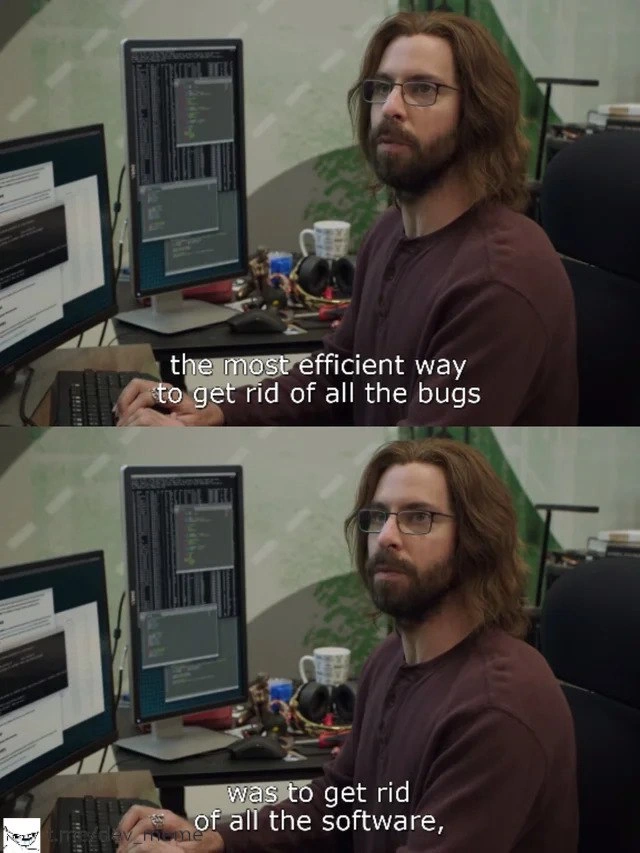
Look at the image: the developer sits at a desk covered in typical programmer stuff – multiple monitors with code and console output, a messy assortment of coffee mugs (fuel for late-night coding), possibly a rubber duck by the keyboard, and wires everywhere. That rubber duck isn’t just decoration; it’s actually a famous tool in programming folklore. Rubber duck debugging is when you explain your problem out loud to a rubber duck (or any inanimate object) as if it were a colleague. The act of articulating the issue often helps you see the solution. So if our guy has a duck on his desk, it’s a sign he’s been neck-deep in debugging mode, trying everything to squash those bugs. The left monitor filled with scrolling text and ASCII progress bars suggests he’s running some build or test scripts, or tailing logs to catch errors in real-time. The right monitor shows code (it looks like C or a similar language, given the syntax with braces { } and semicolons). C code is notorious among developers for how unforgiving it can be – managing memory manually, for instance, often leads to tricky bugs like crashes or leaks. The green text on black background is a classic coding aesthetic (some of us just find it easier on the eyes during long sessions, plus it looks cool and “hacker-ish”). All these visual clues paint a picture: this developer has been struggling with a gnarly program in a complex environment.
Now the captions: “the most efficient way to get rid of all the bugs was to get rid of all the software.” This is definitely DeveloperHumor – it’s funny to people who write code because it’s a sarcastic twist on software practices. We have terms like CodeQuality which refer to how maintainable and reliable code is. High code quality means fewer bugs. But achieving that can be really hard, especially in older projects. Over years, software accumulates Technical Debt – think of this like quick-and-dirty decisions or outdated code that “owes” you fixes later. When you have a lot of tech debt, the code becomes fragile: change one thing and something else breaks, because the system is so entangled with patches and workarounds. This is related to SoftwareComplexity – the more complex a system, the more likely it is to have hidden problems. Sometimes newbie developers wonder, “Why not just write code perfectly from the start?” The reality is that requirements change, people make mistakes, and often you’re rushing to meet deadlines, so imperfect code gets written. Over time those imperfections pile up like debt.
The meme’s joke is a culture reference too. The character in the image is Gilfoyle from the TV show Silicon Valley, known for his dry wit. Even if you don’t know the show, you can appreciate that his expression is very “I’m so done with this”. The line could well be a gilfoyle_quote_vibe: a deadpan, cynical one-liner after he’s seen one too many deployment failures. Among developers, there’s also a well-known myth/joke: “the only truly bug-free program is the one that never runs.” This meme is basically that idea written out. It’s Engineering Irony because engineers usually pride themselves on solving problems logically, yet here the “solution” is to not solve it at all but rather to remove the problem by removing the product. It’s like saying the cure for headaches is to cut off your head – obviously not serious advice, but it conveys the frustration!
Optimization usually means making your software faster or more efficient. For example, you might optimize code to use less memory or run in less time. Here, “uninstall everything and call it optimization” is a punchline that plays on that term. Removing features would technically make an application use fewer resources (since it’s doing less work), so in a twisted way you are making it extremely efficient – a program that does nothing uses zero CPU and never crashes. That’s the absurdist humor: taking a valid principle (“fewer operations means fewer chances to fail”) to a ridiculous extreme (zero operations). There’s also a grain of truth that experienced developers impart to juniors: every new feature or every extra line of code is also a new potential bug. So one way to improve code quality is to simplify and even delete unnecessary code. In fact, part of improving CodeQuality is refactoring (rewriting or restructuring code without changing what it does) to make it cleaner and deleting code that isn’t needed. But of course, you wouldn’t delete everything. The meme just imagines a scenario where a manager demands zero bugs, and the dev facetiously delivers by shipping an empty product. It’s humor that stems from the constant pressure in software projects: “no bugs, tight deadline, add new features, and make sure nothing breaks.” At some point, a tired developer might crack a joke: “Well, if you want zero bugs, I have an easy solution… but you’re not gonna like it.”
OverEngineering is another concept here: sometimes projects become way too complex for what they need to do. An over-engineered system might have dozens of modules, microservices, or abstractions that aren’t really necessary – and each adds overhead and potential bugs. A junior dev reading this meme might not have felt this pain yet, but it’s common in big companies or long-lived projects. The meme’s “delete the system solution” is basically the final option when a system becomes unmanageable. It’s jokingly referred to as a “nuclear option” among engineers – like rebooting the entire project. (Note: In reality, if a project is truly a disaster, teams sometimes really do a rewrite, but that’s always a risky last resort, not a first choice!).
In summary, the meme is an inside joke for software folks. It says: If our code is so buggy we can’t fix it, we might as well remove the code. It highlights the truth that maintaining quality gets exponentially harder as systems grow complex or accumulate messy fixes. And it gives a cathartic laugh, because every developer has had that nightmare release where nothing is going right, and the idea of just shipping nothing feels momentarily tempting. It’s EngineeringIrony and DeveloperHumor rolled into one grim punchline – we laugh because, as absurd as it is, we’ve all had that thought in dire moments.
Level 3: Refactor to /dev/null
Every seasoned developer has felt the temptation to nuke the codebase from orbit when drowning in bugs. The meme captures that exact senior-engineer sentiment: "If it hurts, just stop doing it." In the images, we see a long-haired developer (a dead ringer for Gilfoyle from Silicon Valley, the master of morose one-liners) surrounded by a chaotic workspace – monitors full of scrolling logs, a disarray of coffee mugs and cables, maybe even a rubber duck perched atop some manuals. It’s the classic warzone of debugging a legacy system under production pressure. You can practically smell the all-nighters and tech debt in the air. The code on the right monitor appears to be C-like (green text on black, old-school hacker vibes), probably part of some gnarly system where one wrong pointer can bring everything down. The left monitor’s dark terminal with ASCII progress bars and logs suggests he’s been running build scripts or tailing logs, watching exceptions and stack traces fly by at 3 AM. This poor soul has likely been swatting one bug after another, only to watch new ones spawn in their place – the classic whack-a-mole debugging nightmare that haunts senior devs.
In such moments of despair, sarcasm becomes a coping mechanism. The subtitle reads: “the most efficient way to get rid of all the bugs was to get rid of all the software.” That’s a veteran Gilfoyle-grade quip dripping with EngineeringIrony. It’s funny because it’s an exaggeration of a very real strategy seniors actually advocate in milder form: delete code aggressively. There’s an unwritten industry rule that “the fewer lines of code, the fewer places for bugs to hide.” Good engineers often pride themselves on removing more code than they write, simplifying systems to reduce complexity. This meme just pushes that logic to the absurd limit: remove everything. It’s the ultimate refactor to /dev/null (in Unix, /dev/null is the “black hole” where you send unwanted output – here it’s like sending your entire codebase into oblivion).
Why is this bittersweet joke so relatable? Because any developer who’s inherited a legacy monstrosity or a product held together by duct tape and technical debt has had that daydream: “What if we just… start over from scratch?” When you have a 10-year-old codebase with global variables breeding like rabbits, functions thousands of lines long, and bug reports piling up by the hour, the idea of a fresh slate is tantalizing. In reality, we can’t usually press the big red DELETE button on a mission-critical system – too much business logic and user functionality would vanish. But the wishful thinking is therapeutic. In fact, some companies have resorted to drastic rewrites (often with mixed results or worse), proving how desperate the situation can get.
This meme also hides a sardonic take on CodeQuality practices. We preach writing tests, doing code reviews, refactoring, and optimizing performance. But under a crushing deadline with an app that’s buckling under its own weight (hello SoftwareComplexity!), a cynical voice in the back of your head whispers: “No bugs at release if there’s no release.” It’s quality assurance by way of annulment. Notice the caption calls it “optimization.” Normally, optimization means making software faster or more efficient – here it’s redefined as making the software infinitely efficient by removing it entirely. It’s a dark joke that resonates with overworked devs: you can’t get more optimal than a system that uses zero CPU, zero memory, and has zero crash reports. Production paranoia also plays a role: experienced engineers sometimes half-joke about not deploying on Friday (to avoid weekend fire-fights) or about pulling an update that’s too risky. This meme is that instinct on steroids – pull the whole app, not just the update.
There’s a sprinkle of truth in the absurdity. “Deleting the software” is an exaggerated form of simplifying the system. In real life, teams do mitigate bugs by removing problematic features or reducing scope. Feature flags and kill-switches exist precisely so that if a new module is wreaking havoc, you can turn it off in production, effectively making that part of the software inert (i.e., gone) until it’s fixed. Seasoned devs also know that many bugs are self-inflicted wounds from over-engineering – adding overly complex architecture or needless code. Thus, they champion leaner designs: each line of code not written is one less line to debug later. As a grim final resort, if an application truly becomes a nightmare (imagine a service so broken and outdated that any change risks collapse), companies sometimes do decide to rewrite from scratch. It’s the phoenix approach: burn it down and rebuild anew, hopefully with cleaner code (though as veterans will warn, this comes with huge risks and costs – the new system might introduce a whole new set of bugs).
So, the humor hits home because it exaggerates a coping strategy every developer recognizes. The bearded engineer’s expression in the meme is beautifully blank, as if he’s reached a state of enlightenment: “I can guarantee zero bugs… but you’re not gonna like the method.” It’s a combination of resignation and dark humor. This is the TechDebt nightmare distilled into one quote. We laugh, a little nervously, because we’ve all had that moment of wanting to just rm -rf the whole project. It’s the laugh of IYKYK (if you know, you know): only folks who’ve been on call at 3 AM, watching a critical system crash repeatedly, truly appreciate why “delete everything” sounds like a tiny bit of relief. The meme gives us permission to chuckle at that absurd impulse, then sigh and get back to refactoring for real.
Level 4: Proof by Deletion
At the most theoretical extreme, this meme hints at a vacuously true solution to software bugs. In formal logic, a statement about all items in an empty set is automatically true (a vacuous truth). By analogy, a program with no code trivially has no bugs – there's nothing to go wrong. This is essentially proof by deletion: remove every function, feature, and file until the system does nothing at all, and voilà – you’ve proven it bug-free simply because there’s no behavior left to be incorrect. It’s a tongue-in-cheek nod to how computer science grapples with program correctness.
Realistically, ensuring a non-trivial program has zero bugs borders on solving the Halting Problem – in general, it’s undecidable to determine if an arbitrary program will exhibit a certain bug or terminate correctly. Automated tools (like static analyzers or formal verification systems) can catch some issues, but for complex software they face combinatorial explosion of states. The only 100% bug-proof program is the one that does nothing at all, because it has zero states to misbehave. This dark truth echoes the security adage: “the only truly secure computer is one that’s unplugged.” Likewise, the only truly crash-proof codebase is one that never runs. In systems theory, every additional line of code is a potential point of failure. So from a purely theoretical lens, deleting code is an optimization toward simplicity—reducing the system’s state-space to nil. It’s like achieving a perfect algorithm by removing all operations: you minimize time complexity to $O(1)$ by doing one thing (nothing) and space complexity to near zero. You can’t have a memory leak if your program allocates no memory; you can’t have a race condition if there are no threads to race. This is computing’s bleak Zen state: No code, no bugs. Of course, it’s a Pyrrhic victory – a program that does nothing solves no real problem – but mathematically, you can’t argue with the result. The meme wryly points out that if management demands a “zero-bug release”, well, the empty set of features meets that spec by definition. It’s a sarcastic salute to the ultimate optimization: reducing a program to a verified void where nothing can go wrong (because nothing happens at all).
Description
A two-panel meme featuring the character Gilfoyle from the TV show 'Silicon Valley'. In both panels, Gilfoyle, a long-haired developer with glasses, is seen at his multi-monitor workstation, which displays code in dark mode. He has a characteristically deadpan and serious expression. The top panel has the subtitle: 'the most efficient way to get rid of all the bugs'. The bottom panel completes the sentence: 'was to get rid of all the software,'. The meme captures a deeply cynical piece of developer humor: the only truly bug-free code is no code at all. It speaks to the frustration of dealing with complex, bug-ridden systems where the thought of deleting everything and starting over (or just giving up) feels like the only rational solution
Comments
7Comment deleted
The final stage of refactoring: `git rm -rf .` and call it a 'serverless' architecture
Pro tip: if `kubectl delete namespace prod` passes CI, you’ve technically hit perfect reliability - nothing left to fail
After 20 years in the industry, I've finally achieved the holy grail of software engineering: a codebase with zero bugs, zero technical debt, and zero maintenance overhead. The secret? It's also zero lines of code. My KPIs have never looked better
When your production incident post-mortem concludes that the root cause was 'having a codebase,' and the remediation plan is 'aggressive decommissioning.' Zero bugs, zero features, zero problems - the ultimate O(1) solution to technical debt that even your VP of Engineering can't argue with during the next architecture review
Our reliability plan was simple: retire the monolith, replace it with /dev/null - SLOs hit, feature requests evaporated, and the burn-down chart finally went vertical
SRE nirvana: 100% availability via 0% uptime - no software, no incidents
We finally hit zero defects by reducing KLoC to zero - SLOs flatlined at 100% and the API now reliably returns 410 for every request