The Joy of Coding with Bob Ross
Why is this CS Fundamentals meme funny?
Level 1: Coding is Art
Imagine you’re doing something really difficult, like building a tall house of cards. You know how if you place a card wrong, the whole thing might fall down? Now picture a very kind, calm teacher sitting next to you, guiding you through it as if it’s the easiest, nicest thing in the world. In a soft voice they say, “Alright, now very gently put this next card on. Veeery gently… Good. Don’t worry about doing it exactly like mine – you can make your tower however you want. just let your imagination go!” As you carefully add cards, they continue, “You’re doing great. Take your time, be gentle… almost like you’re caressing it. There you go.” Finally, when your card house is standing, they suggest with a cheerful smile, “Let’s place a happy little flag on top, just for fun.” It’s funny because building a card house is usually tense and frustrating – one shaky move and oops, cards everywhere! But this teacher makes it feel calm and fun, as if even mistakes are okay. In the same way, the meme shows a programmer teaching coding (which can be really hard and fussy) in that warm, soothing style. It’s saying that maybe coding could be a bit like art, where you add “happy little” pieces to your project and feel good about it, instead of getting upset. The idea of being so relaxed and positive during a tough coding task is silly and sweet, and that’s why it makes people laugh.
Level 2: Gentle Pointer Handling
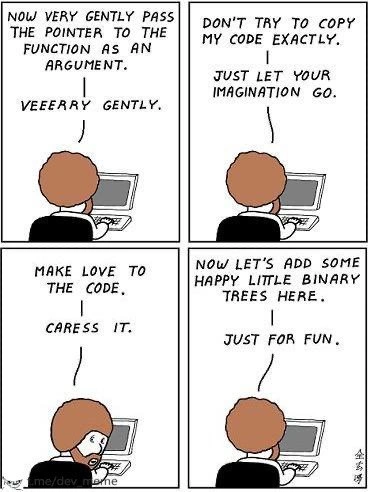
At its core, this comic imagines a code review (a process where developers check each other’s code for mistakes and improvements) being conducted in the style of Bob Ross. Bob Ross was a famous painter and TV host known for his calm, encouraging voice and phrases like “happy little trees.” Instead of painting strokes on a canvas, here we have a developer giving coding advice with the same soothing energy. The humor comes from mixing serious programming topics with that easy-going, creative vibe.
Let’s break down the technical bits being referenced:
Pointer (in C): A pointer is essentially a variable that holds a memory address. In languages like C, if you want a function to modify a variable or work with large data without copying it, you pass a pointer to that data. This is called passing by reference (since the pointer refers to the original data in memory). The first panel’s line “pass the pointer to the function as an argument” is describing exactly this: giving a function a direct line to some memory. The meme says to do it “very gently” because working with pointers can be tricky – if you pass the wrong address or misuse a pointer (for instance, pointing to something that’s been freed or doesn’t exist), your program can crash or behave unpredictably. In real life you don’t physically handle anything gently, but it’s a playful way to say “be careful with that pointer!” This is a nod to low-level programming caution: C will let you do almost anything with memory, which is powerful but also dangerous if you’re not careful.
“Don’t try to copy my code exactly. Just let your imagination go.” This is something Bob Ross would say about art – he often told viewers that it’s okay to deviate from his painting because everyone’s artwork is unique. Applied to coding, it humorously suggests that instead of copy-pasting code from someone else or following a tutorial to the letter, you should use creativity and understanding to implement your own solution. In a typical junior developer scenario, when faced with a problem (say, how to sort a list or how to use a pointer), it’s tempting to just copy code from the internet. But the better approach is to learn the concept and adapt it to your situation – essentially “let your imagination go” within the boundaries of the problem. It’s unusual to phrase it that way in a code review (most reviewers emphasize adhering to standards rather than imagination), and that contrast is what makes it funny. It gently encourages original thinking in programming, much like an art teacher encouraging a personal touch in your painting.
“Make love to the code. Caress it.” This line is exaggeration for comedic effect, but it’s hinting at the idea of caring deeply about code quality and detail. In more normal terms, a mentor might say “pay attention to your code, take pride in it.” It means you should write the code with care: think about clarity, style, and maintainability. Maybe it implies doing a thorough job – like carefully refactoring a function or optimizing an algorithm – with patience and dedication. The use of such intimate language (“make love to it”) is deliberately over-the-top and silly, showing just how overly gentle and positive this Bob Ross-style reviewer is. No actual code reviewer is going to say that, but they might say things like “this code could use some love” meaning it needs improvements, or “take care of this section.” The meme turns that into a literal, almost absurdly kind instruction. It personifies the idea that code isn’t just a mechanical thing; writing good code can be an artistic craft that you finesse and polish. It’s also a bit of developer humor in that many programmers joke about “loving” or “hating” their code depending on the day!
“Happy little binary trees”: This is a direct parody of Bob Ross’s famous “happy little trees.” In programming, a binary tree is a common data structure that consists of nodes, where each node can branch into two others (often called the left child and right child). It’s called a “tree” because if you draw it out, it looks like an upside-down tree with a root at the top and branches downward. Binary trees are fundamental in computer science (CS fundamentals): they’re used for organizing data in hierarchies, and for algorithms like binary search (where you cut the search space in half each step). They come up in many contexts, from parsing expressions to managing sorted data to implementing games. However, binary trees are a bit more advanced for beginners compared to something like an array or list. The meme jokes about casually adding a binary tree “just for fun,” as if it’s a whimsical extra detail in a painting. In reality, you’d add a binary tree to your code because you need one for the task – for example, you need quick lookup of items (use a Binary Search Tree), or you’re representing structured information (like a family tree or a decision tree). It’s not something you throw in without reason, because using a binary tree means you’ll have to write additional code: defining node structures with pointers, managing those pointers when adding or removing nodes, ensuring the tree stays balanced (if needed), and traversing the tree algorithmically. In C, implementing a binary tree is a classic exercise and it heavily relies on pointers (each node typically has a pointer to its left child, right child, maybe a parent). So this one panel combines both major themes – pointers and data structures – under the cozy blanket of Bob Ross’s phrasing. It’s funny because the reviewer says it in such a carefree way, as though adding a complex data structure is as simple as a little dab of paint. It pokes a bit of fun at how experienced devs might sometimes understate the complexity of a suggestion (“oh, you could just use a binary tree here”) when to a newbie that suggestion is a big deal!
Now, some context on Bob Ross in case you haven’t seen him: he hosted The Joy of Painting, where he would create landscape paintings in real-time on TV. He had a very gentle, supportive teaching style. For example, if he made what looked like a mistake, he’d say “We don’t make mistakes, just happy little accidents,” encouraging viewers not to worry and to turn errors into something pretty. In this meme, the developer with curly hair and a calm demeanor is channeling Bob Ross, but instead of canvas and paint, it’s code on a laptop. So phrases like “veeery gently,” “just let your imagination go,” and “happy little trees” are all direct references to how Bob talked. The comic replaces the art stuff with coding stuff: pointers instead of paint brushes, code instead of canvas, and binary trees instead of forest trees. If you recognize Bob Ross, it’s immediately clear why it’s humorous – it’s an unexpected crossover between a peaceful art lesson and a technical code review.
The categories and tags attached to this meme clue us into the topics: PointersInC and BinaryTrees are the big technical themes. These are indeed fundamental concepts taught in computer science and used in system-level programming. LowLevelProgramming is signaled because C and pointers are as low-level as you get in user-level code (managing memory directly). CodeQuality and the idea of a code review suggest it’s also about the culture of coding – how we review and improve code. By presenting all this with a Bob Ross twist, the meme manages to both educate (in a way, it reminds us of good practices: careful pointer use, understanding code beyond copy-paste, thoughtful design) and entertain, by showing something serious in a ridiculously gentle light. It resonates especially with developers who have struggled with these exact topics: they remember trying to figure out pointers for the first time, possibly getting errors, and they find it funny to imagine a calm voice saying “it’s okay, just handle it gently.” The happy little data structures reference puts a bow on it – turning a tough concept (binary trees) into something that sounds adorable and easy. It’s a loving tease of the programming world, suggesting that maybe we could all afford to approach tough problems with a bit more calm and positivity. And who knows, perhaps thinking of a gnarly pointer bug as a “happy little accident” might just make debugging it a tad less stressful!
Level 3: The Joy of Pointers
In this meme, a code review is being conducted with the soothing enthusiasm of Bob Ross, and it’s absolutely delightful for those who understand the low-level details. Each panel mixes CS fundamentals with Bob Ross’s gentle art-teacher style, creating humor through contrast. The first panel’s advice, “Now very gently pass the pointer to the function as an argument. Veeeray gently.”, instantly evokes C programming and careful memory management. In C (a classic low-level programming language), a pointer is a variable holding a memory address, essentially pointing to a location in memory where data lives. Seasoned developers know that passing a pointer into a function is a delicate operation: you must ensure it points to valid data, the function knows what to do with it, and you aren’t accidentally copying or misusing it. One wrong move with a pointer – say, dereferencing a NULL or invalid address – and boom! you’ve got a segmentation fault crashing your program. So when the reviewer says “veeery gently,” it’s a tongue-in-cheek reminder that pointer handling needs a soft touch (much like a painter delicately touching a brush to canvas). It’s the gentle pointer handling everyone wishes were actually possible – if only taming dangling pointers and memory leaks were as tranquil as dabbing a little paint!
Moving to the second panel, “Don’t try to copy my code exactly. Just let your imagination go.” – this is a funny twist on both coding practices and Bob Ross’s creative guidance. In real coding, junior devs often copy-paste code from Stack Overflow or tutorials to solve a problem. Here the reviewer, channelling Bob Ross, advises the opposite: don’t copy my code line-for-line, but rather understand the idea and implement it in your own way. This mirrors Bob Ross telling viewers not to obsess over reproducing his painting exactly, but to use their imagination. For experienced engineers, this hits home as solid advice: while examples and reference code are helpful, true learning (and good software design) comes from making the solution your own. It’s a gentle nudge towards creativity in coding. Of course, the humor is that during an actual code review, reviewers usually emphasize correctness, style guides, and best practices – you won’t literally hear “let your imagination go wild” when reviewing mission-critical C code! The meme playfully pretends coding is an art class where personal expression is encouraged, contrasting with the often rigid reality of programming where copying code exactly (when you don’t fully understand it) leads to unhappy little bugs.
The third panel cranks up the absurdly soothing tone: “Make love to the code. Caress it.” This is an over-the-top way to tell someone to treat their code with tender loving care. It satirically highlights how passionate developers can get about code quality and craftsmanship. A veteran engineer might indeed advise writing code as if you care deeply about it – meaning pay attention to detail, write clear and elegant logic, and refactor mercilessly – though they probably wouldn’t phrase it quite like that! In a Bob Ross-style code review, however, everything is positive and intimate. The phrase “caress it” suggests being gentle and meticulous: for example, carefully refactoring a tricky function, spacing and indenting code neatly, or naming variables with thought – all done with patience and love. It’s funny because if you’ve ever wrestled with a gnarly C bug at 3 AM, “making love” to the code is the last thing on your mind; more likely you’re angrily whispering “why won’t this work?!” through gritted teeth. But what a world it would be if debugging memory leaks felt like a relaxing art session! This panel taps into the shared experience of developer humor: we know we should be kind to our code, but it often feels like code fights back. The meme gives a warm, almost absurd reinterpretation of the ideal developer mindset – one of infinite patience and positivity – which seasoned devs find both humorous and oddly heartwarming.
Finally, the fourth panel delivers the punchline that ties everything together: “Now let’s add some happy little binary trees here. Just for fun.” This is a direct riff on Bob Ross’s iconic “happy little trees” catchphrase, transplanted into a coding context. Instead of painting a cheerful tree on a canvas, our gentle code reviewer suggests sprinkling a binary tree data structure into the codebase, as casually as adding a little pine tree to a landscape painting. To any developer, the idea of adding a data structure “just for fun” during a code review is hilariously out of place. A binary tree isn’t something you randomly add unless it serves a purpose – it’s a hierarchical structure where each node references up to two child nodes (left and right), often used for organizing data for quick lookup, sorting, or parsing tasks (think of binary search trees or syntax trees in compilers). Implementing a binary tree can be complex, involving pointers to connect parent and child nodes, recursion or loops to traverse it, and careful memory allocation. It’s the kind of feature you plan and code deliberately, not on a whim at the end of a review. By saying “just for fun,” the meme exaggerates the Bob Ross persona: in painting, adding a happy little tree might be a lighthearted, optional flourish to fill out the composition. In programming, adding something as heavyweight as a new data structure for fun is comedic hyperbole. This nods to the low-level programming detail that binary trees (especially in C) rely on pointers for their node links – connecting back to that idea of carefully handling pointers. Seasoned devs also recognize a subtle satire here: sometimes in over-engineered systems, an enthusiastic programmer does introduce unnecessary complexity (like an elaborate tree structure) where a simple list would do, perhaps because it’s “fun” or intellectually satisfying. But in a Bob Ross code review, it’s all good – we’re just painting with data structures, no pressure! The juxtaposition of a happy little data structure with the serious nature of system code is what makes this meme so chuckle-worthy. It celebrates the inner joy and creativity in coding while poking fun at how out-of-place that artsy ease would be in a real code review meeting.
Underlying all these panels is a brilliant contrast: Bob Ross’s idealistic, calming advice vs. the real-world systems programming reality. Pointers and data structures in C are notoriously unforgiving – but here they’re presented as friendly and benign. Seasoned engineers will recognize the shared absurdity: if only debugging memory issues or implementing trees felt as serene as a Sunday afternoon painting show! The meme resonates because it merges two worlds we don’t normally put together. It reminds us that writing code, especially in languages like C, is often a precise and even perilous activity, yet there is an art and craft to it as well. And hey, maybe code reviews could borrow a bit of Bob Ross’s positivity. After all, as Bob might say, there are no mistakes in coding, only happy little accidents – though we usually call those segfaults and bugs and scramble to fix them. This comic is a light-hearted wish that programming could be approached with the same joyful creativity as painting, and it gives experienced developers a good laugh through its gentle, wholesome satire of our daily technical struggles.
Description
A four-panel comic strip parodying the painter Bob Ross as a programmer. A character with a large afro sits at a laptop, dispensing advice in Ross's signature soothing style. In the first panel, he says, 'NOW VERY GENTLY PASS THE POINTER TO THE FUNCTION AS AN ARGUMENT. VEEERRY GENTLY.' The second panel continues, 'DON'T TRY TO COPY MY CODE EXACTLY. JUST LET YOUR IMAGINATION GO.' In the third, the character briefly has a beard and advises, 'MAKE LOVE TO THE CODE. CARESS IT.' The final panel delivers the punchline: 'NOW LET'S ADD SOME HAPPY LITTLE BINARY TREES HERE. JUST FOR FUN.' The humor lies in the juxtaposition of Bob Ross's calm, gentle demeanor with complex and potentially stressful programming concepts like pointers (notoriously tricky in languages like C/C++) and data structures like binary trees, recasting them as joyful, creative acts
Comments
7Comment deleted
Bob Ross would have loved debugging. There are no mistakes, just 'happy little accidents' that result in a segmentation fault
If only production incidents could be fixed by whispering “let’s just add a happy little rollback pointer right here…”
After 15 years of explaining pointer dereferencing to executives, you eventually realize Bob Ross had the right approach all along - just paint happy little segfaults and pretend they're intentional features in the architecture landscape
This is what happens when you let a C programmer watch too much PBS. They start treating pointer arithmetic like a meditative art form, gently coaxing memory addresses through function boundaries while adding 'happy little binary trees' to their data structures. The real joke? After 20 years, you realize Bob Ross's approach to painting is actually more forgiving than Rust's borrow checker - at least Bob never complained about lifetime annotations on his happy little clouds
Nothing soothes like “gently pass the pointer” - until someone returns a pointer to a stack buffer and our happy little trees become a haunted forest of dangling refs and nondeterministic segfaults
Finally, a CS tutorial where segfaults are just 'happy little accidents' - no Valgrind required
In C, 'pass the pointer gently' translates to 'please don’t double-free,' and those happy little binary trees are why the heap now looks like a national forest during a Friday deploy