Skip to content
DevMeme
830 of 7435
The Android Developer Genome Project
MobileDev Post #939, on Dec 29, 2019 in TG

The Android Developer Genome Project

Why is this MobileDev meme funny?

Level 1: In Their DNA

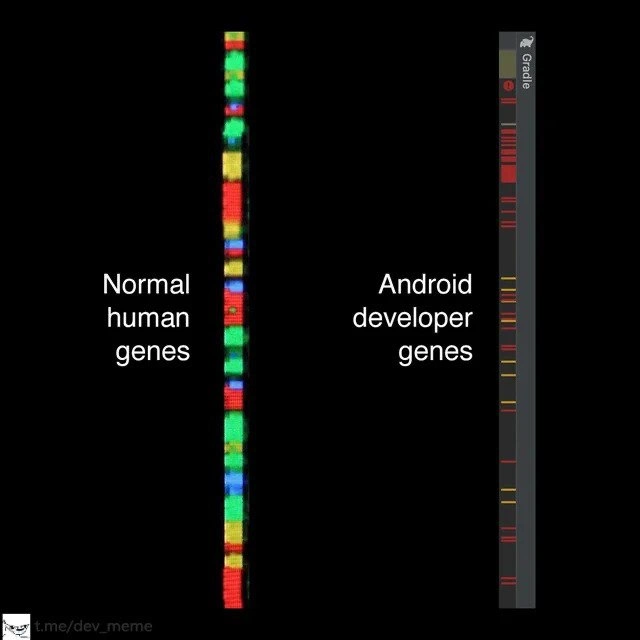
Imagine you have a chore or process you do all the time, so much that it feels like it’s a part of you. For example, think about a school crossing guard who stands in front of red, yellow, and green traffic lights every day. They might joke that they’ve been stopping and going at lights so often, they must have a little traffic light inside them now. This meme is saying something similar in a funny way. An Android programmer has to wait for their app to build (kind of like a long loading screen or a cooking timer) so frequently that it’s as if that waiting process is built into who they are. Instead of ordinary human genes, the picture shows their “genes” as a series of red, yellow, and green blocks – just like a progress bar. In simple terms, it’s a joke that building apps is such a big part of an Android developer’s life, it might as well be part of their genetic makeup. So, while normal people are “made” of regular DNA, an Android developer is portrayed as being “made” of a loading bar. It’s a playful way to say, “This thing I do all the time has become a part of me!”

Level 2: Builds on the Brain

Let’s break this meme down in simpler terms. Gradle is a popular build automation tool – essentially a system that takes your source code and turns it into a finished app. If writing code is like cooking up a recipe, Gradle is the cook that follows the recipe steps for you every time you need a fresh dish. In Android development, Gradle is the default build system that compiles your Java/Kotlin code, packs all the images and resources, runs tests, and produces the final APK (the app package you install on your phone). Android Studio, the official Android development IDE (Integrated Development Environment), uses Gradle under the hood. Every time you click “Run” or “Build” on your app project, Gradle kicks off a series of tasks to assemble your application. And Android Studio conveniently displays a little timeline or progress bar of these tasks so you can see what’s happening – that’s the gray bar with red, yellow, and green segments in the meme. It’s actually a UI element showing each build task’s progress and status. For example, one segment might represent “compile the code,” another “process the app resources,” and another “package everything together.” Green usually means a task succeeded, red means something failed or had an error, and yellow might indicate a task that’s running or has warnings. The left side of the image, labeled “Normal human genes,” is showing a brightly colored chromosome – basically a visual of human DNA. The right side, labeled “Android developer genes,” mimics that look using the Gradle build bar. The joke is comparing the two: a regular person’s genetic code vs. an Android developer’s “genetic code,” which humorously is just a bunch of build process segments. In plain language, the meme says: “ordinary people are made of normal DNA, but an Android developer is ‘made of’ Gradle and build timelines.”

Why would someone joke that an Android developer has a build timeline as their genes? Well, it’s highlighting how central Gradle builds are to an Android developer’s day-to-day life. Mobile developers – especially those making Android apps – run builds constantly. Every time you make changes to the app, you need to rebuild (at least partially) to see the effect, either in an emulator or on a device. This means waiting for Gradle to do its thing over and over. If you’re a newcomer to Mobile Development, you might be surprised how much waiting is involved. For instance, even a simple “Hello World” app isn’t instant – you hit run, and you might watch a progress bar for 30 seconds or a minute as Gradle compiles the app and then the app launches. On larger projects, builds can take several minutes if you don’t use shortcuts like incremental build features. Seasoned devs often joke about this wait: they might say “ time to grab a coffee while the app builds” or share memes about staring at progress bars. Over time, Android developers become so used to this routine that it’s almost automatic – fix code, run build, wait, repeat, dozens of times a day. The meme exaggerates this reality by saying it’s in their genes. In other words, building the app isn’t just a task they do – it’s become a fundamental trait of being an Android developer. It’s as if the habit of running Gradle builds is encoded inside them because they do it all the time.

Let’s explain the gene analogy a bit. Genes are the basic units in our DNA that determine how we’re built – like instructions for our body. “Splicing genes” means taking a piece of DNA from one organism and inserting it into another, like combining traits. The meme jokingly says someone took the Gradle build timeline (that bar with colored sections) and spliced it into the DNA of every experienced Android engineer. Of course, that’s not literally possible, but it’s a fun metaphor. It implies that after working with Android builds for so long, devs have essentially been “genetically modified” by their environment – the environment of endless Gradle builds! Another way to think about it: imagine if a baker spent so many years baking bread, someone jokes that flour and yeast are in their bloodstream. Here, since Android devs spend so many years building apps with Gradle, someone’s joking that the Gradle build bar is in their bloodstream (or DNA). It’s emphasizing how integral the build process is to the identity and daily life of an Android developer.

For a junior developer or someone just learning, here are a few key points from the meme:

  • Gradle build bar – In Android Studio, when you run a build, you see a progress bar with colored blocks. Each block is a step in building your app. Android developers see this every day, many times. It becomes a very familiar sight.
  • Developer genes vs normal genes – Normally, genes are what make you a human. The meme replaces a developer’s genes with a tech process (the build bar) to show how inseparable that process is from their work life.
  • Build time wait – This is the experience of waiting for the app to compile. It’s a common source of DeveloperFrustration. New developers quickly learn that patience (or finding ways to optimize build speed) is part of the job.
  • Mobile dev routines – In mobile development, you can’t escape building and rebuilding the app. It’s different from something like scripting or web development where you might just refresh a page. Mobile apps need that compilation step. So the workflow has natural stop-and-go cycles: write code, build, wait, run, repeat. The meme is basically riffing on this repetitive cycle.

All of this is wrapped in humor: the idea of literally having a “Gradle chromosome” is silly, and that silliness makes us laugh. But it’s funny to Android devs especially because it feels so true. When you spend half your day looking at something (like a build progress bar), it does start to feel like part of you! This meme speaks to the shared experience of Android developers, letting everyone know that if you feel like you’ve been doing endless builds — you’re not alone, and in fact it’s practically a badge of being an “Android dev”. Your non-programmer friends have normal human DNA, but you, my friend, have the DNA of an app builder – or so the joke goes.

Level 3: The Gradle Chromosome

If you’ve spent long hours building Android apps with Gradle, this image hits close to home. It shows a normal human chromosome (the colorful band on the left) vs. a bar labeled “Gradle” on the right – which is actually the familiar Android Studio build progress timeline with red, yellow, and green segments. The meme claims that a seasoned Android developer’s DNA isn’t made of ordinary genes at all, but of that Gradle build bar. It’s a tongue-in-cheek way to say Gradle builds are so ingrained in an Android dev’s life, they might as well be encoded in their genes. Build systems like Gradle have become part of the developer’s very being – at least it feels that way after the thousandth build. The humor here is equal parts absurd and relatable: absurd because, of course, nobody’s literally genotyping developers for a build tool, yet relatable because every Android engineer has felt like their “make app” workflow is hard-wired into their daily routine. We jokingly nod along because yes, sometimes it does feel like build automation is a part of our biology.

The meme nails a shared experience in the Android community: the inescapable Gradle build process. Seasoned devs have watched that stop-light colored timeline so often that its pattern is burned into memory. Green bars, red bars, yellow bars – they’re like the A, T, C, G of an Android dev’s genetic code, indicating successful tasks, failed tasks, and those cautionary “maybe I’ll work, maybe I’ll slow you down” tasks. A veteran Android engineer can often glance at the build timeline and instantly recognize what each colored chunk represents. A long green segment at the start? That’s probably the :app:compileDebugKotlin step chewing through code. A cluster of yellow? Possibly R8 or resource merging taking a bit longer than usual. A sudden red sliver? Oops, a compile error or test failure – time to hit that stacktrace and see what went wrong. Over years of Android development, you internalize this sequence of tasks the same way you might internalize a heartbeat or a circadian rhythm. It’s always there: compile, merge, dex, install… repeat. The comedic claim is that Android devs have literally internalized it – evolutionarily speaking – by splicing it into their DNA. In other words, after countless project builds and endless wait times, we’re basically part human, part Gradle.

To illustrate the joke in pseudo-code form, consider this snippet that humorously “updates” a developer’s genome using a build tool:

# Pseudocode: injecting the Gradle build timeline into an Android developer's genes
if dev.role == "Android Developer":
    dev.genome.append("Gradle Build Timeline")

In reality, no one’s adding a GradleBuildTimeline gene to your 23 pairs of chromosomes, but every experienced Android coder can relate to the sentiment. We’ve all had those moments where you hit “Run” in Android Studio, and then… hurry up and wait. You might open a browser, check messages, or grab a coffee while Gradle churns away, resolving dependencies and compiling. It’s practically a reflex. Many of us joke about the “coffee/compile ratio” – how many cups of coffee you can fetch in the time it takes for a clean build to finish. When a process consumes that much of your day-to-day workflow, it starts feeling like a fundamental part of you. The meme exaggerates it to genetic levels: that’s dark humor pointing to a real pain point. It’s the kind of hyperbole that makes you laugh and wince at the same time.

Behind the humor is an acknowledgement of Developer Experience (DX) reality. Gradle is powerful, but it can be slow or unpredictable, especially on large projects. The build process involves a long list of tasks – compiling source code to bytecode, converting bytecode to Dalvik code (DEX), crunching images, merging resource files, running code generators (like annotation processors), packaging everything into an APK, maybe even running tests. Gradle coordinates all these steps via a directed acyclic graph of tasks (that’s those little colored bars lined up in sequence and parallel). A seasoned dev has spent so much time watching these steps fly by (or crawl by, on bad days) that they start to optimize life around it. We enable the Gradle daemon, turn on parallel builds, tweak heap sizes, invest in faster SSDs – all evolutionary adaptations for survival in the wilds of slow build times. And just when we think we’ve finally tamed the build speeds, along comes a new library or an update that adds another few seconds (or minutes) to the timeline. Adapt or perish, as the saying goes – and Android devs have adapted by basically coexisting symbiotically with Gradle. The meme bittersweetly suggests this relationship is so symbiotic that it’s like we’ve merged at the genetic level.

From an industry perspective, this image also pokes fun at how Android development became inseparable from Gradle over the years. Historically, Android projects weren’t always built with Gradle – back in the early days, the default was Apache Ant (with Eclipse IDE). Gradle was introduced with Android Studio to provide a more flexible, modern build system, and oh boy, did it deliver on flexibility. We got a whole plugin ecosystem (Gradle Plugins for Android, Kotlin, you name it), sophisticated dependency management, and the ability to script our build in Groovy or Kotlin DSL. But that power came at the cost of complexity and longer setup times. Builds went from a simple linear script to a sprawling graph of tasks. The first time you saw Android Studio’s build output, it was like watching a NASA launch sequence scroll by. Over time, Google and the community have improved Gradle’s performance (incremental builds, AGP optimizations, build caching), but for many of us the Build → Run → Wait cycle remains a daily constant. And it’s not just on your machine – every commit you push runs through the company’s CI/CD pipeline with Gradle orchestrating tests and packaging in the cloud. Even our Jenkins/TeamCity agents have that Gradle timeline in their logs, grinding away. In a sense, the entire Android ecosystem’s “genetic code” has Gradle stamped all over it. We joke about it because we’ve all felt that mixture of reliance and frustration. As the meme implies, being an Android developer means accepting that the build process is part of your very identity. It’s funny – and a little tragic – that one of the most defining traits of our work is how we cope with waiting on our tools.

Description

A two-panel comparison meme set against a black background. The left panel is labeled 'Normal human genes' and displays a colorful, vertical strip that resembles a DNA sequencing gel with bands of red, green, blue, and yellow. The right panel, labeled 'Android developer genes', shows a screenshot of a scrollbar from an IDE, most likely Android Studio or IntelliJ. This scrollbar is dark grey and filled with numerous horizontal red and yellow lines, which represent errors and warnings in the code. At the very top of the scrollbar, the Gradle elephant logo and the word 'Gradle' are visible. A watermark for 't.me/dev_meme' is in the bottom-left corner. The humor is a visual metaphor, equating the complex, colorful pattern of human DNA with the perpetually error- and warning-filled scrollbar that Android developers see daily, implying that wrestling with code issues and the Gradle build system is an inherent part of their identity

Comments

7
Anonymous ★ Top Pick My IDE scrollbar isn't a gene sequence, it's a legacy system's EKG, and the prognosis is 'perpetual refactoring'
  1. Anonymous ★ Top Pick

    My IDE scrollbar isn't a gene sequence, it's a legacy system's EKG, and the prognosis is 'perpetual refactoring'

  2. Anonymous

    Scientists tried CRISPR on me, but all they could edit was the settings.gradle

  3. Anonymous

    The gray chromosome is just years of accumulated deprecated APIs that we can't remove because someone's enterprise app from 2012 still targets Gingerbread

  4. Anonymous

    After years of waiting for Gradle builds to finish, Android developers have evolved a unique genetic marker: the ability to context-switch to three other tasks during a single 'assembleDebug' run, only to return and find it's still resolving dependencies. Natural selection favors those who've learned to read the entire Gradle documentation while their build 'optimizes dex files' for the 47th time today

  5. Anonymous

    Genome-wide association study suggests Android devs inherit a dominant Gradle allele that manifests as red/yellow error-stripes, 12‑minute clean builds, and a reflex to blame kapt when everything inexplicably breaks

  6. Anonymous

    Android genes: overexpressed FragmentTransactions and recessive ActivityLifecycle callbacks that never onDestroy properly

  7. Anonymous

    Android devs don’t have recessive traits - they have transitive ones; every Gradle resolve ends with my DNA doing Invalidate Caches/Restart

Use J and K for navigation