Skip to content
DevMeme
852 of 7435
Stack Overflow: Apes Together Strong
DevCommunities Post #962, on Jan 6, 2020 in TG

Stack Overflow: Apes Together Strong

Why is this DevCommunities meme funny?

Level 1: Teamwork Saves the Day

Imagine some bananas are high up in a tree where a single monkey can't reach. One monkey jumping alone keeps failing. But if a bunch of monkeys work together – say one monkey gives another a boost, and maybe a third monkey climbs on top – eventually they can grab those bananas. Each monkey by itself is too weak or short, but all together they succeed.

This meme is saying the same thing about people (specifically about programmers). Sometimes one person can't solve a hard problem alone, especially when they're tired or the problem is really tricky. But if people help each other and share what they know, they can fix the problem as a group. In the picture, the apes holding the Stack Overflow logo and saying "Apes together strong" is a fun way of showing that teamwork makes us stronger. It means when everyone shares their knowledge and works as one team, even big problems (like a broken program in the middle of the night) can be solved. The joke is that even the smartest tech experts need help from friends sometimes — just like those apes needed each other to succeed. Together, we are truly strong.

Level 2: Copy-Paste to the Rescue

Let's break down what's happening in this meme in simpler terms:

  • Stack Overflow – This is a famous online Q&A forum where developers ask programming questions and other developers answer them. It's like a huge communal knowledge base. If you run into an error or bug, chances are someone on Stack Overflow has asked about it before, and there's an answer waiting there. It's a cornerstone of modern developer culture to search Stack Overflow for solutions.

  • Tribal knowledge – Tribal knowledge means information that isn't formally documented but is known within a group. In tech, "Stack Overflow tribal lore" refers to all those little tips, fixes, and weird solutions that developers have shared informally on forums or chats over the years. It's the stuff you won't find in an official manual, but you might hear from a veteran coworker or find in a decade-old forum post.

  • Production ("prod") – The production environment is the live system that real users or customers interact with. When we say "prod is down" or "prod is on fire," it means the live website or service is broken or experiencing a serious issue. Fixing problems in prod is urgent because every minute of downtime might affect users or revenue. So if something breaks in prod, developers jump on it immediately — even if it's late at night.

  • 3 AM emergency – The meme caption mentions bailing out prod at 3 AM. This paints the picture of a worst-case scenario: a critical problem happening in the middle of the night. Many teams have an on-call developer who must wake up and handle such emergencies. A 3 AM call is kind of an infamous situation in programming — it's when you're groggy, under pressure, and just want to get the issue resolved as fast as possible.

  • Copy-pasting an arcane one-liner – This phrase means taking a small snippet of code (maybe just one line) from someone else's answer and using it in your own code or in the command line to quickly fix a problem. "Arcane" implies the code is obscure or not well-understood, like a magic spell you just trust to work. The meme jokes that the solution comes from a 2009 answer on Stack Overflow. 2009 is over a decade ago, which feels like ancient history in tech years. Saying it "still compiles" means that code from that old answer still works today. Developers often do this during crunch time: find a trusted answer and literally copy the solution into their program because it's a quick, no-think fix.

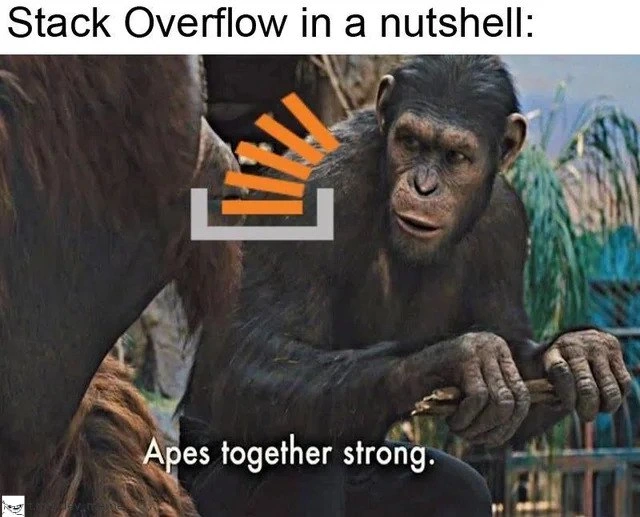
  • "Apes together strong" (meme image) – The picture is a scene from Planet of the Apes. In that movie, the apes say "Apes together strong" to mean they are powerful when they stick together. In the meme, you see two apes holding the Stack Overflow logo together. This visual is comparing developers to those apes: one developer alone might struggle, but a bunch of developers sharing knowledge (through Stack Overflow) can solve pretty much anything. It's a fun way to highlight developer collectivism and teamwork. The Stack Overflow logo (the orange stacked lines with a gray bracket) is shown like it's the object the apes are uniting around, symbolizing the collective knowledge base.

Overall, the meme is humorously saying that programming isn't a solo activity — even experienced engineers lean on the community's shared knowledge. When something breaks badly, developers often turn to each other’s answers on the internet to save the day. It's funny and relatable because almost every programmer has felt that wave of relief when a copy-paste fix from an online forum solves their problem. In short: when developers help each other and share solutions, they become much stronger than if each person tries to fight the problem alone. Apes (developers) together strong!


Level 3: Tribal Band-Aids at 3AM

At 3:00 AM, with production on fire and alarms blaring, every developer becomes a bit of a desperate survivalist. Official documentation? At this ungodly hour, rummaging through a 500-page manual feels hopeless. Instead, you find yourself performing a Stack Overflow séance: scouring an old Q&A thread from 2009, hand-picking an arcane one-liner that promises to banish that bizarre error. The meme nails this absurd yet all-too-familiar scenario. It shows two apes from Planet of the Apes clutching the Stack Overflow logo, captioned "Apes together strong." It's a cheeky depiction of developers as code monkeys who might not individually have all the answers, but by banding together and sharing knowledge, can muscle through even the gnarliest bugs.

In practice, those decades of Stack Overflow Q&A form a sort of tribal knowledge repository for coders. The phrase "tribal lore" hints that this knowledge is passed around informally like campfire stories or ancient wisdom. Senior engineers often have mental bookmarks of obscure fixes gleaned from years of combing through Stack Overflow. That one weird hack to patch a memory leak in an old framework? It's stashed in an answer from 2011 with 500 upvotes. These are the folklore of programming — unsung hacks and one-liner workarounds that never made it into any official manual but get whispered from one burnt-out developer to the next.

There's dark humor here because everyone in software has been there: an on-call pager goes off, you're bleary-eyed, and you're googling cryptic error messages. Nine times out of ten, the top result is a Stack Overflow answer where some generous soul already slayed this monster of a bug years ago. Maybe it's a snippet that toggles an obscure feature flag or a Linux sysctl tweak for kernel parameters. It might look like black magic, but when it has 300+ upvotes and a green "accepted answer" checkmark, you bet your last coffee it's getting copy-pasted into your code. If it compiles and runs without blowing up, it's going to prod — we'll ask questions (and write proper docs) later.

// 3 AM production firefighting pseudocode:
if (productionOnFire && currentTime == "03:00") {
    auto fix = searchStackOverflow("Error 0xDEADBEEF urgent");
    apply(fix.codeSnippet);
    // Apes together strong: collective knowledge saves the night
}

From an engineering perspective, this scenario is both comforting and a tad horrifying. Comforting because it shows the power of collective intelligence: thousands of developers worldwide contributing to a shared troubleshooting guide that anyone can tap into at any hour. It's like a distributed brain for debugging. But it's also horrifying (in a comedic way) because it highlights our dependence on tribal fixes we might not fully understand. The meme’s tagline "Stack Overflow in a nutshell" winks at the idea that the site's true purpose is as a giant archive of copy-paste solutions for crisis moments. And honestly, that’s a big part of developer culture now: we don’t memorize every API or command; we just remember "I saw this before on Stack Overflow" and rush off to grab the solution.

For experienced devs (the battle-scarred veterans), this meme triggers a knowing smirk. We're basically admitting that behind every "I have seen this before" moment is probably a bookmark to an old Stack Overflow page or a snippet saved from a decade ago. It's the not-so-glamorous side of on-call life and Developer Experience (DX): sometimes being a "Senior Engineer" just means you've amassed a library of Stack Overflow solutions over the years. In war-room calls, you might even hear someone say, "I recall a Stack Overflow post about this exact glitch — try that fix," and everyone nods in agreement because they've lived that exact scenario too. The humor lies in how relatable this is: no matter how advanced our systems get, when things break badly at an ungodly hour, we're all just apes clutching at decades-old code snippets hoping one will hold everything together.


Description

The meme humorously summarizes the Stack Overflow community ethos using a popular movie scene. The top of the image has the text 'Stack Overflow in a nutshell:'. The main visual is a still from the film 'Rise of the Planet of the Apes', featuring the intelligent chimpanzee, Caesar, speaking to another ape. The Stack Overflow logo is photoshopped onto Caesar's shoulder. A subtitle at the bottom of the frame captures his famous line: 'Apes together strong.' This meme creates a powerful and funny analogy, comparing the global community of developers who collaborate on Stack Overflow to the united apes. It highlights the platform's core value: the collective intelligence and mutual support of programmers working together to solve complex problems, making the entire community more powerful than any single developer
Comments

7
Anonymous ★ Top Pick Stack Overflow proves that with enough apes, you can eventually rewrite Shakespeare... or at least get a regex for parsing HTML
  1. Anonymous ★ Top Pick

    Stack Overflow proves that with enough apes, you can eventually rewrite Shakespeare... or at least get a regex for parsing HTML

  2. Anonymous

    Proof that our industry’s real distributed consensus algorithm is hitting “Cmd-C, Cmd-V” on whichever primate answered the question first

  3. Anonymous

    Stack Overflow: Where the accepted answer from 2011 using jQuery somehow outranks the modern solution, but the real gold is buried in a comment thread arguing about whether it's O(n) or O(n log n)

  4. Anonymous

    Stack Overflow: where 'apes together strong' perfectly encapsulates how we've collectively built entire production systems by stitching together answers from 2012, marked as duplicates three times, with the actual solution buried in a comment with 2 upvotes - yet somehow, through sheer collaborative determination and strategic Ctrl+C/Ctrl+V, we ship features that actually work

  5. Anonymous

    Our on‑call playbook is basically quorum on the right Stack Overflow thread - CAP theorem says you can pick consistency, availability, or the accepted answer

  6. Anonymous

    Stack Overflow: where one ape's stick of wisdom outlasts a thousand solo debuggers reinventing the wheel

  7. Anonymous

    Our incident runbook basically implements Raft: elect the top‑voted Stack Overflow answer as leader, replicate by copy‑paste, and consider committed when prod stops paging

Use J and K for navigation