Skip to content
DevMeme
6352 of 7435
A Legendary Pun Chain for Game Developers
GameDev Post #6966, on Jul 18, 2025 in TG

A Legendary Pun Chain for Game Developers

Why is this GameDev meme funny?

Level 1: Hidden in Plain Sight

Imagine someone making a sentence that secretly hides a bunch of names inside it. If you don’t know the names, the sentence just sounds a little funny. But if you do know them, it’s exciting because you feel like you uncovered a secret message. This meme is doing exactly that, but with names of game-making tools. It’s like if your dad told a joke using the names of all your favorite superheroes in one go – you might not catch it at first, but when you do, you giggle because you recognize each one. Here, the person managed to squeeze five different game engine names into one regular sentence. That’s why it’s called a “dad joke”: it’s a goofy, cleverly hidden pun that makes you groan and smile at the same time. The fun part is discovering the hidden names. Every time you read the sentence again, you might spot another familiar word, and that “Aha!” feeling is what makes it so amusing. In simple terms, it’s funny because it’s a little puzzle and a joke rolled into one – the names were there all along, hiding in plain sight, just waiting for you to notice them.

Level 2: Meet the Engines

Let’s break down the joke in simpler terms. This meme crams five different game engines (game development platforms) into one sentence. In the image, the text says:

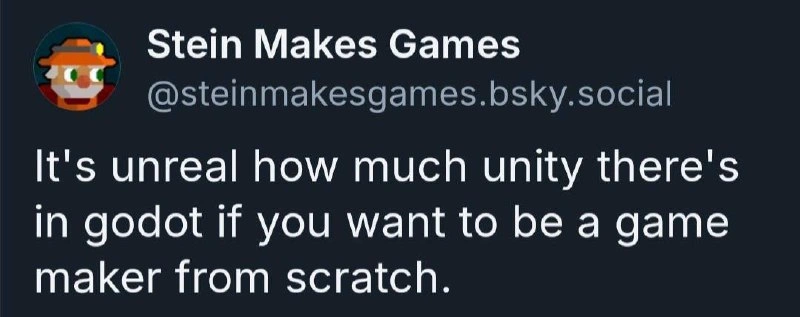
“It’s unreal how much unity there’s in godot if you want to be a game maker from scratch.”

At first, it looks like a regular sentence about making a game from scratch. But actually, Unreal, Unity, Godot, GameMaker, and Scratch are each the names of popular tools used to create games. Here’s who they are:

  • Unreal Engine – A powerful game engine by Epic Games. It’s used for high-end, realistic 3D games (think of big titles like Fortnite or Gears of War). Developers write code in C++ with Unreal, and it’s known for its stunning graphics capabilities.
  • Unity – Another hugely popular game engine (by Unity Technologies). Unity uses C# for scripting and is beloved for its versatility. You can make 2D or 3D games, and it’s common in indie game development and mobile games. Popular games like Hollow Knight and Pokemon Go were made in Unity.
  • Godot – An open-source game engine that’s completely free to use (no fees or royalties). Godot has its own easy-to-learn scripting language called GDScript (which feels a bit like Python), and it now also supports C#. It’s great for both 2D and 3D projects. Many developers gravitate to godot_engine for its friendly community and the fact that they can dig into its source code if they want.
  • GameMaker – Short for GameMaker Studio, this is a game creation tool that’s especially good for 2D games. It lets you drag and drop behaviors or write scripts in a language called GML. A lot of early indie games (like Undertale and Hyper Light Drifter) were made in GameMaker. It’s often recommended for beginners who want to make a simple game quickly without full-blown programming.
  • Scratch – Scratch isn’t a commercial game engine like the others; it’s an educational programming platform from MIT. Aimed at kids and beginners, it uses colorful scratch_programming blocks that you snap together to create animations and games. It’s typically used in a web browser. If you ever see a child showing off a simple game or story they “coded,” there’s a good chance they used Scratch. The name comes from “starting from scratch,” meaning starting from the very beginning.

Now, the meme brilliantly fits all five names into one coherent line. Here’s how: the sentence uses the ordinary meanings of those words to make sense grammatically: “unreal” as in “unbelievable,” “unity” as in “togetherness,” “Godot” (which reads like a proper noun – it’s actually the name of a famous play Waiting for Godot, but in this context it just slips by), “game maker” as a general term for someone who makes games, and “scratch” as in “from scratch,” meaning from nothing. So on a literal level, it sounds like someone is saying:

“It’s unbelievable how much togetherness there is in Godot if you want to be a creator of games from the very beginning.”

That sentiment is a bit odd, but it isn’t pure nonsense – you could almost think the person is commenting on how the Godot community is very unified, for someone wanting to start fresh in game development. However, the real joke is that each of those key words is a proper name of a game engine. The poster is effectively name-checking every major game creation tool in one sentence! It’s a classic case of engine name puns: using each engine’s name as a common word.

This is funny to developers because they recognize the pattern and feel clever for catching it. It’s like a puzzle or a riddle hidden in plain text. The phrase “maximum cross-platform dad joke” in the title refers to how the meme spans multiple “platforms” in a sense — not Xbox/PlayStation kind of platforms, but multiple development platforms (engines). “Cross-platform” usually means software that runs on many different devices, and each of these engines can publish games to multiple platforms (Windows, Mac, consoles, etc.). By including all major engines, the joke itself is like it’s cross-platform. And calling it a “dad joke” means it’s a deliberately corny pun that makes you groan and laugh at the same time, much like a father joking with his kids using silly wordplay.

For a junior developer or someone new to game development, this meme is also a mini tour of the landscape of game engines. It hints at the question every beginner eventually faces: Which engine should I use? Each option has its pros and cons – and veterans often have strong opinions about them. The humor here doesn’t take any side; instead, it playfully suggests that there’s a bit of each everywhere (“unity in Godot” could even cheekily imply that some ideas from Unity are present in Godot, which is kinda true since Godot adopted C# support). Also, notice the phrase “game maker from scratch” packs two tool names back-to-back! It’s saying GameMaker and Scratch right next to each other, disguised as the phrase “make a game from scratch” (meaning starting a project with no pre-existing code). That’s a clever double usage of common terminology and proper nouns.

So, essentially, this one-liner is winking at the entire GameDevelopment community. It’s saying: “Hey, we’ve got Unreal, Unity, Godot, GameMaker, and Scratch all in one place – isn’t that cool?” For someone not familiar with these terms, it might just pass as an odd sentence. But once you learn what each of those names means, you can appreciate the joke. It’s a fun way to show you’re in the club of people who know these game engines. And it also subtly celebrates the diversity of tools out there. From a high-end engine used in blockbuster games to a kid-friendly program used in school projects, each gets a nod. That’s the cross_engine_humor of it: uniting the whole spectrum of game creators with a little punny bow.

Level 3: Multiengine Mashup

For experienced game developers, this meme lands as a masterful wordplay_game_engine_names gag. At first glance, the sentence reads like a throwaway line about game development: “It’s unreal how much unity there’s in Godot if you want to be a game maker from scratch.” But those with industry experience immediately recognize the capitalized terms as five famous GameDev engines woven seamlessly into the phrase. It’s a multiengine mashup that sparks both laughter and a knowing nod. Why? Because anyone who’s been around the block in GameDevelopment has either used or at least debated these tools – and here they are, bizarrely united in one “maximum cross-platform dad joke.”

Each engine name doubles as an English word or phrase, which is why the sentence still makes grammatical sense on a surface level. But the real punch comes from the subtext: it’s slyly poking fun at the game_engine_choice conundrum every developer faces. Do you go with Unreal Engine for its realistic graphics and strong performance? Do you choose Unity for its rapid development pipeline and huge asset store? Or perhaps try Godot, championing open-source freedom and avoiding licensing fees? Maybe you started out with simpler tools like GameMaker Studio (popular for 2D titles and beloved by many indie devs of the 2000s) or even dabbled in Scratch when learning the basics. The meme doesn’t take sides – it name-drops them all, as if saying “whichever engine you favor, it’s all part of the same game-making family.” This inclusive punchline resonates with senior devs who have seen the engine wars come and go. Unity vs Unreal flamewars on forums, the rise of Godot as the community’s darling, the nostalgia of GameMaker, even the educational roots of Scratch – it’s all compressed into one friendly joke.

There’s an implied camaraderie here. The phrase “how much unity there’s in Godot” can be read as commentary on how the Godot engine’s community-driven approach has united developers (especially after some disillusionment with corporate engines’ licensing changes). Seasoned devs remember the recent drama: for example, when Unity changed its pricing model, many looked toward Godot, finding unity (togetherness) in an open-source alternative. This kind of insider context isn’t explicitly stated, but it adds flavor – the meme dropped just when the ecosystem debates were hot. Mentioning all engines in one breath feels like a cheeky statement: We’re all in this together, whether our project runs on Unreal’s cutting-edge or on a Scratch prototype. It bridges the proprietary vs open-source divide with humor, echoing the tag cross_engine_humor – the kind of joke only a dev who has juggled multiple toolchains and porting headaches would concoct. (Think of the pain of trying to convert a Unity project to Unreal or vice versa – you’d practically rewrite the whole game. The absurdity of mixing engines is very real to a senior developer, which makes the one-line fusion even funnier.)

The “dad joke” label in the title is well-earned. This is exactly the kind of groaner pun a veteran programmer might drop in a chat room or at a GDC GameDev after-party, eliciting both chuckles and eyerolls. It’s packed with engine name puns, yet it reads so naturally that you almost miss a couple on the first read. Indeed, as the post’s caption says, “More times you read it…” the more engines you spot. Maybe you catch Unreal and Unity immediately, but did you notice Godot? And oh wait, Game Maker and Scratch are hiding at the end! That delayed realization is comedy gold for those in the know – it’s like an Easter egg hunt for game developers. By the second or third pass, you’re appreciating just how engine-packed this one-liner is, and it gets funnier (or groanier) with each revelation.

Also, a quick nod to context: this screenshot comes from a Bluesky post (bsky.social is Bluesky, a Twitter-like social network popular with devs). The handle @steinmakesgames and the pixel-art avatar set the scene – it’s a gamedev enthusiast making a quip on a platform where fellow techies share jokes. The social media aspect isn’t crucial to the joke’s content, but it does reflect how developer humor spreads online. Whether on Bluesky or Twitter or a subreddit, a cross-engine pun like this unites programmers across communities – much like the engines in the sentence unite disparate techies through shared laughter. In summary, experienced devs love this meme because it encapsulates a whole era of Frameworks and tools in one witty package. It’s a celebration of the diversity of game engines we’ve used, each name carrying its own weight of memories and opinions, all coming together for a one-line punch. And if you’ve ever stayed up late debating the merits of Unity vs Unreal, or refactoring a project to a new engine, you can’t help but appreciate how game-engine culture itself is being playfully toasted here.

Level 4: Engine Singularity

At the most technical level, this meme teases a hypothetical convergence of game development frameworks – an engine singularity where all major game engines unify. In one sentence, it name-drops five distinct game engines that normally have very different architectures and paradigms. Let’s unpack the hidden complexity: Unreal Engine (Epic’s C++ powerhouse for photorealistic graphics), Unity (the C#-based ubiquitous engine for indie and mobile games), Godot (the open-source engine with its own GDScript language and node-based scene system), GameMaker Studio (a 2D-focused engine with a proprietary scripting language, GML), and Scratch (MIT’s beginner-friendly, block-based programming environment). Each of these frameworks abstracts away the gritty details of rendering, input, and physics to let developers focus on game logic – but under the hood, their design philosophies diverge dramatically.

Consider the low-level differences: Unreal uses a native C++ codebase with a robust editor and Blueprints (visual scripting) to manage complex graphics and physics; Unity runs on a managed .NET runtime (Mono/IL2CPP), using garbage-collected C# for scripting; Godot is written in C++ but offers high-level scripting (GDScript, plus optional C#) and a flexible scene graph composition; GameMaker provides a simplified event-driven approach with drag-and-drop alongside GML scripting, ideal for 2D sprite-based games; and Scratch, running in a web VM, teaches programming logic through draggable blocks rather than typed code. The meme’s sentence, by cramming all these names together, humorously imagines a world where these disparate systems harmonize. It’s a tongue-in-cheek nod to the ultimate cross-platform dream: write your game once and magically have it run on every engine and device.

In reality, achieving such unity among engines is unrealistic due to fundamental incompatibilities. Each engine has its own file formats, component systems, and rendering pipelines (DirectX vs OpenGL/Vulkan, etc.). For instance, Unity and Godot both handle scenes and game objects, but Unity’s component-based GameObject model isn’t directly transferable to Godot’s node hierarchy. Similarly, Unreal’s advanced material shaders and C++ gameplay classes don’t translate into GameMaker’s simplified world. This is why porting a game between engines can feel like rewriting the whole thing from scratch – not Scratch the tool, but literally coding everything over. The joke sentence slyly suggests “there’s Unity in Godot,” which tickles seasoned developers because Godot has indeed adopted some ideas popularized by Unity (such as optional C# scripting and an intuitive editor), yet the two remain entirely separate codebases. It also packs in “game maker from scratch,” alluding to building a game from the ground up (i.e. from scratch) versus using GameMaker or Scratch – a clever double meaning that highlights a classic engineering decision.

On an academic level, the meme hints at an open_source_vs_proprietary_engines subtext. Notice how it bridges open-source (Godot) and proprietary engines (Unity, Unreal, GameMaker) in one line. In software engineering theory, we often talk about interoperability and standardization – for example, universal scene description formats or scripting standards – but game engines historically evolved in silos. The sentence playfully imagines a unified theory of game engines, where all tools share unity (pun intended) despite different corporate owners and communities. It’s like referencing a grand unification in physics, but for game dev: amusing because we know the laws of software (licensing, architecture, and yes, ego) keep these worlds apart. By packing all these engines into a single phrase, the meme achieves a kind of multiversal collision that exists only in wordplay. Veteran developers chuckle at the absurdity and brilliance of this engine_name_puns overload, appreciating how it wraps deep knowledge of the game engine landscape into a one-liner. It’s the kind of joke you’d only fully appreciate after you’ve grappled with each of these tools’ idiosyncrasies – a theoretical inside joke about the engine ecosystem’s impossible unity.

Description

A screenshot of a social media post from the user 'Stein Makes Games' (@steinmakesgames.bsky.social). The post, set against a dark background with white text, reads: 'It's unreal how much unity there's in godot if you want to be a game maker from scratch.' The user's avatar is a pixel-art style character with an orange hat and a white beard. This post is a clever and dense pun that seamlessly integrates the names of five popular game development platforms into a single, grammatically coherent sentence. The humor is derived from the wordplay involving Unreal Engine ('unreal'), Unity ('unity'), Godot ('godot'), Game Maker ('game maker'), and the Scratch programming language ('scratch'). It's a niche joke that is highly relatable and amusing to individuals within the game development community who would immediately recognize all the references
Comments

23
Anonymous ★ Top Pick This is the kind of sentence that would crash a recruiter's keyword parser but would get you hired by a senior principal engineer on the spot
  1. Anonymous ★ Top Pick

    This is the kind of sentence that would crash a recruiter's keyword parser but would get you hired by a senior principal engineer on the spot

  2. Anonymous

    Careful - feed that sentence to your build server and it’ll download five SDKs, trigger four different EULAs, and still fail on a missing DLL called ‘irony32.dll’

  3. Anonymous

    After 15 years of engine migrations, I've learned the real game development pattern: spend 6 months evaluating engines, 3 months building your own ECS framework, then realize you should've just shipped with GameMaker and moved on to the next project

  4. Anonymous

    A masterclass in technical wordplay that captures the existential crisis every indie game developer faces: choosing between Unity's ecosystem lock-in and runtime fee drama, Unreal's C++ complexity and 5% revenue cut, or Godot's MIT license freedom with a smaller asset store. The real joke is that after 6 months of analysis paralysis comparing rendering pipelines and ECS architectures, you'll realize the engine choice matters far less than actually shipping something - but by then you've already rewritten your prototype in all three

  5. Anonymous

    The only real “unity” between Unreal, Unity, Godot, GameMaker, and Scratch is the team agreeing the port is actually a rewrite - right after discovering HLSL vs GLSL, C# vs GDScript, and physics determinism don’t merge without a therapist

  6. Anonymous

    That sentence is our engine migration plan: five editors, four languages, three asset importers, two license headaches, and one shattered GUID

  7. Anonymous

    From-scratch game dev: Download Godot, pretend it's raw C++, profit from Unity's battle-tested ghosts

  8. @VaisovD 11mo

    The better it gets

  9. @moosschan 11mo

    the silliest true sentence ever

  10. @mrYakov 11mo

    And any of this engines sucks if you want something more complex than fps

    1. @gegechin 11mo

      Okay druzhishe I heard you

    2. @deadgnom32 11mo

      that's basically all the major and minor engines used in production of 99.99% of the games.

      1. @mrYakov 11mo

        And major of this games is either shooter or unoptimised and cant even hit 60 fps on top pc

        1. @deadgnom32 11mo

          like which one?

          1. @mrYakov 11mo

            Ksp, satisfactory, cities skylines for example

            1. @deadgnom32 11mo

              what about final fantasy?

              1. @mrYakov 11mo

                it's empty talk in an attempt to get to the bottom of words instead of meaning. these are still games in a static world where you just control a character and beat enemies.

                1. @deadgnom32 11mo

                  empty indeed.

        2. @deadgnom32 11mo

          https://boilingsteam.com/lenovo-legion-go-s-windows-vs-steam-os-performance/

          1. @deadgnom32 11mo

            and its a portable console, not a pc

          2. @deadgnom32 11mo

            is witcher 3 a shooter?

            1. @mrYakov 11mo

              Witcher 3 dont use unreal, unity or godot, lol

    3. @deadgnom32 11mo

      any — well, scratch may be a not so well choice.

Use J and K for navigation