Skip to content
DevMeme
747 of 7435
Unit Tests vs. Integration Tests: The Cybertruck Method
Testing Post #846, on Nov 23, 2019 in TG

Unit Tests vs. Integration Tests: The Cybertruck Method

Why is this Testing meme funny?

Level 1: When It Matters, It Breaks

Imagine you’ve built a small science-fair volcano at home and practiced it ten times. Every time, the little volcano happily erupts with baking soda and vinegar, and you’re confident it’s going to wow your class. Each practice is like testing one part of your project by itself – and it always worked. But now comes the big science fair presentation (the real show). You set up everything in front of everyone. You pour in the vinegar… and nothing happens. Or worse, the volcano erupts at the wrong time and makes a huge mess. 😬 Everyone gasps, and you stand there thinking, “But it worked at home, I swear!” It’s both funny and frustrating because the very moment you needed it to work, it fell apart.

This meme is laughing at that kind of situation. All the private practice runs (each part tested alone) went perfectly, just like the truck’s door and glass tests did fine separately. But during the big live demo – the one that counted – things went wrong in a way nobody expected. It’s like a magic trick that always worked when you rehearsed, but during the actual performance the magic fails and the rabbit doesn’t come out of the hat. The humor comes from that feeling we all recognize: sometimes everything only goes wrong when everyone is watching.

Level 2: But I Did Test It!

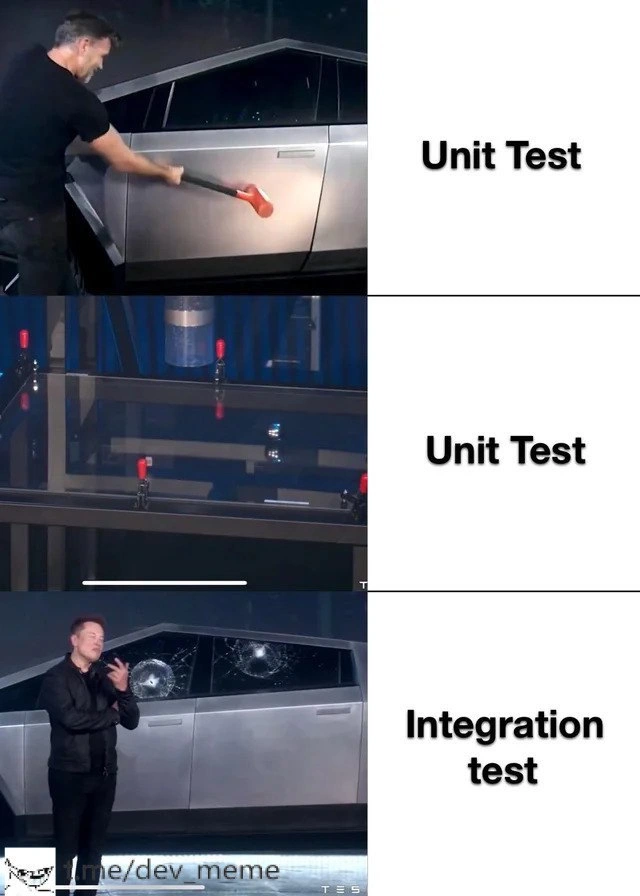
Let’s break down the meme’s meaning in simpler terms. In software development, testing happens at different levels. A unit test checks one small piece of code (like a single function or class) in isolation, to confirm it behaves as expected. For example, if you have a function calculateBrakeForce(), you’d write a unit test to give it certain inputs and assert that it returns the correct output. Unit tests are usually fast and focused – they often use fake inputs or mocks (simulated components) so that we can test just that one piece without interference. In the meme, the first panel with the sledgehammer on the door is akin to a unit test of the truck’s door: we’re testing just the door’s strength by itself. The second panel with the metal ball on a glass pane is another unit test, this time of the window glass alone. Both isolated parts pass their tests: the door doesn’t dent, the glass doesn’t break.

An integration test checks if multiple parts of a system work together correctly. It’s like testing the whole feature or system end-to-end, not just individual functions. In the third panel, when they combine the real truck door, frame, and window and then throw the ball, that’s an integration test – and it fails (the window breaks). This dramatic on-stage failure is analogous to running your entire application to see if all the modules integrate properly, and discovering a problem that didn’t show up when tests were done on each part alone. In software, you might have a situation where Module A and Module B each work fine by themselves (their unit tests all pass), but when A tries to use B for real, something goes wrong. Maybe A expects a response in miles and B provides kilometers – if your unit tests didn’t catch that mismatch, an integration test (or sadly, a live demo) will reveal it. The meme’s joke is that even though everything was “tested” in pieces, the final combined test had a surprise outcome.

To a new developer, this highlights why we have multiple testing stages in a SoftwareTestingTypes spectrum. Unit tests are like testing individual LEGO blocks: you check each block for cracks, and they all seem strong. But integration tests are like building those blocks into a tower – and sometimes the tower wobbles or collapses because of how the pieces fit together. It’s not that the pieces are bad, it’s that their interaction created a new problem. In coding, these interaction bugs can happen due to shared state, different assumptions, or just the complexity of systems. It’s a key part of the QAProcess: after unit tests, we do integration tests to catch issues with the wiring between components.

For instance, imagine a simple program with two functions: one saves a file and another reads from it. Individually, each function might work (unit tests: “file saved successfully,” “file read successfully”). But what if the reader expects the file to be in a certain format that the writer isn’t using? If our unit tests didn’t cover that, an integration test (where the actual file write and read happen in sequence) will expose the mismatch. Suddenly the read function crashes or returns gibberish because the two functions weren’t truly compatible in practice. A beginner might be puzzled: “But I tested those functions! They each passed their tests.” – only to realize later that they never tested them together. This meme is basically illustrating that But I did test it! moment of confusion.

Let’s connect back to the Cybertruck example more concretely with a bit of pseudo-code analogy. It’s like we had a Door component and a Window component in code. We test each one separately and they pass:

class Window:
    def __init__(self, strength):
        self.strength = strength  # some measure of durability
    
    def hit(self, force):
        # Simulate impact: reduce strength
        self.strength -= force
        return self.strength > 0  # returns True if window is still intact

# Unit tests for Window durability (isolate each scenario):
window = Window(strength=100)
assert window.hit(50) == True    # Test 1: window survives a 50-force hit (passes)
window = Window(strength=100)
assert window.hit(90) == True    # Test 2: window survives a 90-force hit (passes)

# Now an integration-like test: two hits in sequence on the same window
window = Window(strength=100)    
window.hit(50)                   # first hit (like the sledgehammer on door, possibly weakening window)
result = window.hit(90)          # second hit (like throwing the ball at the same window)
assert result == True            # This assertion FAILS because the window shatters on the second hit.

In the code above, each unit test started with a fresh window at full strength, so a single hit of 50 or even 90 wasn’t enough to break it. But in an integrated scenario, we didn’t reset the window’s state between hits – the combined effect of a 50 force hit followed by a 90 force hit broke it. This is similar to what likely happened in the real demo: the initial sledgehammer impact, while not visibly damaging the door, might have weakened the window’s integrity (maybe jarred something in the frame). So when the metal ball hit, the glass couldn’t handle the cumulative strain. In software terms, running tests in isolation vs. running them in sequence or in a shared environment can yield different outcomes.

New developers quickly learn that integration testing catches issues you never saw in unit testing. Here are a few common reasons why something passes unit tests but fails when integrated:

  • Shared State or Side Effects: In unit tests, you often reset conditions (just like using a brand-new Window each time). But in a real run, one action can leave the system in a different state for the next action. If you don’t account for that, things break. (Think of one function leaving a database entry that confuses the next function, similar to the door hit affecting the window.)
  • Different Environments: Your code might behave differently in the real world than in the test environment. For example, maybe the lab tests (unit tests) used a perfectly flat glass pane bolted down tight. But the real truck window had slight flex or was mounted differently, introducing an unexpected variable. In software, this could be the difference between your local machine settings and the production server, or a mock service vs. the real service API responses.
  • Assumption Mismatch: Each component might make assumptions about how it will be used. Perhaps the door test assumed “nobody will hit the window right after.” In software, one module might assume a value is already validated by another, but if that assumption is wrong, the chain breaks. Integration tests reveal if Module A and Module B assumptions don’t line up.
  • Timing and Interactions: Some failures only appear when things happen in a certain order or at the same time. You wouldn’t catch a race condition or timing bug with isolated tests that execute sequentially. It’s like how dropping a ball on static glass isn’t the same as throwing a ball at glass right after a shock – the timing and sequence differ. Only an integrated test or real demo reproduces that timing.

The meme falls under TestingHumor and DeveloperHumor because it dramatizes the QAProcess in a way that developers (even fairly new ones) find painfully funny. You’ll often hear jokes like "Unit tests passed, ship it!" followed by regret when something crashes later. It’s essentially reminding us: testing only pieces isn’t enough; you have to test the pieces working together. So, as a junior dev, don’t be too surprised if your program that “worked in all your unit tests” still has a bug when everything runs as a whole. That’s why teams do code reviews, integration testing, and sometimes a full dress rehearsal before a big demo – nobody wants a high-profile unexpected interaction failure at show time!

Level 3: Shattered Expectations

In this meme’s three panels, we witness a high-profile testing fiasco that any senior engineer can appreciate. It references the infamous Cybertruck demo where Tesla’s supposedly bulletproof glass shattered on stage – a live_demo_disaster turned instant meme. In the first two images, we see controlled tests: a sledgehammer slam against the truck’s stainless steel door (which amazingly leaves it pristine), and a heavy metal ball dropped onto a sheet of armored glass in a lab rig (the glass survives). Both of these are proudly labeled "Unit Test," implying each component was tested in isolation and passed with flying colors. But the final image is pure IntegrationPain: during the actual combined demo, the presenter (Elon Musk) throws that same metal ball at the real truck’s window and CRACK! – the glass spider-webs into a shattered_glass_moment of embarrassment. The caption now reads "Integration test," highlighting the joke: all the unit tests succeeded, yet the integrated system still failed spectacularly.

Seasoned developers immediately nod at the unexpected_interaction_failure being illustrated. It’s a classic software testing truth: you can rigorously test each module or component in isolation (doors un-dented, glass unbroken), but once you assemble them and test the interactions, things can still blow up in your face. The humor lands because we’ve all been there. One might have a suite of 100% passing unit tests giving a false sense of security—“everything is green, what could possibly go wrong?”—only to find the application crashes or behaves badly when you run it as a whole. This meme is basically the automotive equivalent of “It works on my machine, but not in production.” Here, “my machine” was the lab or controlled conditions, and “production” was the live on-stage demo in front of the world. The painful truth: just because each part is individually bulletproof, the system can still fall apart under real conditions.

From a senior perspective, the meme cleverly satirizes gaps in the QAProcess and testing strategy. It’s poking fun at teams (or showmen) who focus on unit tests and assume that guarantees overall quality. In real life, unit tests are necessary but not sufficient. You also need integration tests (and system tests, etc.) to cover how components work together in a realistic environment. The Cybertruck’s armored glass probably was tough in isolation — they likely did drop tests and even sledgehammer tests as shown. But integrating that glass into the truck’s frame and then whacking the door before hitting the glass introduced variables that the isolated tests didn’t capture. Perhaps the door impact caused a subtle crack or weakened the window’s mounting, turning the subsequent ball throw into a perfect storm failure. This is a spot-on analogy for software: maybe Module A and Module B each pass tests alone, but A might leave some system state (memory, a file, a database entry) that B isn’t expecting, and boom – integrated they fail. The meme tags it as unit_vs_integration humor, and that’s exactly the point: integration testing often uncovers issues that unit tests by design overlook.

Why do experienced devs find this so relatable (beyond schadenfreude at a billionaire’s embarrassment)? Because every senior engineer has stories of a “shatter moment” when something broke at the worst possible time despite all the prep. It highlights an industry anti-pattern: relying solely on unit tests and assuming the “happy path” will just work in a live demo or production. We know that feeling: all tests passing, code deployed, and yet things explode under real usage. It might be due to an environment mismatch (the infamous “it worked in staging!”), a misunderstanding between components (like two services using different data schemas), or just Murphy’s Law in action. This meme compresses all that shared dev agony into one perfectly visual gag. The combination of images is funny on the surface (smash, smash, oops shattered) but also cathartic – it’s basically saying “Yeah, our software does that too.” The takeaway for the battle-scarred developer is both humorous and cautionary: don’t celebrate too early just because the unit tests passed. Real-world integration has a way of humbling even the most confident engineering efforts (and tech CEOs!), often in front of a live audience.

Description

A three-panel meme using the infamous Tesla Cybertruck demonstration to explain software testing concepts. The first panel shows a man hitting the Cybertruck's door with a sledgehammer, which remains undamaged, labeled 'Unit Test'. The second panel shows a lab test of the 'armor glass' withstanding an impact, also labeled 'Unit Test'. The final panel shows Elon Musk on stage looking dismayed in front of the same Cybertruck, now with two large, shattered windows, labeled 'Integration test'. This meme perfectly illustrates a common software development scenario where individual components (units) pass their isolated tests, but the system as a whole fails when these components are combined and tested together (integration). The humor lies in the very public and catastrophic failure of the live demonstration, which serves as a painfully relatable real-world analogy for when 'it works on my machine' meets the production environment

Comments

7
Anonymous ★ Top Pick The Cybertruck windows are the perfect metaphor for microservices. They work flawlessly in their isolated test environment, but the moment they have to interact with another service - like a small metal ball - the entire system shatters and you're left explaining it to a bewildered CEO on stage
  1. Anonymous ★ Top Pick

    The Cybertruck windows are the perfect metaphor for microservices. They work flawlessly in their isolated test environment, but the moment they have to interact with another service - like a small metal ball - the entire system shatters and you're left explaining it to a bewildered CEO on stage

  2. Anonymous

    Everything was green in CI until DoorService published an unmocked “sledgehammer” event and GlassService discovered the contract tests were as brittle as the glass

  3. Anonymous

    Unit tests passing with 100% coverage is just your code's way of building false confidence before the integration tests reveal you've been mocking reality the whole time

  4. Anonymous

    This perfectly captures the eternal optimism of green CI pipelines: your unit tests pass with 100% coverage, your mocks are pristine, your stubs are elegant - then you deploy to production and discover that while each microservice works flawlessly in isolation, together they create a distributed system that shatters like Cybertruck glass. The real test isn't whether your code works; it's whether your code works with everyone else's code, third-party APIs having a bad day, network partitions, and that one legacy service written in 2003 that nobody dares touch. Unit tests give you confidence; integration tests give you humility

  5. Anonymous

    100% unit coverage on door and glass; integration failed due to an undocumented coupling via the "car frame" event bus - aka physics

  6. Anonymous

    Everything was green locally until CI ran the integration suite with real dependencies and we learned the door test mutated global state - turns out my mocks were tempered, not the glass

  7. Anonymous

    Unit tests: 100% coverage on seams. Integration: 'Congrats, your monolith just became a sieve at scale.'

Use J and K for navigation