A Backend Developer's Greatest Fear: CSS
Why is this Backend meme funny?
Level 1: Ghost Stories with Code
Imagine you have a friend who is really, really good at one thing but gets scared of another thing they don’t understand. Let’s say your friend is great at building toy robots, but they are terrified of drawing or coloring. Now picture this: one day you and another buddy decide to tease that friend. Instead of a normal ghost story, you start describing a super detailed coloring instruction in a spooky voice: “...and then you take the red crayon and draw a thick line around the edge...!” Your robot-building friend jumps and covers their ears, because to them, those artsy instructions sound confusing and scary. You and your buddy laugh and say, “Stop it, you’re scaring him!”
That’s exactly what’s happening in this meme, but with coding. Squidward (the friend who codes the behind-the-scenes stuff) is freaking out when Patrick starts reading a style rule like a scary story. It’s like Patrick is saying “BOO!” but using fancy code words that Squidward isn’t comfortable with. SpongeBob yells, “Stop it, Patrick, you’re scaring him!” because Patrick’s “ghost story” is working – poor Squidward is trembling! The whole joke is a silly way to show how one friend’s normal words (in this case, simple styling code) can sound like scary monster talk to another friend who isn’t used to it. In everyday terms: we’re all a little afraid of what we don’t know, and sometimes our friends playfully tease us about it – just like telling ghost stories around a campfire to someone who’s easily spooked. Here, the “ghost story” is made of code, and that’s what makes it extra funny for people who write programs!
Level 2: Demystifying CSS
Let’s break down the joke in simpler terms. First, what do we mean by “backend developer” versus “frontend developer”? In web development, a backend dev works on the server-side of an application — they handle things like databases, servers, and application logic that happen behind the scenes. Think of them as the cooks in a restaurant kitchen. You normally don’t see them, but they’re busy preparing the food (data, processing) that will eventually be served. A frontend dev, on the other hand, works on the client-side — everything you actually see and interact with in your browser, like buttons, layouts, and text styles. They’re like the presentation chefs or plating artists, making the dish look appealing and ensuring the experience is nice for the customer. CSS (which stands for Cascading Style Sheets) is one of the main tools frontend developers use to style web pages. It’s essentially a set of rules that tell web elements how to look — colors, sizes, spacing, borders, fonts, you name it. If HTML is the structure of a house, CSS is the paint, wallpaper, and decor.
Now, the meme jokes that being a backend dev “means he is afraid of CSS.” Of course, it’s an exaggeration — backend folks aren’t actually cowering in fear when they see CSS 😄. But it’s true that many backend developers are far less familiar with CSS, because they don’t work with it every day. So they might feel out of their depth when dealing with front-end styling. It would be like a mechanic (who’s great with engines and gears) being asked to decorate a cake with fine icing art. They might do it, but they’ll probably feel clumsy or unsure. In tech terms, writing SQL queries or API endpoints is their comfort zone, while tweaking CSS layouts might make them go “Uh oh, what’s this?”
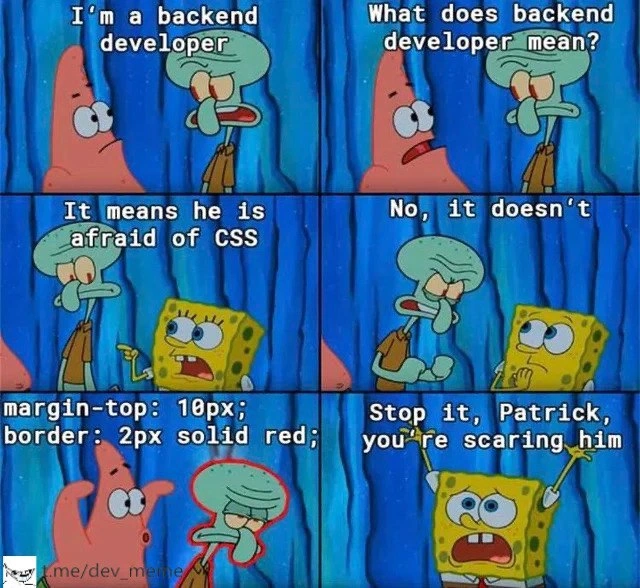
In the cartoon, Patrick scares Squidward by reading out some CSS code in a spooky way. The code he recites appears in a white monospace font (to mimic code style) and is:
margin-top: 10px;
border: 2px solid red;
Let’s demystify these CSS snippets:
margin-top: 10px;— This is a CSS declaration that adds some empty space above an element. Margin is like the outside spacing of an item. So if you had a picture or a text box on a page,margin-top: 10px;pushes it down a little, creating a 10-pixel gap above it. It’s like saying “leave a tiny buffer of space at the top.”border: 2px solid red;— This line gives the element a border. In particular, it says the border should be2px(two pixels) thick, asolidcontinuous line (not dotted or dashed), and coloredred. So imagine drawing a red rectangle outline that’s two pixels wide around your content; that’s what this style does.
These are very basic CSS styles – web developers use them all the time to do things like add spacing between items or outline sections for emphasis. In fact, if you’ve ever edited a Word document, adding space before a paragraph is analogous to margin-top, and adding a border is like drawing a box around something. Nothing scary, right? But to Squidward (our backend dev in the joke), hearing those lines of CSS spoken out loud is like hearing spooky gibberish, because he’s not used to it. It’s as if someone rattled off art-supply jargon to that engine mechanic – “Just take the fondant, do a basketweave pattern, and add some dragees” – the mechanic’s eyes might widen in confusion or concern!
The SpongeBob characters amplify this. SpongeBob and Patrick often have a playful, childlike attitude. In Panel 5, Patrick looms over Squidward and recites the code slowly, just like you might tell a scary campfire story: “margin-top: 10px; border: 2px solid red;” to spook him. Squidward’s face is circled in red, trembling, showing he’s shocked and petrified. Then SpongeBob shouts, “Stop it, Patrick, you’re scaring him!” as if Patrick just said “Boo!” or read a creepy ghost tale. The format is a six-panel cartoon sequence, a popular meme style, where each panel shows a part of the conversation progressing like a mini comic strip. By the final panel, the punchline lands: Squidward the backend dev is literally frightened by a couple of CSS declarations.
In simple tech terms, the meme is a lighthearted jab at how some developers specialize. Backend devs might be masters of coding logic but beginners with visuals, whereas frontend devs might style a beautiful page in minutes but feel lost writing a complex server script. The truth is, neither CSS nor backend logic is inherently scarier – it’s all about what you’re used to. But jokes like this resonate because many of us have felt that pinch of panic when stepping into a part of coding we’re not familiar with. If you’re a new developer, don’t worry: being “afraid” of something like CSS (or conversely, of database queries) just means you haven’t learned it yet. Everyone starts somewhere, and with a bit of practice, those once-spooky margin and border lines become friendly tools in your toolkit. This meme just makes us laugh by imagining the over-the-top worst case: a backend dev treated CSS like it’s a monster under the bed!
Level 3: Cascading Style Scares
This meme hilariously highlights the classic Backend vs Frontend divide in WebDev. It uses a six-panel SpongeBob SquarePants cartoon to caricature a common industry stereotype: backend engineers are “afraid” of CSS. In the meme, Squidward proudly declares, “I’m a backend developer.” Patrick naively asks what that means, and SpongeBob jokes, “It means he is afraid of CSS.” This punchline plays on BackendHumor – the idea that a programmer who wrangles servers, databases, and API logic might panic when confronted with something as “simple” (yet mysteriously frustrating) as CSS.
Why is this so funny to developers? Because it’s alarmingly relatable. Many seasoned backend devs will nod (or cringe) remembering times they had to fix a stylesheet and ended up in a frontend nightmare. They might be fluent in writing complex algorithms or optimizing queries, yet a humble CSS file can feel like an arcane spellbook. The meme exaggerates this dynamic perfectly: Patrick literally scares Squidward by reciting raw CSS syntax like a ghost story. The code he chants – margin-top: 10px; border: 2px solid red; – are basic CSSProperties for spacing and borders. To a front-end developer, those lines are mundane styling; to our terrified backend Squidward, they sound like eerie incantations from a forbidden language. SpongeBob jumps in with “Stop it, Patrick, you’re scaring him”, treating the CSS snippet as if it were a horror movie villain. It’s a spot-on parody of how frontend pain points can spook someone who’s never ventured beyond API endpoints and server scripts.
The humor also taps into real developer culture. In many teams, backend and frontend roles are siloed: one side handles business logic and databases, the other deals with user interfaces and style. Over time, this specialization breeds good-natured (usually 😅) teasing. Backend folks might joke that CSS stands for “Crazy Scary Stuff” in their world. They recall battles with layout quirks or CSS specificity wars that left them traumatized. Perhaps at 3 AM, a backend on-call hero once tried to patch a page’s UI and ended up yelling “Why won’t this <div> center?!” as if facing an eldritch horror. Meanwhile, frontenders chuckle because they’ve mastered those quirks (or at least have their own war stories of Internet Explorer CSS bugs). The meme encapsulates this shared understanding: it’s funny because it’s true enough – many backend devs indeed avoid touching the stylesheet if they can help it.
There’s also an element of technical irony. Cascading Style Sheets are often dismissed as “not real programming” by those who don’t understand them, yet CSS can be fiendishly complex in practice. It’s a declarative language with its own rules (the “Cascading” in CSS means style rules can override or cascade based on specificity and source order). To a backend engineer used to deterministic logic, this cascading behavior can feel unpredictable – almost like the code has a mind of its own. The meme’s choice of simple CSS (a margin and a border) is deliberate: even the most harmless-looking style can trigger irrational dread if you’ve been scarred by past CSS struggles. It’s the equivalent of a spider in the bathtub for someone with arachnophobia – harmless in reality, but terrifying if you have the fear. Here, raw CSS declarations are the spider 🕷️ for the backend dev.
From an organizational perspective, this comic exaggeration points to how specialization can create comical knowledge gaps. The industry often jokes about “Full-stack developers” who are equally comfortable in both worlds, but the truth is everyone has weak spots. When a backend specialist hears talk of pixel-perfect layouts, float vs flexbox, or centering with CSS, they might feel as uneasy as Squidward does in that last panel. The meme’s scenario is basically a tech hazing ritual: Patrick torments Squidward with CSS syntax because he knows it’s out of Squidward’s comfort zone. In real teams, you’ll sometimes see a playful version of this — e.g., a frontend dev might say “hey, can you just tweak the CSS for that button?” and watch their backend colleague break into a cold sweat or jokingly pretend to run away.
The shared trauma underlying the humor is that CSS can be deceptively tricky. Centering a simple element vertically caused years of collective frustration before modern CSS made it easier; forgetting a box-sizing or misusing a position: absolute could wreck a layout in ways that baffle an untrained eye. Many backend devs have at some point tried to style a web page and ended up muttering something like “this is witchcraft!” 🤣. So the meme resonates: it pokes fun at that knee-jerk panic. Even the specific styles in Patrick’s “scary code” – a red border and a top margin – conjure a mental image of a poorly-styled element, perhaps a dreaded “red outline” highlighting a CSS bug or a misaligned section with awkward spacing. Those little details amplify the joke: a red border in dev lore often means “something’s wrong here” (like the notorious red outline debugging trick). Patrick basically pulled out the simplest spooky props to get a scream.
In summary, this SpongeBob meme uses cartoon drama to spotlight a real-world developer comedy: the fearless backend engineer who can refactor a monolithic codebase in his sleep, yet recoils at the sight of a CSS file. It’s charming DeveloperHumor born from the truth that every techie has their boogeyman. For backend devs, it just might be a cascading sheet of styles. And for anyone who’s struggled with CSS alignment at midnight, Squidward’s wide-eyed fear is 100% relatable. Stop it, Patrick, you’re scaring him – an admonition we laugh at because we’ve either felt that fright or caused it in someone else with a well-timed <style> tag mention.
Description
A six-panel comic strip meme using characters from SpongeBob SquarePants to illustrate a common developer stereotype. In the first panel, Squidward tells Patrick, 'I'm a backend developer.' Patrick asks what that means. In the third panel, SpongeBob explains to Patrick, 'It means he is afraid of CSS,' which Squidward angrily denies. In the fifth panel, Patrick starts reciting CSS properties, 'margin-top: 10px; border: 2px solid red;', which causes Squidward to cower in fear, highlighted by a red outline. In the final panel, SpongeBob yells, 'Stop it, Patrick, you're scaring him!' The meme plays on the well-known trope that backend developers, who focus on server-side logic, are often uncomfortable with or inept at frontend styling using CSS, finding its rules and behavior frustratingly illogical compared to traditional programming
Comments
7Comment deleted
A backend dev can happily design a multi-terabyte, sharded database schema with sub-millisecond query times, but ask them to vertically align an element in CSS and they'll start talking about how the laws of physics must be different in the browser
The same architect who debugged a live split-brain in Raft will whisper “margin-top: 10px; border: 2px solid red;” and suddenly claim the CSS box model is an unsolved Byzantine fault
I've spent 15 years architecting distributed systems that handle millions of requests per second, but ask me why that div isn't centered and suddenly I'm googling "CSS flexbox vs grid 2024 please help" like it's my first day
This perfectly captures the existential dread backend engineers feel when asked to 'just center this div real quick' - because while they can architect distributed systems handling millions of transactions, CSS box model behavior remains the true unsolved mystery of computer science
CSS: where margin-top collapses until you add a 2px red debug border and the whole layout reflows - frontend Heisenbug
We ship consensus across five regions without blinking - show us a collapsed margin and we start drafting a Padding‑as‑a‑Service RFC
Backend devs tame distributed systems, but one rogue CSS margin collapse sends them into fullstack denial