The God Complex vs. Debugging Reality in Programming
Why is this Learning meme funny?
Level 1: No Magic Wand
Imagine you have a big box of LEGO bricks and you’re super excited to build the coolest castle ever. In your mind, it seems easy – you almost feel like you could just wave a magic wand or snap your fingers and poof! the castle would appear, perfectly built. That’s the expectation. But then you actually start trying to build it. Very quickly, things get tricky. Pieces don’t fit right, or the instructions are confusing. The castle keeps falling apart, and you get stuck fixing the same wall over and over. Hours later, you’re still sitting there, tired and frustrated, with a half-built, wobbly castle. That’s the reality. The joke in the meme is just like that. When people start learning to code, they expect it to be like having a magical power to create anything instantly (easy and fun). But when they really do it, they find out it’s harder and takes a lot more time and effort (sometimes it feels like you’re working on it “for 30 hours!”). It’s funny because everyone knows the feeling of thinking something will be a piece of cake and then discovering it’s actually a tough, draining task. This meme uses a superhero story way of saying it: at first you feel all-powerful, and later you feel totally worn out. The big difference between those two feelings is exactly why we laugh – we’ve all been in a situation where reality turned out to be much harder than we thought, and seeing it captured in a picture like this is both true and hilarious.
Level 2: Debugging 101
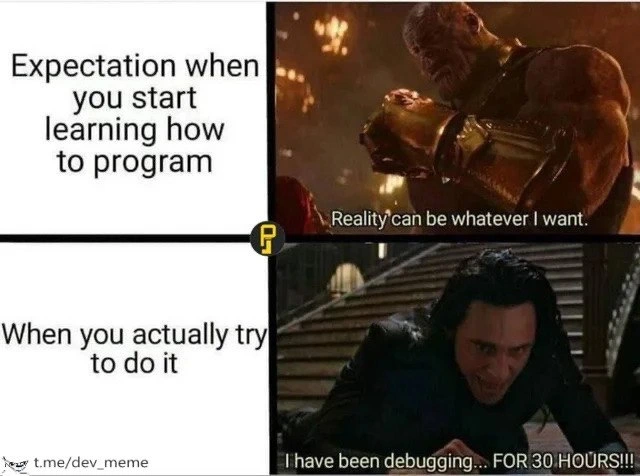
This meme shows a funny expectation vs. reality comparison that many new programmers can relate to. In the top part (the “expectation”), there’s text that says “Expectation when you start learning how to program.” Next to it is an image of Thanos from Marvel’s Avengers. Thanos is wearing his famous Infinity Gauntlet – a powerful glove that, in the movies, lets him control reality and do almost anything he wants. A subtitle on that image shows Thanos saying, “Reality can be whatever I want.” This represents how beginners often feel when they just start coding: super excited and confident. It’s like thinking, “Wow, I have this amazing power now. I can make the computer do whatever I imagine!” The Infinity Gauntlet is a perfect symbol for that feeling of unlimited power, because with it Thanos literally believes he can reshape reality. Similarly, a person new to coding might believe they can easily create any program or game they dream up.
Now, the bottom part of the meme (the “reality”) has text that reads “When you actually try to do it.” The image below that text shows a character (it’s actually Loki from the Marvel movies) looking completely exhausted and beaten down, sitting on steps in the rain. His face is blurred out, but you can tell he’s not having a good time. The caption on this image says, “I have been debugging... FOR 30 HOURS!!!” — with three exclamation points to really stress it. This scene is the opposite of the top panel’s mood. It represents what often happens when you actually sit down to write a real program as a beginner: you run into problems and spend a ton of time trying to fix them. The word “debugging” here is key. In programming, debugging means finding and fixing errors in your code. Those errors are fondly (or not so fondly) called “bugs.” So when the caption says “I have been debugging for 30 hours,” it’s a comical way to say “I’ve been trying to fix my code forever and it’s still not working!” Thirty hours is an exaggeration (most people would take a break long before that), but it emphasizes that it feels like forever when you can’t solve a programming issue.
So, taken together, the meme is highlighting the difference between what newcomers expect from coding and what it’s actually like. The expectation is that programming will be straightforward and almost magical – you think you’ll just write some code and instantly have a working app or game (that’s the Thanos mindset: “reality can be whatever I want”). The reality, however, is that programming is challenging and requires a lot of patience. In reality, your first projects might not go smoothly at all. You’ll write code and then run it, and often you won’t get the result you expected. Instead, you might get errors or the program doesn’t do what it’s supposed to do. Then you have to figure out what went wrong – that’s debugging.
For example, maybe you forgot a tiny detail like a semicolon at the end of a line, or you made a typo in a variable name. The computer doesn’t understand what you wanted; it only sees what you actually typed. So it might crash or give you a weird output. As a beginner, finding that one little mistake can take a long time because you’re not sure where to look. It can definitely feel frustrating. There’s even a jokey phrase developers use for this scenario: “debugging hell.” That’s not a technical term, just slang for the experience of being stuck for a very long time trying to fix a nasty bug. The bottom image with the person saying they’ve been debugging for 30 hours is showing someone deep in debugging hell. He’s drenched (maybe from the rain, or symbolically from sweat and tears!), which dramatizes how rough that experience is.
The meme’s humor comes from exaggerating this common experience. Obviously, not every coding problem will have you at it for 30 hours straight in a rainstorm 😅. But every programmer remembers the first time they hit a problem they just couldn’t solve for ages. Maybe you spend an entire weekend on a project that you thought would only take an hour, all because of one tricky bug. It’s a shocking lesson: coding isn’t as easy as just telling the computer what to do – you have to think carefully and you will make mistakes. The meme prepares you (in a lighthearted way) for that reality. It’s saying: learning to code can be awesome and empowering, but it also comes with moments of hair-pulling frustration when things don’t work. And that’s completely normal! Every developer, especially when starting out, goes through this phase. The good part is that debugging, while frustrating, is how you learn. With each mistake and fix, you understand the code a bit better. So, the next time you start a project with big hopes (feeling like Thanos) and then find yourself stuck debugging, remember this meme. It’s a funny reminder that you’re not alone and that this tough part is just part of the journey from newbie to experienced coder.
Level 3: The Debugging Gauntlet
This meme uses Marvel characters to hilariously illustrate the Expectation vs Reality of learning programming. In the top panel, we see Thanos wielding the all-powerful Infinity Gauntlet and proclaiming, “Reality can be whatever I want.” For a newbie coder, that line perfectly captures the initial mindset: you feel like with code, you’ll have god-like control to create anything. It’s that rush of omnipotence when you first get a program to work — as if programming is your personal Reality Stone letting you bend computers to your will.
But the bottom panel snaps us back to, well, reality. It shows a drenched, defeated figure on stone steps (it’s actually Marvel’s Loki in a very bad moment) exclaiming, “I have been debugging... FOR 30 HOURS!!!” 😫. This dramatic caption is a tongue-in-cheek exaggeration of DebuggingFrustration. It even riffs on a famous Loki quote (“I have been falling for 30 minutes!”) to emphasize how endless those hours of debugging feel. The contrast is extreme: one moment you’re an all-powerful titan in control, and the next you’re a soaked, exhausted developer who’s been wrestling a single bug for an eternity.
Every experienced developer sees this and nods knowingly. The meme nails a rite of passage in the Learning to Code journey. We all started out thinking we’d build our dream project in a snap — just write some code and boom, app finished! — only to slam into the harsh truth that most of our time is actually spent finding and fixing errors. In software development, writing code is just the beginning; making that code work correctly is the real challenge. There’s an old joke: “The first 90% of the code accounts for the first 90% of the development time. The remaining 10% of the code accounts for the other 90% of the time.” 🙃 In other words, that last stretch (testing and debugging) often takes more time than you ever imagined, and newbies usually aren’t prepared for that. This meme is funny because it’s true: it highlights the huge gap between a developer’s expectations and the actual reality of building software.
Why does this gap happen? A big reason is that computers are extremely literal. Beginners might think coding is like telling a smart genie what to do, but it’s more like giving instructions to a very picky robot. The computer will do exactly what you tell it to do, not necessarily what you meant. That discrepancy is where bugs thrive. Missing one semicolon, using a wrong comparison operator, or misplacing a single logic check can crash your program or produce bizarre results. Finding that one tiny mistake can feel like searching for an Infinity Stone in a cosmic haystack. We’ve all had that one bug that kept us up all night. You change one thing, run the program, still broken. Change something else, run again, still broken. Hour 10 rolls by and you’re questioning your life choices. Hour 30 (if it ever gets that far) is comedic exaggeration, but in the moment it does feel endless! The meme isn’t really saying people literally debug for 30 hours straight on the regular; it’s dramatizing that feeling of a never-ending battle with a stubborn bug.
The top panel’s boast, “Reality can be whatever I want,” perfectly captures the DeveloperExpectationsVsReality theme: the expectation is total creative control through code. The bottom panel’s cry, “I have been debugging... FOR 30 HOURS!!!”, shows reality reminding you who’s boss. The visual difference — bright, triumphant Thanos vs. dark, rain-soaked Loki — is basically how it feels going from coding in theory to coding in practice. It’s a classic case of Developer Humor: taking a painfully familiar situation and exaggerating it to laugh it off. (After all, if we didn’t laugh about that 30-hour bug, we might cry!) Here’s the core comparison the meme is making:
| Expectation (new coder excitement) | Reality (actual coding grind) |
|---|---|
| “I’ll just write some code and build anything I imagine, easy!” (Thanos-level confidence) |
“Why is nothing working?! I’ve tried everything!” (hours into debugging, barely holding on) |
| Feeling like an omnipotent tech wizard with an Infinity Gauntlet of code. | Feeling like you’re trapped in debugging hell, fighting an endless battle against an invisible bug. |
| “Look, reality can be whatever I want (I control the computer)!” | “I have been debugging... FOR 30 HOURS!!!” (Reality hits hard when a simple program won’t work.) |
Seasoned developers chuckle at this meme because we’ve all lived through that humbling transition. It’s funny now, but it wasn’t funny at the time when we were that soaked, miserable coder! This kind of exaggeration is textbook CodingHumor — turning a real struggle (hunting a bug) into a ridiculous overstatement (30 hours in despair) so we can collectively laugh at our past pain. The meme perfectly captures the moment a beginner’s bubble bursts. But it also carries a bit of wisdom: debugging is a huge part of programming. That slog, as painful as it can be, is where you truly learn how code works. After each “gauntlet” of debugging, you emerge with new skills and insight. So in a way, the journey from feeling like Thanos to feeling like defeated Loki is one every developer must go through to earn their stripes. The humor makes it memorable: in programming, reality (how the code actually runs) often refuses to match our expectations on the first try. Or put in coder terms, reality != expectation in software development — and that’s why we end up debugging so much!
Description
A two-by-two panel meme contrasting the expectations of learning to program with the reality. The top-left panel contains the text 'Expectation when you start learning how to program'. Adjacent to it, the top-right panel shows the Marvel character Thanos, holding the Infinity Gauntlet, with the subtitle 'Reality can be whatever I want.', suggesting a feeling of ultimate power. The bottom-left panel has the text 'When you actually try to do it'. The bottom-right panel shows another Marvel character, Loki, lying defeated on the ground in a state of distress, with the subtitle 'I have been debugging... FOR 30 HOURS!!!'. This meme hilariously captures the disillusionment many new programmers face. They begin with the idea that they will be able to create anything they can imagine, only to spend the vast majority of their time on the frustrating and lengthy process of debugging unexpected errors

Comments
7Comment deleted
Learning to code is the only time you can go from feeling like a god who can manipulate the fabric of reality to a desperate prisoner trapped in a time loop by a missing semicolon, all in the span of five minutes
Architect plan: “We’ll wield Kubernetes like the Infinity Gauntlet.” Reality: 30-hour marathon chasing a prod-only memory leak that vanishes faster than half the universe every time you attach gdb
The same junior who thought they could reshape reality with code is now explaining to their tech lead why a missing semicolon in a webpack config cascaded into corrupting the entire CI/CD pipeline and somehow triggered a Kubernetes autoscaling event that maxed out the AWS bill
The transition from 'Reality can be whatever I want' to debugging for 30 hours perfectly captures every developer's journey from reading 'Hello World' tutorials to discovering that semicolons, off-by-one errors, and race conditions are the true infinity stones of software development. The real superpower isn't bending reality - it's maintaining sanity while your IDE insists the bug is on line 47 when you only have 46 lines of code
Expectation: the Reality Stone; reality: grep and trace IDs across microservices, plus 30 hours negotiating with a Heisenbug that refuses to reproduce
Everyone starts believing they’ll Thanos‑snap features; the real gauntlet is a 30‑hour git bisect across five microservices to chase a DST‑induced heisenbug hiding behind a stale feature flag
Thanos snaps half the universe away; we rebase for 30 hours just to resurrect the other half