Skip to content
DevMeme
1329 of 7435
The Escalating Horrors of C++ Dependencies
Languages Post #1488, on May 4, 2020 in TG

The Escalating Horrors of C++ Dependencies

Why is this Languages meme funny?

Level 1: When a Boo Grows Up

Imagine you’re playing a game of surprise. First, your little friend jumps out and goes “Boo!” – but they’re so small and polite about it that it’s not scary at all. You maybe even giggle because the tiny ghost is more cute than frightening. That’s the first boo. Now, picture a whole crowd of people suddenly shouting “BOO!” at someone – like in a movie when an audience doesn’t like a show. That’s a lot louder and a bit mean, right? It’s definitely scarier than the little “boo” from before. We’ve gone from a tiny cute scare to a big group scare.

Now for the last part: instead of just a shout, imagine someone hands you a giant heavy book of magic spells called “The Big Book of BOO-St.” This book is so huge and complicated that just holding it is scary! You open it and it’s filled with thousands of pages of spooky gibberish. That’s what the meme is doing: it starts with a tiny ghost saying boo (not scary), then a bunch of people booing (more scary), and ends with something called Boost – which for computer programmers is like that giant magic book that’s powerful but super complicated. It’s the biggest “boo” of all, the kind that makes the person hearing it go “yikes!”

So, in everyday terms: the meme is funny because it’s like a little harmless ghost grew up into a huge scary monster, but in a nerdy way. The first “boo” is nothing to fear, but by the time it turns into Boost, even the bravest coder might scream and run away (or at least groan and laugh). It’s a playful way to say some problems start simple and then become really over-the-top and frightening – and that makes us laugh because we’ve all seen little things get way too complicated before.

Level 2: From Ghost to Boost

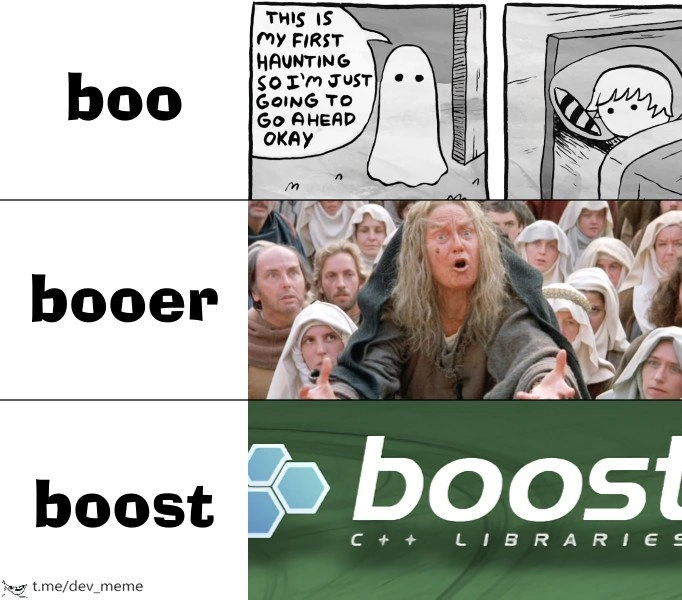
Alright, let’s unpack this meme in simpler terms. It’s comparing three things side-by-side – “boo”, “booer”, and “boost” – and each one gets a picture. The joke relies on how those words sound alike, but each one is a step up in intensity (and one becomes a tech reference). Here’s what each panel actually means:

  • Boo: This is the classic ghost sound “boo!” In the meme, it’s written in bold on the left, and the image on the right is a cute little cartoon ghost saying, “This is my first haunting so I’m just going to go ahead okay.” The ghost is very polite and not scary at all. This sets up the idea of something small or harmless. In a coding context, think of “boo” as a tiny simple program or a first attempt at something. No big complicated stuff, just a basic try. It’s like when you write your first “Hello World” in a language – simple and maybe a bit awkward, but it works. Nothing to be afraid of here.

  • Booer: Now we add “er” to “boo” – usually, adding “-er” can mean a person who does something (a runner, builder, etc.) or a comparative form (like tall vs taller). The meme plays on both. The label says “booer,” which literally means “someone who boos.” The picture is a scene with a bunch of medieval-looking people, and one crazy-looking older lady is front and center, clearly yelling “Boo!” with a thumbs-down kind of vibe. If you’ve ever seen a movie where a crowd boos a bad performer, you get the idea. This part of the meme is showing a much louder, more intense “boo.” It’s not friendly or timid – it’s disapproving. In developer terms, imagine you wrote that simple program (the ghost’s “boo”), and then the booer is like your senior colleague or a code reviewer going “Boo! Not good enough!” 😆. It represents a step up in “scariness” or intensity. It’s basically saying: the situation just escalated – we went from a tiny ghost to an angry crowd booing.

  • Boost: Now comes the big twist for techies. Instead of “booest” (which would be the grammatical superlative of boo, like the most boo or scariest boo), the meme uses Boost. Boost is a proper noun here – specifically the Boost C++ Libraries. The image shows the Boost logo (green background, hexagonal icons, and “boost C++ libraries” text). If you’re not a C++ programmer, this might be unfamiliar, but trust me, to C++ folks, Boost is a huge deal. It’s a collection of libraries that you can add to your C++ projects to get a ton of extra functionality. Sounds great, right? The catch is that Boost is famously large and complex. It’s known for long compile times and sometimes tricky setup. Many C++ developers have a love-hate relationship with it: they love what it can do (like provide ready-made solutions for networking, filesystems, smart pointers, etc., especially before those were in the standard library), but they hate how heavy it can make their project. Including Boost can feel like dragging in a whole haunted house of code just to do one little thing. 🎃

So why is “boost” the punchline of the meme? Because it’s spelling-wise just adding “st” to “boo”, and conceptually it’s like taking the scariness to the max for a coder. For a normal person, a ghost going “boo” is the scary thing. For a C++ developer, a ghost is nothing – what really scares them is seeing Boost added to their project (jokingly, of course). It means “uh oh, now our code is going to get complicated or slow to compile.” It’s a bit of DeveloperHumor where the fear is about managing huge dependencies rather than ghosts.

The caption “Things getting scarier. Right, single language devs?” is nudging those who stick to one programming language (like only C++). It implies: if you don’t diversify, you’ll end up escalating your one language into craziness – e.g., solving every problem in C++ until you’re pulling in Boost (the heaviest solution) and scaring yourself. Many polyglot (multi-language) developers might avoid that by switching to a simpler language for some tasks. For example, instead of using a massive C++ library to parse a file, a developer might write a quick Python script. But a single-language dev sticking to C++ will try to do it all in C++... and often that means using Boost to avoid reinventing the wheel. Hence, “things getting scarier” – the situation escalates from a tiny ghost “boo” (small simple solution) to a full-blown Boost dependency (big complex solution) because you never left that one language.

Let’s connect this to DependencyManagement basics: In any language, a dependency is just external code or library you bring into your project to use its functionality. Boost is one of the biggest ones for C++. It’s practically a giant grab-bag of libraries (sort of like a Swiss Army chainsaw 😅). Adding Boost can solve your problem, but now you have to manage that dependency (make sure it’s installed, your build knows about it, etc.). “Dependency hell” is a phrase devs use when managing lots of libraries becomes a headache – conflicting versions, big size, complex setup, you name it. Boost is sometimes jokingly associated with that because it’s such a large dependency.

In simpler terms, the meme is funny because it uses a wordplay (boo → booer → boost) and mixes a Halloween-ish scare with a developer scare. It starts cute and ends with an inside joke for programmers. If you’re a junior dev, the takeaway is: Boost is a mighty C++ library collection that folks both admire and fear. And the meme jokes that hearing “boo!” from a ghost isn’t half as scary as hearing “we need to use Boost” in a C++ project. It’s a playful jab at how complicated C++ can get.

Level 3: Ghost in the Library

At first glance, this meme mashes up grammar humor with a punchline only a C++ programmer would fear. It’s structured like a comparison chart: boo, booer, boost – mimicking how English adjectives form comparative (-er) and superlative (-est) forms. But here the innocent little “boo” (a ghost’s scare sound) morphs into Boost, the notorious C++ mega-library that haunts compile times. The humor escalates a haunting into a heavyweight dependency. C++ developers immediately recognize Boost as a powerful but spooky sprawling collection of libraries often blamed for turning simple builds into marathon sessions. This meme pokes fun at how something that starts as harmless (like a tiny ghost going “boo”) can grow into a dependency hell in the world of programming languages.

Let’s break down why this resonates with seasoned devs:

  • Morphing “boo” into “boost”: It’s a clever boo_vs_boost_pun. In grammar, we’d go from “boo” to “booer” (comparative or “one who boos”) to “booest” (superlative “scariest” if it were a real word). Instead, the meme substitutes Boost (spelled boo + st) as the final form. This twist works because Boost C++ Libraries are famously the ultimate form of “boo” for C++ devs – not a ghostly scare, but a technical one. It’s the LanguageWars inside joke: one minute you’re dealing with a simple boo (maybe a small program or a standard library feature), and the next you’re facing Boost, which for many is scarier than any ghost.

  • Boo (Panel 1): On the left it simply says “boo.” On the right is a cute comic ghost politely saying, “This is my first haunting so I’m just going to go ahead okay.” The ghost is clearly harmless and nervous – a perfect analog to a novice developer writing their first simple program. It might not scare anyone; it might not even work on the first try, but gosh is it earnest. In programming terms, this could be like writing a tiny C++ program with just #include <iostream> – a small, innocent start. No heavy dependencies, nothing fancy, just a basic “Hello World” or “boo” output. The ghost’s timid line is comedic on its own, but in context it sets the baseline: not scary at all. Seasoned devs chuckle because they remember their first timid steps in code (and maybe how unscary those “hauntings” were compared to what came later).

  • Booer (Panel 2): Now the left label says “booer” – implying a step up. The image shows a medieval crowd scene with a wild-eyed grey-haired figure emphatically booing (if you’ve seen Monty Python or The Princess Bride, you know the kind of scene – an old woman shouting “Boo! Boo!” at the top of her lungs). This represents a comparative level of boo: louder, more intense, and coming from a crowd of critics. For a developer, this stage could symbolize code reviewers or senior engineers reacting to that naive first attempt: “Boo! Is that all you’ve got?” 🗯️ It’s the feeling of a simple solution being heckled as too naive or not performant enough. The booer could also be interpreted as the compiler or runtime errors “booing” the newbie’s code (“It compiles on my machine” – BOO! – “not on mine!”). In any case, things are getting scarier. The harmless ghost-boo has evolved: now there’s pushback, complexity, maybe negativity. At this point, an experienced C++ dev in the audience knows where this is heading… because the ultimate answer in C++ for “not powerful enough” often used to be: bring in Boost.

  • Boost (Panel 3): Finally, we hit “boost” – with the official Boost C++ Libraries logo on the right. For the uninitiated, Boost is a legendary collection of peer-reviewed C++ libraries that extends the capabilities of C++ well beyond the standard library. It’s the heavyweight dependency many C++ projects pull in when they need extra functionality. Why is this scary? Well, Boost has a reputation: it’s huge (dozens of libraries from smart pointers to JSON parsing), often template-heavy, sometimes tricky to compile, and infamous for long compile times. In short, it’s a beast. Many C++ devs have war stories of adding a single Boost header and watching their build times go from seconds to minutes. Boost can feel like unleashing a monster in your codebase – incredibly powerful but potentially overwhelming. The meme’s joke is that a simple “boo” escalated into Boost – the kind of thing that can indeed haunt build servers and developer sleep schedules.

The phrase “heavyweight C++ dependency” in the title nails it: Boost is powerful but can weigh down your project like an anchor (or a ghost chain rattling 👻). It sits at the intersection of Languages and Dependencies – highlighting a classic DependencyManagement dilemma: do you pull in a massive library to solve your problem quickly, or avoid it to keep your build lean? The meme winks at single-language devs, “Things getting scarier. Right, single language devs?” – because if C++ is all you’ve got in your toolbox, you might end up summoning Boost to accomplish tasks that other languages might handle with lighter tools. This is a sly nod to LanguageWars: for example, a Python dev might say, “Parsing JSON is built-in/easy for me,” whereas a C++ dev might groan “Alright... I’ll Boost it,” then endure the arcane incantations of boost::property_tree or similar. 😅

There’s also an industry history buried in this joke. Boost emerged in the late 1990s when C++ lacked many modern conveniences. Before C++11, there was no std::shared_ptr, no std::regex, no threading library – Boost filled those gaps. It was the place where cutting-edge C++ libraries were developed and tested; many eventually made it into the C++ Standard Library (Boost is literally where new CPlusPlusStandardLibrary features are born). That means older codebases or very ambitious projects leaned heavily on Boost for essentials. Over time, Boost became a jack-of-all-trades – a bit like that ancient grimoire full of spells: extremely useful, but written in a language only wizards fully understand. So the meme captures a truth: a simple idea can snowball into a complex solution in C++ world. A newcomer says “boo” (writes a trivial solution). Experienced devs boo it (needs to handle more cases, more performance, more whatever). The final answer might be “Fine, we’ll use Boost,” pulling in hundreds of thousands of lines of template code – Boost is the “boo-est” (scariest) form of “boo” imaginable for the codebase.

Why is this funny (and painfully true) for senior developers? Because we’ve lived it:

  • Seeing a one-line problem turn into a Boost dependency that bloats the project.
  • The shared trauma of linking issues like “undefined reference in boost::filesystem” or mysterious template errors spanning 20 screens of compiler output. (Nothing says horror to a C++ dev like a template error that reads like eldritch hieroglyphs.)
  • Jokes in dev circles like “I’m gonna Boost it… hold my compile” or “Boost: when you want your simple task to take 5 hours to compile.” It’s DeveloperHumor born from real pain.
  • The gap between ideal and reality: Ideally, you write clean, minimal code. In reality, a deadline looms and someone pastes in Boost because it has a ready-made solution – and now your DependencyHell has a new resident.

In summary, Level 3 reveals the in-joke: C++’s Boost library is a double-edged sword – an incredibly powerful toolkit that many devs find as scary as a ghost in the machine. The meme masterfully escalates boo → booer → Boost, turning a simple scare into a punchline about heavy dependencies and the spooky side of C++ development. It’s a high-level laugh that acknowledges both the linguistic play and the technical reality behind that final green Boost logo: here be dragons (and long link times). 🐲👻

Description

A three-panel meme format escalating in scariness. The first panel, labeled "boo," shows a timid cartoon ghost on its first haunting mission, saying, "THIS IS MY FIRST HAUNTING SO I'M JUST GOING TO GO AHEAD OKAY". The second panel, labeled "booer," depicts an angry mob booing, a scene from the movie Monty Python and the Holy Grail. The final and most climactic panel, labeled "boost," displays the logo for the Boost C++ Libraries. This meme humorously portrays the Boost libraries as the most terrifying thing a developer can encounter, far scarier than ghosts or angry crowds. The joke resonates with C++ developers who have grappled with Boost's complexity, heavy use of templates, and steep learning curve. It contrasts a simple scare with the very real technical intimidation that a massive, powerful, and intricate library can induce. The watermark "t.me/dev_meme" is visible in the bottom left corner

Comments

7
Anonymous ★ Top Pick Some say the scariest thing in C++ is manual memory management. The truly initiated know it's trying to decipher a Boost template compilation error that's longer than the entire file
  1. Anonymous ★ Top Pick

    Some say the scariest thing in C++ is manual memory management. The truly initiated know it's trying to decipher a Boost template compilation error that's longer than the entire file

  2. Anonymous

    “Boo” is a jump scare; “booer” is crowd noise; “Boost::Spirit recursively instantiating 10,000 templates while the linker starts chanting in Latin - that’s how you raise the dead build times

  3. Anonymous

    The real horror isn't the ghost or the angry mob - it's explaining to your team why the build takes 45 minutes after adding one Boost header, and why the template error message is longer than your entire codebase combined

  4. Anonymous

    Boost: where 'boo' goes from a friendly ghost's first day on the job to a compile-time template instantiation error spanning 47 screens that makes medieval villagers look calm by comparison. It's the library that turns 'Hello World' into 'Hello, 6-hour compile time and a PhD in template metaprogramming.' But hey, at least your smart pointers are *really* smart now

  5. Anonymous

    Boost: the lib that turns one innocent header include into a recursive template apocalypse scarier than any Halloween boo-st

  6. Anonymous

    Every C++ feature request starts as a tiny “boo” - then someone says “just use Boost,” and your build spends 20 minutes summoning b2, ABI goblins, and two competing optionals

  7. Anonymous

    C++ escalation: boo → boos → Boost - then the linker chants undefined reference to boost::system::generic_category() like an ABI seance

Use J and K for navigation