Skip to content
DevMeme
1328 of 7435
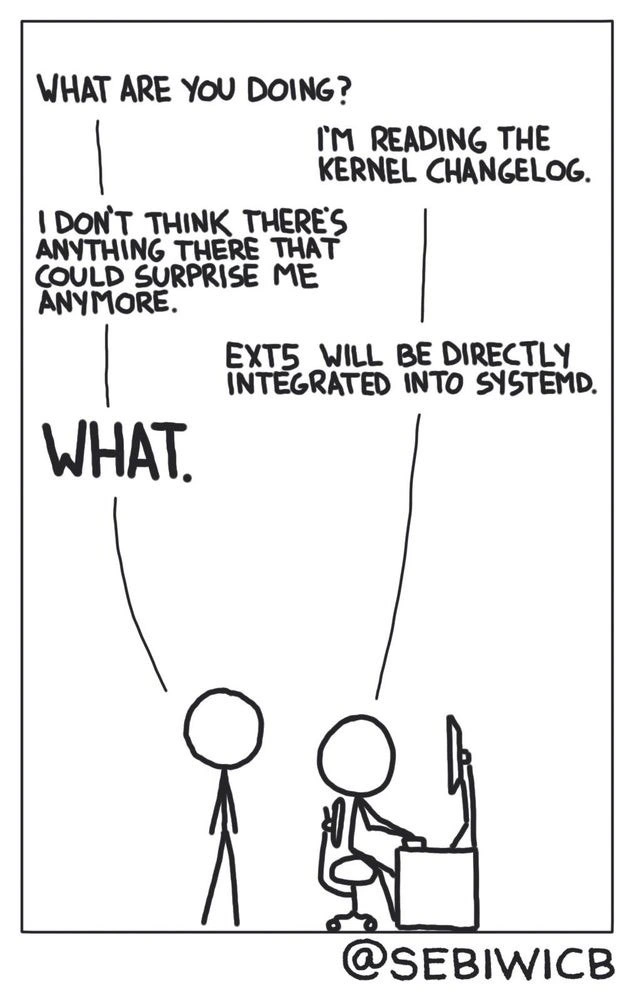
Systemd's Final Form: The Filesystem
OperatingSystems Post #1487, on May 4, 2020 in TG

Systemd's Final Form: The Filesystem

Why is this OperatingSystems meme funny?

Level 1: Kitchen Surprise

Imagine a master chef who’s been cooking for decades and thinks nothing in the kitchen can surprise him anymore. He’s seen every odd gadget and crazy recipe out there. Then one day, his assistant says, “Hey, check this out: the new oven model will also double as a refrigerator in one unit!” The chef would freeze for a moment, ladle in hand, and blurt out, “WHAT?!” in total disbelief. It’s the same kind of out-of-nowhere surprise and humor – mixing two things that just don’t usually go together – that makes this joke funny, even to the most seasoned experts.

Level 2: File System Bombshell

Let’s break down the elements in simpler terms. First, the Linux kernel is the core of the operating system – it talks to the hardware and manages fundamental resources. One of the kernel’s jobs is handling file systems. A file system like EXT4 (Fourth Extended Filesystem) defines how files and folders are organized on a disk. It decides how data is stored and retrieved – using structures like directories, inodes (unique file IDs), and journals (which help recover from crashes). EXT4 is widely used in Linux today. EXT5, as mentioned here, would logically be the next updated version in that series – think of it as a future improvement on ext4, possibly with new features or better performance (note: ext5 doesn’t actually exist yet, it’s a hypothetical “what-if” in this joke).

Now, systemd is something entirely different: it’s the modern init system for most Linux distributions. “Init system” means the program that boots up the user space. When you power on a Linux machine, the kernel loads first, then it starts PID 1, which is systemd on many systems. Systemd’s job is to launch all the background services and keep them running. For example, it starts your network manager, print service, web server, GUI login screen, and so on, according to a set of instructions (called unit files). It basically babysits all the processes that should run automatically. Systemd replaced an older approach (SysV init, which used simple scripts) and brought a bunch of integrated tools along with it (for logging, scheduling tasks, device management, etc., collectively referred to as systemd services like systemd-journald for logs or systemd-networkd for network setup).

Here’s the key point: the file system (ext4/ext5) and the init system (systemd) usually don’t overlap in their implementation. The init system might use the file system – for instance, systemd will read configuration files from disk (which sits on ext4) and it will ask the kernel to mount drives at boot – but systemd doesn’t contain the code that knows how to read/write the ext4 format. That job stays inside the kernel. The kernel changelog is basically the release notes that accompany a new Linux kernel version. It lists new features or big changes, like “added support for X hardware” or “improved scheduler for better performance.” If someone reading that changelog sees a line saying “EXT5 will be directly integrated into systemd,” it sounds like they are saying this new file system ext5 won’t just be a normal part of the kernel; instead, it’s going to be built into the systemd program itself.

For a systems administrator or developer, that idea is a huge surprise. It’s like hearing that a new car model will have its tires built directly into the steering wheel – combining two parts that are normally separate. In a computer, the file system is one component and the init system is another, and they communicate but don’t live within one another. So the reaction in the comic (“WHAT.”) is basically a moment of shock and disbelief. The standing character confidently said “nothing in there could surprise me anymore” because kernel change logs can be a bit dry or routine after you’ve read enough of them. But then this wild announcement comes up, and it completely catches them off guard.

The reason it’s funny is because it’s so unexpected. Normally, if a new file system were introduced (ext5, for example), you’d expect it to be an optional feature you could enable in the kernel, not something tied into how the system boots or the service manager. Systemd is already a critical piece of the OS (since if it crashes or misbehaves, your whole system can be in trouble), and a file system is critical in another way (it holds all your data). Keeping them separate has always been the norm for safety and simplicity. So merging them feels absurd. It would mean one program (systemd) is doing the job of both managing processes and managing how files are stored on disk. Even if you’re new to this, you can sense why that’s unusual: it’s putting a lot of eggs in one basket.

Finally, consider the tone: this comic panel exaggerates things for humor. Tech humor often takes a real concern or debate and blows it up a bit. Systemd really has taken on many roles over time (people joke about it being “jack of all trades” in the OS), and some seasoned admins genuinely roll their eyes at each new thing it adopts. The idea of it encompassing even the disk filesystem is a comedic stretch of that trend. So when the veteran stick-figure shouts “WHAT”, it’s both relatable and funny – even if you don’t get all the deep Linux history, you understand that a major unexpected change was announced and it left an expert speechless. That’s the crux of this joke: even the know-it-all guru got surprised by something truly off-the-wall.

Level 3: The Monolith Strikes Back

This meme hits home for experienced Linux folks by poking fun at systemd’s notorious habit of absorbing more and more responsibilities. The comic’s scenario shows a jaded sysadmin reading the Linux kernel changelog – something they do regularly – and claiming, “I don’t think there’s anything there that could surprise me anymore.” That confidence is immediately shattered by the absurd entry: “EXT5 will be directly integrated into systemd.” The veteran’s incredulous “WHAT.” is the punchline, underscoring just how outlandish that sounds even to someone who’s seen every crazy update in the book.

Why is this so hilarious (or horrifying) to a senior dev or admin? It riffs on the ongoing monolithic vs modular debate around systemd. Systemd started as a replacement for the traditional init system, but over the years it hasn’t stopped at just booting the machine. It has relentlessly expanded its scope, bundling in components that used to be independent:

  • Device management – absorbed udev (handling hardware events and device nodes).
  • Logging – introduced systemd-journald to supplant classic plaintext system logs.
  • Networking – includes systemd-networkd for network config and even a DNS resolver systemd-resolved.
  • Scheduled tasks – implements timer units, muscling in on cron’s job scheduling turf.
  • User management – even experiments like systemd-homed to manage user accounts and home directories.

In other words, systemd has become a one-stop shop for core system functions. This is convenient in some ways (with unified configuration, parallel startup, and tight integration), but it’s also sparked fierce backlash. Old-school Unix admins value the “small tools working together” approach – you can swap out or tweak one component without dragging down the whole system. Systemd’s approach is more “one ring to rule them all,” which feels like a single point of failure and a betrayal of Unix minimalism. Jokes have flown around for years like, “systemd is eventually going to manage everything on Linux... give it time and it might even make your coffee.”

Against that backdrop, the idea that EXT5 (the hypothetical next-gen Linux file system after ext4) would be baked into systemd is like the final frontier of scope creep. File systems have been one of the few domains untouched by systemd’s hands – they’re typically part of the kernel, developed and maintained somewhat separately from user-space init concerns. So hearing a line that ext5 will live inside systemd is akin to spotting Bigfoot riding a unicorn: an extreme, eyebrow-raising surprise engineered to jolt even the most world-weary sysadmin. It’s a tongue-in-cheek exaggeration built on a kernel of truth (systemd’s ever-growing scope) taken to an absurd extreme.

Seasoned sysadmins find this both funny and a bit too real because it echoes their water-cooler jokes and nightmares. These are folks who have spent late nights wrestling with systemd service configurations and debugging strange startup issues. Many recall the community flame wars when major Linux distros adopted systemd – some saw it as inevitable progress, others were so opposed they forked entire distributions (looking at you, Devuan) to avoid it. Now imagine the reactions if an official source actually announced “ext5 is now inside systemd”; there’d be pandemonium on the forums. The comic captures that exact shocked disbelief. The stick figure who thought they were beyond surprise represents those gruff veterans who’ve lived through every bizarre update and deprecation. This news makes them do a double-take and yell “WHAT” so loudly you can practically hear their astonishment echoing.

In short, the meme cleverly exaggerates Linux’s internal culture clash and architecture debates for comedic effect. It blends OperatingSystems lore with SystemsAdministration headaches and a dash of SystemsProgramming absurdity. It lands so well because it’s just plausible enough in spirit – systemd has spread into so many areas – that the notion of it swallowing the file system too makes Linux old-timers laugh, then shudder, then laugh again. It’s a way of saying, “Well, now I’ve truly seen everything!”

Level 4: Borg-Level Integration

At the deepest level, this scenario upends fundamental operating system design principles by blurring the boundary between user-space and kernel-space responsibilities. In classical architecture, the Linux kernel itself implements file systems (like the ext family) for efficiency and reliability, while the init system (now typically systemd) runs in user space to orchestrate boot and services. The idea of fusing a new file system EXT5 directly into systemd crosses a line that even grizzled OS architects would raise an eyebrow at. It’s a Borg-like assimilation of functionality: systemd absorbing yet another component of the system into its collective.

Such an integration is practically sacrilegious from a separation-of-concerns viewpoint. File systems are low-level beasts managing how data is stored on disk — handling inodes, block allocation, caching, and journaling for crash recovery and consistency. They normally live in the kernel, close to the metal, where they can efficiently schedule I/O and maintain integrity (for example, EXT4’s journaling writes critical metadata twice to guard against corruption). Systemd, on the other hand, is PID 1 in userland – the first process started at boot – responsible for launching and supervising all other processes. If EXT5’s code were grafted into systemd, it implies a single user-space process would now be partially responsible for core filesystem mechanics. That is like plugging a high-performance engine into a family sedan’s onboard computer; sure, it might run, but you’d worry about the RPMs redlining and the whole car shaking apart.

From an academic perspective, this merges policy and mechanism in a way few would attempt. Microkernel enthusiasts might note that some OS designs (like GNU Hurd or MINIX) run file systems as user-space servers – but crucially, those are separate dedicated processes, not lumped into the init system itself. Here we’d have a giant monolithic user-space program (systemd) taking on an even more monolithic role. All the decades-old debates about monolithic kernels vs microkernels echo in the background: we’re witnessing a twist neither side anticipated, where a once-modular user-space is turning monolithic. The Unix philosophy of “do one thing well” feels thoroughly violated reinterpreted when one daemon is doing everything. If systemd becomes the file system driver too, it’s basically playing the role of a mini-kernel inside the OS, but without the rigorous isolation the real kernel has.

For veterans who cut their teeth on plain-text boot scripts and minimalistic tools, this idea is jaw-dropping. It’s reminiscent of the joke, “Emacs is a great operating system, it just lacks a good editor,” but here in reverse: systemd is becoming a whole operating system, it just happens to also be PID 1. The mention of this change in the kernel changelog is the cherry on top – implying that even the kernel maintainers felt the need to acknowledge this bizarre coupling. That means the core Linux developers saw fit to include a note about tying EXT5 to systemd, something almost unimaginable in more orthodox times. In the Star Trek analogy, the Borg-like systemd has assimilated an entire file system into its collective, and even Starfleet’s most jaded officers (seasoned Linux sysadmins) are left uttering a stunned “WHAT.”

Description

A minimalist black-and-white comic strip, stylistically similar to xkcd, featuring two stick figures. One figure is standing while the other is sitting at a computer. The standing figure asks, 'WHAT ARE YOU DOING?'. The seated figure replies, 'I'M READING THE KERNEL CHANGELOG.' The standing figure then says confidently, 'I DON'T THINK THERE'S ANYTHING THERE THAT COULD SURPRISE ME ANYMORE.' In the next panel, the seated figure reveals, 'EXT5 WILL BE DIRECTLY INTEGRATED INTO SYSTEMD.' The standing figure's only response is a large, bold 'WHAT.' The comic satirizes the long-standing controversy in the Linux community regarding 'systemd,' an init system that has grown to encompass many services, which critics say violates the Unix philosophy of 'do one thing and do it well.' The joke is that integrating a filesystem (ext5) into systemd is an absurd and horrifying escalation of this trend, making it a perfectly surprising and shocking entry in a kernel changelog. A watermark '@SEBIWICB' is present at the bottom

Comments

7
Anonymous ★ Top Pick Systemd's next feature will be to replace the entire TCP/IP stack with a single binary called 'systemd-networkd-httpd-ftpd-sshd-connectd'. DNS resolution will be handled by 'journalctl -u systemd-dnsd'
  1. Anonymous ★ Top Pick

    Systemd's next feature will be to replace the entire TCP/IP stack with a single binary called 'systemd-networkd-httpd-ftpd-sshd-connectd'. DNS resolution will be handled by 'journalctl -u systemd-dnsd'

  2. Anonymous

    EXT5 is being merged into systemd? Perfect - I’ve always wanted a filesystem that only mounts after passing health-checks from pid 1 and writes its superblock to journald

  3. Anonymous

    After 15 years of systemd absorbing everything from DNS to home directories, the only thing more surprising than ext5 being integrated into systemd would be systemd NOT trying to absorb it. At this rate, we'll need a separate init system just to boot systemd itself

  4. Anonymous

    The joke brilliantly captures the Linux community's existential dread about systemd's ever-expanding scope. For veterans who remember when init systems were simple PID 1 processes, the notion of systemd absorbing a filesystem - traditionally a kernel-space concern - represents the ultimate architectural boundary violation. It's the logical conclusion of 'systemd does everything' taken to its absurd extreme, resonating with anyone who's watched systemd grow from init replacement to encompassing logging, networking, DNS, time synchronization, and boot management. The punchline works because it's simultaneously impossible and somehow feels inevitable given systemd's trajectory - a perfect encapsulation of the 'do one thing well' philosophy's death by a thousand features

  5. Anonymous

    Systemd integrating EXT4? At this rate, it'll fsck your hardware interrupts next - kernel purity lost to PID 1 imperialism

  6. Anonymous

    Ext5 integrated into systemd? Perfect - now / is a unit with Requires=systemd and After=/, so the boot failure is a documented dependency loop instead of a kernel panic

  7. Anonymous

    At this rate, mount(2) will be deprecated in favor of “systemctl storage up.”

Use J and K for navigation