When the NPM Website Has an Identity Crisis
Why is this PackageManagement meme funny?
Level 1: When a Dog Meows
Imagine you’re reading a story about a dog, and suddenly it says the dog let out a loud “meow.” 🐱 Wait, what? Dogs don’t meow! Instantly, you’d know something in that story is wrong. You might even giggle because it’s such a silly mistake – it feels like the dog forgot it’s a dog and tried to be a cat for a second. In this meme’s case, a website for JavaScript programmers accidentally said it was for Python programmers, which is just as obviously mixed-up. It’s like a sign on a pizza restaurant that says “Best Sushi in Town” by mistake – anyone who sees it will pause and think, “Ha, that can’t be right!” The humor comes from that immediate uh-oh feeling you get when something is clearly labeled wrong. Just like you know a dog should bark and a cat should meow, developers know which tools belong to JavaScript and which belong to Python. When those labels get crossed, it’s both confusing and funny, and everyone who notices can’t help but point it out – just like spotting the dog that meowed.
Level 2: Language Mix-Up 101
Let’s break down why that one sentence is so obviously wrong to any developer. npm (short for Node Package Manager) is the default package manager for Node.js, which means it’s a tool and an online repository for sharing libraries and modules written in JavaScript. When you’re building a Node/JavaScript project – say a web app using React or a server using Express – you use npm to download npm packages (libraries) from the npm registry (the website shown in the meme). The npm CLI (command-line interface) is invoked with commands like npm install package_name to fetch these libraries.
On the other hand, Python is a completely separate programming language with its own ecosystem. Python’s equivalent of npm is a package installer called pip, which pulls packages from an online repository called PyPI (the Python Package Index). For example, a Python dev might run pip install numpy to get a library for numerical computing. PyPI’s website might describe itself as “a repository of software for the Python programming language” – which makes sense there, because PyPI is indeed for Python code.
Each programming language typically has its own PackageManagement system:
- JavaScript/Node.js uses the npm Registry (npmjs.com) and the
npmCLI to share and install packages written in JavaScript. - Python uses the PyPI repository (pypi.org) and the
piptool to distribute and install packages written in Python.
So why did seeing “Python programming language” on npm’s site immediately signal a web_documentation_error? Because it’s a node_vs_python mix-up: the site basically claimed “npm is for Python” which is like saying a phone charger for Android works on an iPhone – a clear mismatch. Developers who work with these tools know that npm is all about Node/JavaScript. The rest of the npm page in the meme even talks about “the JavaScript community” and how to package your JavaScript code for npm. All clues point to JavaScript, except that one rogue mention of Python. It’s a bit like reading a cooking recipe where every ingredient is for a cake, except one line that says “now add tomato sauce” – you’d do a double-take because it doesn’t fit the context.
For a junior developer or someone new to these technologies, here’s why this is funny: the site literally got its own identity wrong. Imagine you visit the official website of a JavaScript tool and it suddenly describes itself as a Python resource. If you know even a little about these languages, you’d be confused. Did I click the wrong link? Is Python involved with Node now? The answer is no – it’s just a mistake. But it’s the kind of obvious mistake that in the world of DeveloperHumor makes people point at it and laugh. It’s an inside joke on how one small typo (calling npm a Python repo) can be so clearly out-of-place that every dev knows something’s off immediately. And of course, developers love to rib on documentation errors, because we rely on docs to be correct – when they’re not, it’s both baffling and comic. This meme captures that moment of “Wait a second… that’s not right” perfectly.
Level 3: Package Manager Identity Crisis
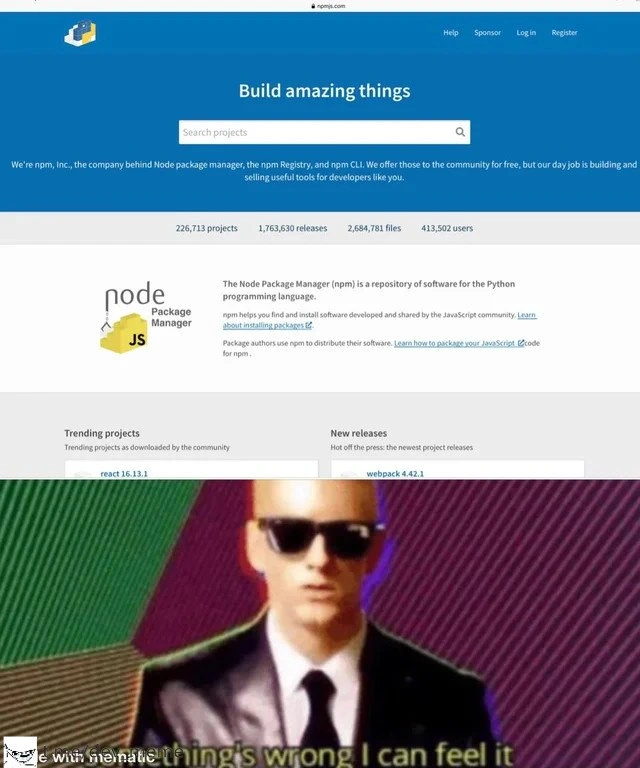
On the surface, this meme shows a documentation bug that any seasoned developer can spot in a heartbeat. The top half is an actual screenshot of npm’s official website (npmjs.com) proudly introducing itself. We see the familiar Node.js logo, a tagline about building amazing things, and stats about packages and users. Everything screams JavaScript: trending projects include React 16.13.1 and new releases feature Webpack 4.2.1 – all highly recognizable tools from the Node.js ecosystem. Then comes the record-scratch moment in the text:
“The Node Package Manager (npm) is a repository of software for the Python programming language.”
This single sentence is a glaring language_confusion error. It’s as if the site can’t decide if it’s Node or Python – a true package_registry_mistake. Every developer’s mental alarm goes off here; we all know npm is not for Python. In fact, Python has its own separate universe of packages (typically the PyPI repository accessed via pip). Seeing “Python programming language” on npm’s page is like seeing a Ferrari logo on a Boeing airplane – it just doesn’t belong, and you instinctively know something’s wrong.
What makes this especially humorous to experienced devs is the shared understanding of how PackageManagement works in different ecosystems. NodeJS (JavaScript runtime) uses npm to manage JavaScript libraries, while Python uses tools like pip and the Python Package Index. Mixing them up in official documentation is a nearly impossible goof… unless someone did a copy-paste from the wrong template. 😉 In fact, the phrasing here (“a repository of software for the Python programming language”) is almost word-for-word how PyPI is described. It’s likely an editing slip-up — perhaps a technical writer reusing text and forgetting to swap “Python” for JavaScript. Seasoned devs have seen this kind of snafu before: maybe a README copied from another project with leftover references, or configuration files claiming to be on a different OS. It’s a classic DocumentationHumor scenario where a tiny oversight reveals the behind-the-scenes human error.
The meme’s bottom panel – a suited figure in sunglasses with the caption “Something’s wrong I can feel it” – perfectly captures a senior engineer’s gut reaction. This is a popular something_is_wrong_meme used in tech circles to joke about our almost paranormal ability to sense bugs or inconsistencies. Here it implies that the moment a developer reads “for the Python programming language” on npm’s site, their internal siren goes off. It’s an in-joke among developers (TechHumor): we’ve developed such strong context awareness that a single word out of place (especially a big word like “Python” in the land of Node) triggers instant suspicion.
Beyond the chuckle, there’s an underlying nod to quality control and BugsInSoftware (or in this case, bugs in documentation). It’s a reminder that even official, high-profile sites can have mistakes — and that developers, especially the battle-tested ones, will spot them immediately. No matter how polished a platform is, the DeveloperHumor here is that a trivial typo can momentarily give the whole community pause, wondering if the universe glitched or if npm secretly started hosting Python packages overnight. Of course, it’s just a mistake, but it’s delightful to see how one wrong word can unite Node and Python devs in a moment of shared disbelief and laughter.
Description
A two-panel meme. The top panel is a screenshot of the official npmjs.com website. In the description text, it incorrectly states, 'The Node Package Manager (npm) is a repository of software for the Python programming language.' The bottom panel features the 'Something's wrong, I can feel it' meme, showing a man in a black suit and sunglasses with a look of suspicion. This meme humorously points out a glaring and fundamental error on a critical piece of web development infrastructure's website. The joke lies in the cognitive dissonance experienced by any JavaScript or Node.js developer seeing NPM, the cornerstone of their ecosystem, being attributed to Python. It captures the subtle feeling of unease when something is almost right but profoundly wrong

Comments
7Comment deleted
This is what happens when you let the intern copy-paste the description from the PyPI website. At least they didn't try to install it with pip
npm calling itself a Python repo is the doc-site version of a distributed transaction: it cleared CI, nobody knows how, and now we’re all stuck pretending eventual consistency was intentional
When npm says "Build amazing things" but your node_modules folder is 3GB and you haven't even installed your dev dependencies yet
Ah yes, the node_modules folder - the only black hole in software engineering where 300MB of dependencies are required to center a div. You can always feel when something's wrong: it's that moment between 'npm install' and realizing your disk space just evaporated faster than your sprint velocity after the PM added 'just one more feature.'
When the homepage says “npm is a repository for the Python programming language,” you’ve found a runtime type error in the marketing layer - SemVer can’t version-control copy‑paste
npm's homepage sells 'Build amazing things' - until audit finds 1,500 vulns in your hello-world deps
npm: “repository for Python” - perfect, now package-lock.json can import pip’s dependency hell and our SBOM doubles its CVEs