Skip to content
DevMeme
5084 of 7435
When 'Learn to Code' Gets an AI-Powered Reply
AI ML Post #5564, on Oct 10, 2023 in TG

When 'Learn to Code' Gets an AI-Powered Reply

Why is this AI ML meme funny?

Level 1: Tables Turned

Imagine two friends, Alex and Bob. Alex loves playing soccer with his favorite ball, but one day his ball bursts and he can’t play anymore. He’s really sad about it. Bob, who prefers video games, just laughs and says, “Ha ha, just play video games instead!” That’s a mean and unhelpful thing to say – Bob is basically dismissing Alex’s problem and telling him to go do what Bob likes to do. But a week later, Bob’s game console suddenly breaks, and now Bob is the one upset that he can’t play his game. Alex remembers what Bob said before, so he smirks and says, “Ha ha, maybe you should go play soccer outside instead!” Now Bob understands how hurtful and silly that kind of advice was. Bob got a taste of his own medicine.

This is just like what happens in the meme, but with grown-up jobs. In the first scene, a programmer guy laughed at a factory worker who lost his job and told him, “learn to code” – which meant “stop complaining and become a computer programmer like me.” That wasn’t very kind or easy to do. Years later, the programmer himself loses his job because a smart computer (an AI) can do the coding for him. Now a welder (a guy who works with metal) laughs at the programmer and says, “learn to weld” – meaning “maybe you should become a metal worker like me.” It’s funny because the tables have turned: the person who was laughing before is now the one being laughed at. The meme is showing that you shouldn’t be arrogant about your job being safe. Being told to “just learn something else” feels bad, and it can come back to haunt you when things change and you’re the one in the tough spot. In other words, don’t make fun of someone losing their job – you might be in their shoes someday!

Level 2: Switching Gears

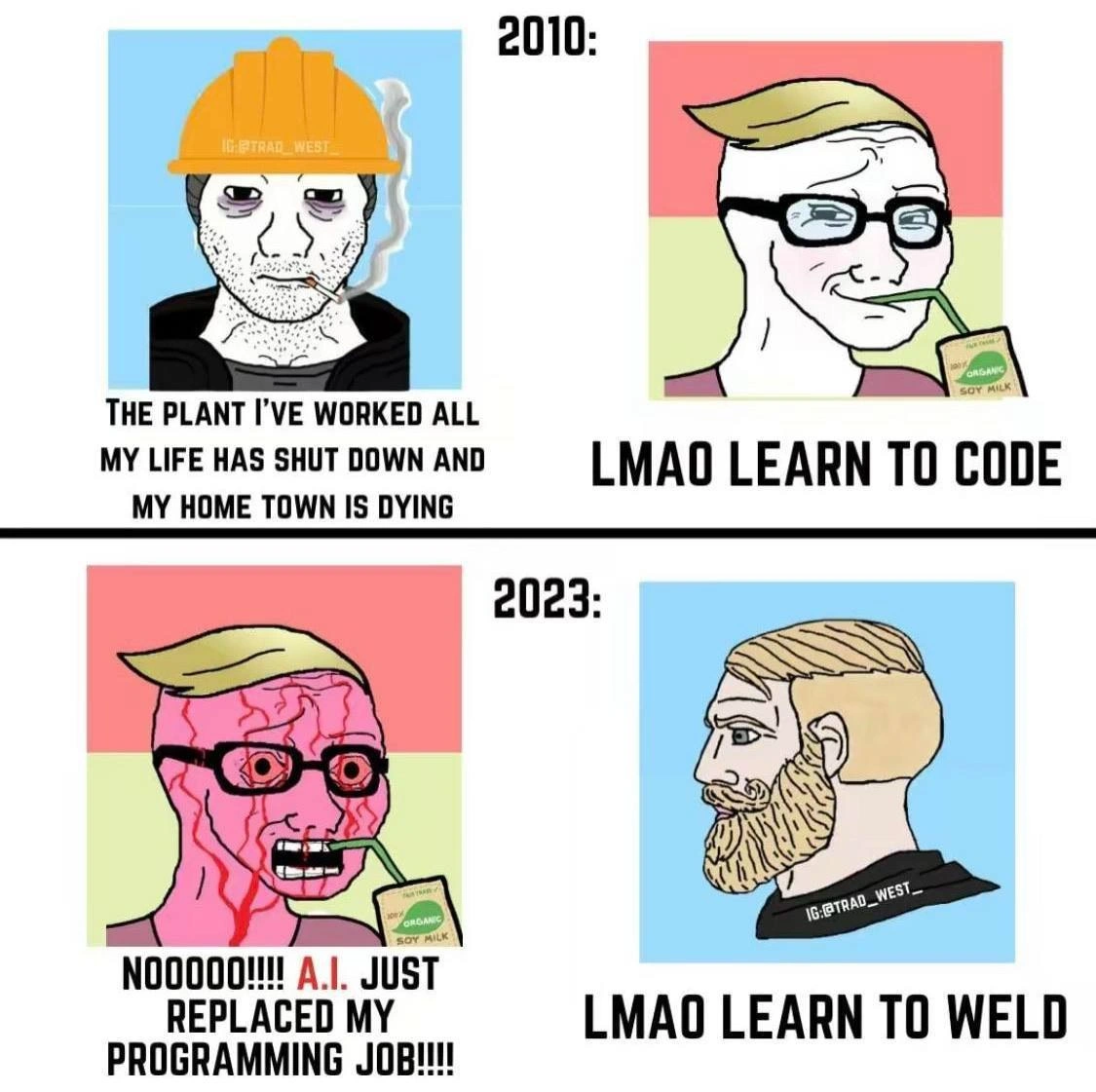
In each panel of this meme, we’re seeing two different time periods side by side – 2010 at the top and 2023 at the bottom – with two characters interacting in each.

  • 2010 Scenario: On the left, there’s a cartoon of a sad, tired-looking construction worker wearing a yellow hard hat and smoking a cigarette. He’s upset because, as the caption says, “The plant I’ve worked all my life has shut down and my home town is dying.” This means his factory closed and his whole community is suffering economically. On the right, there’s another cartoon guy with a smug expression, trendy glasses, and a box of “organic soy milk” he’s sipping through a straw. This guy represents a tech-savvy person. He responds by laughing and saying “LMAO learn to code.” “LMAO” is internet slang for “Laughing My A** Off,” basically him saying “Haha!” in a rude way. “Learn to code” means he’s telling the factory worker to go learn computer programming as a new career. In context, this is pretty mocking and dismissive – he’s making it sound like coding is the obvious solution and laughing at the worker’s plight.

  • 2023 Scenario: Now the roles flip. On the left, we see the same glasses-wearing tech guy, but in 2023 he’s drawn in a panicked state – his face is pink/red with stress, and he’s screaming “NOOOOO!!!! A.I. just replaced my programming job!!!!” He’s still holding that soy milk, but now he’s freaking out because A.I. (Artificial Intelligence) took over his job as a programmer. That implies some advanced software or machine can do the coding work he used to do. On the right, there’s a different character: a muscular, blond bearded man looking calm and confident. This is the Chad meme character (often used to represent someone who is tough, cool, or old-school). Chad in this case is likely a welder or skilled tradesman. He replies to the panicking programmer, “LMAO learn to weld.” Welding is a manual skill where you fuse metal pieces together using high heat (common in construction, manufacturing, etc.). So “learn to weld” means he’s telling the programmer to go learn a trade skill (in other words, go do manual labor for a living since your fancy coding job is gone). And he says it with the same mocking laughter (“LMAO”) at the start. It’s a direct parallel to the first scene, but reversed: now the tech guy is the victim and the tradesman is the one giving the snarky advice.

This whole setup uses the popular Wojak meme format. Wojak characters are those simple cartoon faces (like the sad bald guy, or the angry pink guy, or the confident Chad) that represent different stereotypes or emotions in memes:

  • The construction worker Wojak (sometimes called “Doomer” when he looks depressed) represents a blue-collar worker who lost his job. He’s the sympathetic figure in 2010.
  • The “soyjak” (Wojak with glasses and soy milk) represents a certain kind of internet/tech guy. The soy milk is a comedic detail — it’s often used in memes to poke fun at someone for being an urban hipster or not traditionally masculine (it comes from a running joke about “soy boys” who drink soy milk or eat tofu, implying they’re soft). In the meme, this guy is initially smug and laughs at the worker.
  • The Chad (the buff, bearded guy) represents the stereotypical “alpha” male or someone who’s practical and tough. Here he’s likely symbolizing a welder or tradesperson, and he’s the one dishing out the ironic punchline in 2023.

The text “LMAO” in both scenes shows that the person speaking is laughing at the other person’s problem. It’s a pretty rude, carefree laugh. So in 2010, the tech dude is basically saying “Haha, tough luck, go learn programming.” In 2023, the welder guy is effectively saying “Haha, tough luck, go learn metalworking.” The tone in both cases is mocking; neither speaker actually cares about helping – they’re just making fun of the other’s misfortune.

Now, what’s the meme getting at? It’s highlighting how advice about careers and job skills can be very ironic and hypocritical over time. Back around 2010, it became common to say “learn to code” to people who lost jobs in old industries. The idea was that tech jobs (like software developer roles) were lucrative and in-demand, so if a factory closed, folks should switch to coding. This was often said by people in tech or media, and it sounded kind of smug (it’s easy to tell someone to completely change their career path when you’re not the one going through it). It even turned into a meme/insult online, because it was used in a mocking way towards people who were struggling.

Fast forward to today (2023): Artificial Intelligence has advanced a lot. AI, especially forms of it like machine learning (where computers learn from data) and things like ChatGPT (a very advanced AI that can answer questions and even write code), has started doing tasks that we used to think only humans could do. One of those tasks is writing computer programs. AI tools are now able to generate code, debug, and build simple apps by themselves or with little human help. This has caused some panic among programmers. They’re thinking, “If a machine can code, will I lose my job?” It’s a big topic in the tech industry right now (sometimes called the AI hype vs. reality issue – people are debating how much of the hype is real). Some companies are even saying they might not need as many junior developers in the future because AI can help the seniors do more work. So, suddenly the shoe is on the other foot: it’s the programmers who are afraid of being replaced, much like factory workers were worried about being replaced by automation or cheaper overseas labor in the past.

So, the meme cleverly flips the old saying. Instead of a tech person telling a laid-off factory worker “learn to code,” we have a tradesperson telling a laid-off tech person “learn to weld.” Welding, being a physical skill, isn’t something current AI can do (robots can weld in factories in very controlled situations, but you can’t replace a skilled human welder on a job site as easily as an office job... at least not yet). There’s an implied message that manual trades might be more secure now than coding, which is the opposite of what people thought a decade ago. The humor really comes from this dramatic reversal and a bit of karma. It’s like saying, “See? You laughed at us for losing our jobs, and told us to join your field. Now your field is in trouble and guess what — maybe you should join our field (and see how it feels)!”

For a junior developer or someone new to this meme, the key points are:

  • “Learn to code” was advice (often given in a mean or joking way) to people who lost traditional jobs, suggesting they become programmers.
  • A.I. replacing my programming job refers to the current fear that artificial intelligence could automate coding work.
  • “Learn to weld” is the exact same style of advice but turned around, suggesting the programmer should go learn a hands-on trade skill since his coding job is gone.
  • It’s poking fun at the idea that switching careers is easy or that any job is “safe.” It shows how what goes around comes around in the job market.

In simpler terms, the meme uses an easy-to-recognize comic format to say: Ten years ago, tech people told factory workers to adapt and learn programming when machines took their jobs. Now technology (AI) might be taking programming jobs, and those tech people are being told to adapt and learn a hands-on trade. It’s a comedic way to highlight how times change, with a bit of a “gotcha!” attitude. If you laughed at someone else’s misfortune, don’t be surprised if someday someone laughs at yours. Always stay humble and be ready to “switch gears” (pun intended) because no career is guaranteed to be forever.

Level 3: Hype Cycle Whiplash

Role Reversal: In this four-panel meme, the tables have completely turned between 2010 and 2023. In the top panels (2010), a dejected factory worker laments, “The plant I’ve worked at all my life has shut down and my hometown is dying.” In the opposite panel, a smug tech bro with glasses (sipping from a carton of organic soy milk) responds with zero sympathy: “LMAO learn to code.” Fast-forward to the bottom panels (2023): that same glasses-wearing tech guy is now the one freaking out — “NOOOO!!!! A.I. just replaced my programming job!!!!” — and a stoic bearded welder (the classic Chad character) dryly tells him, “LMAO learn to weld.” The meme uses this scene to highlight a complete role reversal: the once-mocked blue-collar worker and the once-smug coder have swapped places in terms of who’s facing unemployment and who’s giving snarky career advice.

Historical Cycles: This meme captures a snapshot of changing industry trends. Around 2010, many Western towns were suffering from industrial decline – factories closing due to automation or jobs moving overseas. At the same time, tech was on the rise, so “learn to code” became a buzzphrase (and often a flippant piece of career switch advice) suggesting workers from dying industries should become software developers. It was the era of the knowledge economy boom, where coding was hyped as the ticket to a stable future. Fast-forward to the 2020s: now it’s the techies who are nervous, thanks to rapid advances in AI and automation. The very skill that was supposed to be “future-proof” – computer programming – is now under threat from smart algorithms. It’s a cycle of creative destruction: old jobs get replaced by new technology, and then those new jobs in turn get threatened by an even newer technology. The meme cleverly compresses this cycle: coding was once the new hotness displacing old labor, but now AI is the next wave, potentially displacing coders. Seasoned developers (and tech historians) recognize this pattern: every decade or so, there’s a new disruptive wave (the PC revolution, the internet, outsourcing, machine learning, etc.) that shifts the job landscape and forces people to adapt.

AI Hype Cycle: A big part of the humor here is rooted in the current AI hype. In 2023, technologies like machine learning and advanced language models (think GPT-4 or coding assistants like GitHub Copilot) have hit the scene. Tech media and CEOs were loudly proclaiming that these AIs can write code, design apps, and do other programming tasks — potentially cheaper and faster than humans. This led to a wave of anxiety that human programmers might become obsolete. The meme exaggerates this fear: the coder character is shown with bulging red veins, screaming that AI replaced his job overnight. This is the peak of the AI hype cycle talking. Of course, in reality, most senior engineers will point out that AI-generated code still needs oversight: it can produce bugs, security flaws, or nonsense if not carefully guided. So, while AI can automate some aspects of coding, it’s not (yet) a magic replacement for humans. The truth is likely that programmers’ roles will evolve (maybe more code reviewing and design, less repetitive coding), rather than vanish entirely. But the meme runs with the nightmare scenario for comic effect, capturing how a lot of developers feel during the hype: a mix of impressed and terrified. It’s poking fun at how quickly the narrative went from “learn to code for a secure future” to “uh oh, coding itself might be automated.”

Schadenfreude: There’s a strong undercurrent of schadenfreude in this meme – that is, finding humor in someone else getting their comeuppance. The soy milk-sipping tech guy was pretty arrogant and dismissive back in 2010, essentially laughing at the misfortune of the laid-off laborer. Now, in 2023, he’s the one in a panic, and the meme rubs it in by having someone laugh at him with the exact same phrasing. It’s a form of internet karma. Developers and IT professionals sharing this meme are wryly acknowledging, “Yep, this is karma biting the know-it-all who laughed at others.” It’s a guilty laugh at the reversal of fortune. Many in the tech community remember how irritating and tone-deaf the “LMAO learn to code” attitude was, so seeing that guy become the butt of the joke is perversely satisfying. This is humor as a coping mechanism too – we laugh at this scenario partly because, as developers, we secretly fear being in the tech guy’s shoes, and laughing makes it a little less scary.

Stereotypes and Symbolism: The meme uses familiar internet cartoon characters to amplify its message. The figures are all variants of the Wojak meme format:

  • The Doomer Wojak (tired, sad eyes, often depicted with a cigarette) wearing a construction hard hat stands for the older-generation blue-collar worker. He’s exhausted and devastated by losing his lifelong factory job.
  • The Soyjak (a Wojak drawn with a goofy grin, here sipping “organic soy milk”) represents a younger, internet-savvy person, stereotyped as a smug or out-of-touch tech geek. The soy milk is a mocking detail – in meme culture, “drinking soy” implies he’s a bit soft or hipster-ish. It caricatures the tech dude as someone who’s perhaps physically weak but quick to give unsolicited advice.
  • The Chad (drawn with a strong jawline, blond beard, and confident posture) is a meme archetype of a no-nonsense alpha male. Here, Chad is cast as the welder – a tough, traditional tradesman. He delivers the punchline with a stoic expression.

These stereotype characters are visual shorthand. Even without reading the captions, many meme-literate folks recognize the dynamic: Doomer = despairing working man, Soyjak = smug know-it-all, Chad = confident realist. By using these familiar faces, the meme instantly telegraphs who’s supposed to be laughed at and who has the last word. It adds an extra punch to the humor: the moment you see Chad telling Soyjak “learn to weld,” you know the jokester has become the joke.

“Learn to Code” Meme History: The phrase “learn to code” didn’t come out of nowhere – it was a real slogan and later an infamous meme. In the late 2000s and 2010s, as many manufacturing and coal mining jobs dried up, some commentators and even politicians would say workers should retrain by learning programming. It was intended as well-meaning advice (coding jobs are the future!). However, it quickly sounded patronizing and out-of-touch. Telling a 50-year-old factory worker to suddenly become a software developer is like telling someone to grow wings — easier said than done. By the late 2010s, “learn to code” turned into a sarcastic insult on social media. For example, when some journalists were laid off in 2019 and tweeted about it, trolls replied “learn to code,” which was received as mockery of their misfortune (to the point Twitter had to moderate that phrase as targeted harassment). So in internet culture, “LMAO learn to code” is remembered as a smug, tone-deaf response to someone losing their job. This meme riffs on that history: now the job displacement is happening to the coder, and the comeback is “LMAO learn to weld.” It’s funny because it flips a well-known catchphrase on the very group of people who used it. The techie who once thought his field was untouchable is getting a taste of the dismissive advice he gave others. It underlines the short-sightedness of assuming any job is immune to change.

The Human Side: Beyond the tech and meme references, this joke has an emotional core about empathy (or the lack of it). It reminds us that it’s easy to be smug when someone else’s career is in trouble, but it feels very different when it’s your own job on the line. In the tech world, there’s growing anxiety about job security in tech – people are asking, “Will AI automate me out of a job?” At the same time, folks in traditional skilled trades or those who went through layoffs in the past might be thinking, “Now you know how we felt.” The meme captures that tension by showing the once-laughing programmer now screaming in panic. It’s basically an empathy lesson wrapped in humor. When you’re riding high in a booming industry, you might dismiss others with a “just learn my skill” comment. But when the hype cycle shifts and you find yourself on the losing end, suddenly that glib advice isn’t so fun. The meme is a light-hearted way of saying what goes around comes around. Both the 2010 scene and the 2023 scene are extreme and cartoonish, but they resonate because many people have experienced something similar: having to reinvent themselves when their industry changes. The humor makes a sharp point: maybe next time, instead of laughing and saying “just learn to ___,” we should have a bit more compassion — because no one’s career path is truly assured in a world of rapid technology shifts.

Description

A four-panel Wojak comic that contrasts the years 2010 and 2023 to illustrate a reversal of economic fortunes. In the top half, dated 2010, a distraught Doomer Wojak in a hard hat and smoking a cigarette says, 'THE PLANT I'VE WORKED ALL MY LIFE HAS SHUT DOWN AND MY HOME TOWN IS DYING.' Next to him, a smug Soyjak Wojak sips from a carton of organic soy milk and retorts, 'LMAO LEARN TO CODE.' In the bottom half, dated 2023, the same Soyjak is now rendered as a pink, enraged, and veiny mess, screaming, 'NOOOOO!!!! A.I. JUST REPLACED MY PROGRAMMING JOB!!!!' In the final panel, a calm and confident Chad Wojak looks on and advises, 'LMAO LEARN TO WELD.' The meme critiques the once-common refrain that coding is a universally secure career path, highlighting the irony of programmers now facing their own displacement by AI, just as they once dismissed the plight of blue-collar workers
Comments

29
Anonymous ★ Top Pick The 'learn to code' movement forgot to add a disclaimer: skill is a temporary variable, but the demand for skilled trades is a constant
  1. Anonymous ★ Top Pick

    The 'learn to code' movement forgot to add a disclaimer: skill is a temporary variable, but the demand for skilled trades is a constant

  2. Anonymous

    Twenty years of splitting monoliths into microservices, and HR’s new upskilling plan is “learn to split I-beams with a plasma cutter” - on the plus side, steel never bikesheds your code style

  3. Anonymous

    After 15 years of telling displaced factory workers to 'just learn to code,' senior engineers are discovering that GitHub Copilot doesn't need their carefully crafted abstractions, SOLID principles, or heated debates about tabs vs spaces - turns out the real job security was in trades that require physical presence and can't be solved by a transformer model trained on Stack Overflow

  4. Anonymous

    The ultimate irony: we spent decades automating everyone else's jobs with deterministic scripts and ML models, confidently telling displaced workers to 'learn to code.' Now that LLMs can generate boilerplate React components and debug stack traces, we're discovering that welding robots still can't handle the edge cases of real-world fabrication. Turns out the hardest problems to automate aren't the ones we thought - they're the ones that require physical dexterity, spatial reasoning, and dealing with the chaotic entropy of the material world. Who knew that 'move fast and break things' doesn't work when you're joining structural steel?

  5. Anonymous

    After AI took CRUD, my roadmap updated from AbstractFactory to ActualFactory - finally a join that won’t fail in prod

  6. Anonymous

    We’ve been welding brittle microservices together with YAML, retries, and circuit breakers since 2016 - no PPE, just PagerDuty

  7. Anonymous

    The ultimate tech debt: a 13-year sprint to obsolescence, now refactoring careers into eventual weld consistency

  8. @Hollow_Arigo 2y

    What is weld?

    1. @uebuntu 2y

      aka making money rn

  9. @Hollow_Arigo 2y

    Thanks for improving my English

  10. Deleted Account 2y

    4 (5) Russians talking in English, lmao

    1. @Dorikan 2y

      English only chat.

  11. @Regalusarm 2y

    ai is stupid so much, they cant replacing our job.

    1. Manuel 2y

      For now

      1. @ckm_nodoma 2y

        for next 10+ years

    2. Felix 2y

      Most humans don’t care enough to notice

      1. @Assarbad 2y

        fortunately the code written is meant for the computers, not for humans

    3. @Agent1378 2y

      Mgimo finished?

    4. @dwanford 2y

      so are we

  12. @MagnusEdvardsson 2y

    Thinking that writing code is all there is to be a developer is like thinking that writing a prescription is all there is to be a doctor.

  13. @mariiakostenko 2y

    These people who think AI will create all infrastructure for they fucking candy crush game <3

  14. @Bitals 2y

    Welding is actually cool, a lot of IT professionals I know (me included) have some manual work skills and use them for fun. The difference is, in most of the world IT guys have the ability to buy welding tools and learn to use them in their free time, while most welders are unable to build a homelab and develop IT skills that easily.

    1. @apopov_spb 2y

      Why wouldnt welders be able to build homelab enough for learning it? You don't really need expensive hardware for that

      1. @pnlt_s 2y

        welding machine and materials to work with¯⁠\⁠_⁠(⁠ツ⁠)⁠_⁠/⁠¯ imo welders just don't have that much spare time

  15. @Bitals 2y

    Well, even in these parts of the world if you are a really good welder you will get paid way more than an average developer. It's just that like 20% of welders earn as much as 50% of developers do.

  16. @fll_fll_fll 2y

    AI will not replace you (now), but it will increase the productivity of professionals in all areas. In other words: indirectly replacing people Greetings from Brazil 💌

  17. @qwnick 2y

    2023 is almost ended, AI still didn't replaced noticeable percent of people in programming, wtf is this meme about?

  18. @elpetro9 2y

    50 men

  19. @ercolebellucci 2y

    its 2023 and i'll start in few month programing and machine learning, how dumb am i

Use J and K for navigation