Starfield at Home Runs on XP
Why is this Games meme funny?
Level 1: Space Game at Home
It is like asking for a giant fancy spaceship toy and being handed a piece of black paper with white dots on it. Technically, both show stars in space, but one is an adventure and the other is just dots. That gap between what was wanted and what was offered is the whole joke.
Level 2: Same Name, Different Universe
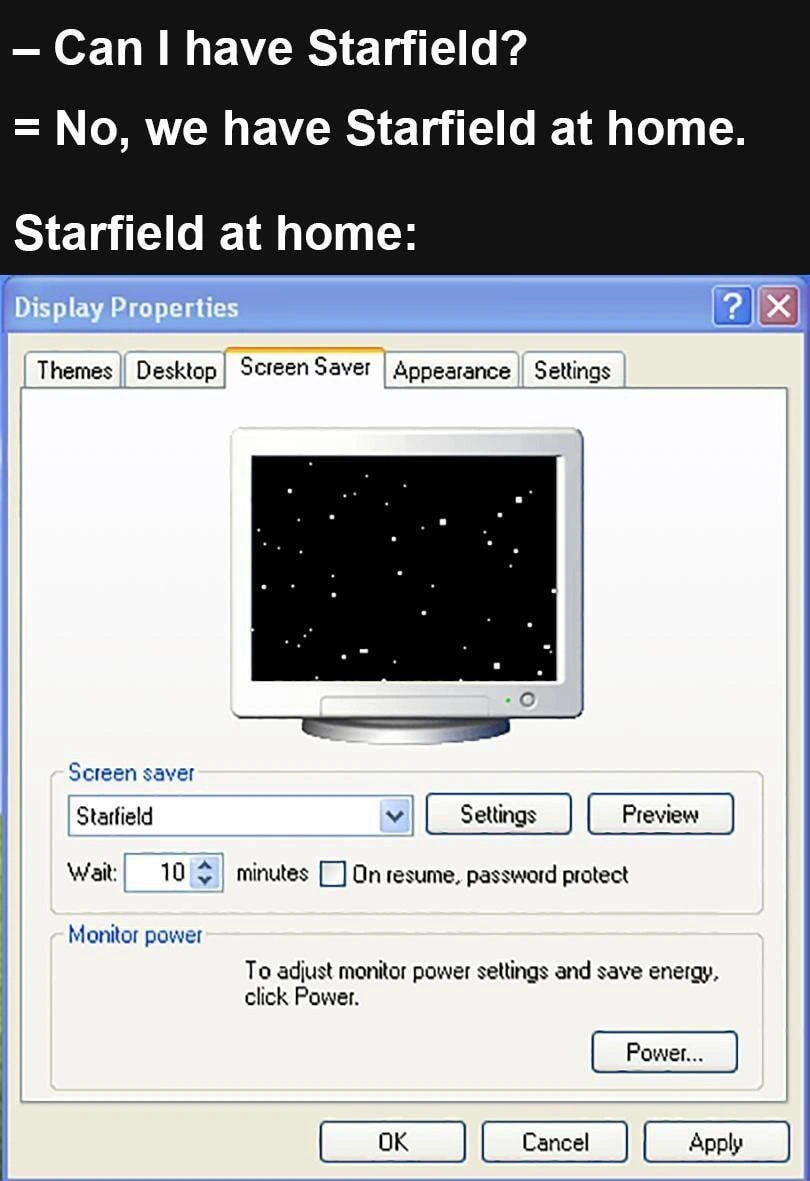
In computing, a screen saver was originally meant to prevent static images from damaging old displays. By the Windows XP era, screen savers were also decorative idle animations. The one shown here is called Starfield, and its preview is literally a black rectangle with small white stars.
The meme compares that simple utility with the game Starfield, a large space-themed role-playing game. The joke uses the "we have X at home" format, where the thing "at home" is a cheaper, worse, or absurdly literal substitute for the thing someone wanted.
Several visible details carry the joke:
Display Propertiesidentifies the old Windows settings panel.- The
Screen Savertab shows this is not a game at all. - The dropdown value
Starfieldcreates the wordplay. - The CRT monitor preview makes the whole thing feel retro.
- The
Settings,Preview,OK,Cancel, andApplybuttons remind anyone who used XP how manual desktop configuration used to feel.
For a newer developer, this is also a lesson in context. A word like Starfield does not have one universal meaning. In one context it is a game title; in another it is just the name of a tiny graphics effect. Software is full of names like that: React, Rust, Go, Spring, Phoenix. Half the job is figuring out which universe the conversation is currently in.
Level 3: Procedural Nostalgia
The visible setup is the classic parental denial format:
- Can I have Starfield? = No, we have Starfield at home.
Starfield at home:
The punchline is that "Starfield" is both the name of a modern space game and the name selected in an old Windows XP Screen Saver dropdown. Below the caption, the image shows the Display Properties window, with tabs like Themes, Desktop, Screen Saver, Appearance, and Settings, plus a CRT monitor preview full of white dots on a black background. The dropdown says Starfield, and the Wait: 10 minutes control makes the whole thing feel aggressively pre-cloud, pre-launcher, pre-120GB-install.
This is a naming-collision joke with a history tax. Bethesda's Starfield represents the contemporary AAA software machine: vast asset pipelines, open-world design, patches, GPU requirements, and enough project management ceremony to make a space program jealous. Windows XP's Starfield screensaver is the opposite: a tiny built-in visual effect whose entire promise is "white pixels move around until you touch the mouse."
That contrast is why the meme works for both gamers and developers. It collapses a huge modern product into the most minimal possible implementation of the same word. If the product requirement is merely "show a star field," then XP shipped the MVP decades ago. Product managers hate this one weird trick.
The Windows XP interface adds another layer. The beveled buttons, gray dialog, CRT preview monitor, Power... button, and On resume, password protect checkbox evoke an era when desktop operating systems exposed configuration as a physical control panel full of tabs. Modern UI often hides settings behind search, account sync, and glossy panels; XP simply says, here is the screen saver, here is the wait time, please try not to burn the phosphor. It is clunky, but legible.
The meme also satirizes how software value is shaped by expectation. A moving starfield can be trivial, nostalgic, or a massive commercial release depending on packaging, audience, and hype. Developers see this pattern constantly: the same phrase in a requirements document can mean a weekend script, a quarter-long platform initiative, or a meeting series with its own roadmap. The stars are the easy part. The meaning of "Starfield" is where the budget goes.
Description
The meme uses the classic "we have X at home" format with white text on a black header: "- Can I have Starfield?" followed by "= No, we have Starfield at home." and "Starfield at home:". Below it is a Windows XP "Display Properties" dialog on the "Screen Saver" tab, showing a CRT monitor preview full of white stars on a black background. The visible UI includes tabs for "Themes," "Desktop," "Screen Saver," "Appearance," and "Settings," a "Screen saver" dropdown set to "Starfield," buttons labeled "Settings" and "Preview," "Wait: 10 minutes," an "On resume, password protect" checkbox, monitor power text, and "Power...", "OK", "Cancel", and "Apply" buttons. The joke contrasts the modern space game Starfield with the old Windows screen saver of the same name.

Comments
2Comment deleted
Bethesda needed a galaxy-scale content pipeline; Windows XP just waited 10 minutes and rendered the MVP.
Still better than the bethesda’s one Comment deleted