The 'Surprise' of a Cobalt Strike License Instead of a House
Why is this Security meme funny?
Level 1: Traded House for a Toy
Imagine you and your family have been saving money to buy a new house – you have a big jar of savings everyone’s excited about. Now picture your dad taking all that money and spending it on a super fancy computer toy for his job because he just had to have it. Instead of coming home with house keys, he comes home with this complicated-looking computer program that only he uses. Your mom would be pretty upset, right? The meme is showing exactly that kind of silly situation. The husband spent the house money on his hacking toy. He was so excited about this special tool (it’s like a very expensive video game for cybersecurity geeks) that he forgot the money was meant for something important like a home. It’s funny in a crazy way: it’s as if someone traded a comfortable new house for a shiny new gadget. The wife’s face in the picture says, “Really? You spent it on THAT?” It’s a joke about choosing a personal obsession over a family need. Even if you don’t know about computers, you can laugh because everyone knows a house is more important than a toy – but here the dad/husband acted like a kid who blew all the cookie jar money on candy. It’s an over-the-top goofy mistake that makes us shake our heads and smile.
Level 2: When Tools Break the Bank
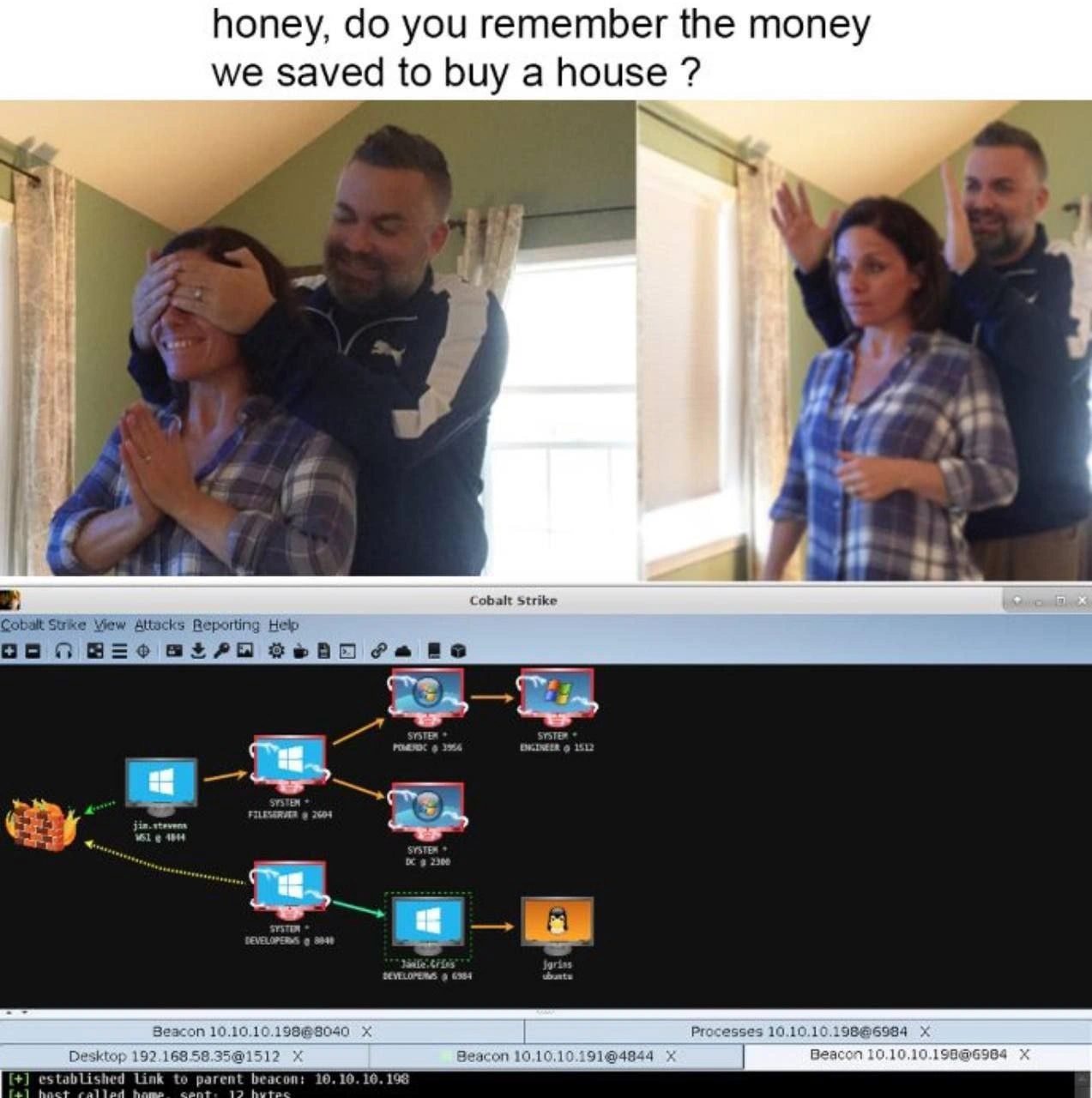
Let’s break down what’s happening here. Cobalt Strike is a famous (and expensive) hacking tool used in penetration testing and red team exercises. A red team is like an “attack” team that companies hire (or have in-house) to test security by behaving like real hackers. They use tools to find ways into systems, move around inside networks, and demonstrate what a real bad guy could do. Cobalt Strike is one of their deluxe toys – it has a slick graphical interface that shows compromised computers as nodes (little icons, like those blue Windows logos and the Linux penguin in the screenshot) connected by arrows. Those arrows mean the user has pivoted from one machine to another. For example, from “jim.stevens” (possibly a user’s PC) to “FILESERVER” to “DC @ 2300” (likely a Domain Controller), and so on. This is a visual map of an attack in progress, all controlled through Cobalt Strike. The bottom console text Beacon 10.10.10.191@4844 -> Beacon 10.10.10.198@6984 shows one compromised machine establishing a connection to another – essentially linking beacons to expand control. A “beacon” in Cobalt Strike is a tiny agent program that runs on a hacked machine and quietly talks back to the attacker, giving them remote access. So, in short, Cobalt Strike lets a hacker systematically take over multiple machines and coordinate them, as if they were an invading army capturing territory. This makes it immensely powerful for offensive security tooling.
Now, here’s the kicker: Cobalt Strike is not cheap. Unlike many open-source hacking tools (for example, the popular Metasploit framework which is free), Cobalt Strike requires a paid license. It can cost on the order of several thousand dollars per year. It’s a professional-grade tool intended for companies, not casual tinkerers. Usually, a cybersecurity firm or a well-funded security department buys this. It’s pretty rare for an individual to purchase a personal license with their own money – unless they’re really, really into their craft (and have money to burn). That’s why the meme is funny: the husband treated this tool purchase like someone buying a car or making a down-payment on a house. The text “honey, do you remember the money we saved to buy a house?” sets up a serious family conversation. You’d expect the next line to be about finally getting that house… but nope! Instead, the joke is that he spent it on this red_team_tool_license. The images of the couple show the husband first covering the wife’s eyes (as if he has a surprise) and then raising his hands apologetically while she looks disappointed. It’s a common meme format where one person does something outrageous with money and the other is, understandably, not thrilled. In this case, the outrageous thing is buying a penetration testing tool instead of something practical like a home.
For a junior developer or someone new to security, think of it this way: penetration testing tools help you find vulnerabilities in systems by simulating attacks. Tools range from free ones to very costly professional suites. Cobalt Strike is considered a premium suite – it’s prized for its powerful features, including stealthy communication (so the fake “attacks” aren’t easily detected by antivirus), teamwork functions, and an easy-to-use interface for controlling many hacked machines (those are the nodes you see). Red teams love it because it saves them time and lets them do complicated attacks more easily. However, that convenience and power come with a high price tag. So high, in fact, that if you’re on a personal budget, you’d probably never buy it yourself. Here the husband likely is a security enthusiast who just had to have this tool, maybe for his job or hobby in cybersecurity. And he went to an extreme: using their house_savings_spent_on_software. The tag BudgetConstraints is very relevant – most people have limited money, and spending so much on software means sacrificing something else. A house down-payment is a huge sacrifice, basically the family’s future home.
The meme also pokes fun at the stereotype in IT and security: professionals sometimes convince themselves that expensive tooling is an “investment” or absolutely necessary, even when cheaper or free alternatives exist. There’s a bit of truth in that – for example, you could use free tools and a lot of manual effort to mimic some of what Cobalt Strike does, but it wouldn’t be as slick or efficient. Still, you have to justify the cost. Usually, that justification happens in front of a finance manager or a boss at work. Here, it’s in front of his spouse, which is a comedic twist. The husband_house_fund_meme_format with him covering her eyes is basically saying, “Surprise! I did something you’re not going to like.” And indeed, the bottom image (the Cobalt Strike GUI) is the reveal of what he did with the money. In plain terms: he spent the house fund on a piece of software for cyber attacks simulation. That’s why she looks resigned – how do you even react to that if you’re not a tech person? It’s as if your partner said, “I know we planned to buy a family car, but I spent it all on a supercomputer to play my favorite game.” It’s comical because it’s so irrational from a normal perspective.
So, the meme is tagged Security and specifically references CyberSecurityMemes and RedTeam life. It’s highlighting the clash between personal life priorities and cybersecurity nerd priorities. Many in the field chuckle because they’ve experienced (or at least heard of) similar albeit less-dramatic situations – like begging their boss for budget to get a fancy tool, or spouses joking “don’t you dare buy another fancy gadget instead of fixing the kitchen.” This meme just takes that common theme and cranks it up: turning a life milestone (buying a house) into a joke about a penetration testing tool purchase. In sum, to a junior dev or someone learning security: it’s funny because it’s an extreme exaggeration of how passionate security folks can be about their tools, to the point of absurdity. And it also indirectly teaches you what Cobalt Strike is (a very potent, pricey hacking toolkit) and why not everyone has one – you usually need either corporate backing or, apparently, a willingness to burn a hole in your wallet the size of a new house.
Level 3: Beacons Over Bedrooms
In this meme, a red-team professional has effectively pwned his own family's finances by splurging on a Cobalt Strike license instead of a house down-payment. For the uninitiated, Cobalt Strike is a high-end penetration testing toolkit used by security pros (and ironically, hackers too) to simulate advanced breaches. It’s the kind of software that gives you a slick command-and-control interface – those colorful node icons in the screenshot represent compromised machines (beacons) across a network, all under the attacker’s control. The bottom panel logging established link to parent beacon: 10.10.10.198 is basically the tool saying, "I've successfully burrowed into another system and linked it into our covert network." In a real engagement, a red teamer moves from one foothold to pivot deeper into a target environment, chaining together exploits. That graph UI is essentially a victory lap for hackers: each node like “SYSTEM : FILESERVER @ 2064” or the Linux penguin “lyarios ubuntu” means “yep, we owned that box too.” It’s like a proud trophy wall of compromised servers. No wonder our guy is grinning (at least until he notices his wife’s face).
Now, why is this scene hilarious to security folks? Because a legit Cobalt Strike license costs serious money – we’re talking thousands of dollars a year. It’s the Ferrari of red-team tooling: powerful, sleek, and shockingly expensive. Companies might budget for it as a business expense, but here we have a home user buying it out-of-pocket. That’s absurd – like someone spending their mortgage funds on a single piece of software. The text “honey, do you remember the money we saved to buy a house?” sets us up: the wife is expecting news about their dream home. Instead, the husband sheepishly reveals (in classic meme fashion) that he diverted that entire savings into an offensive security tool. The two-photo sequence (her excited anticipation turned into resigned disappointment) says it all: his priorities went from bedrooms to beacons.
This hits a nerve in the cybersecurity community because it exaggerates a real tension: the obsession with cutting-edge tooling vs. practical life goals (or even practical security measures). Seasoned professionals have seen it before – maybe not someone literally wiping out a house fund, but certainly teams blowing budgets on fancy tools while neglecting basics. It’s a BudgetConstraints 101 horror story. Why fix your old clunker of a roof (legacy systems with unpatched vulnerabilities) when you can buy a shiny new exploit kit, right? Sarcasm aside, red-teamers love their tools, sometimes to a fault. They’ll justify big spending for something like Cobalt Strike because it streamlines exploit development, post-exploitation pivoting, and collaboration during simulated attacks. It’s basically an all-in-one special ops kit for cybersecurity missions. But the meme jokingly asks: at what cost? In this case, the cost was a real house. The humor is dark and spot-on: he’s achieved god-mode in a lab environment, mapping out owned systems with pastel icons, but back in real life he might be explaining to his spouse why they’re still renting an apartment.
There’s also an inside-joke layer here: Cobalt Strike is so pricey that even actual hackers often use cracked copies or older leaked versions. So a legit paid license is a flex – it means you’re either a well-funded professional or a cybersecurity fanatic with very questionable spending habits. The husband in the meme clearly falls into the latter category. The #security crowd laughs (and cringes) because many of us have felt the temptation of expensive gear and software. We joke about needing approval from the "Home CFO" (spouse) or the actual CFO at work to buy these toys. This meme just escalates it to the extreme: “Remember our grown-up goal (a house)? Welp, I swapped it for my hacker dream toolkit.” It’s an ultimate RedTeam fantasy gone wrong. The final punch is that screenshot: instead of a photo of a new house or keys, we see the Cobalt Strike UI – essentially the husband’s justification for vaporizing their savings. The wife’s face says, “Was it worth it?” And every techie who’s ever had to justify a costly tool can’t help but chuckle and shake their head.
Description
A two-part meme. The top part uses the 'Man Surprising Woman' format. In the first frame, a man covers a woman's eyes with a caption: 'honey, do you remember the money we saved to buy a house ?'. In the second frame, he reveals the surprise, and she looks shocked. The bottom part of the image reveals what the 'house money' was spent on: a screenshot of the Cobalt Strike command and control (C2) interface, showing a graphical representation of a compromised network with multiple nodes. The humor lies in the extreme expense of a Cobalt Strike license, implying the man spent a significant amount of money (meant for a house) on a powerful cybersecurity tool, much to his partner's dismay. It's an insider joke for cybersecurity professionals who are aware of the tool's cost and its use in both offensive security testing and by malicious actors

Comments
24Comment deleted
He told her it was an investment in 'securing their future assets.' He just didn't specify which assets or whose
“Relax, I didn’t blow the house fund - I just converted it into prime real estate on the client’s domain. Cobalt Strike calls it ‘persistent foothold,’ I call it our starter home.”
Nothing says 'long-term investment' quite like explaining to your spouse that the house down payment became a distributed C2 infrastructure with redundant beacon nodes and custom malleable profiles - at least the persistence mechanisms will outlast any mortgage
The real lateral movement here isn't through the network topology - it's explaining to your partner why a Cobalt Strike license and OSCP certification are 'essential infrastructure investments' while the down payment sits in escrow limbo. At least the beacons are more stable than that conversation
That house fund? It's been PERFORM VARYING'ed into eternal COBOL vendor support
He couldn’t afford real estate, so he bought Cobalt Strike - now he owns the domain, just not a home
We skipped the mortgage and bought Cobalt Strike - now we “own” the AD domain and have more Windows than any house on Zillow
Isn't Cobalt Strike leaked on GitHub for a few years now? Comment deleted
Shitdows👎 Comment deleted
what ? Comment deleted
Did he spent all their money on some security software? And so what? What was his plan to earn even more money from that? Or earning money was not his intention, but just spending it? Comment deleted
It's a meme, bro Comment deleted
The point is "I don't get it, even after googling what the heck this piece of software is", bro. Comment deleted
It can be even a software for changing the color of silverware, it really doesn't matter. The clue of this joke is about its ridiculousity. Comment deleted
ridiculousness - still don't get why this is funny Comment deleted
I guess the thing is about the annual licensing of this software (about $4k/year) Comment deleted
If they cannot afford $4k/year, then how are they supposed to save enough money to buy a house? Comment deleted
its funny because expensive 👍 Comment deleted
Dude, thanks god you are. Now I am not the number one dushnila of this chat) Comment deleted
for yall my lovely niggaz, download+use at ur own risk <3 Comment deleted
what even is this Comment deleted
i never used security softwares Comment deleted
Cobalt Strike 4.9 Licensed c0565d03d5f6335311927c6f93f3f5689804da596e6734b1ac26bf4b12cc85ed verify.cobaltstrike.com Comment deleted
there nev version btw Comment deleted