Skip to content
DevMeme
658 of 7435
The Sleep Cycle of a Programmer
MentalHealth Post #746, on Oct 17, 2019 in TG

The Sleep Cycle of a Programmer

Why is this MentalHealth meme funny?

Level 1: Small Task, Big Mess

Imagine your mom asks you to quickly grab a toy from your messy closet. You figure it’ll take just a minute – easy peasy. You open the closet door to reach for that one toy, but uh-oh! A bunch of other toys and boxes start tumbling out. Suddenly, you’re sitting there with a gigantic mess on the floor. What was supposed to be a 1-minute job now means you have to spend the whole afternoon picking up toys and trying to organize everything. By the end of it, you’re tired and frustrated, thinking, “I only wanted to do one little thing!” That’s the feeling this meme is capturing. Rick thought they’d be in and out in a flash, but just like your quick closet chore gone wrong, it turned into a huge, exhausting adventure. It’s funny because we’ve all had moments like that – when something we expected to be simple blows up into a big complicated mess, leaving us looking as exhausted and upset as Rick and Morty in that second picture.

Level 2: The 20-Minute Myth

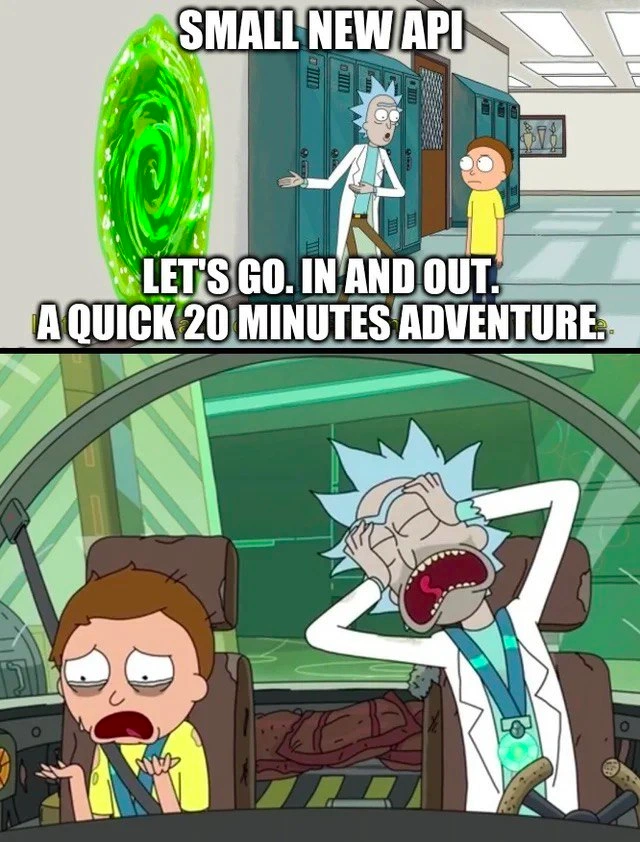
For a newer developer, this meme is a cartoon lesson about why nothing in software is as simple as it first seems. In the first panel (top image), Rick is excitedly talking about adding a small new API endpoint. An API – which stands for Application Programming Interface – in this context usually means a web service endpoint, basically a URL on a server that you can call to get some data or perform an action. Rick calls it a "tiny helper endpoint," implying it's just a minor addition to the system. The joke is that he thinks it will take only 20 minutes. Morty (the boy next to him) is tagging along like, “Sure, if you say so,” much like a junior dev might trust a senior engineer or a manager who promises, “This will be quick.” But in the second panel, we see them both traumatized and exhausted. What happened? Reality hit. The quick adventure turned out to be anything but quick.

Even small changes can hide big complications. If you’re relatively new to API development, imagine being asked to quickly add a new feature to a project – say, a new button in a app or a new API route in a web service. You think, “Alright, I’ll write a few lines of code, and done!” But then you discover all the extra things that need attention. For example, you might have to ensure only certain users can access this new function (that’s authentication/authorization – like making sure only people with the right key can open a locked door). Or you realize the data you need isn’t all in one place, so you have to gather information from two different sources, which means writing additional code and handling the case where one of those sources might be slow or offline. You also can’t just launch a new feature without checking it – you need to test it to make sure it works and doesn’t break anything important. Writing tests and running them takes time, but it’s how we avoid those breaking changes that crash other parts of the application. All these extra steps start piling up, and that “20-minute” task keeps growing.

On top of that, there’s something called scope creep – when the scope of a task (the defined chunk of work you set out to do) quietly expands beyond what was originally planned. Maybe while you’re implementing this “tiny” feature, your team or client says, “Actually, can we also add this other little improvement while we’re at it?” Or you discover that to make the feature truly useful, you need to tweak two other things as well. Suddenly the task isn’t so tiny anymore. And if your change might affect people who are already using the system, you have to think about backward compatibility. For instance, if some users or other programs are relying on an older version of your API, you can’t just change it in a way that breaks their stuff (those are the dreaded breaking changes we try to avoid). Often the solution is API versioning – basically offering a new version of the service (like “/api/v2/...”) for the changes, while keeping the old version (“v1”) around for existing users. That way, nothing old suddenly stops working. But supporting two versions means extra work and careful coordination, which again adds more time.

All of this explains why in the meme’s second panel Rick and Morty look completely beat up. In software terms, they just went through what you might call an “existential crisis sprint.” A sprint is an Agile project management term for a short, focused period of work (often 1 or 2 weeks) where a team tries to complete a set of tasks. An “existential crisis sprint” isn’t a real official term – it’s a tongue-in-cheek way to describe a sprint that was so stressful and unexpected that the team felt like they were in crisis mode, questioning why they ever thought the task was easy. Morty’s facepalm and Rick pulling his hair in panic are exactly how you feel after diving into a “simple” bug fix or feature that turned out to be a huge headache. The “quick 20-minute adventure” became days or weeks of debugging, rewriting, and firefighting. The takeaway for a junior developer is that time estimation in programming is really hard to get right – even small tasks can surprise you – so it pays to be cautious when assuming something will be fast. The meme uses a Rick and Morty sci-fi comedy scene to highlight this common experience in development: what starts as a carefree mini-mission can quickly turn into a chaotic, draining ordeal.

Level 3: Big Trouble in Little API

Seasoned engineers can practically hear the foreshadowing in Rick’s boastful line, “Let’s go, in and out, a quick 20 minutes adventure.” Those are famous last words in software development. The top panel’s bold text "SMALL NEW API" and Rick’s cavalier confidence encapsulate a classic scenario: misaligned expectations and the estimation fallacy at work. The humor is that every senior dev knows a “20-minute task” can easily spiral into a multi-week saga. We grin (or cringe) because we’ve all ridden that rollercoaster: one moment you’re promising a tiny REST endpoint to fetch some data, and the next you’re neck-deep in a full-blown “existential crisis” sprint, just like Rick and Morty screaming in the second panel. The meme nails this contrast – the naive optimism vs. the shell-shocked reality – and every experienced programmer recognizes it immediately. It’s basically shouting: “Remember that quick fix that almost broke the prod ecosystem? Yeah, that.”

Why does a tiny helper endpoint turn into such a big deal? From an experienced perspective, it’s the iceberg of software engineering. The part you planned (the visible tip – writing a simple endpoint) is just a fraction of what’s actually involved. Underneath lies a mass of hidden complexity that only surfaces once you’re in the thick of it. Rarely is anything truly “in and out” in a production codebase. Here’s how that innocent API adventure often unfolds in reality:

  • Authentication & Authorization – First, you realize this new endpoint needs to fit into the existing auth system. That means validating user credentials or API keys. Suddenly you’re reading up on OAuth scopes because your endpoint shouldn’t be open to everyone by default.
  • Data Handling & Validation – The endpoint is supposed to return data from a database or another service. But wait, the data isn’t in the shape you expected. Maybe you need a new database query or to call two different microservices and combine results. Now you’re dealing with SQL joins or network calls, plus adding input validation and error handling for all the edge cases (what if the inputs are weird or one of the services is down?).
  • Avoiding Breaking Changes – You discover that adding this endpoint or modifying an existing API might affect old clients. Uh-oh, a potential breaking change. To avoid disrupting users, you consider API versioning or other backward-compatible tweaks. Designing a /v2/ of the API or adding feature flags becomes another mini-project within the project.
  • Testing & QA – No senior dev will push new code without tests (and if they do, QA will certainly catch it). You write unit tests for the new logic, integration tests to make sure it plays nice with other parts of the system, and maybe update end-to-end tests. Each test failure teaches you about another case to handle. That “20 minutes” is now days of writing and fixing tests, but it’s necessary to prevent future disasters.
  • Documentation & Deployment – Time to document the endpoint (updating the API docs or the OpenAPI spec so others know how to use it). Then you have to actually deploy the update. Deployment might require a config change, a coordination with DevOps, or a feature toggle so it can be safely rolled out. And of course, something in the CI/CD pipeline could fail unexpectedly (perhaps the linter flagged an unrelated file or a container didn’t build correctly), which means more time troubleshooting before you’re finally done.

And we’re not done! Often while doing all this, unexpected obstacles appear. Maybe an “easy” library you depend on needed an upgrade, and that upgrade introduced compatibility issues, dragging you into dependency hell. Or perhaps a stakeholder sees the new endpoint in testing and says, “Actually, could we also add this other small feature while we’re at it?” (hello, scope creep!). By the end, that tiny API endpoint has entangled database migrations, three other microservices, an emergency patch to a shared library, and a very grumpy product manager wondering why it missed the deadline.

The second panel of the meme – with Rick clutching his head and Morty in despair – is basically the team after finally shipping that “quick” change, experiencing a bit of post-release trauma. It captures the exhaustion and the “What just happened?!” vibe that comes when a supposedly simple task balloons out of control. This relates to a well-worn industry truth: there’s no such thing as a small change in a large software system. Every little portal you open can lead to a cascade of unforeseen adventures. Senior developers have internalized this the hard way. So when we see Rick’s overconfidence followed by utter chaos, it perfectly satirizes the over-optimistic planning we’ve all been guilty of. The meme resonates as a cautionary tale: even a thin “wrapper” service is never truly thin – under the hood, it’s thick with hidden complexities. In short, misaligned expectations meet reality, and the result is equal parts hilarious and painfully relatable for anyone who’s been in the trenches of software delivery.

Level 4: Halting Problem of Estimation

No matter how seasoned a developer is, accurately predicting the effort for even a “small” change can be akin to solving an undecidable problem. This meme hints at a deep truth: in complex software, a task that seems O(1) (constant effort) in isolation often reveals O(n) or even O(2^n) effort once you account for all the interactions and edge cases. In theoretical terms, we might liken the challenge to something like the Halting Problem of project planning — there's no general algorithm that can perfectly foresee all the hurdles a “quick” development adventure will encounter. A new API endpoint may look straightforward, but behind the scenes it’s bound by the gravitational pull of all the existing components: databases, services, authentication flows, and legacy assumptions. Ensuring that adding this endpoint doesn’t break anything else can feel like proving a theorem; you're essentially attempting to verify that the change is safe in all possible states of the system (a combinatorially explosive number of states, reminiscent of NP-hard complexity). The joke exploits this hidden complexity: Rick’s glowing green portal (the “small new API”) might as well be an entrance to a labyrinth of unforeseen technical challenges.

Moreover, human cognitive biases compound the difficulty of estimation. Psychologically, we all fall for the planning fallacy and overconfidence bias — tendencies documented in studies showing that experts and novices alike consistently underestimate how long tasks will take. This isn't just anecdotal; it's practically a law of nature in software engineering (cue Hofstadter's Law: “It always takes longer than you expect, even when you take into account Hofstadter's Law.”). So when Rick confidently proclaims “a quick 20 minutes adventure,” he epitomizes that classic bias. Fred Brooks, in The Mythical Man-Month, described how the unpredictable essential complexity of software (the true complexity of the problem itself) combined with accidental complexity (the extra complexity added by tools, integrations, and processes) defeats our optimistic schedules. That “tiny helper endpoint” likely has a vast iceberg of integration work beneath it — work that algorithmically and organizationally is hard to see from the surface. In essence, the meme humorously illustrates a kind of estimation paradox: the simpler something appears, the more likely we’ve underestimated its hidden depth, as if the act of opening that green portal creates an ever-expanding ripple of tasks that defy our initial time computations.

Description

A humorous pie chart titled 'My Sleep,' with only two, very unequal slices. The vast majority of the chart, a large blue section, is labeled 'thinking about the bug I can't solve'. A tiny sliver of a yellow slice is labeled 'sleep'. This meme is a painfully accurate representation of a common developer experience: being unable to switch off from a challenging problem, even when trying to rest. It highlights the obsessive nature of debugging and the mental toll it can take, where a persistent bug can consume one's thoughts and disrupt sleep, a phenomenon many in the tech industry know all too well

Comments

7
Anonymous ★ Top Pick I finally solved the bug in my sleep. The solution was to wake up and realize the bug was actually a feature request from a nightmare client
  1. Anonymous ★ Top Pick

    I finally solved the bug in my sleep. The solution was to wake up and realize the bug was actually a feature request from a nightmare client

  2. Anonymous

    If it really only takes 20 minutes, why does the Swagger doc alone need two architecture review meetings and an IAM policy change request?

  3. Anonymous

    The vendor's OpenAPI spec was autogenerated from their SOAP service, their OAuth flow requires a manual approval step, and they just deprecated the endpoint you spent three days integrating without updating the changelog

  4. Anonymous

    Every senior engineer knows that 'quick 20-minute API integration' is the technical equivalent of 'hold my beer' - it's the moment before you discover their OAuth implementation violates three RFCs, their rate limits aren't documented, their error responses are all HTTP 200 with success:false in the body, and their 'REST' API requires XML with a custom namespace. Three days later, you're writing a state machine to handle their webhook retry logic and explaining to stakeholders why 'just calling their endpoint' somehow required architecting an entire event-driven microservice

  5. Anonymous

    Promised: 20-min adventure. Delivered: eternal struggle with CORS, 429s, and the ghost endpoint that breaks schema validation

  6. Anonymous

    Translation of “small new API” at staff‑engineer level: three auth schemes, one silent 429, a semver “minor” that breaks your contract, and a 20‑minute estimate amortized over two sprints and a blameless postmortem

  7. Anonymous

    Every “small API” is a distributed system in a trench coat - undocumented scopes, schema drift, non‑idempotent POSTs, and a rate limiter that turns retries into an accidental DDoS, so your “20 minutes” becomes a circuit‑breaker saga

Use J and K for navigation