Skip to content
DevMeme
4418 of 7435
Rebranding a month-long task as an Agile win in two sprints
Agile Post #4838, on Sep 2, 2022 in TG

Rebranding a month-long task as an Agile win in two sprints

Why is this Agile meme funny?

Level 1: It’s How You Say It

Imagine you have a big school project that actually took you four weeks to finish. Telling your parents or teacher “it took me a whole month” might make them raise an eyebrow, because a month sounds like a really long time. Now instead, you say, “I finished it in just two rounds of work.” That second way of saying it makes it sound like you had it all under control and got it done in a couple of planned steps. It’s the same amount of time in reality (you worked in week 1 and week 3, for example, which totals four weeks span), but how you phrase it changes how it feels. It sounds shorter or more organized when you split it into two parts. In the meme, that’s exactly what’s happening: the first panel says the task took a month, and the second panel cleverly says it took two sprints (which is just another way to say “two time periods that add up to a month”). The joke is that by using the fancy work term “sprints,” the team makes it sound like they achieved something fast or in a cool way, even though it’s really the same amount of time. It’s funny because it shows that sometimes just changing the words can trick people into feeling better about the same result. It’s like a little language magic – making a long wait sound like a speedy victory just by how you say it.

Level 2: Scrum Semantics

Let’s break down the jargon and context so it’s clear why this meme is amusing. Agile is a style of software development that emphasizes working in small, manageable chunks and getting feedback often, rather than delivering everything in one big release. One popular Agile framework is Scrum, which organizes work into sprints. A sprint is a short, fixed period of time for developing and delivering a set of features or updates. Teams typically use 1 to 2-week sprints (some teams might do 3 or 4 weeks, but 2 weeks is very common). At the end of each sprint, the team ideally has something to show — some increment of the product that’s done or usable. They then review what was accomplished (in a sprint review meeting) and plan the next sprint. This cycle repeats, which helps the team adjust to changes quickly and continuously deliver value. It’s a bit like having mini-deadlines every couple of weeks instead of one giant deadline at the end of a project.

Now, the meme’s text compares two ways of reporting how long a feature took to build: “a whole month” versus “only 2 sprints.” If a team’s sprint length is 2 weeks, 2 sprints equals roughly 4 weeks – which is basically one month of work. In plain terms, there’s no difference in actual time spent. The joke is that by phrasing it as “completed in 2 sprints,” it sounds like a planned, efficient outcome rather than a long wait. It’s all about semantics (wording). Saying something took “a month” can imply it was drawn-out or longer than expected, especially if stakeholders were hoping for a quick turnaround. In contrast, saying it took “2 sprints” frames it in the normal Agile process context. It implies “Yes, we did it within our regular two-week sprint cycles, nothing to see here, we’re on track.” The addition of the word “only” (“only 2 sprints”) further suggests that this duration is not a big deal — it’s modest, even a positive achievement. It’s the same duration, but “only two sprints” has a triumphant ring to it, as if completing a feature in two iterations is a cause for minor celebration.

For someone new to these terms: Scrum teams often estimate their work using something called story points (a unit that represents the relative effort or complexity of a task), and track how many points they finish in each sprint. That rate is called velocity. For example, if a team usually completes ~20 points per sprint, a feature estimated at 40 points would naturally take about 2 sprints to finish. If they indeed deliver it in 2 sprints, they’ve met expectations. So a manager or Scrum Master presenting this might highlight, “we delivered the feature in two sprints with consistent velocity,” which to them means the team performed as planned. It’s a metric-driven way to say “we’re on schedule.” On the other hand, simply saying “it took a month” doesn’t reference the plan or the process; it just states the elapsed time, which might invite questions like “Why so long?” or “Couldn’t we have done it faster?” In an environment focused on DeadlinePressure, that phrasing could sound like a negative.

This meme is poking fun at Management/PM behavior too. Project Managers (PMs) and other stakeholders sometimes prefer hearing progress in Agile terms. They are used to timelines being discussed per sprint, because that’s how planning is done in Scrum. So telling them “feature X was completed in 2 sprints” fits that narrative and feels like an Agile win. It’s essentially a bit of corporate wordsmithing: the ManagementHumor here is that leaders might actually be more satisfied with the phrasing that uses Agile lingo, even though it’s describing the exact same reality. It highlights a small irony in Agile practice: even though Agile is supposed to be about transparency and honest frequent communication, teams still find themselves reframing things to manage perceptions. For a junior developer or someone new in a Scrum team, this might be a revelation – you learn that how you report progress can be just as important as the progress itself. The first time you hear a teammate or manager strategically phrase a delay as “we’ll handle that in the next sprint,” you realize it’s basically a gentle way of saying “we’re running late” without triggering panic. In the meme, Pooh’s transformation from unhappy to suave represents exactly that kind of Agile spin: using Scrum terminology to put a positive, almost celebratory twist on what is essentially a one-month timeline for a feature. It’s a form of inside joke among developers and tech teams – we all know two 2-week sprints equal about a month, but saying it the Scrum way just sounds professionally better.

Level 3: Sprint Spin Cycle

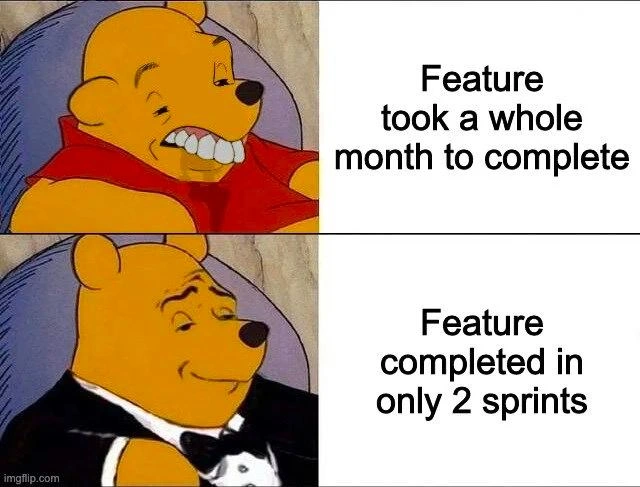
In this two-panel Winnie-the-Pooh meme, we witness a classic case of Agile spin-doctoring. In the top panel, a grumpy casual Pooh hears the frank statement, “Feature took a whole month to complete.” This is the unvarnished reality — four weeks of development slog. Pooh’s grimace says it all: a month sounds like an eternity to impatient stakeholders or deadline-obsessed managers. In the bottom panel, however, Pooh is decked out in a tuxedo with a smug half-smile as he appreciates the rephrased triumph, “Feature completed in only 2 sprints.” Same four-week timeline, but now expressed in Scrum terminology that makes it feel like an achievement. It’s the identical duration dressed up to impress, as if putting a tuxedo on the timeline itself. The humor hits home for seasoned developers because we’ve all seen how simply rebranding a month-long effort as an Agile win can magically change the narrative. It’s the fancy Pooh meme format applied to project reporting: plain truth versus posh phrasing. Here, “a month” (bleh, sounds slow) undergoes Agile alchemy to become “only two sprints” (hooray, sounds swift!).

Why is this funny to anyone who’s survived a few Scrum cycles? Because it satirizes the way management and Product Managers often obsess over velocity metrics and optics. A sprint in Scrum is a fixed time-box (commonly 2 weeks) for planned work. So 2 sprints usually is roughly a month of work – just chopped into two bite-sized iterations. By saying “only 2 sprints,” the team or manager is basically performing a linguistic sleight of hand. They’ve taken a 4-week timeline and spun it into Agile-speak, knowing it will sound more palatable. It’s like they’re whispering, “Don’t worry, we’re Agile, so this isn’t a delay, it’s two time-boxed deliveries!” That little word “only” is doing some heavy lifting here, turning what could be read as a drawn-out timeline into something that feels right on schedule. It’s a cheeky reminder that in corporate tech culture, how you frame it can matter more than the raw facts.

Let’s put those two statements side by side to see the transformation:

Plain Reality Agile Spin Phrasing
Feature took a whole month to complete. Feature completed in only 2 sprints.

The content is identical in meaning — one month of effort — but the framing is completely different. The left phrasing is the plainspoken truth: it took a full month. The right phrasing is the polished Scrum version: it sounds like a triumph (“only two sprints!”). Notice how month feels like a long time, whereas sprint invokes a sense of speed. In Agile terms, delivering a feature in two sprints implies a steady, predictable pace, maybe even an accomplishment if it was originally estimated as a two-sprint job. To a client or executive not intimately familiar with the actual work, “two sprints” sounds routine — after all, sprints are how work gets done in Agile, right? But “a whole month” might set off alarm bells about delay or bloat. The meme nails the absurdity of this velocity_metric_spin: it’s essentially a PR trick for timelines.

Seasoned devs find this hilarious (and painfully familiar) because it reflects a common Agile pain point: sometimes the process turns into a game of optics. We’ve seen managers morph into scrum spin-doctors, reframing any slippage or lengthy effort in Scrum-friendly terms. Did the team overshoot the initial estimate? Just say we “completed it in the first week of Sprint 3,” rather than admitting it ran 2 weeks late. Was the project a mini-death march all month? Don’t mention four 60-hour weeks – report it as “delivered in a two-sprint timeframe” with a straight face. It’s a darkly comic reality: the deadline pressure is still there, but Agile lingo gives cover to save face. This aligns with Goodhart’s Law in action: when the organization fixates on a metric (say, consistently finishing work within 2-sprint increments), people will optimize for that metric – even if it means simply changing the wording of the status update. The actual work doesn’t magically speed up, but the storytelling around it sure does get an upgrade.

Under the hood, Agile teams plan and measure work using story points and velocity. Story points are an abstract unit to estimate effort, and velocity is how many points a team typically completes per sprint. Let’s say the team estimated this feature at 40 story points total, expecting to finish around 20 points per sprint. Delivering it in “2 sprints” means the team met their planned velocity of ~20 points per sprint. From a metrics perspective, everything looks on track – the burndown chart probably shows steady progress down to zero by the end of Sprint 2. To a Scrum Master or Project Manager in a status meeting, this is reported as a win: the team delivered the feature within the expected two-sprint window. All boxes checked ✅. Now, to the devs who lived through those four weeks, it might have felt like an eternity of debugging and hair-on-fire moments. But you won’t see that in the PowerPoint slide to leadership; you’ll see a neat note about accomplishing the goal “within two sprints” to imply a smooth, Agile operation. It’s a brilliant little piece of corporate management humor – the kind that makes engineers smirk and cry inside at the same time. We know that two sprints = one month in plain English, but hey, saying it the Agile way is an instant morale boost (or so the PMs hope).

Ultimately, this meme lands so well with developers who’ve been through Sprint Planning and endless stand-ups because it exposes the gap between Agile theory and real-world practice. Agile evangelism preaches honest, transparent communication and embracing reality (responding to change, etc.), yet here we are chuckling at how the same timeframe can be repackaged to sound like a success. It’s a gentle nod to the cynicism that grows after you’ve seen a few too many Jira charts and management spin. We laugh because it’s true: sometimes, the fastest way to satisfy a stakeholder is not to work faster, but to talk faster – dressing up the timeline in Agile attire so everyone feels better. Fancy Pooh in his tux is basically the Project Manager treating a routine month of work like it’s an elegant achievement. And as jaded as we may be, you have to admit, it’s pretty clever — in a slightly absurd, “this is fine 🔥” kind of way.

Description

Two - panel Winnie-the-Pooh meme. Top panel: casual Pooh in his red shirt grimacing; to the right in black text it reads, “Feature took a whole month to complete.” Bottom panel: the refined Pooh in a black tuxedo, half-smiling with raised eyebrows; adjacent text reads, “Feature completed in only 2 sprints.” The joke highlights how simply expressing the same four-week duration in Agile terminology makes it sound like a faster, more palatable achievement to stakeholders, poking fun at velocity metrics, sprint framing, and managerial spin within Scrum teams

Comments

11
Anonymous ★ Top Pick Stakeholder calculus 101: a 20-day Gantt bar becomes a “velocity surge of two 40-point sprints” the moment you swap Excel for Jira
  1. Anonymous ★ Top Pick

    Stakeholder calculus 101: a 20-day Gantt bar becomes a “velocity surge of two 40-point sprints” the moment you swap Excel for Jira

  2. Anonymous

    The real skill isn't delivering faster - it's knowing that 'two sprints' sounds infinitely more agile than 'four weeks' in the quarterly board deck, even though your burndown chart still looks like a ski slope in Aspen

  3. Anonymous

    Ah yes, the classic Agile sleight of hand: reframing 'one month' as 'two sprints' to make it sound more impressive. It's the software equivalent of a restaurant charging $12 for 'artisanal hand-crafted H2O' instead of tap water. Senior engineers know that whether you call it 4 weeks, 2 sprints, 8 standups, or 1/12th of a year, the feature still took the same amount of calendar time to ship. But hey, at least 'completed in 2 sprints' looks better in the retrospective slide deck and gives management something to celebrate while we're already three sprints deep into the next 'quick win' that'll somehow take six months

  4. Anonymous

    2 sprints: Agile's genius rebrand for 'a whole month' - because velocity metrics hide calendar reality

  5. Anonymous

    Funny how throughput doubles when you measure time in sprints; our velocity stayed flat - only the calendar API got refactored

  6. Anonymous

    We didn’t ship sooner; we just converted Gregorian to Scrum UTC and gained 20% ‘velocity’ on the exec dashboard

  7. @yysva 3y

    **2 springs

  8. @feskow 3y

    Wtf are sprints...

    1. @jor_ban 3y

      Something about racing

    2. @wowwhatagirl 3y

      Read about the scrum system

      1. @feskow 3y

        Thanks I will

Use J and K for navigation