Skip to content
DevMeme
4417 of 7435
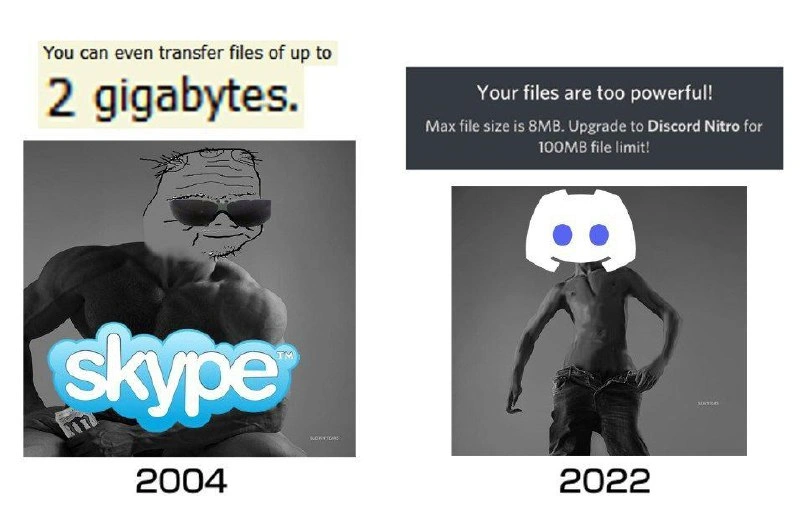
2004 Skype Flexes on 2022 Discord Over Free File Transfers
Communication Post #4837, on Aug 31, 2022 in TG

2004 Skype Flexes on 2022 Discord Over Free File Transfers

Why is this Communication meme funny?

Level 1: Big Box vs Little Box

Imagine you have two friends who can help you send a birthday gift. In 2004, your friend Skype showed up with a huge truck – you could load a giant box (up to 2GB worth of stuff, which is a lot) and he’d deliver it for free. He’s strong and doesn’t mind carrying something really heavy; it’s just how he rolls. In 2022, your new friend Discord comes along with a tiny car. You try to give him a box, and he says, “Whoa, that’s too big! I can only take a little package (8MB size). If you want me to carry a bigger box, you’ll have to pay for my special moving service (Discord Nitro).” It’s a bit like going from a super helpful, strong friend who’d do it for free to a weaker friend who asks for money to do the same job. This is funny in a head-shaking way because usually we expect things to get better over time, not worse. We laugh because the old friend from way back could handle a big gift easily, but the new friend struggles with even a small one unless we give him extra cash. It feels backwards, and that little twist is what makes it humorous and relatable – especially to anyone who’s tried to send a big file to a buddy and been told, “Nope, too big!”

Level 2: File Limits and Nitro Explained

Let’s break down the technical jokes and references for those newer to the scene. On the left (labeled 2004), we have the old-school program Skype. Skype is a communication tool, originally famous for internet voice and video calls (hence the tag SkypeCalls), but it also let users send files back and forth. The meme highlights that Skype allowed file transfers up to 2 gigabytes in size. To clarify, 2 GB (gigabytes) is 2,000 megabytes, which is a lot of data – roughly equivalent to an entire movie file or tens of thousands of pages of documents. In 2004, this was an outrageously high limit for a chat program; most files people sent then were much smaller (think a few MB for photos or songs). Skype’s ability to go up to 2 GB was basically saying, “Don’t worry about file size, we’ve got you.” The muscular figure with sunglasses and the Skype logo is an internet meme character meant to symbolize strength, confidence, and a bit of bragging. It visually says, “I’m powerful – look what I can do!” Here, that power refers to Skype’s robust file-sharing capability.

On the right (labeled 2022), we see the Discord logo on a skinny, unimpressive figure. Discord is a modern communication platform popular for group chats, communities (called DiscordServers), voice chat, and collaboration. Developers and gamers use it heavily to work together or hang out. Discord, however, imposes a file_size_limit of 8 MB (megabytes) for any file upload on the free plan. 8 MB is actually pretty small – for example, a single high-resolution image or a medium-quality PDF can be near that size. Above the skinny Discord figure, the meme shows a dark dialog box (like a screenshot of Discord’s interface) saying: “Your files are too powerful! Max file size is 8MB. Upgrade to Discord Nitro for 100MB file limit!” This is exactly what Discord tells you if you try to upload anything larger than 8 MB. It’s half technical limit, half cheeky error message (“too powerful” is a humorous way to say “too large”). The meme compares 8 MB vs 2 GB to make the contrast clear: modern Discord allows 250 times smaller files than old Skype did for free.

Now, what’s Discord Nitro? Nitro is Discord’s paid subscription plan. If you pay for Nitro, one of the perks is you can upload files up to 100 MB in size to Discord, instead of the measly 8 MB. Nitro isn’t free – you have to shell out a monthly fee. The meme is poking fun at how Discord basically says, “If you want to send bigger files, you gotta pay.” This is an example of a freemium_upgrade_pressure: the app is free to use for basic things, but it pressures you to upgrade (pay money) for advanced features, in this case larger file sharing. Many modern apps use this freemium model (basic tier free, premium tier paid with extra features).

Why does this matter to developers? In everyday developer work (DevExperience_DX), people often need to share files like logs (text records of what a program did), crash dumps (records from a program that crashed, which can be quite large), or build artifacts (like compiled programs, installation packages, or data sets). These can easily be tens or hundreds of megabytes. If a team is using Discord to collaborate and someone tries to post a 20 MB log file to diagnose a problem, they’ll hit that error message. It’s a tooling frustration because it interrupts the workflow – now the dev must find another way (maybe compress the file, split it, or use a different service like Google Drive or a file-sharing site) just to get their teammate a piece of data. That’s inconvenient, especially when time is critical (say you’re debugging an urgent issue). It’s a very relatable dev experience – nearly every programmer has run into a situation where a tool’s arbitrary limit or paywall got in the way of quick collaboration (collaboration challenges indeed!).

Let’s talk a bit about why this difference exists, in simpler terms. Skype (2004) used a technology approach called peer-to-peer (P2P). This means your computer would directly connect to your friend’s computer to send the file; Skype’s network was more decentralized. It didn’t cost Skype much for you to send a file because they weren’t handling all of it on a central server. In contrast, Discord (2022) uses a more centralized model: when you send a file on Discord, it typically goes to Discord’s servers in the cloud and then to your friend. That means Discord is doing the heavy lifting of moving or storing that file, which costs them money (servers, bandwidth). So from a business perspective, Discord set a low limit (8 MB) for free users so that people who often send bigger files will consider paying for Nitro, which helps Discord cover costs and make profit. This can also lead to a bit of vendor lock-in: if your whole team or community is on Discord (which is very common), you might feel pressured to pay for Nitro rather than switch to another tool, because all your friends are here (communication gap in switching tools). The meme is light-heartedly complaining about this modern reality: earlier tech gave us more freedom out-of-the-box, while newer tech sometimes gives less unless you open your wallet.

The categories listed, Communication and DeveloperExperience_DX, tell us this is about tools developers use to communicate and how that affects their day-to-day experience. Tags like messaging_platform_comparison, legacy_features_removed, and freemium_upgrade_pressure all hint at the theme: comparing an old messaging platform (Skype) with a newer one (Discord), noticing that a useful feature (large file transfers) from the old days has been limited or “removed” in the new era, likely to push upgrades. The humor here is a mix of TechHumor (you have to know a bit about these tools to get it) and genuine frustration – it’s funny because it’s true! Devs share this meme to commiserate: “Remember when sending big files was simple? Now we get this silly ‘too powerful’ message, ugh.”

Level 3: Freemium Frustrations

This side-by-side meme hits home for seasoned devs because it satirizes a regression in user experience that we’ve all felt. In the early 2000s, Skype was like the wild west of internet tools — it felt innovative and unbridled. Need to send your teammate a massive 1.5GB log file or a compiled build artifact? No problem, Skype’s got you. The left panel’s ultra-buff Wojak donning the Skype™ logo personifies that era’s feature muscle. Skype could handle file transfers so large they’d spill over multiple CDs; it flexed on the notion that any normal user would ever need such generosity. And indeed, many DeveloperPainPoints (like sharing large crash dumps or VM images) were solved by simply dragging-and-dropping into a Skype chat. Sure, it might take all night on 2004 internet speeds, but it was free and built-in, no questions asked.

Now contrast that with the right panel’s frail Wojak sporting a Discord logo for a head — the epitome of modern ToolingFrustration. By 2022, Discord has become the de facto community and team chat app, especially among devs and gamers. But try to share something as humble as a 9MB log file in a Discord server and you get slapped with that dark popup: “Your files are too powerful! Max file size is 8MB.” Ouch. The meme quotes this almost verbatim because it’s a phrase seared into our collective memory. It’s the digital equivalent of a bouncer stopping you over a trivial dress code rule. For a developer who just wants to send a crash dump or a high-res screenshot to a colleague, being told their file is “too powerful” is equal parts TechHumor and irritation. It’s a comically hyperbolic way to say “too big,” as if your modest log file is some kind of dangerous artifact that must be contained. We chuckle because it’s an error message that feels both absurd and all-too-familiar.

Behind that chuckle is a groan about freemium_upgrade_pressure. Discord’s free tier hard-caps file uploads at 8 MB explicitly to nudge you towards Discord Nitro, their paid subscription, which raises the limit to 100 MB (still far below Skype’s 2 GB flex). The meme frames this as “2004 vs 2022” to highlight how something as basic as file transfer seems to have devolved. It’s the old guard calling out the new: “Back in my day we sent 2 GB for free!” versus “Now you want me to pay for what used to be baseline.” Experienced developers see the broader pattern here: once-novel features becoming basic expectations, then suddenly getting paywalled by a new wave of SaaS tools. It’s a commentary on VendorLockIn and monetization tactics. Discord knows many communities (open-source projects, gaming clans, developer groups) practically live on their platform — that’s the lock-in of network effect. So they also know that when that “file too powerful” message appears, a fraction of users will sigh and pony up for Nitro, because emailing the file or switching platforms is just too cumbersome. The result is a premium on convenience, and an almost oxymoronic situation: our 2022 ultra-broadband, cloud-driven world imposes stricter limits on file sharing than the early 2000s tech did. From a DeveloperExperience_DX perspective, this feels backward. We’ve come to expect progress with time — faster tools, bigger limits, better CollaborationChallenges solved — so it’s darkly funny (and a bit sad) to see an essential capability shrink unless you pay.

Older devs and IT folks in particular remember when SkypeCalls were the new hotness and how file transfer was a non-issue then. This creates a shared nostalgia and a bit of incredulity: How did we end up here? The meme’s humor thrives on that question. It exaggerates with the buff vs. skinny imagery to make a point: somewhere along the way, our Communication platforms got ripped in other areas (Discord is great for voice, text, integrations, scalability in servers) but skipped leg day when it comes to something as fundamental as sending files. And we all know why — money. In the 2000s, a free product like Skype could offer big freebies either because the costs were offloaded (P2P) or because user growth was valued over short-term monetization. By 2022, however, the norm is every free service has a catch; there’s always a Nitro, a Pro tier, a something-plus waiting to upsell you. The meme lampoons this SaaS zeitgeist: the legacy_features_removed vibe of “we had this 18 years ago, what gives?” combined with the annoyance of CollaborationChallenges (like trying to quickly share a log during a debugging session and hitting a roadblock). It’s extremely RelatableDevExperience – pretty much anyone who’s worked on a team in the last decade has run into some “sorry, that’s for premium users” moment at the worst time. So the senior folks smirk at this image and think, “Yup, sounds about right. Progress, huh?”

Level 4: Peer Power vs Paywall

In 2004, Skype’s architecture harnessed true peer-to-peer might. Under the hood, Skype operated on a decentralized network of user-run “supernodes” (a design influenced by its creators’ earlier P2P project, Kazaa). This meant when you sent a file on Skype, it often went directly from your machine to your friend’s, zigzagging through a mesh of peers without burdening a central server. The result? Huge file transfers — up to 2 GB — were not only possible but actually encouraged. Back then, 2 GB was an absurdly generous cap (consider that in 2004, many hard drives were only 40-80 GB and broadband upload speeds were measured in kilobytes per second). Yet Skype flexed those P2P muscles to let you share a CD’s worth of data in one go. Architecturally, Skype’s distributed approach scaled by offloading work to the network’s edge; it avoided a single choke point, so the concept of a strict file_size_limit felt almost unnecessary. The network and your own bandwidth were the main constraints, not an arbitrary policy.

Fast forward to 2022: Discord runs on a classic cloud-based client/server model — all messages and file uploads funnel through centralized DiscordServers and storage. This centralization simplifies user experience but means Discord pays the bandwidth and storage bill for every file shared. From a systems perspective, letting millions of users freely shuttle 2GB files would turn Discord into a free CDN, potentially choking their infrastructure and racking up huge costs on the back end. So the 8 MB cap for free users isn’t just evil laughter in a boardroom; it’s a deliberate trade-off to throttle load and encourage only light file sharing unless costs are covered. The decision is part network economics, part freemium model design. Modern SaaS platforms are engineered with these limits because, unlike pure P2P, each byte of an upload might hit centralized disks and pipes that the company must scale, monitor, and pay for. In essence, Discord built a paywall where Skype relied on peer power. It’s a fascinating inversion: early internet communication tools leaned on distributed architecture and in doing so gave users more freedom (and responsibility), whereas contemporary cloud-based Communication platforms often trade that freedom for centralized control and monetization. The meme humorously highlights this architectural and economic reversal: the beefy 2004 Skype (P2P muscle, unlimited swagger) versus the scrawny 2022 Discord (cloud burden, monetization shackles). One shows off raw technical brawn, the other conserves strength unless you feed it cash via Nitro.

Description

Two side-by-side grayscale panels compare file-sharing limits. Left panel (captioned “2004”) shows a hyper-muscular, sunglasses-wearing Wojak figure with the bright blue Skype™ logo covering his torso; above him, yellow-highlighted text reads, “You can even transfer files of up to 2 gigabytes.” Right panel (captioned “2022”) shows a skinny figure striking a weak pose with a white Discord logo for a head; above, a dark dialog box states, “Your files are too powerful! Max file size is 8 MB. Upgrade to Discord Nitro for 100 MB file limit!” The meme contrasts generous early-2000s peer-to-peer Skype transfers with Discord’s modern 8 MB gate unless users pay, lampooning how contemporary SaaS monetization can regress core functionality. Developers familiar with sharing large logs, crash dumps, or build artifacts in chat will relate to the inconvenience and the paywall-driven “feature downgrade.”

Comments

32
Anonymous ★ Top Pick 2022 DevOps: we autoscale 10k pods and stream terabytes to S3, yet I’m still rar-splitting a 9 MB core dump because Discord thinks it’s “too powerful” - might as well container-run 2004 Skype as our file-transfer microservice
  1. Anonymous ★ Top Pick

    2022 DevOps: we autoscale 10k pods and stream terabytes to S3, yet I’m still rar-splitting a 9 MB core dump because Discord thinks it’s “too powerful” - might as well container-run 2004 Skype as our file-transfer microservice

  2. Anonymous

    Remember when we complained about Skype's 2GB limit being too small? Now we're paying $10/month for the privilege of sending a 100MB log file that would've been emailed as a zip in 2004. Next thing you know, we'll need a premium subscription to use more than 80 columns in our terminals

  3. Anonymous

    Ah yes, the classic 'innovation' trajectory: from 2GB free file transfers in 2004 to 8MB in 2022 - truly a testament to Moore's Law running in reverse. Nothing says 'modern cloud infrastructure' quite like artificially crippling basic functionality that was solved two decades ago, then charging $10/month to unlock a fraction of what Skype gave away for free when dial-up was still common. At this rate, by 2040 we'll need Discord Platinum to send messages longer than 140 characters

  4. Anonymous

    Skype 2004 shipped your monorepo for free; Discord 2022 demands Nitro tribute for a single Dockerfile

  5. Anonymous

    Skype’s P2P let you sling 2GB on someone else’s uplink; today’s centralized Discord runs through a CDN, so your 9MB crash dump hits an implicit HTTP 402 until you buy Nitro

  6. Anonymous

    In 2004 Skype punched through NAT to sling 2GB installers; in 2022 my 9MB flamegraph is 'too powerful' unless I buy Nitro - apparently object-storage egress margins beat UDP bravado

  7. @exhausted 3y

    skype used p2p for a file transfer 🤷🏻‍♂️

    1. @RiedleroD 3y

      did it? damn. truly acceptable 🙂👍 unlike discord 😕👎

      1. dev_meme 3y

        Skype had almost everything p2p and truly decentralised, unlike modern crypto startups Tho now all patents owned by Microsoft so it’s kinda hard to do something cool from legal standpoint, lol

    2. @plusdanshi69 3y

      discord cant even use p2p lol it sucks so much

  8. @choke_hazard 3y

    Both still shitty though

    1. @ahmubashshir 3y

      meanwhile telegram: free? 2gb for ya. premium? 4gb is all you get, upload tfyw

      1. @daniilfurgen 3y

        however speed is meh even on gigabit connection. I was blaming my 100mbps connection previously but when got gigabit I have understood that it is just Telegram what is slow

        1. @deerspangle 3y

          Yup, they boast premium gets priority downloads, but... It's still super slow loading up stickers and stuff. It's just telegram being slow and bad at caching.

      2. @choke_hazard 3y

        I'm ok with that since they are messengers not file hosts and I don't use them to send 4k movies. As a messenger telegram like x5 better than skype or discord

        1. @freeapp2014 3y

          Discord is a bit better for big communities with complex structures, since you have things like multiple channels, roles with granular access control and others And Skype is pretty much just a business tool at this point, even like grandmothers use other apps like whatsapp, viber or telegram But yes, telegram is definitely much better than whatsapp or viber

          1. @furqan 3y

            people still use viber?

  9. @ygerlach 3y

    torrents: unlimited

    1. @sylfn 3y

      the hard drive you are downloading torrent to: lmao

      1. @SamsonovAnton 3y

        cloud storage you mount as your torrent's placeholder: 😎 cloud storage bills you get for it: 😱

      2. @freeapp2014 3y

        Download to /dev/null, easy unlimited free storage Like and follow for more lifehacks!

        1. @sylfn 3y

          next post: how to read actual data from /dev/null

          1. @freeapp2014 3y

            It’s called /dev/random

            1. @RiedleroD 3y

              urandom for unsigned randomness

              1. Deleted Account 3y

                lol

  10. @ygerlach 3y

    2x10TB RAID 0 :D

  11. @frag_er 3y

    https://youtu.be/j80UUgnJ6Cw

    1. @Crusader 3y

      Eternal classic

  12. @freeapp2014 3y

    pacat?

  13. @affirvega 3y

    cat /dev/speaker > /dev/null

  14. @affirvega 3y

    chaotic neutral

  15. Deleted Account 3y

    swisstransfer.

Use J and K for navigation