The True Measure of a Desperate Debugging Session
Why is this Debugging Troubleshooting meme funny?
Level 1: Needs Quiet to Think
Imagine you’re trying to solve a really hard puzzle or do a difficult homework problem, and you have your favorite music playing. Usually the music might even help you relax. But this problem is so tricky that you eventually turn off the music and say, “I need it to be quiet so I can think!” That’s exactly what’s happening in this comic, but with a computer programmer.
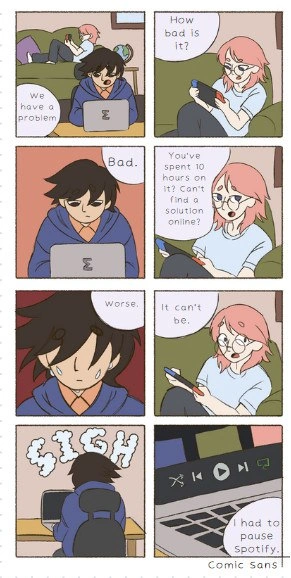
The comic shows two friends who are coders. One of them has a big problem with their code (something isn’t working right and it’s very hard to fix). The friend asks how bad the problem is. The conversation goes like this: the programmer says “we have a problem,” and the friend asks “How bad is it?” The programmer says “Bad.” The friend asks, “Did you spend 10 hours on it and not find anything on the internet to help?” The programmer says, “worse.” The friend is shocked and says, “It can’t be.” Then the programmer shows that he even paused his music on Spotify because the bug was so bad. In simple terms: the issue was so tough that he had to stop listening to his songs to focus completely on fixing the code.
For a programmer, pausing their music is a big deal because they love to code with some tunes in the background. It’s like their brain’s comfort food while working. So when he says he had to pause Spotify, it’s a funny, exaggerated way of saying “this problem is super serious.” It’s similar to how if you were driving a car and got lost, you might turn down the radio so you can concentrate better on finding the right path. Or if you’re reading a hard book and the TV is on, you turn off the TV to concentrate. We find it funny in the comic because the programmer acts like pausing music is the ultimate emergency measure. It shows just how frustrated and focused he is: he even gave up something he enjoys (his music) until he can solve this big coding puzzle. The humor comes from treating a normally small thing (turning off music) as if it’s a dramatic, “unthinkable” action – which tells us, in a silly way, just how severe the coding problem must be. It’s a playful reminder that sometimes, when you’re really stuck on a problem, you need silence to concentrate – and to everyone around, that silence says “Whoa, do not disturb, serious problem-solving in progress!”
Level 2: Pause Button Panic
This meme is a short comic strip that shows two programmer friends and how a coding problem becomes a mini-crisis. In simple terms, one developer has run into a really bad bug (a bug is a mistake or error in the code) and is struggling to fix it. The panels use dialogue to build up how serious the situation is, ending with the shocking fact that the coder even stopped their music on Spotify just to concentrate. For developers, that’s a humorous way to say “all hands on deck, this is not a drill!”
Let’s walk through the panels and why they’re funny, especially if you’re new to coding culture. In the first panel, the dark-haired coder says, “we have a problem,” and he looks stressed, sitting on the floor with his laptop. His pink-haired colleague, lounging on the sofa, asks, “How bad is it?” You can tell from this that something is wrong with the code they’re working on. When the coder simply answers “Bad,” it means the bug is serious. The colleague then asks, “You’ve spent 10 hours on it? Can’t find a solution online?” This question reveals two things: first, the coder has already spent a long 10 hours debugging (which is a really long time to be stuck on one problem), and second, they have tried looking up the issue on the internet but found nothing helpful. Typically, when programmers get stuck, they search sites like Stack Overflow or Google for error messages and fixes. Stack Overflow is a famous Q&A website where developers post problems and others offer solutions. If you can’t find your error or question on Stack Overflow, that usually means the bug is uncommon or tricky. So the colleague is basically asking, “Is it that bad that even the internet doesn’t have an answer?” The dark-haired dev responds, “worse.” This makes the friend (and the reader) think, “Oh no, what could be worse than no online solution after 10 hours of effort?”
The next panel shows the pink-haired friend with wide eyes saying, “It can’t be.” They’re anticipating something almost unthinkable in the programmer world. And then we get the dramatic reveal: the dark-haired coder had to pause his Spotify music. The final image zooms in on a music player’s controls with the pause symbol active, and the caption confirms, “I had to pause Spotify.” For many developers, listening to music (often via Spotify or another music app) is a normal part of coding. It helps them focus or at least makes work more enjoyable. They might have their headphones on or speakers playing their favorite playlist while they write and debug code. So why is pausing the music such a big deal? Because it means the bug is so challenging that even music became a distraction. The programmer needed absolute silence to concentrate on the problem. It’s like saying, “This issue is so bad that I can’t even enjoy music until it’s solved.” That’s a huge thing in a coder’s daily routine, and it’s presented as the last straw in this comic. The humor comes from the idea that pausing music is almost a taboo or extreme measure for a programmer — something they’d only do in an emergency. It exaggerates the importance of background music in a programmer’s life for a funny effect. Essentially, the comic is using DeveloperHumor to highlight how absorbed in debugging a developer can get: they’ll even give up their tunes if that’s what it takes to fix the code!
Let’s break down some of the technical bits in plainer language. Debugging (or troubleshooting) is the process of finding what’s causing a problem in your code and fixing it. It often involves running the code, seeing where it goes wrong, reading error messages, and trying different solutions. It can be straightforward or it can turn into a detective mission that takes hours. Here the comic says the person spent 10 hours debugging – that signals this was a really stubborn bug. Next, finding a solution online usually means searching the error or problem keywords on Google, or directly on forums and sites where programmers help each other. If nothing comes up, that’s pretty discouraging. Imagine if you had a very specific question and when you search for it, no one on the entire internet seems to have asked or answered it before – you’d feel pretty alone! That’s how this developer feels. The friend’s shocked face and “It can’t be” line show that even another programmer knows how dire that situation is. It’s like a shared understanding: “No solution on the internet? This really is the worst-case scenario.”
Now, about the Spotify part: Spotify is a popular music streaming service, and many people (not just programmers) listen to music on it while working. In tech offices and coding communities, it’s almost a stereotype that programmers wear headphones and have music on while coding. It helps them get into a flow state, which means a deep focus where they can really think about the code without their mind wandering. You might hear this called being “in the zone.” Music, especially instrumental or familiar tracks, can actually help some developers block out distractions and maintain a rhythm in their work. It’s a little trick for better developer productivity. So what happens if a programmer turns off their music? Typically, it means they need zero distractions now – the issue they’re working on requires their full brainpower. This is the flow_state_interruption we’re talking about: their flow (focus) got interrupted by how hard the bug is, and they willingly stopped the music to try and get back into that zone at a deeper level. It’s the programmer equivalent of saying, “Everyone, quiet, I need to think!”
The comic plays with this idea in a funny way. The final panel doesn’t even show the characters talking. Instead, it shows the media player UI with the pause button engaged. Any Spotify user will recognize that interface instantly – the play triangle ▶️ is showing, meaning the music is currently paused (since if the music were playing, we’d see the pause icon || instead). By using this image, the comic lets us see the crucial moment rather than just read it. The little “play” icon lit up is universally understood: music is not playing. And then the caption “I had to pause Spotify” drives it home. For a non-programmer, pausing music might not seem like a big deal, but in the context of coding life and this joke, it’s the final stage of a programmer’s desperation.
Also, there’s a tiny joke in the art: the signature says “Comic sans!” in the corner. This is likely the artist’s playful tag, referring to the font Comic Sans. Why is that funny? Well, Comic Sans is famously known among designers and developers as a font you’re not supposed to use in serious situations (people consider it childish or cheesy looking). It’s kind of an ongoing gag in tech and design circles. By writing “Comic sans!” as a sign-off, the artist is winking at the audience, adding an extra layer of inside humor. It matches the lighthearted tone of the strip.
In summary, this comic shows a programmer’s worst day in an exaggerated, humorous way. The steps are: big coding problem, long hours debugging, no help from the internet, and finally the paused_music moment – giving up the beloved Spotify playlist. It highlights how important focus is to developers (a key part of DeveloperExperience at work) and how even something as small as pausing a song can be played up as a dramatic event. It’s a slice of CodingHumor that’s funny to developers because it’s rooted in truth: sometimes debugging really does make us so desperate that even music, coffee, or other comforts get put aside until we conquer the code.
Level 3: The Sound of Silence
In the world of developer humor, pausing music during coding is practically an apocalyptic scenario. This comic escalates a debugging crisis to the point where the dark-haired coder does the unthinkable: pausing Spotify mid-session. For seasoned engineers, that single act speaks volumes. It indicates the bug at hand is so severe that the programmer needs to go into emergency focus mode, eliminating even their beloved background tunes. Beneath the joke, the comic nails a truth of coding life: tough bugs can push developers to extreme measures. It’s poking fun at that special brand of developer frustration we all know too well, the kind of debugging headache that forces you to sacrifice your usual comforts.
The dialogue frames this escalation like a dramatic horror story for coders. The pink-haired colleague cautiously asks, “How bad is it?” and our slumped developer flatly replies, “Bad.” Next comes the probing question every programmer dreads: “You’ve spent 10 hours on it? Can’t find a solution online?” – in other words, “Did even Stack Overflow fail you?” When the coder mutters “worse,” the colleague incredulously responds, “It can’t be.” This “it can’t be” moment shows a shared understanding of what’s coming. The final panel delivers the punchline: “I had to pause Spotify.” In developer terms, that’s equivalent to a red-alert alarm. The humor here comes from treating a fairly mundane action (hitting the pause button) as if it were a catastrophic last resort, which in the context of CodingHumor exaggerates how critical uninterrupted music can feel to a programmer’s routine.
Why is paused music such a big deal? Many coders treat music as a background thread for their brain. Having a Spotify playlist on is part of the normal operating environment — it helps maintain a flow state. Flow state (a.k.a. being “in the zone”) is that mental groove where a developer is deeply focused and highly productive, a treasured state for DeveloperProductivity. Music often helps drown out office noise or provides a rhythm that keeps the coder’s mind engaged but not distracted. So when even mellow background tunes become too much to handle, you know the problem is beyond ordinary. Hitting the Spotify pause button is like terminating all non-essential processes to devote 100% CPU to the bug. In fact, this level of flow_state_interruption only happens for the gnarly, mind-bending issues that completely consume your cognitive resources.
To experienced devs, “can’t find a solution online” is a horror in its own right. Usually, when you hit an error or bug, the first instinct is to Google it or search on Stack Overflow. If Stack Overflow (the legendary programmer Q&A site) has zero hits for your error message, you’ve officially entered uncharted territory. It’s both terrifying and a little thrilling. Terrifying because you’re on your own — no quick copy-paste fix, no well-worn blog post to guide you. Thrilling (in a masochistic way) because you might be discovering a truly rare edge case or a new bug that nobody’s documented. The comic highlights this with the “10 hours” line: spending an entire day on one bug is the kind of Debugging_Troubleshooting marathon that every developer encounters eventually. It’s the phase when you’ve tried all the usual tricks, combed through logs, added dozens of print statements, and maybe even dug into library source code. At that point, there’s a sort of resigned sigh — perfectly depicted in the panel where the coder slumps with a big “SIGH” cloud — and that final desperate act of silencing the music. For veteran engineers, this scenario triggers war stories of those 3 AM sessions where the office is quiet, the coffee is cold, and you realize you might be the first person ever to debug this particular issue. It’s a lonely feeling of DeveloperFrustration: you roll up your sleeves, maybe mutter “alright, let’s do this,” and yes, likely pause the music because every neuron is needed on deck.
We can almost express this moment in code-like logic. A senior dev might jokingly write the pseudocode for it as:
# Brain's emergency protocol for extreme bugs
if hours_spent_debugging > 10 and stack_overflow_results == 0:
spotify.pause() # engage maximum concentration mode
This snippet humorously captures the decision threshold: more than 10 hours stuck and no help from the internet triggers spotify.pause(). It’s the brain saying "all chips in". The comic’s humor lands because every programmer recognizes that threshold. It’s the moment when troubleshooting goes from a casual background task to an all-consuming mission.
From a DeveloperExperience perspective, this comic also underscores how crucial a comfortable routine is for productivity. In terms of office culture and DeveloperExperience_DX, many programmers use music and headphones as part of their work habitat. It’s akin to a chef needing their kitchen just so, or an athlete with a pre-game ritual. Disrupting that ritual – voluntarily! – means the situation is serious. Seasoned devs often joke that when the headphones come off or the music stops, you know things are on fire. In real life teams, people might see Bob at his desk with no music and whisper, “Uh oh, Bob turned off his playlist, production bug must be nasty.” It’s funny, but also true that noise or interruptions can wreck a programmer’s concentration. That’s why this scenario resonates: it highlights a flow killer. There’s even industry wisdom about it. We talk about preserving “maker’s time” (long stretches of uninterrupted work) because any context switch — even a quick question or, here, a song lyric catching your attention — can interrupt the flow and set back progress. So the poor coder in the comic isn’t just being dramatic; every dev reading this nods and thinks, “Yep, been there – when even music is a luxury I can’t afford because the bug is that perplexing.”
The visual storytelling amplifies the joke. The sequence of panels in this comic strip is like a mini suspense thriller for software folks, each panel upping the ante. By the final frame, we get a close-up of the music player controls on the laptop screen. The familiar play/pause icon is shown in its “paused” state (the play ▷ symbol is highlighted, meaning the music is currently stopped). Without any words, that image tells the whole story. It’s a clever use of a UI element as a punchline: every developer instantly recognizes that interface (it looks like the Spotify media bar) and understands that silence is now in the room. The choice to zoom in on the paused player is cinematic – it’s the dramatic reveal, the equivalent of showing the empty ice cream tub at the end of a breakup scene (all the comfort is gone!). And as a cherry on top for the observant geek, the artist’s signature in the corner says “Comic sans!”. This is an extra wink of humor: Comic Sans is the infamous font that designers and devs love to mock for its goofy looks. By invoking Comic Sans at the end, the comic stays lighthearted about the whole situation. It’s like the creator is saying, “Don’t worry, we’re still having fun here.” That little comic_sans_punchline Easter egg fits perfectly in a strip about CodingHumor, underlining that the comic itself doesn’t take things too seriously. In summary, the meme hilariously captures a DeveloperExperience nightmare in an exaggerated way: when a bug is so bad that the coder’s world goes silent, you know it’s a epic battle between human and code.
Description
An eight-panel comic strip depicting a conversation between two people. A developer with dark hair, wearing a blue hoodie, is intensely focused on their laptop, which has a Sigma symbol (Σ) on its back. They tell their friend, who is relaxing and playing a handheld game, that there is a problem. The tension escalates through their dialogue as the developer confirms the problem is 'Bad' and then 'Worse', even after 10 hours of work and failing to find a solution online. The friend reacts with growing alarm. The punchline is revealed in the final panels: the developer lets out a dramatic sigh, and a close-up on the laptop shows that the Spotify application has been paused. The friend remarks, 'I had to pause spotify.' The humor is deeply relatable for experienced developers, for whom listening to music is often essential for maintaining a 'flow state' of high concentration. Pausing the music is a ritualistic sign that a bug is so complex or frustrating that it requires absolute, undivided attention, representing the highest level of debugging seriousness
Comments
33Comment deleted
There are three levels of debugging severity: asking for help, actually using the interactive debugger, and turning the music off. The last one is how you know the bug might not be in your code
You know it’s a true P0 when the staff engineer pauses the lo-fi playlist - turns out the only thing louder than Spotify was 15 years of legacy exceptions screaming up the call stack
After 20 years in tech, you realize the scariest production incident isn't data loss or security breaches - it's when your carefully crafted design system defaults to Comic Sans because someone forgot to escape a font-family string in a third-party integration, and now you have to explain to stakeholders why 'professional typography' matters more than the P0 bugs in the backlog
After 15 years in the industry, you learn that the severity of a production incident is inversely proportional to how much it disrupts your Spotify playlist. P0: Entire data center on fire? Fine, I've got my AirPods. P1: Database corruption affecting millions? I can work through it. P2: Have to pause my carefully curated focus playlist and see Comic Sans in the media controls? Time to update the resume. The real technical debt is the emotional trauma of typography crimes rendered in system UI
Our incident runbook’s unwritten step: when you pause Spotify, you’ve reallocated two audio cores to the single‑threaded debugger - next step is killing Slack and calling it Sev‑0
Pausing Spotify for Comic Sans? Peak SRE: the only incident where the RCA is 'taste failure'
Had to pause Spotify - the universal Sev0: switching the brain from eventually consistent to linearizable just to catch the race condition
why is it so bad ? Comment deleted
not a spotify user, but if I stop the music while solving some problem, it means that the problem was too complex to solve it casually Comment deleted
So true Comment deleted
Why on Earth do you listen music during intellectual work, at all? Comment deleted
Distraction, I think many other people will say the same Comment deleted
White noise is the answer, sometimes you wanna hide the incoming sound Comment deleted
To limit your brain power, to stop overthinking. The "F%ck it we ball" brain mode, when you have no mental capacity to become distracted on problem-searching, only problem-solving. Comment deleted
To adjust your brain power to match your pay grade. 👌 Comment deleted
No, hopefully my brain activity don't drop to 0. Comment deleted
also true Comment deleted
It helps you focus. Depends on the kind of music tho Comment deleted
it keeps me awake during casual problems Comment deleted
I have a special playlist (mostly dubstep and vocal-less metal) for that Comment deleted
specially picked out to keep me awake, while also not being too distracting: https://www.youtube.com/playlist?list=PLk5KkYG8je9ALCqvNpXOTvHxcGGCgolPX Comment deleted
works best in shuffle mode, the first few are mostly from my regular music playlist and are a bit more conventional in terms of music Comment deleted
Me too. I have over 48 hours of trance, techno, dubstep, and other types of music (curated to have no lyrics) https://open.spotify.com/playlist/4oUlf4ANOZ70tQftIJnETs?si=b6xxi-v0RP68eWYo55xz-Q&utm_source=copy-link Comment deleted
damn, that's as much as my main playlist Comment deleted
That IS my main playlist! 😁 Comment deleted
so you don't listen to music with lyrics at all? Comment deleted
Never liked lyrics, as far back as I can remember... Comment deleted
damn, ok. I used to be like that too, but I grew to like some kinds of lyrics Comment deleted
* awake while daly video-conferencing. 😅 Comment deleted
well, no. I can't hear speech that well, so I need to turn the music off for video meetings Comment deleted
Because it's fun? Comment deleted
++ Comment deleted
💀💀💀😂😂😂😂 Comment deleted