Roadmap Arithmetic Meets Budget Reality
Why is this Management PMs meme funny?
Level 1: Too Many Chores
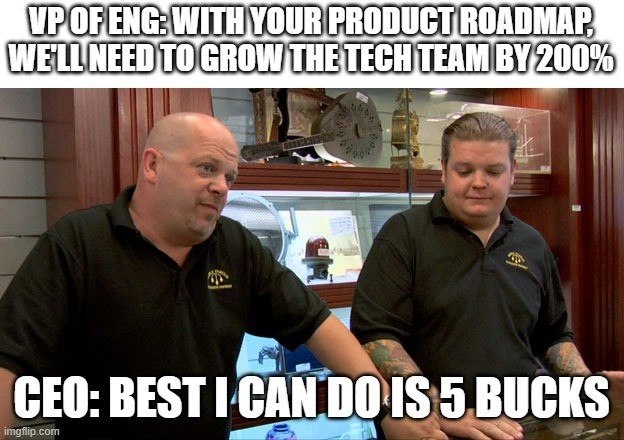
This is funny because one person says, "To do all these jobs, we need way more helpers," and the boss says, "How about almost no help at all?" It is like asking someone to clean the whole school, then handing them one tiny sponge and five dollars.
Level 2: Headcount Is Not Magic
A product roadmap is a plan for what features, improvements, or business goals a product team wants to deliver over time. It usually includes desired launch dates and priorities. The roadmap is useful, but it is not the same as a staffing plan.
Engineering management is the work of matching goals to people, systems, and time. A VP of Engineering has to ask whether the team can realistically build, test, deploy, support, and maintain what the roadmap promises. If the roadmap grows but the team does not, something else has to change: scope, quality, timeline, or morale.
Resource allocation means deciding where limited people, money, and attention go. This meme shows a ridiculous version of that discussion. Engineering says the plan needs a much bigger team. The CEO offers almost nothing. The humor comes from the giant mismatch between the size of the work and the size of the budget.
For a junior developer, this explains why teams sometimes seem stressed even when the work sounds simple. A feature is not only the code you type. It may need design review, backend changes, database migrations, tests, monitoring, documentation, support training, rollout flags, security review, and maintenance after launch. When leadership funds only the visible part, the invisible parts do not disappear. They become future emergencies.
The meme is also about negotiation. A healthy company can say, "With the current team, we can do these three things well, or these ten things badly." An unhealthy one says, "Do all ten, but cheaper," then holds a meeting later to ask why velocity went down.
Level 3: Roadmap Meets Cashflow
The caption sets up the entire management tragedy:
VP OF ENG- WITH YOUR PRODUCT ROADMAP, WE'LL NEED TO GROW THE TECH TEAM BY 200%
and answers it with:
CEO- BEST I CAN DO IS 5 BUCKS
The Pawn Stars-style counter scene is perfect because it turns engineering capacity planning into haggling over a used guitar. The VP of Engineering is describing a resource constraint: the requested roadmap needs far more people, time, or scope reduction. The CEO responds as if staffing is a sticker price and reality might accept a lower offer if everyone keeps a straight face.
The senior-level joke is that both sides may be speaking honestly in different currencies. Engineering is talking in capacity, throughput, maintenance burden, and risk. The CEO is talking in runway, budget, fundraising, margin, and board expectations. The product roadmap lives in the middle, pretending those currencies convert cleanly. They do not. There is no API endpoint where you POST /features with "urgency": "strategic" and receive three backend teams by Friday.
"Grow the tech team by 200%" is also a loaded phrase. Depending on how someone means it, that could imply doubling the team or adding two more teams' worth of people. Either way, it is not a small ask. Hiring engineers requires sourcing, interviewing, onboarding, management capacity, codebase ramp-up, architecture ownership, security access, product context, and enough senior attention that the existing team does not stop shipping while trying to absorb the new one. Headcount is not horizontal autoscaling. New people do not join the cluster and immediately handle production traffic.
The anti-pattern here is roadmap-first planning without capacity modeling. A company lists outcomes, commitments, launches, and stakeholder promises, then asks engineering how to make them happen after the promises have already hardened. At that point, estimates become political documents. If engineering says the plan needs three times the team, that sounds obstructive. If leadership says there is only money for "5 BUCKS," that sounds delusional. Both may be true, which is how quarterly planning becomes performance art with spreadsheets.
The hidden cost is not only missed deadlines. Underfunded roadmaps create architectural shortcuts, weaker testing, poor documentation, rushed onboarding, pager load, and attrition. The team pays the missing budget in overtime, brittle systems, and future migrations. The CEO may save cash this quarter, but the codebase records the debt with compound interest and a surprisingly judgmental stack trace.
Description
A Pawn Stars-style negotiation meme shows two men behind a shop counter with large white impact text. The top text reads, "VP OF ENG: WITH YOUR PRODUCT ROADMAP, WE'LL NEED TO GROW THE TECH TEAM BY 200%" and the bottom text reads, "CEO: BEST I CAN DO IS 5 BUCKS." The humor comes from the gap between engineering capacity planning and executive budget constraints, where an ambitious roadmap is treated like something to haggle over rather than staff realistically.
Comments
10Comment deleted
The roadmap needs horizontal scaling; the budget allocator returned HTTP 402 with a coupon code.
— Yo, dawg! We heard your team of 3 developers cannot keep up with 2 project managers, so we hired 2 more managers to help you with time management. — 🤦♂ Comment deleted
It was funny until it wasn't 😢 Comment deleted
Thanks, I'm going to code something this evening. Work isn't enough Comment deleted
Same same Comment deleted
May the power of focusing be with you Comment deleted
That's definitely true. I don't know how it works, but on Friday evenings I may be more focused... Comment deleted
... on getting a life. 😁 Comment deleted
Is there the advanced book on this subject? With some algorithms, schemas Comment deleted
It's that simple. Just apply 3 drops of Felix Felicis in the morning, and you will be fine. Comment deleted