Skip to content
DevMeme
2866 of 7435
The Silent Sophistication of an Implicit Boolean Check
CodeQuality Post #3166, on May 27, 2021 in TG

The Silent Sophistication of an Implicit Boolean Check

Why is this CodeQuality meme funny?

Level 1: Just Say Yes

Imagine someone asks you a yes-or-no question like, "Did you finish your homework?" A simple answer would be, "Yes." Now imagine answering, "Yes, it is true that I have finished my homework." That second answer sounds overly formal and a bit silly – you're basically just saying "yes" in a long-winded way. In the same way, writing extra words in code (for example, saying something is "equal to true") is like giving that needlessly complicated answer. It’s funny because everyone knows what "yes" means on its own, so adding "is true" is unnecessary. The meme is poking fun at this by showing that the fancier (and better) way is actually to just give the straightforward answer. In other words: if something is true, you can just say yes and leave it at that!

Level 2: No Comparison Needed

This meme is talking about boolean values and how we compare them in code. A boolean is simply a true/false value. In an if statement, you usually don’t need to explicitly compare a boolean to true or false – you can just use it directly. For example, if we have a boolean variable isDone, writing:

if (isDone == true) {
    // do something
}

is unnecessary. The cleaner way is just:

if (isDone) {
    // do something
}

Both versions do the same thing (execute the block if isDone is true), but the second way is shorter and clearer. There’s no comparison needed because if already expects a boolean condition.

Now, in JavaScript (a loosely-typed language), there are actually two different comparison operators for equality: == (double equals) and === (triple equals). The double equals is the loose equality operator. It will perform type coercion (automatic type conversion), which means if the two things you’re comparing are of different types, JavaScript will try to convert one to the other type so it can compare them. For instance, 5 == "5" is true in JavaScript because the string "5" gets coerced into the number 5 and then 5 equals 5. Likewise, doing value == true might convert value to a boolean or convert true to a number behind the scenes, which can lead to confusing behavior if you’re not careful.

The triple equals === is the strict equality operator. It does no type conversion at all. Both sides have to be the same type and value for it to return true. So 5 === "5" would be false, because one side is a number and the other is a string (no sneaky conversion happens). In general, JavaScript developers prefer === for comparisons because it’s more predictable – you know it's not doing any magic in the background.

However, in the case of a simple boolean check, you usually don’t need either == or ===. If isDone is already true or false, if (isDone) is enough to check it. Adding == true doesn’t make it more correct; it just adds extra words. Many programming style guides (Clean Code principles) say that you should avoid redundant comparisons like this, because it makes the code cleaner and easier to read. A reader of the code can understand if (isDone) at a glance (it means "do this if isDone is true"). If they see if (isDone == true), it’s still understandable but feels verbose – like someone stating the obvious.

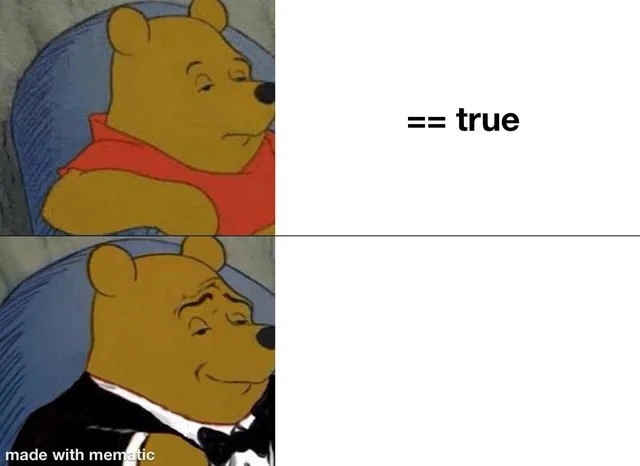
The meme itself uses the Winnie the Pooh meme format to make this point. In the first panel, Pooh in his normal red shirt looks bored or unimpressed next to the text "== true". This represents the dull or sloppy way to write the condition. In the second panel, Pooh is dressed in a tuxedo (often called Tuxedo Pooh or fancy Pooh) and looks proud, with the space next to him blank (implying the improved code). The joke is that not writing "== true" is the "classy" move. It’s a bit of programming or comparison operator humor: we’re joking that a small change in syntax (dropping the == true, or using a stricter check) is akin to Pooh putting on a suit and becoming sophisticated.

For a newer developer, it might seem more "correct" or explicit to write == true (because you’re literally saying equals true). But as you gain experience, you realize that if something is true, you can just let it be true without the extra check. The code becomes more readable and idiomatic. And in languages like JavaScript, avoiding == also helps prevent weird surprises from type coercion.

So, in summary: the meme is highlighting a small code quality tip. Don’t compare a boolean to true in a condition – just use the boolean. It’s cleaner, and in JavaScript specifically, if you ever do need to compare values, use === to avoid any hidden type conversions. Pooh in his tux is basically saying, "Ah, much better!" to the cleaner code.

Level 3: Equality Etiquette

In this meme, a classic Winnie the Pooh two-panel format highlights a coding style contrast. The top panel shows casual Pooh looking unimpressed at the code == true. This represents a developer writing an explicit boolean comparison in code, which experienced programmers consider a bit naive or unnecessary. The bottom panel features Tuxedo Pooh smirking in a fancy suit with a blank space – implying a more refined approach to the same problem. In other words, Pooh-in-a-tux approves of writing the condition more elegantly, either by using the strict equality operator or by omitting the redundant comparison altogether.

So why is == true considered sloppy? In languages like JavaScript, == is the loose equality operator, meaning it tries to be "helpful" by performing type coercion. This operator will convert one side to match the type of the other side before comparing, which can lead to quirky results:

  • For example, '0' == false in JavaScript evaluates to true – because '0' (a string) is coerced to the number 0, and false is coerced to 0 as well, so it thinks they're equal.
  • Similarly, 1 == true is true (both become the number 1 under the hood), but 2 == true is false (2 becomes 2, true becomes 1, and 2 != 1).

Because of such odd rules, seasoned JavaScript developers prefer ===, the strict equality operator, which does not perform any conversion. With ===, values must be exactly equal in both type and value to return true. So '0' === false correctly yields false (string vs boolean, no sneaky conversion). In fact, many codebases enable a linter rule (like ESLint’s eqeqeq) that forbids using == at all, precisely to prevent these sorts of bugs.

Now, how does this relate to writing == true specifically? When a variable itself is boolean, writing if (isActive == true) is redundant. The condition in an if statement already expects a boolean context, so you can (and should) just write if (isActive). Adding == true is like explicitly asking "is this true equal to true?" Every experienced dev reading that will roll their eyes a bit. It’s a matter of code quality and clarity. One of the core Clean Code principles is to avoid unnecessary words or operations. Just as we wouldn't say "if (x equals true) then..." in plain English, we avoid that fluff in code too. It might feel more explicit to a beginner (who is thinking in natural language terms), but to a seasoned programmer it's just noise.

Beyond just being verbose, using == true can actually mask bugs in loosely-typed languages. A common newbie mistake is assuming if (value == true) means "execute if value is truthy". But in JavaScript, that’s not the same thing:

let value = 2;
if (value) {
    console.log("Truthiness: value is truthy, so this runs.");  // 2 is truthy (non-zero)
}
if (value == true) {
    console.log("Loose equality: value == true, so this runs.");
}

In this example, the first if will run because 2 is truthy, but the second if will not run, since value == true evaluates to false (2 is not equal to 1, which is what true coerces to). The developer who wrote if (value == true) might have expected it to catch any non-zero number, but instead it only returns true if value is exactly 1. This kind of subtle bug is exactly why the tuxedo-wearing Pooh is smirking – he knows better than to trust loose comparisons.

From a broader engineering perspective, the joke touches on how different languages and teams handle boolean checks. In a strictly-typed language like Java or C#, you can write if (someBoolean == true), but it's considered poor style (and some linters will warn you). In Python, doing == True isn’t a syntax error, but it's seen as unpythonic and redundant. Across the board, the more "sophisticated" approach (what Pooh in a tux represents) is to trust the boolean’s value on its own or, if needed, use a strict comparison that doesn’t introduce ambiguity.

The humor comes from treating a trivial code tweak as if it’s a question of high sophistication and class. The tuxedo Pooh meme exaggerates minor improvements by portraying them as elite knowledge. Developers chuckle at this because it's a shared experience: most of us have written something like == true when we were new, only to have a senior dev or a code review point out “you don’t need that part.” The meme is both poking fun at the newbie habit and celebrating the cleaner, more polished style – all with a Winnie-the-Pooh flair.

Description

This is a 'Tuxedo Winnie the Pooh' two-panel meme format, which contrasts a basic idea with a more sophisticated one. The top panel shows the standard Winnie the Pooh in his red shirt, looking neutral, next to the code snippet '== true'. This represents the verbose and often redundant practice of explicitly checking if a boolean value is equal to true. The bottom panel features Winnie the Pooh dressed in a tuxedo, looking smug and refined. The space next to him is intentionally left blank. The joke for experienced developers is that the 'sophisticated' way to check for a boolean's truthiness is to use it directly in a conditional (e.g., 'if (variable)'), making the explicit '== true' comparison unnecessary. The blank space humorously represents this absence of code, implying that less code is more elegant. A watermark 'made with mematic' is in the bottom left corner
Comments

73
Anonymous ★ Top Pick The evolution of a programmer: First, you write 'if (isValid == true)'. Then you learn to write 'if (isValid)'. Finally, you write 'isValid && performAction()' and call it functional programming
  1. Anonymous ★ Top Pick

    The evolution of a programmer: First, you write 'if (isValid == true)'. Then you learn to write 'if (isValid)'. Finally, you write 'isValid && performAction()' and call it functional programming

  2. Anonymous

    Using ‘== true’ says, “I don’t trust the type system.” Omitting it says, “I don’t have one.” Writing a branded Boolean that fails compile-time if nullable says, “I’ve paid the post-mortem tax and refuse to file again.”

  3. Anonymous

    After 15 years in the industry, you realize the real sophistication isn't choosing === over ==, it's explaining to the junior why '0' == false returns true during their third production incident this month

  4. Anonymous

    Ah yes, the triple equals - because after debugging why `0 == '0'` but `0 !== '0'`, and explaining to yet another junior why `[] == ![]` evaluates to true, you realize that JavaScript's loose equality isn't 'flexible,' it's just gaslighting with extra steps. Strict equality is the tuxedo you wear to the production deployment: it might seem unnecessarily formal until you remember that time loose equality let `null == undefined` slip through and took down the payment service at 3 AM

  5. Anonymous

    Casual dev's 'foo = true' (lounge Pooh) vs. architect's === true (tuxedo): both truthy, but only one survives the type checker gala

  6. Anonymous

    Every time I delete '== true', ESLint’s eqeqeq stops screaming and another class of coercion bugs dies before prod

  7. Anonymous

    Upgrading '== true' to '=== true' is tuxedo-grade lint compliance; the real fix is just 'if (flag)' and an API contract that stops sending "false" as a string

  8. @PatiHox 5y

    Da

    1. @lvanPetr0v 5y

      Are you iz Anglii?

      1. @affirvega 5y

        Oh a vi is anglii?

        1. @lvanPetr0v 5y

          Yes, Ya am

  9. @lvanPetr0v 5y

    Nothing funny when you try to compare nullable Boolean e.g. in Kotlin

    1. @dosboxd 5y

      don't do that please

      1. @lvanPetr0v 5y

        How can I do something like if(a?.b == true) {...} else {...} more elegantly?

        1. @dosboxd 5y

          unwrap it first and then check. don't try to make it look beautiful, readability is the first I think

          1. @lvanPetr0v 5y

            What if there is no need to unwrap it? And why do you think that this code reads worse?

            1. @dosboxd 5y

              because you have to read == true which already makes it more complex to think and also some times you forget when you want to check if it needs to be false, e.g. if (a.?b == false) {}. here code might easily be broken

              1. @lvanPetr0v 5y

                That's right, ok

        2. @dosboxd 5y

          if let a = a, a.b { } in Swift

          1. @lvanPetr0v 5y

            Understand nothing🙈

  10. @affirvega 5y

    bool expr = ...; if (expr == true) {} else if (expr == false) {} else { system("rm -rf /*"); }

    1. @tnov1k 5y

      Обработка значения null, которую мы заслужили

      1. @affirvega 5y

        Python moment

      2. @RiedleroD 5y

        Please speak english in this chat, mate. warning 1/3 for @t13novik

        1. @tnov1k 5y

          What if I'll change my nickname? Warnings will be erased I guess?

          1. @RiedleroD 5y

            technically? Yes. I'll count it as ban evasion though, and if I catch you doing it, you'll get into trouble… If it's provably ban evasion.

            1. @RiedleroD 5y

              If you just change your username because you like your new one more, then I'll just carry the warnings over.

              1. Deleted Account 5y

                Bot, kak tebe takoy povorot?

            2. @FLIPFL0P_T 5y

              сum

            3. @FLIPFL0P_T 5y

              Please, be kind to other users warning 2/3 @RiedleroD

              1. @RiedleroD 5y

                that counts for you too, I don't make exceptions for friends.

                1. @FLIPFL0P_T 5y

                  Looks like you haven't played tic-tac-toe, you didn't notice my second warning. As a matter of fact, I now give you the last 3rd warning and you'll get banned. What a pity. Good bye! warning 3/3 @RiedleroD. You will be banned shortly

                  1. @RiedleroD 5y

                    I'm not joking, mate. warning 1/3 for @XazkerBoy

                    1. @FLIPFL0P_T 5y

                      Ban speedrun warning 4/3

                      1. @RiedleroD 5y

                        hippety-hop you're banned, dirty thot

                        1. @RiedleroD 5y

                          temp ban only, I'll let him back in soon

          2. @nkormakov 5y

            Just don’t tell anyone and you’re golden

        2. @kirillov06 5y

          Please, idi naxuy. warning 1/3 @RiedleroD

          1. @feskow 5y

            bruh

            1. @kirillov06 5y

              warning.1/3 @affirvega

              1. @feskow 5y

                ok, and?

                1. @kirillov06 5y

                  кремлебот

                  1. @feskow 5y

                    +5 rubles from Navalny headquarters

                    1. @kirillov06 5y

                      nixuya sebe. thanks you

                    2. @NiKryukov 5y

                      Stoinks

                  2. dev_meme 5y

                    Please, refrain from usage of Russian here in any forms. That's international community with people from everywhere around the World. Thanks in advance

          2. @RiedleroD 5y

            bro I'm a moderator. You're not. stop giving people warnings.

            1. @kirillov06 5y

              sorry bro. never will do this

              1. @RiedleroD 5y

                👍🏻

      3. @RiedleroD 5y

        translation btw: "the null handling we deserve"

      4. @affirvega 5y

        I think nullable object analogue in c++ is std::optional

    2. @PatiHox 5y

      That looks kinda scary

  11. @tnov1k 5y

    Russian memes channel moment

  12. @dosboxd 5y

    I had this issue and made code unreadable and also you forget how optional affects your boolean states

  13. @RiedleroD 5y

    my personal opinion: If you need a nullable boolean, you're better off working with integers.

  14. @dosboxd 5y

    here's my question on this topic on SO https://stackoverflow.com/questions/55540215/is-it-a-bad-practice-to-use-something-isempty-true

  15. dev_meme 5y

    Take it or leave it

    1. @kirillov06 5y

      okk

  16. @gammapopolam 5y

    管理员不好

    1. dev_meme 5y

      I’m watching you 👀

  17. @FLIPFL0P_T 5y

    I used a russian "с" letter instead of "c", what will you do, huh?

  18. 🌯 🇺🇦 5y

    Does anyone know what "вахтёр" is in English?

    1. @p4vook 5y

      I literally do not know how to translate it

      1. @RiedleroD 5y

        I don't either because I don't speak russian 😃👍🏻

        1. @p4vook 5y

          Shut up you capitalist pig

          1. @RiedleroD 5y

            austria is (mostly) socialist, but ok I guess

            1. @p4vook 5y

              Lmaoooo

              1. @RiedleroD 5y

                what's so funny about that?

    2. Deleted Account 5y

      Maybe watchman

    3. Deleted Account 5y

      a guard

  19. @ZgGPuo8dZef58K6hxxGVj3Z2 5y

    😂😂😂😂🏴‍☠️

  20. @thedeltaw 5y

    And then you flex infront of your dumb friend

  21. @lol123a10 5y

    === true

Use J and K for navigation