Skip to content
DevMeme
2865 of 7435
The Joker's Approach to Software Release Management
Testing Post #3164, on May 26, 2021 in TG

The Joker's Approach to Software Release Management

Why is this Testing meme funny?

Level 1: What Could Go Wrong?

Imagine you’re about to do something important without checking it first – it’s a bit silly, right? This meme is joking about that exact idea. It’s like if you baked a big cake for a party but never tasted it or followed a recipe, and then a friend asks, “Are you sure it’s good? Did you try it out before serving everyone?” and you just grin and say, “Do I look like someone who plans that far ahead?” In real life, you’d usually test or try things out beforehand to avoid surprises. So this situation is funny because the person didn’t practice or test at all and is still super confident (almost in a crazy way). It’s the kind of joke where we all know something might go wrong (maybe the cake tastes awful, or in the meme’s case, the code might break), and that makes it both tense and humorous. We’re basically laughing and thinking, “Uh-oh, this could end badly... but he really doesn’t seem to care!” It’s a playful reminder that skipping safety checks is asking for trouble – and that’s exactly why everyone finds it amusing when someone says, “No plan here, what could possibly go wrong?”

Level 2: Works on My Machine

This meme highlights a scenario every junior developer learns to dread: deploying code without testing and just hoping for the best. The text at the top, “Friend: Did you test the code before the release?”, represents that colleague or team lead asking the most basic sanity-check question. Testing the code means running it through test suites to catch bugs or running the application in a controlled environment to see if everything works. Common types of tests include unit tests (which check individual functions or modules in isolation) and integration tests (which verify that different parts of the system work together). There’s also QA (Quality Assurance) testing, where either a QA engineer or an automated process checks the application in a staging environment (a safe copy of production) for issues. In a healthy software development process, you don’t deploy code to real users until it passes these quality gates.

In the meme, the answer comes back as “Do I really look like a guy with a plan?” – which is a quote from the Joker, a comic-book villain known for causing chaos. Here that quote is used humorously to admit there was no plan at all: the developer didn’t run tests and just went ahead with the deployment. A “no-plan Friday release” implies they pushed out new code right before the weekend without any careful planning or testing. This is something most teams avoid because if something breaks, it breaks when many folks have logged off for the weekend. It’s a bit like closing your eyes and throwing the code onto the server, then walking out the door. Deployment refers to the act of releasing or deploying the code to the production environment (the live system users interact with). Doing this on a Friday, especially late in the day, is risky – it’s practically a running joke in IT departments that Friday deployments lead to weekend emergencies.

Let’s break down the elements for a newer developer:

  • Untested code – This means the developer did not run any formal tests or perhaps even skip manual checks. For example, they might have skipped running the app locally after changes or didn’t execute the automated test suite. Untested code is prone to have bugs – mistakes or errors that can cause the program to behave in unexpected ways or crash. In software, even small changes can have unintended side effects, so testing is how we catch those issues early.

  • No plan – In a well-run deployment, having a plan might include steps like: scheduling the release at a safe time, informing the team, having a rollback strategy (so you can undo the change if something goes wrong), and verifying the update in a staging environment first. Saying there’s “no plan” means the developer likely did none of that. They just deployed on a whim (or under pressure) without coordinating or preparing for potential problems. It’s like winging it. This can lead to deployment anxiety – a very nervous feeling that something will go wrong, because the usual safety nets aren’t there.

  • “Works on my machine” – This is a classic phrase in developer humor. It means the developer only ran the code on their own computer (their development environment) and it seemed fine there, so they assumed it would work everywhere. But often, the production environment (with real user data, different configurations, maybe multiple servers) is not the same as a developer’s laptop. A program might appear to work locally but then fail in production due to environmental differences or untested conditions. Relying on “works on my machine” is an infamous rookie mistake – it’s basically saying I didn’t thoroughly test this, but it didn’t explode in the one place I tried it.

  • Bugs and Code Quality – By skipping tests and planning, the developer is gambling with code quality. Good code quality often involves following best practices, one of which is writing tests. Tests act like a safety net that catches you if you introduce a bug. Without them, bugs can slip through to production where they might affect real users. For example, imagine if this code change was meant to calculate discounts on an e-commerce site. Without tests, a bug could accidentally give everyone 90% off instead of 10% – a costly mistake to find out in production! The friend in the meme is basically asking, “Did you at least verify it doesn’t break anything?”, and our Joker-like developer is saying, “Nope!” in a cocky way. That’s why this scenario is both funny and cringe-worthy to developers: it’s a known recipe for production bugs.

  • Release/Deployment – The meme specifically says “Friday release”. In many companies, there’s a tradition (often unwritten) to avoid deploying on Fridays. This is because if the new release has issues, people might have to work late or over the weekend to fix them. A Friday deploy with no tests is like the ultimate risk – if things go wrong, the timing couldn’t be worse. Many of us have learned that the hard way, so it’s become a bit of shared folklore in tech: No deployments on Friday unless you’re very confident (or enjoy living dangerously). The meme’s punchline embraces the “living dangerously” part.

For a junior developer, the lesson hiding behind this humor is clear: always test your code and have a plan for your releases. That means writing and running your tests, using a staging environment if possible, and communicating with your team about deployments. Skipping these doesn’t mean you’re cool or efficient; it usually means you’ll be scrambling later to fix a mess that could have been caught earlier. In the meme, the developer is portrayed as a famous villain to exaggerate how reckless it is – it’s a tongue-in-cheek warning. We laugh at the meme, but it’s also a gentle reminder of what not to do. All those tags like TestingHumor, UnitTesting, DeploymentAnxiety are there because this situation is a perfect storm of testing gone wrong and deployment nerves. If you’ve ever stayed up late patching a bug you missed because you didn’t test enough, this meme probably hits home. It’s saying: “Don’t be that guy – the one without a plan.”

Level 3: Release Roulette

In this scene, a developer just deployed untested code on a Friday – the software equivalent of lighting a fuse and walking away. The meme riffs on an infamous movie moment: a chaotic character (the Joker in a nurse uniform) responds to "Did you test the code?" with "Do I really look like a guy with a plan?". It’s a darkly funny nod to how release discipline often gets thrown out the window in crunch time. Seasoned engineers instantly recognize the deployment anxiety here: shipping code at 5 PM Friday with no unit tests, no QA, and no rollback strategy. We’ve all witnessed that planless deployment scenario where someone pushes a last-minute commit, skips the test suite, and says "It’s fine, it works on my machine!". This meme nails the absurd confidence (or desperation) behind those words.

Why is this so hilariously painful? It spotlights the classic anti-pattern: untested release directly to production. The calm hospital setting (a place of healing) is ironically juxtaposed with a chaotic release that might put the codebase in critical condition. The Joker’s nurse disguise in the image is like a developer pretending everything is okay in production, while secretly expecting it all to blow up. The friend’s question, “Did you test the code?”, is that reasonable voice of sanity we’ve heard in countless post-mortems and code reviews. The response — no plan, no tests, just winging it — captures a shared trauma in developer humor. It’s funny because it’s too real: we laugh, having learned the hard way that skipping tests is a one-way ticket to late-night debugging sessions.

In real-life teams, this combination of Bugs, lack of CodeQuality checks, and YOLO deployments leads to legendary outages. It’s the kind of scenario that triggers a flurry of Slack messages and a dreaded PagerDuty alert at 3 AM. The meme resonates with senior devs because it underscores the unwritten rule: Friends don’t let friends deploy on Friday. We’ve seen how a tiny Friday fix can cascade into a production fire when nobody’s around to help. The humor comes from the disconnect between best practices and what actually happened: the developer should have a test plan, but instead he’s channeling a supervillain who “just does things.” It satirizes the cowboy coding mentality — the planless_deployment culture where speed trumps safety. And yet, behind the laughter is a wince of recognition: tight deadlines, overconfidence, or pressure from above can push even smart people into chaotic releases like this. After all, writing tests or coordinating QA takes time, and sometimes team leads foolishly say, “Just ship it, we’ll fix forward.” The result? – a codebase as stable as a pile of TNT in a Gotham hospital.

Let’s be clear: not testing code before a release is basically testing in production, which is as risky as it sounds. When this meme’s developer skipped his test suite, he essentially turned his users into unwitting QA engineers. Experienced developers know that untested deployments are a gamble – think of it as Release Russian Roulette. You might get lucky once or twice, but eventually a bullet (a serious bug) will hit: maybe a critical feature crashes or data gets corrupted. Without a plan (like a rollback or hotfix procedure), you’re stuck scrambling to patch live issues while customers are impacted. The Joker’s gleeful “Do I look like a guy with a plan?” is the sardonic punchline because any sane release process requires a plan – whether it’s a test plan, a deployment checklist, or at least a contingency. Here, the “plan” was apparently cross fingers and hope. It’s an absurd inversion of how CodeQuality control is supposed to work, and that absurdity is what makes the meme funny to developers. We laugh in self-defense, remembering those war stories of production bugs born from exactly this kind of hubris.

To drive it home, imagine the likely aftermath hidden outside the meme frame:

  • The new code hits production late Friday.
  • An undiscovered bug immediately starts wreaking havoc (transactions failing, error logs exploding…).
  • The on-call engineer’s phone buzzes like crazy at midnight.
  • Saturday is spent rolling back code and issuing hotfixes that also weren’t tested (because who has time?).
  • By Monday, the team is exhausted, a manager is asking “How did this happen?”, and the culprit meekly shrugs, “It worked on my machine.”

This cynical little story lives behind the meme’s text. TestingHumor like this gets passed around by developers to vent about the very real stress of ReleaseAnxiety. The image of a grinning Joker with zero plan perfectly encapsulates that mix of horror and comedy. It’s a reminder that skipping tests and QA gates is courting chaos – a lesson every burnt-out on-call veteran has learned. The meme strikes a chord because, deep down, every dev knows that code without tests is a joke just waiting to blow up the punchline. And as the Joker might say, “Why so serious?” – well, deploy untested on a Friday and you’ll find out soon enough.

Description

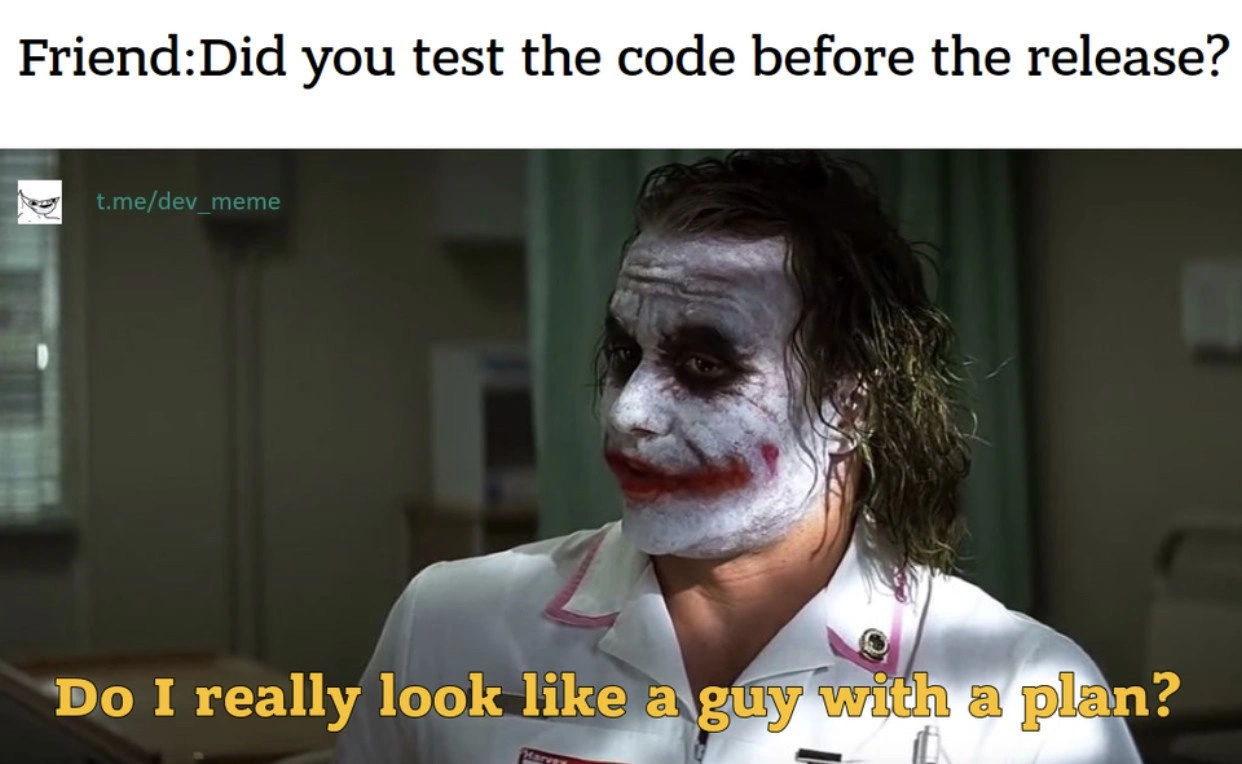
A meme featuring a screenshot of Heath Ledger as the Joker from the movie 'The Dark Knight,' specifically from the scene where he is dressed as a nurse. Above the image, the text reads, 'Friend: Did you test the code before the release?'. The Joker looks slightly to the side with a smirk, and the yellow subtitle text below him, a direct quote from the movie, serves as the punchline: 'Do I really look like a guy with a plan?'. There is a small watermark in the top left corner for 't.me/dev_meme'. The meme humorously captures the anti-pattern of 'cowboy coding,' where a developer, often due to deadline pressure or overconfidence, skips the crucial testing phase before deploying code. The Joker, as an agent of chaos, perfectly embodies the reckless spirit of pushing untested code to production, a scenario that is both terrifying and relatable to experienced developers who have witnessed the fallout

Comments

8
Anonymous ★ Top Pick Some developers want to watch the world burn. Others just ship to prod on a Friday afternoon, which achieves the same result
  1. Anonymous ★ Top Pick

    Some developers want to watch the world burn. Others just ship to prod on a Friday afternoon, which achieves the same result

  2. Anonymous

    Our release process is technically “test-driven” - we push to prod on Friday, let PagerDuty assert the failures, and whatever’s still up by Monday becomes the spec

  3. Anonymous

    After 20 years in tech, I've learned that 'Do I really look like a guy with a plan?' is actually the most honest answer you can give about your testing strategy - right after 'it works on my machine' and just before 'we'll fix it in post-production monitoring.'

  4. Anonymous

    When your CI/CD pipeline is just 'Continuous Integration' of bugs directly into production because 'Continuous Deployment' means deploying before anyone can ask uncomfortable questions about test coverage. The Joker gets it - why write unit tests when you have users who can beta test in production for free? After all, monitoring is just testing with extra steps and real consequences

  5. Anonymous

    Tested before release? We call it observability-driven QA - canary to 1%, mute alerts, and let the error budget write the runbook

  6. Anonymous

    Testing? Nah, prod is my integration suite - if it survives the first wave of users, ship it

  7. Anonymous

    Our test strategy is observability-driven development: deploy to prod, and if the canary pages, we call it exploratory testing

  8. @maxpaw 5y

    Test plan

Use J and K for navigation