Applying Crypto Red Flags to Fiat Currency
Why is this Blockchain meme funny?
Level 1: Cheating at Monopoly
Imagine you’re playing a game of Monopoly with your friends. Everyone starts with some money and the game has a fixed amount of cash that comes in the box. Now picture one player who is in charge of the bank – let’s call him Sam. Sam has a special printer and can create new Monopoly money whenever he wants, as much as he likes. If he’s running low on bills, he just says “Hold on, I’ll print some more!” and adds tons of money to his stash. In six months of game time, he magics up about a quarter of all the Monopoly money that ever existed in your game. 😮 Not only that, but since he’s the banker, only he gets to decide when to add more money. There’s no discussion with anyone else – he’s the only “node” (or the only decision-maker) in this Monopoly world. Over time, Sam and maybe one of his best buddies hoard a huge pile of the money – a tiny group of them hold about 30% of all the cash, while the rest of you share the other 70%. Feels unfair, right?
Now, if someone described this Monopoly game to you – with Sam printing unlimited money and a few players hogging a big chunk – you’d probably laugh and say, “This game sounds rigged! That’s not how it’s supposed to work.” That’s exactly the reaction the meme is aiming for. The twist is that this isn’t a silly game scenario at all – it’s comparing to real life. In the real world, the United States dollar works a bit like that game: the government can print more dollars whenever it thinks it’s needed, and a small percentage of people end up with a very large portion of the money. The meme makes it funny by presenting the US dollar as if it were a sketchy game or a made-up coin someone is trying to sell you. It’s surprising because we usually think of our money as stable and trustworthy, not like some cheat-filled board game. So the joke is like saying, “Imagine a totally unbalanced game where one player can change the money rules… sounds unfair? Well, that’s kind of what’s happening with real money!” It’s a playful way to point out something serious, and that surprise – realizing our real money system has those “unfair” traits – is what makes it both funny and a little eye-opening.
Level 2: Shills and Dollar Bills
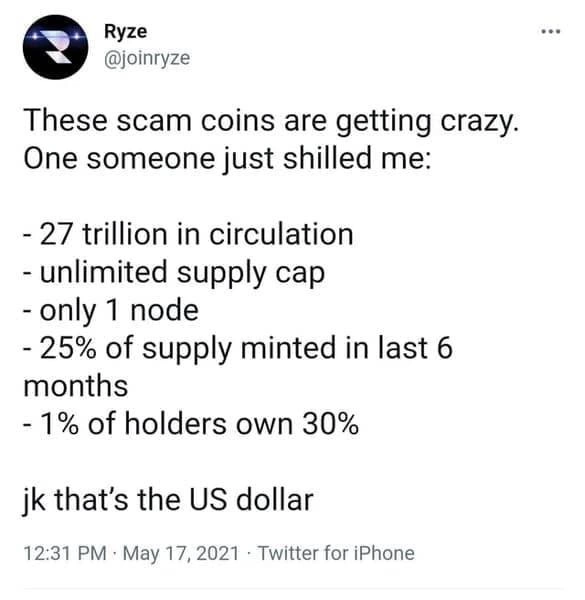
Let’s break down the crypto jargon and concepts in this tweet in plain terms. The tweet is styled like a message from someone complaining about “scam coins,” which is a slang for fraudulent or sketchy cryptocurrencies. When they say, “These scam coins are getting crazy. One someone just shilled me,” they’re setting the scene: supposedly a person tried to shill them a coin (to “shill” means to aggressively promote something, usually a token, often with the promoter having a hidden agenda like they own a bunch of it and want the price to go up). So, someone was hyping this particular coin to the author, and the author is listing the coin’s properties that sound alarmingly bad:
“27 trillion in circulation” – This means there are 27 trillion units of this currency currently out there in the world. Circulation refers to how many coins (or dollars, in this case) exist and are available for use. To put that in perspective, 27 trillion is 27,000 billion. It’s an enormous quantity. In crypto terms, a coin having a supply in the trillions isn’t automatically bad, but it suggests each individual coin might be worth very little (because value per coin often inversely relates to how many are out there). For comparison, the US dollar has about that many individual dollars in existence (counting all cash and balances). This bullet immediately gives a clue that we might be talking about a very large established currency (since new crypto projects usually start with far fewer coins and then maybe inflate).
“Unlimited supply cap” – A supply cap is the maximum amount of currency that can ever exist. For example, Bitcoin’s code caps the total at 21 million bitcoins; it can’t go beyond that (that’s a selling point for Bitcoin: it’s scarce by design). Unlimited supply cap means there is no upper limit – theoretically infinite coins could be created over time. In the context of a cryptocurrency, having no cap is usually seen as a negative by investors who fear that the coin might lose value if the creators keep making more (this is analogous to printing more money, which can lead to inflation). So an “unlimited supply” is a red flag because it implies inflationary pressure with no built-in brakes. When you hear that about a coin, you think, “They can always make more of it, so my share can get diluted (watered down).” With national currencies like the U.S. dollar, this is actually true: there’s no strict limit to how many dollars can exist — the supply can expand whenever the central bank decides it needs to.
“Only 1 node” – In blockchain lingo, a node is basically a server or computer that participates in the network, keeping a copy of the ledger (the record of all transactions) and helping verify new transactions. Most well-known cryptocurrencies have many nodes distributed around the world (Bitcoin has tens of thousands of independent nodes run by different people; Ethereum similarly has many nodes). When a currency has many nodes, it’s called decentralized — no single computer is in charge, and they all check each other’s work. Now, “only 1 node” means just one computer or entity is running the whole show. That implies extreme centralization: one authority that everyone has to trust. This is exactly how traditional currencies work: effectively, the official ledger of the U.S. money supply is maintained by a central authority (the Federal Reserve and the banking system). There isn’t a public decentralized network confirming every dollar transaction – instead, we trust banks, which trust the central bank. In crypto terms, saying a coin has one node would be like saying “Don’t bother with a whole network, just trust this one server.” It sounds laughable to anyone who expects a cryptocurrency to be decentralized. This tweet is winking at the fact that the US dollar’s system is basically one centralized ledger, not a blockchain at all.
“25% of supply minted in last 6 months” – Minted means created or produced, like how coins are minted in a mint or how new crypto coins are generated (for instance, through mining or staking rewards). Saying a quarter (25%) of the entire supply was made in the last half-year is pointing out a huge surge of new money. If a total of 100 coins existed and suddenly 25 new ones were created recently, that’s a big jump in supply in a short time. For a national currency, this refers to rapid money supply growth – essentially a lot of money printing in a short period. Indeed, around 2020-2021, the U.S. Federal Reserve increased the money supply drastically (to help the economy during the COVID crisis). In crypto, if you heard that 25% of all coins ever were created in the last 6 months, you’d suspect the coin is either very new or it went through massive inflation. It’s like if a game suddenly gave out tons of new points to players – everyone’s existing points would feel less special or less valuable. This part of the tweet highlights inflation: creating a lot of new units of a currency typically makes each unit worth a bit less. Crypto fans often criticize fiat (like the dollar) for this kind of inflation. By phrasing it as “minted in last 6 months,” the tweet uses crypto terminology for what the Fed did (the Fed “minted” dollars digitally by injecting money into the financial system).
“1% of holders own 30%” – This is talking about distribution of the currency among people. It means the top 1% of holders (the people or accounts that have the most of this currency) collectively own 30% of all of it. That shows a very unequal distribution — a small fraction of people hold almost a third of all the wealth in that currency. In the world of cryptocurrencies, people track these stats to gauge decentralization and fairness. If a coin is held mostly by a few wallets, it’s risky: those few could dump the coin and crash the price, or it might indicate the coin was pre-mined and mostly kept by the creators (which is a common scam tactic). In society, the equivalent is wealth inequality. For the US dollar, it’s a known fact that roughly the top 1% of wealthy individuals hold about 30% (nearly a third) of all the wealth in the country. It’s a statistic often discussed in economics and politics. By phrasing it this way, the tweet puts a real-world inequality stat in the same breath as crypto “holder stats.” Anyone who’s read about whales in crypto (accounts with huge holdings) will see the parallel: the US dollar has “whales” too – except they’re real billionaires and millionaires. It’s emphasizing that the dollar isn’t exactly democratically distributed either.
Now, the kicker: “jk that’s the US dollar”. “jk” is internet slang for “just kidding.” This reveal tells us that all the alarming points above aren’t describing a sketchy new cryptocurrency at all; they’re describing the US Dollar, the very real currency we use every day. The tweet basically says: “Ha, you thought I was talking about some garbage crypto coin? Nope, I was listing facts about the American fiat currency!” This is both funny and pointed. It’s funny because it’s an unexpected twist – we usually talk about the dollar in totally different terms, not like it’s a coin on Binance or Coinbase. It’s pointed (a bit sharp) because it’s basically criticizing the dollar using the framework that crypto enthusiasts use to criticize bad coins.
To clarify a term from the tags: fiat currency means a government-issued currency that isn’t backed by a physical commodity like gold; its value comes from government declaration and people’s trust. The US dollar is fiat money – it has value because the U.S. government says it does and because everyone accepts it for trade. The tweet contrasts fiat vs. crypto attitudes. Crypto people often champion cryptocurrencies as an alternative to fiat, highlighting issues like limitless printing (inflation) and central control as why fiat is flawed. Here those exact points are presented humorously.
The line “one someone just shilled me” is mimicking how on social media (like Twitter, where this meme comes from) people talk about coins. Crypto MemeCulture often has tweets and posts like: “Someone just shilled me XYZ coin – here are its stats… should I buy?” Usually those stats would be positives (like limited supply, strong node community, etc.). In this tweet, they’re all negatives, which hints that the author is being sarcastic from the get-go.
In simpler words, the tweet is listing why a certain coin would be a terrible investment (huge supply, infinite printing, centralized control, rapid inflation, wealth concentrated at the top). Then it reveals that this “terrible investment” is actually the official currency of the United States. It’s a form of satire – using humor to critique. The tags like IndustrySatire and TechHumor apply because it’s poking fun at both the crypto hype (by using its language) and at the traditional finance system (by pointing out its weaknesses in a cheeky way).
For a junior developer or someone new to blockchain, the meme is a crash course in why decentralization and fixed supply are considered important in crypto. Each bullet is basically “this is what you don’t want in a well-designed cryptocurrency.” And yet, our global monetary system has exactly these traits. It’s a bit of an “inside joke” for folks in blockchain and fintech: they immediately recognize the irony. But even without deep knowledge, once you know what each term means, you can appreciate the jest. It’s saying: imagine if the US dollar were introduced today as a new crypto project – it would look really dodgy!
So, to sum up in plain terms: the meme lists a bunch of bad characteristics of a “scammy” cryptocurrency (lots of coins, no limit, centralized control, rapid recent inflation, and rich-get-richer distribution). Then it jokes that this is actually describing the US dollar, making a tongue-in-cheek point about how the dollar shares those characteristics. It’s a way to laugh at the hype and also perhaps to reflect on the flaws of our current money system, all in one tweet.
Level 3: Plot Twist: It’s the Dollar
At this level, let’s unpack why this tweet is hilarious to tech insiders and crypto-savvy folks. The author lists a bunch of shady-sounding stats as if describing a new cryptocurrency someone hyped to them. Each bullet point is basically a classic red flag that would make any seasoned developer or investor raise an eyebrow:
“27 trillion in circulation” – A coin with tens of trillions of units already out there? That sounds absurdly inflated. Crypto people are used to hearing about total supply: for context, Bitcoin has 19 million coins in circulation (with 21 million max), and Ethereum’s supply is in the hundred millions. 27,000,000,000,000 of something is comically large. It implies each unit might be worth very little (since value per coin often drops as supply skyrockets). It’s the kind of number you usually only see in joke coins or hyper-inflated tokens. It immediately screams “this thing is not scarce at all.”
“Unlimited supply cap” – In crypto culture, this is a major no-no for anyone worried about inflation. A legitimate project often boasts about a fixed supply or a hard cap to assure holders that their share won’t be diluted endlessly. An unlimited supply means the creators can mint new tokens forever, which is exactly what scammy coins do to enrich themselves (imagine a developer printing new tokens to dump on investors – classic rug-pull move). Reading “unlimited supply cap” in a shill pitch is like hearing a smoke alarm go off. Developers and FinTech folks immediately connect this to fiat currency, because guess what? The US Dollar famously has no cap; more dollars can always be printed. This bullet is setting us up for the punchline by using a typical BlockchainHype phrase (“supply cap”) but flipping it negative.
“Only 1 node” – Now this one is a dead giveaway satire. In blockchain terms, a node is any computer that validates the network. If someone bragged a coin has “only one node,” that’s essentially an admission that the coin is completely centralized. No blockchain project would advertise that; it’d be equivalent to saying “we didn’t actually build a network, we just have one database server.” 😂 To anyone in the crypto scene, “only 1 node” is outright ridiculous – it undermines the whole point of using blockchain tech (which is decentralization and trustlessness). At this point in the tweet, readers likely realize it’s a joke because no serious crypto advocate would shill a one-node coin positively. This line pokes fun at the centralized currency model: the hint here is that the US Dollar’s “network” is essentially run by a single authority (the U.S. Federal Reserve). It’s a sly nod to how fiat works versus crypto: fiat has a central node (the central bank) that everyone trusts by necessity, something crypto purists laugh at.
“25% of supply minted in last 6 months” – This metric seems outrageously bad if describing a currency. A quarter of all coins ever made were created in just half a year? If you heard that about a crypto project, you’d assume it’s either hyper-inflating or it’s some pre-mine scam where the creators suddenly bloated the supply (devaluing everyone else’s holdings). It’s the kind of statistic you’d expect from a pump-and-dump scheme or a failing currency in a crisis. Here, the tweet is referencing a real-world fact: around 2020-2021, due to economic stimulus and money printing, roughly 20–25% of all existing US dollars were created within months. In crypto meme terms, people often joked “money printer go brrr” (imitating the sound of a cash printer rapidly churning out bills) to describe how fast the Fed was pumping dollars into the economy. For a developer who follows CryptocurrencyTrends, seeing “25% minted in last 6 months” in a shill list immediately screams “inflation alert!” and likely rings a bell — it sounds exactly like critiques of the Fed’s pandemic response. It’s funny because it’s true: that statistic genuinely applied to USD in that period, but phrasing it like a shady altcoin metric makes it feel absurd.
“1% of holders own 30%” – Crypto enthusiasts often scrutinize how a coin’s supply is distributed. If a tiny fraction of holders own a huge chunk of the supply, it means a few whales have outsized control. They could tank the price by selling, or orchestrate pumps. It’s usually cited as evidence of centralization or unfair distribution – definitely a red flag if you’re evaluating a new coin. Now, apply this to the US economy: indeed, roughly the top 1% of wealthy individuals hold about one-third of the total wealth (or money) in the country. That’s a well-known inequality statistic, but in this tweet it’s framed in crypto terms. For tech folks, it draws a direct line between “whale wallets” in crypto and the wealth of billionaires in fiat. It’s a bit of IndustrySatire, implicitly comparing Wall Street tycoons or wealthy elites to giant crypto whales. The line lands as a punch because it’s the last bullet before the reveal – readers are thinking “wow, what a sketchy coin… oh… oh wait, I recognize those numbers…”
After listing all these sketchy attributes, the tweeter drops: “jk that’s the US dollar.” “jk” means “just kidding,” revealing that this wasn’t actually a new crypto at all — it’s a roast of the US Dollar using crypto-slang. This reversal is the heart of the meme. It triggers an “aha” moment: all those alarming metrics are real fiat currency features. The humor comes from the unexpected comparison. People in tech and fintech circles chuckle because it’s a clever way to highlight issues like inflation and centralization in a context where we usually only hear those criticisms about altcoins. It’s essentially saying, “You know all those things we call sketchy in crypto? The mainstream money has them too!”
This hits close to home for many in the Blockchain community who have long debated fiat vs. crypto. The tweet reads like a classic crypto bro’s shill post – someone shilling (promoting) a new coin – right until that final line. The format is familiar: bullet points of stats, a hype-y tone (“These scam coins are getting crazy. One someone just shilled me: ...”). Usually, such a post would end with “buy now!” or some coin ticker. Instead, it subverts the format with a punchline that it’s actually describing USD. It’s essentially a tech humor mirror held up to the financial system, making both crypto enthusiasts and skeptical developers smirk.
Why do developers and fintech folks find this so funny (and a bit sobering)? Because it underscores an open secret: if you judged national currencies by the same yardstick used for crypto projects, they might look really dodgy! But of course, we normally don’t view the dollar that way – we trust it because of government backing, long history, and legal status. The tweet cleverly satirizes industry hype by turning it on an institution (the US dollar) that is usually considered the opposite of a fly-by-night scam coin. It’s a form of MemeCulture commentary: taking the language of one field (blockchain hype) and applying it ironically to another (central banking).
In the dev community, there’s also an implicit parallel to legacy systems vs. new tech. Think of the US Dollar as the huge legacy system that everyone relies on despite its flaws (like a monolithic app with one big database, unlimited memory usage, and some cron job that suddenly increased data volume by 25%). If someone pitched a new app with those specs, you’d laugh it out of the room—yet the old system chugs along because it’s deeply entrenched. Similarly, fiat currency is the legacy system of finance; crypto is the shiny new tech trying to disrupt it. This meme tickles that part of a developer’s brain that loves pointing out inconsistency: “We criticize bad engineering in new projects, but look, the core system has the same issues!”
It’s also worth noting the timing: this tweet came in mid-2021, when CryptocurrencyTrends and hype were at a peak. People were shilling coins left and right on Twitter (from serious projects to obvious scams), and simultaneously, there were heated discussions about inflation in the post-2020 economy. This meme hit a sweet spot by combining those two conversational currents. The absurdity of comparing the US dollar to a scam token made it a shareable tech humor gem. It’s the kind of joke that makes you laugh, then think for a moment: “Wait, should I be worried that this is kinda accurate?” That mix of laughter and uncomfortable truth is what gives the meme its punch among industry folks.
Level 4: One Node to Rule Them All
From a systems architecture perspective, this tweet highlights a centralization vs. decentralization paradox in currency. In blockchain networks, multiple nodes (computers) maintain the ledger so no single point controls the system. Consensus algorithms (like Proof-of-Work in Bitcoin or Byzantine Fault Tolerance methods) solve the Byzantine Generals Problem, ensuring everyone agrees on one history of transactions even if some nodes are malicious. Here, the joke coin has only 1 node. Technically, a single node means no distributed consensus is needed at all – there’s only one source of truth. It’s as if all the world’s transactions run on one central server. This eliminates the complexity of coordinating many nodes but introduces a huge implicit trust requirement. With one node, you don’t need to worry about network partitions or majority agreement – the lone node unilaterally decides the “truth” of the ledger. In the context of the tweet, that one node is essentially the Federal Reserve’s centralized ledger for the US dollar.
This is fascinating from a distributed systems angle: a currency system with a single authoritative node is just a centralized database disguised as money. There’s no peer-to-peer validation, no cryptographic consensus – just one authority updating balances. In computer science terms, the US Dollar’s monetary system doesn’t need to run a consensus protocol like Raft or Nakamoto Consensus because there are no other independent nodes to consensus with. The consistency is absolute (everyone aligns with the Fed’s ledger), but we sacrifice decentralization and fault tolerance. If that one node fails or acts arbitrarily, there’s no fallback. Contrast that with a blockchain: if one node goes rogue or offline among thousands, the network remains correct and operational.
Next, consider the unlimited supply cap from a theoretical viewpoint. Many cryptocurrencies programmatically enforce a finite supply (for example, Bitcoin’s 21 million cap coded in its protocol) to achieve scarcity. That limit is a fundamental parameter baked into the system’s code and consensus rules – no node can arbitrarily exceed it without forking a new incompatible chain that others reject. It’s like having a hard upper bound in an algorithm, ensuring a predictable growth rate (Bitcoin’s supply grows asymptotically and then stops). The US dollar, however, has no such hard cap – it’s an unbounded supply. In algorithmic terms, the money supply is a variable that can grow without a preset limit, adjusted by policy decisions rather than algorithmic constraints. This is akin to a loop with no fixed end condition, where new iterations (new dollars) can be created whenever needed. The trade-off here is mathematical certainty vs. economic flexibility: an infinite supply space allows the system (the Federal Reserve and Treasury) to respond to crises by creating money (e.g., quantitative easing), but it violates the principle of scarcity that cryptographic coins rely on for value stability.
The bullet point about “25% of supply minted in last 6 months” underscores a historically unprecedented burst of supply growth. In late 2020 to early 2021, the U.S. engaged in aggressive monetary expansion (to stimulate the economy during a crisis), which in algorithmic terms is like drastically increasing a loop’s iteration count on the fly. For a cryptocurrency, such a sudden 25% increase of tokens would be considered a catastrophic inflation bug or a hard-fork level event — it would break most assumptions about value and trust in the network. In the fiat system, it’s permitted by design: the central node can inject new money by mere entries in its ledger (or literally printing notes), effectively minting currency without needing consensus from any other nodes (since there are none). There’s a cryptographic irony here: Bitcoin’s mining process is intentionally hard (expensive computation) to limit how fast new coins appear, whereas creating new dollars can be done with a vote by a committee or even a keystroke in a database. It’s a trusted action, not a trustless computation. The developer humor emerges from recognizing that what would be a blatant violation of protocol in a blockchain (printing tons of new tokens arbitrarily) is an accepted norm in fiat land.
Finally, “1% of holders own 30%” brings in the concept of distribution and network centrality in ownership. In blockchain networks, decentralization isn’t just about nodes, but also about how the token supply is distributed among users. If a small fraction of addresses hold a large portion of coins, those are “whale” wallets – they could in theory collude or crash the market by selling off, and it questions the fairness or resilience of the network (if one entity holds enough tokens, they might even influence consensus in some systems). This is analogous to network centralization in graph theory: a few nodes (people) have disproportionately high “weight” (wealth). For the US dollar, the stat that 1% of holders own 30% of the supply sounds very much like a power-law distribution – which indeed it is, reflecting real-world wealth inequality. Technically, if we model the economy as a network, the wealth distribution is highly skewed. In a blockchain scenario, such skew would be a red flag suggesting the coin might be controlled or easily manipulated by a small elite (imagine if 1% of miners controlled 30% of hash power – that’d raise concerns about a 51% attack, analogously). The tweet cleverly uses this metric to show the parallels: the centralization of wealth in USD land mirrors the kind of concentration that crypto enthusiasts often criticize in poorly designed or scammy crypto projects.
In summary, on a deep technical and theoretical level, this meme contrasts trustless decentralized design with trusted centralized design. The US dollar is effectively a centralized ledger system with one authoritative node, an unbounded issuance algorithm, and a skewed distribution of assets. It doesn’t have the properties that blockchain engineers strive for (like decentralization, censorship-resistance, algorithmic monetary policy), yet the world runs on it. The humor is partly in the absurdity: if you described the US Dollar in the jargon of a crypto whitepaper, it sounds like a ridiculously centralized, insecure protocol that no self-respecting blockchain developer would ever endorse – and yet it’s the most widely used currency on Earth. It’s a tongue-in-cheek reminder of the gap between elegant distributed systems theory and the messy reality of finance.
Description
This image is a screenshot of a tweet from the user Ryze (@joinryze). The tweet criticizes cryptocurrency 'scam coins' and then lists the supposed attributes of one: '- 27 trillion in circulation', '- unlimited supply cap', '- only 1 node', '- 25% of supply minted in last 6 months', '- 1% of holders own 30%'. The tweet ends with the punchline, 'jk that's the US dollar'. The humor comes from satirically applying the metrics and red flags used to evaluate cryptocurrencies to the US dollar, framing the traditional fiat financial system with the skeptical lens of a crypto enthusiast. For tech professionals, particularly those in FinTech or blockchain, this is a pointed critique of centralized monetary policy, highlighting issues like inflation, lack of a supply cap, and wealth concentration, all common arguments for decentralized alternatives
Comments
13Comment deleted
The US Dollar's consensus mechanism is 'Proof-of-Printing,' and its single node has a real uptime problem every time Congress debates the debt ceiling
The US dollar is basically a permissioned blockchain: one node with God-mode, an unchecked mint() loop, and everyone still calls it “stable” - the financial equivalent of that legacy monolith nobody’s brave enough to refactor
The best part about debugging a centralized monetary system with unlimited supply cap is that when it crashes, you can't just roll back to a previous commit - you have to fork the entire economy and hope nobody notices the consensus algorithm is just Jerome Powell's printer going brrr
The real 51% attack was the Federal Reserve we made along the way. Turns out the ultimate shitcoin has been running on a single-node consensus mechanism since 1913, with a monetary policy that makes even the most aggressive token inflation schedules look conservative. At least when crypto projects rug pull, they have the decency to do it quickly - fiat just does it in slow motion while calling it 'quantitative easing.'
Unlimited supply, one validator - turns out it’s not a blockchain at all, it’s the US dollar: a proof‑of‑authority monolith where mint() runs after FOMC stand‑ups and the IRS is the canonical oracle
USD: the ERC-20 where deployer retains eternal mint authority and whales front-run the printer
One node, unlimited supply - so not a ledger, just a privileged singleton with mint() behind an admin key; consensus algorithm: because root said so
😂 Comment deleted
hehe, can someone get the stats on the Euro please? I'm curious. Comment deleted
https://europa.eu/euroat20/the-euro-in-numbers/ Comment deleted
well that seems quite nice Comment deleted
If he dont like dollars, just let him send all he has to me, and i will send him back Belarusian rubles. One for one, honest deal. Comment deleted
🤣 Yeah currently that's goes great. Would be nice if you can exchange like that Comment deleted