Beware the Haskell job siren: pirates succumb to functional programming lure
Why is this FunctionalProgramming meme funny?
Level 1: Too Good to Resist
Imagine a wise old pirate telling a young sailor, “Don’t listen to the magical mermaids’ song. It’s super lovely, but it will get you in trouble!” He’s being very serious, warning about danger. But suddenly, a beautiful mermaid pops out of the water and says, “Hello! I have your favorite candy right here just for you!” in the sweetest voice. The old pirate’s jaw drops, and he basically says, “Oh no! This is the end of me!” as he starts walking toward her, unable to resist. It’s funny because he JUST told the younger person to ignore the mermaid, and a second later he’s the one who can’t ignore her. In real life, it’s like your parent warning you not to fall for a trick, but then even your parent falls for it because the offer is just too good to resist. The joke shows how something very tempting (the mermaid’s offer of the favorite candy, or in the original case a dream job) can make even a very cautious, experienced person lose their self-control. We laugh because the mighty, careful pirate is defeated by his own love for that special treat – just like a developer might drop everything for a super special job. It’s a playful reminder: sometimes what we desire can cloud our judgment, and that contrast is both silly and relatable.
Level 2: The Lure of Haskell
Let’s break down the joke in simpler terms. Haskell is a programming language, and it’s the poster child for functional programming. In functional programming, you write programs by composing functions, avoiding changing variables or mutable state. This is different from the more common imperative style (like in Java or Python) where you change variables and give the computer step-by-step instructions. Haskell takes a very pure approach: functions in Haskell don’t produce side effects. Side effects are things like modifying a global variable, printing to the screen, or writing to a file – basically any interaction with the world outside the function. Because Haskell avoids side effects in its functions, it can guarantee that if you call a function with the same input, you’ll always get the same output and nothing else will happen. This makes reasoning about code a lot like math. It’s a powerful idea, but it also means Haskell has to use special structures (like the famous Monad) to do anything useful like I/O or handle when something might not exist (maybe a computation can fail or be absent – Haskell uses the Maybe monad for that). These concepts – pure functions, immutability (variables you never reassign), higher-order functions (functions that take other functions as input or output) – are key functional programming concepts. They can be mind-bending at first, but they often lead to very robust code.
Now, why is a Haskell job treated like a mythical siren’s call? In the tech job market, Haskell is a niche language. This means not many companies use it for their main software, certainly not compared to languages like JavaScript or C#. Haskell is often taught in universities or used in specialized areas (for example, some financial firms or specific tech startups might use it to leverage its reliability). So, seeing a job opening for Haskell is uncommon – it’s like spotting a mermaid on a rock; you’ve heard about it, but rarely see it. Many programmers learn Haskell out of curiosity or for personal projects, but they never get to use it at work. So an open Haskell position is a bit like a golden ticket for those Haskell enthusiasts. The meme uses the siren metaphor from mythology: sirens are creatures that sing a song so beautiful sailors can’t resist coming closer, only to get shipwrecked. Here, the “song” is actually the spoken line: “Hello! We have an open Haskell position.” This is a very mundane sentence in reality (something a tech recruiter might say in an email), but to a developer who loves Haskell, it’s incredibly enticing. It’s the equivalent of that sweet melody – something too good to resist.
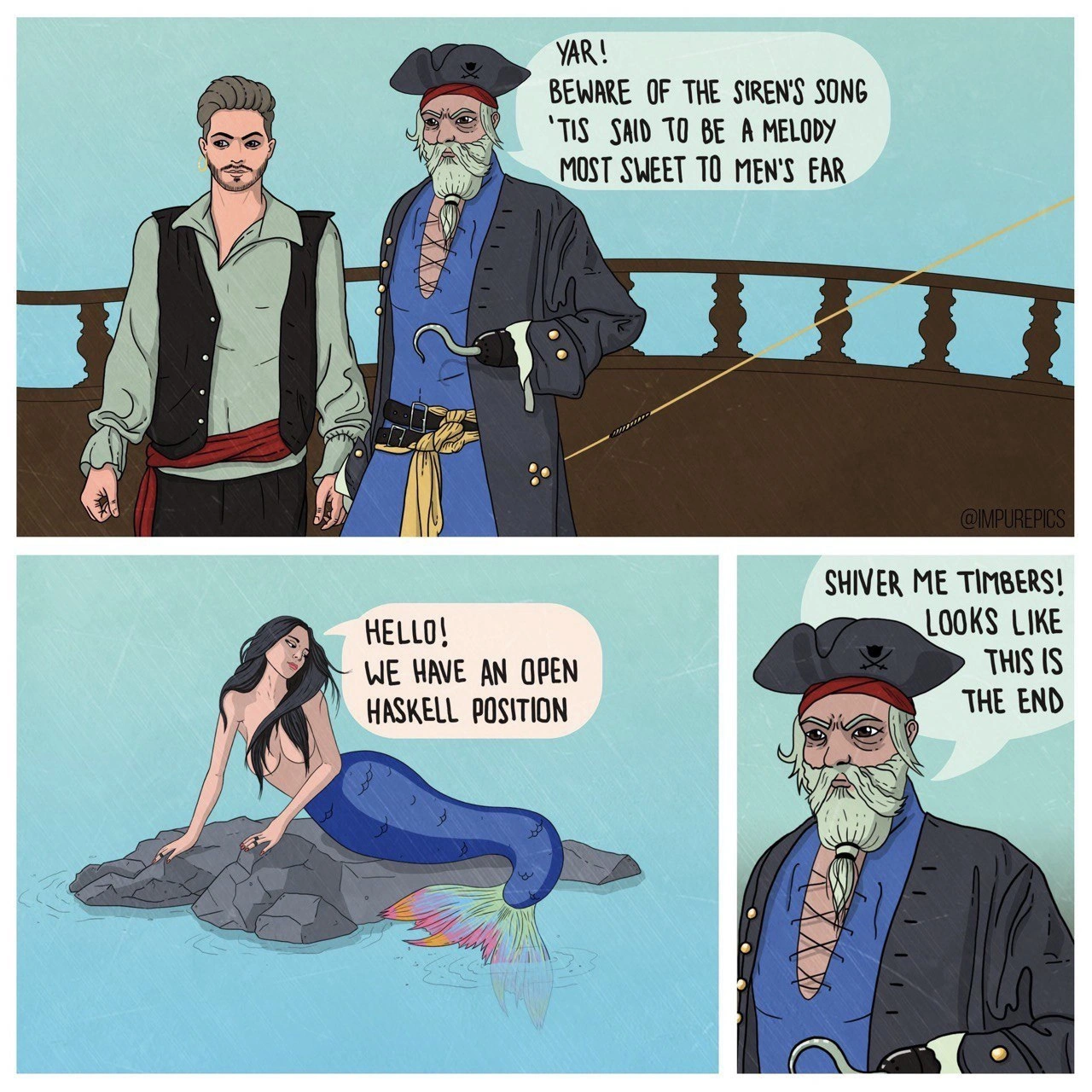
The pirate theme is chosen to make it funny and to lean into the idea of sailors and sirens. We have two pirates on a ship’s deck in the first panel. The older pirate with the hook hand and seasoned look is like a grizzled senior developer. He’s warning, in pirate speak, about a danger: “Beware of the siren’s song ’tis said to be a melody most sweet to men’s ear.” Translated to normal English, he’s saying: “Hey, be careful of temptations (siren songs) — they say those temptations sound really sweet to people.” In a tech context, imagine an experienced developer telling younger ones: “Be wary of things that seem overly appealing, like a super cool job offer or technology, because it might lead you into trouble.” This sets up the expectation that our wise pirate knows how to resist the dangerous lure.
Then, in the second panel, we see the siren – depicted as a mermaid on a rock in the sea – who calls out explicitly with a job offer: “Hello! We have an open Haskell position.” This contrast is hilarious because she’s not singing a mystical song; she’s just stating a recruiting line. Visually, her tail is blue with rainbow fins, a colorful, magical appearance. That matches how a Haskell job might appear in a sea of boring job postings – bright and exciting. The siren is basically the embodiment of niche language recruiting here: a recruiter or hiring manager trying to lure talent by advertising a position with a cool, uncommon tech stack (Haskell). It’s like the functional language lure incarnate.
Now the punchline: the third panel zooms in on the old pirate’s face. His eyes are wide; he looks both shocked and captivated. He exclaims, “Shiver me timbers! Looks like this is the end.” Pirates say “Shiver me timbers!” as an expression of surprise or shock (like “Oh my goodness!” for a pirate). “Looks like this is the end” is him basically saying, “I’m done for.” So even though he himself warned everyone to be careful, he is now basically saying, “I can’t resist this; it’s over for me.” This is the comedic twist. The experienced person who should know better falls for the temptation immediately when it’s something he personally really wants.
In developer terms, a seasoned engineer who maybe has warned others, “Don’t choose a job just because of a cool tech – think about the company stability, etc.” suddenly sees a posting for their favorite obscure language (Haskell) and they’re ready to throw caution to the wind. Perhaps they know it might not be the most practical career move (hence “this is the end” as if he might wreck his ship aka his current career path), but the chance is too exciting. It’s a funny exaggeration of how hiring decisions can sometimes be swayed by tech stack preferences. This is classic developer humor because it pokes fun at our own nerdy priorities: many of us would be giddy at the chance to get paid for using a language or tool we love, even if we suspect it’s not the safest long-term choice. And it’s career humor too, highlighting how people make job choices for passion vs. pragmatism.
Also, notice the speech bubble style and language: the siren’s formal job offer line in a whimsical setting is itself a joke. It’s like putting a corporate email in a fairy tale. And the older pirate speaking in a dramatic, old-timey way (“’Tis said to be…”) adds to the humor by mixing tech context with pirate lingo. The meme’s title even calls it the “Haskell job siren,” making it clear we’re equating that rare job offer to the legendary siren’s lure. In short, the comic is saying: a Haskell job offer is so alluring to certain programmers that it can make even the wariest old pirate sail straight toward danger. It’s a funny way to warn and laugh about how compelling functional programming can be to those who’ve fallen in love with it, and how we’re all a little susceptible to a sweet song in our careers.
Level 3: Hooked on Haskell
From a senior developer’s perspective, this comic nails a piece of developer humor about tech careers. It portrays the scenario as a salty old pirate warning of danger, only to succumb to the exact temptation he warned about – a classic “do as I say, not as I do” twist that makes engineers smirk. The pirate theme sets a playful tone, but it’s really about a career humor scenario: a highly experienced programmer (the old pirate with a hook hand, a symbol of battle scars from many projects) loses composure upon hearing of an open Haskell position. Why is that funny? Because in real life, Haskell jobs are as rare and enticing as mythical sirens. Most companies sail the safer seas of languages like Java, Python, or JavaScript. Haskell is more like a hidden treasure island – you’ve heard tales of it, maybe even visited in personal projects or university, but few get to stay there for a job. So when a recruiter or a company calls out “We’re hiring Haskell developers!”, it sounds like a dream opportunity. This meme exaggerates that feeling: even the grizzled tech veteran, who should know better, is metaphorically “hooked on Haskell.” He’s essentially saying, “Oh no, I can’t resist this… I’m done for,” as if the sheer appeal of that job will be his undoing.
In the industry, there’s a notion of language evangelism – passionate developers advocating for their favorite niche language or paradigm. Older hands often become functional programming evangelists if they’ve seen the benefits of immutability and pure functions in reducing bugs. They’ll extol Haskell’s virtues at meetups or within their team, much like sailors telling tales of a magical island. This comic humorously implies that deep down, even the cautious old guard will drop everything when confronted with the real thing. The pirate initially gives a wise warning (“Beware the siren’s song, ’tis sweet to men’s ear!”) – in other words, a senior dev cautioning that some opportunities are too enticing and could lead you off course. In tech terms, he might be warning younger devs not to get distracted by shiny but risky tech choices or ultra-niche jobs. Yet in the next panel, the siren metaphor comes to life: a mermaid (the siren) literally offers what we might call the ultimate niche tech bait – “an open Haskell position.” This is delivered so straightforwardly that it doubles as a joke about recruiters. It’s as if a recruiter’s plain LinkedIn message (“Hello, we have a Haskell role!”) is cast as a siren’s magical song echoing across the sea. The absurdity is golden: instead of a mystical melody, the siren basically posts a job ad! For a developer who loves Haskell, though, that line is music to their ears.
The veteran pirate’s wide-eyed reaction “Shiver me timbers! Looks like this is the end.” captures the shared experience of many devs: that moment when you see your dream job posting and you just know you’re about to abandon your current safe harbor. In reality, switching to a niche tech stack can be career-risky — it might be the end of your comfortable routine or the start of a wild new adventure. This mix of excitement and self-aware doom is what makes the meme relatable and funny. It’s hiring humor blended with the insider knowledge that niche language recruiting often feels like a trap: “Is this position too good to be true? Will I wreck my career on the rocks of an obscure technology?”
Seasoned developers often joke about this because some have actually jumped ship for a niche technology. They know that while working with your dream language is fulfilling, it can come with downsides: a smaller community, less job security (fewer alternative employers use that tech), and possibly dealing with legacy code or odd quirks alone since not many colleagues grok it. Functional programming in particular has a devoted following that sometimes outpaces its industry adoption. We’ve heard tales of startups bravely choosing Haskell, or teams rewriting a service in Haskell for correctness – sometimes succeeding brilliantly, other times regretting the choice due to hiring difficulties or integration issues. This meme gets a chuckle from experienced devs because it satirizes that collective temptation. It’s essentially saying: “We’ve all heard the legends of working in Haskell, and if we ever hear that call for real, even the best of us might just go for it, eyes open, knowing it could be our downfall.”
By casting this as a pirate-themed comic, the meme also pokes fun at how developers romanticize technology. The high seas adventure vibe suggests that joining a Haskell project is like an epic quest. The older pirate’s dramatic language (“’Tis said to be a melody most sweet”) is like a senior dev recounting industry lore about amazing technologies that can nonetheless sink projects if you’re not careful. It’s both a warning and a wink. The result is a clever piece of developer meme storytelling: it blends developer humor with a bit of cautionary tale. Everyone in the room (especially those who’ve been around long enough) nods and laughs because they recognize both the functional language lure — the almost irrational pull of a cool technology — and the absurdity of how we sometimes act against our own warnings. In the end, the meme zeroes in on that shared comedy of tech passion: we know when something is probably a bad idea (or at least risky), but if it’s something as cool as Haskell, well... “Goodbye, safe harbor, hello adventure!” Shiver me timbers, indeed.
Level 4: Monadic Siren Song
At the deepest technical level, this meme riffs on the almost mythical allure of Haskell in the programming world. Haskell is a purely functional programming language rooted in academic computer science and lambda calculus. In Haskell, everything is an expression and functions have no side effects (they’re pure). This means if you call a function with the same input, it always returns the same output and changes nothing else – a property called referential transparency. To manage side effects like I/O or state changes, Haskell uses advanced abstractions known as monads. Monads (a concept borrowed from category theory) let you sequence actions (like reading a file or printing text) in a purely functional way. For seasoned FP enthusiasts, the elegance of monads and higher-order functions is intoxicating – it’s the siren song of mathematical purity in code.
In this comic, the siren’s call “We have an open Haskell position” is a metaphorical monadic bind pulling the pirate towards an irresistible promise. Why is it so enticing? Because a Haskell job offers the chance to apply functional programming concepts (like monoids, functors, and monads) to real-world problems and get paid for it. It’s like telling a mathematician they’ve found a proof thought impossible – pure catnip for the intellectually curious developer. The humor is that even a battle-worn pirate (an experienced dev) cannot resist this theoretical perfection: the lure of working in a language with strong static typing (Haskell’s Hindley–Milner type inference feels almost magical in catching bugs at compile time), lazy evaluation (Haskell won’t compute values until absolutely needed, enabling things like infinite data structures), and an almost art-like code style. These properties promise a world with fewer runtime surprises – no null pointer crashes, no rogue mutable state – which for a veteran programmer is a melody “most sweet to men’s ear,” as the pirate warns. It’s the fantasy of a codebase where elegant mathematics underpins everyday development.
However, the sirens of ancient lore lured sailors to their doom on the rocks, and here there’s a wink to the hidden rocks of Haskell’s idealism. Seasoned devs know that while Haskell’s purity is beautiful, it comes with real-world challenges: lazy evaluation can sometimes lead to unexpected memory usage (space leaks) if you’re not careful, the learning curve is steep, and integrating Haskell with the messy outside world or legacy systems can be tricky. The meme’s dark humor (“Looks like this is the end.”) acknowledges that chasing this functional paradise might wreck one’s ship (project or career) if done recklessly. It’s a playful nod to the idea that what is theoretically elegant isn’t always practically safe. Still, for those who adore functional programming, the theoretical benefits (mathematically provable correctness, concise declarative code, powerful abstractions) exert an almost mythic pull. Haskell jobs are rare gems, and the opportunity to immerse in that purity can override even a seasoned engineer’s caution. (For the extra pun-aware: the artist’s handle “@ImpurePics” cheekily contrasts with Haskell’s obsession with purity, an inside joke for FP fans.)
-- A tiny taste of Haskell's allure in code:
greetSiren :: String -> String -- a pure function type signature
greetSiren name = "Hello, " ++ name ++ "!" -- it returns the same output for the same input, no side effects
main :: IO () -- 'IO' marks an action with a side effect
main = do
let song = greetSiren "developer"
putStrLn song -- printing is done within IO monad to keep purity elsewhere
-- Output: "Hello, developer!" (the siren beckons)
In this snippet, greetSiren is a pure function (no side effects, just string manipulation), and main uses Haskell’s IO monad to actually produce output. To a Haskell fan, even this simple structure is satisfying – it separates pure logic from side effects. That separation of concerns is part of the siren call: it feels like writing mathematical equations that magically run as programs. It’s easy to see why a theoretically-inclined developer would be enchanted – the code is concise, declarative, and rooted in formal principles. The meme exaggerates that enchantment: the pirate knows the theory so well that hearing about a Haskell job is like hearing the perfect chord that must be followed, consequences be damned.
Description
Three-panel comic styled like a classic cartoon. Panel 1: two male pirates stand on a wooden deck; the older one has a hook hand and says, “YAR! BEWARE OF THE SIREN’S SONG ’TIS SAID TO BE A MELODY MOST SWEET TO MEN’S EAR.” Panel 2: a mermaid with long dark hair sits on a rock, tail colored blue with rainbow fins, waving and saying, “HELLO! WE HAVE AN OPEN HASKELL POSITION.” Panel 3: close-up of the hook-hand pirate, eyes wide, exclaiming, “SHIVER ME TIMBERS! LOOKS LIKE THIS IS THE END.” The humor equates niche functional-programming job offers (Haskell) to mythic siren calls that doom unsuspecting sailors, poking fun at how rare yet irresistible such positions are to developers familiar with purely functional languages
Comments
12Comment deleted
Haskell job offers are the industry’s siren song - you sail toward whispers of pure functions and perfect types, then wake up shipwrecked on a reef of decade-old monad transformers maintained by a guy on permanent sabbatical
After 15 years of explaining monads to CTOs who just want a CRUD app, you realize the real Haskell job was the category theory you learned along the way
The real danger isn't the siren's call itself - it's realizing that after mastering monads, functors, and type-level programming in Haskell, you've become so specialized that the only companies hiring are either academic research labs or that one fintech startup whose entire engineering team consists of three PhD candidates who communicate exclusively through category theory diagrams. The pirate's horror is justified: he knows that once you go full Haskell, your LinkedIn will be flooded with JavaScript recruiters who have no idea what you do, while the two actual Haskell positions globally have 847 applicants each
Haskell jobs: pure functional bliss on the horizon, but one wrong monad and your imperative soul shivers its last timber
Sirens don't sing anymore - they whisper "we're hiring Haskell." Next stop: rewriting prod in purity, debating monad transformers, and the roadmap quietly becoming undecidable
'Open Haskell position' - the siren song that replaces your sprint board with monads and a nine-month hiring pipeline
🤣🤣🤣 Comment deleted
What is so great about Haskell? Comment deleted
It's just awesome Comment deleted
Robust and elegant, even in 'boring' flavor. Comment deleted
its purely functional Comment deleted
Do not show this to HRs! Comment deleted