Skip to content
DevMeme
3058 of 7435
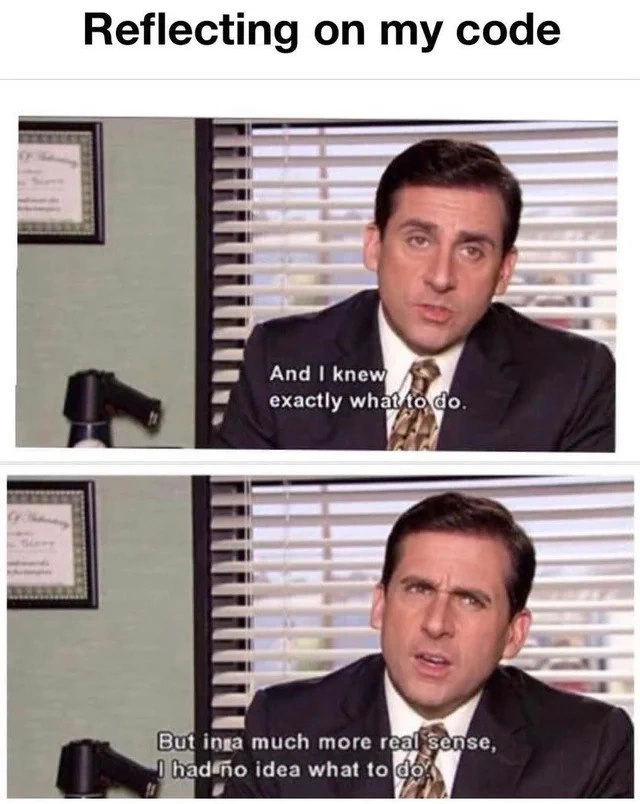
When code review reveals you knew and never knew what you were doing
CodeQuality Post #3373, on Jul 4, 2021 in TG

When code review reveals you knew and never knew what you were doing

Why is this CodeQuality meme funny?

Level 1: Lost Without a Map

Imagine you confidently tell your friends you know the way to a new ice cream shop in town. You sound sure of yourself, so everyone follows you. But after a few blocks, you suddenly realize you’re completely lost and have no idea which way to go! 😅 You thought you knew exactly where you were headed, but in reality, you didn’t know at all. This meme is just like that, but for someone writing a computer program. At first, the programmer felt super sure, like “I’ve got this, I know what I’m doing.” Then later, when they looked at their work again, they felt totally confused, like “Actually... I have no clue what I did here.” It’s funny because we can all relate to that oops moment of being totally confident and then totally puzzled right after. The meme is basically a friendly joke saying, “Remember that time you thought you had a perfect plan, but then realized you were lost? That’s me with my own code!”

Level 2: Code Review Reality Check

In this meme, a character from the sitcom The Office (that’s Michael Scott, the boss in the show) is shown saying he “knew exactly what to do,” followed by admitting “in a much more real sense, I had no idea what to do.” Developers are using this funny quote to describe what it feels like to look back at your own code during a code review. A code review is when you or your teammates examine code line-by-line to catch mistakes and improve the code quality before it’s final. It’s like proofreading an essay, but for programming. The title at the top, “Reflecting on my code,” sets the scene: the developer is rereading what they wrote and reflecting on it. At first, when writing the code, they felt confident — they thought they “knew exactly what to do.” But later, when reviewing or debugging that same code, they realize they are actually confused by it — “I had no idea what to do.” It’s a comedic way to admit that maybe the code wasn’t as clear or well-understood as initially thought.

This highlights a common gap between how we perceive our understanding when we write code versus what happens when we actually have to explain or revisit it. When the developer wrote the code originally, they were probably sure it was correct. But now, in a code review (or even just coming back to the code after some time), they’re experiencing a reality check. They might be thinking, “What does this even do? Why did I write it like this?” It’s both funny and a little scary to realize you don’t immediately understand something you yourself created!

Several real-world programming concepts are being poked at here. First, code quality is important. Code quality means how well-written and clean the code is — good naming, simple logic, and maybe some comments explaining things. If code quality is poor, code can turn into what we call spaghetti code. Spaghetti code is a nickname for code that is tangled and messy, like a bowl of spaghetti. In spaghetti code, the flow jumps all over the place, variables have unclear names, and there’s no clear structure. It’s hard to follow, even for the original author. In the meme’s scenario, the developer’s code might have become spaghetti code during a rushed coding session. At the time of writing, they felt everything was fine. But later, reading it feels like untangling a big mess.

Another concept hinted at is technical debt. Technical debt is a metaphor: when we write quick-and-dirty code to solve a problem now, we “borrow time,” but we owe cleanup later — just like taking on debt. In practice, this means the code works for now, but it might be sloppy or not well thought out. Eventually, that messy code causes trouble (confusion, bugs, etc.), and we have to “pay back” the debt by fixing or refactoring it properly. In the meme, the developer is basically confronting the technical debt they created. They’re realizing that the quick solution they threw together made sense in the moment, but now it’s confusing and needs rework.

Refactoring is the process of improving that messy code without changing what it actually does. For example, you might break a long, confusing function into smaller ones, or rename goofy variable names to something meaningful. Refactoring is often needed when you (or your teammates) look at code and go, “Uh, this could be better.” In the context of the meme, once the person admits “I had no idea what to do,” it’s a hint that refactoring might be necessary. If even the author can’t understand the code, it’s time to clean it up! This is a painful but valuable lesson many new developers learn: write code as if the next person to read it is a total stranger (because quite often, that “stranger” will be future-you who doesn’t remember the details).

The humor here is also very self-deprecating. That means the developer is joking about their own shortcomings. Instead of bragging “I’m a 10x engineer who writes flawless code,” they’re openly laughing at the fact that sometimes even they don’t understand their own work. It’s an oh-so-relatable mix of embarrassment and humor. Pretty much every programmer has experienced writing something that works, then later scratching their head trying to figure out how it works or why they did it that way. It’s a bit like writing an essay late at night and the next day realizing some sentences don’t make sense. You’d think, “What was I trying to say here?” Similarly, in coding, you might see a function you wrote and go, “What was this code supposed to do?!”

Lastly, let’s talk about debugging frustration because it’s closely related. Debugging is when you have to find and fix errors (bugs) in your code. Now imagine trying to debug a problem in code that even you don’t fully understand anymore – that’s incredibly frustrating! To debug effectively, you first need a clear picture of how the code is supposed to work. If reading your own code feels like deciphering a secret message, fixing any issue in it becomes a real challenge. This adds to the comical panic of the situation: not only did the developer realize they are hazy on what they did, but if something’s wrong, they have to play detective in code they themselves wrote. It’s equal parts funny and humbling.

In summary, the meme uses a popular TV show quote to highlight a classic programmer experience: the moment when you thought you understood your code, but later you’re completely baffled by it. It teaches newer developers about the importance of writing clear code and being honest about one’s understanding. And it gives all developers a chance to laugh at ourselves — because feeling lost in your own code is a mistake everyone makes at some point, and it’s better to chuckle and learn from it than to pretend it never happens.

Level 3: Dunning–Kruger Code Review

"And I knew exactly what to do.
But in a much more real sense, I had no idea what to do."

This meme perfectly captures a code review scenario that senior developers know all too well. It's using a quote from Michael Scott (the hapless boss in The Office) to dramatize a programmer's internal monologue. On the outside, the developer exudes confidence about their code — “Sure, I got this, I knew exactly what to do.” But inside, as the review comments start rolling in or as they themselves re-read the code, a cold dread sets in: “Oh no... I have no idea what this code is doing.” The humor hits hard because it’s a tech twist on the Dunning–Kruger effect. In the moment of writing the code, the developer felt on top of the world (perhaps overestimating how solid their solution was). But when confronted with that same code later, reality ensues and their competence feels like an illusion. This is self-deprecating developer humor at its finest — we’ve all been Michael Scott in that interview chair, talking a big game while internally screaming.

Why is this so funny (and painful)? Because it's relatable developer experience distilled into two contradicting sentences. During a code review (where peers or future-you scrutinize the code), every experienced engineer has had that mortifying realization that the code they wrote in a rush or in a fog of late-night programming is basically a stranger’s work. The variable names are nonsensical, the logic is convoluted, and maybe there’s a comment like // TODO: fix this later staring back judgmentally. The outward confidence (“I knew exactly what to do”) often masks the fact that, truthfully, the code was slapped together with fingers crossed. This meme speaks to that gap between perceived understanding and actual understanding of one’s own code. It’s a comedic reminder that writing code often feels like a moment of brilliance, but reading it back can feel like deciphering someone else’s brain-teaser.

Let’s break down the shared developer trauma being satirized here:

  • Outward confidence, inward confusion: Picture yourself in a pull request discussion, walking colleagues through your code. You’re using your best matter-of-fact voice, but internally you’re panicking because half of the functions look alien. You’re essentially re-discovering your code in real-time. Michael Scott’s quote nails this facade: you sound like you know what you’re doing, but your brain is frantically thinking “Wait, what did I do here?!”.
  • Spaghetti code & technical debt: Often, this scenario arises from classic spaghetti code — a tangled mess of logic with no clear structure (think of spaghetti noodles all criss-crossed 🥣). Maybe you accumulated some technical debt by rushing out a feature or patching a bug with a quick hack. It worked in the moment (hooray?), so you moved on. But now that messy solution comes back to bite. The code is so intertwined and opaque that even you, the original author, can’t follow it. It’s like past-you left a trap that present-you must now escape.
  • Stack Overflow magic snippet: Let’s be honest, we’ve all copied a snippet from Stack Overflow or some blog at 2 AM just to make the error go away. At the time, you’re thinking “Yes, I nailed it – exactly what I needed!” But in the code review someone asks “Can you explain how this works?” and you freeze. That code was basically a black box to you; it solved the problem by arcane means you never fully grasped. Now you’re stuck trying to reverse-engineer (or bluff) an explanation for something you barely understand. Cue the much more real sense of “I have no idea what it does, it just works.”
  • git blame self-own: One particularly humbling moment is using version control to find out who wrote this nonsense. You run git blame on the baffling line, fully expecting to unmask some clueless junior... and it turns out you committed it months ago! 🤦‍♂️ Past-you was so sure that doing x = x * magicNumber inside a while loop was genius, but present-you is facepalming. It’s a rite of passage to angrily mutter “Who wrote this garbage?” only to discover your own name. The meme’s blurred face could be any developer, because we’ve all worn that mask of shame.

In all these cases, the code quality wasn’t up to par, and the developer’s initial certainty was an illusion. The result? A painful refactoring session looms ahead. Refactoring means going back in to clean up and restructure that ugly code without breaking it – essentially untangling the spaghetti. But refactoring something you don’t fully understand is like performing surgery blindfolded. It’s risky and stress-inducing (“please don’t let production break, please don’t let production break…”). No wonder the meme character looks distressed in the second panel.

What elevates this meme is that it wraps a lecture on code quality and humility in a joke format. It quietly tells us: Yes, even the person who wrote the code can be completely clueless about it later. This is why we preach writing clear, maintainable code and leaving comments or documentation. Future-you (or your teammates) shouldn’t have to play detective to figure out what your intent was. The laugh comes from recognition – we developers laugh because we’ve been there, and it’s better to laugh than to cry! It’s a form of self-deprecating humor that bonds programmers over shared debugging frustration. Instead of feeling alone in our “I have no idea what I wrote” moments, we meme about it and move on. In short, the meme lands so well because it captures a universal truth in software development: that awkward moment when your code works, but you don’t know why. Senior engineers know this feeling, junior engineers will inevitably discover it, and everyone in between can’t help but smirk (and maybe cringe) at how real this comedy is.

Description

The meme has a white banner at the top with the bold black title text “Reflecting on my code.” Below, two stacked screenshot panels from a well-known office sitcom show a suited man sitting in an office interview setting; his face is blurred for anonymity. In the first panel the subtitle reads, “And I knew exactly what to do.” In the second panel, he continues, “But in a much more real sense, I had no idea what to do.” The visual joke contrasts outward confidence with inward confusion, capturing a developer’s common experience of rereading their own code: initial certainty turns into panic when realizing the implementation no longer makes sense. Technically, it lampoons code quality issues, refactoring pains, and the gap between perceived and actual understanding during debugging or code review
Comments

6
Anonymous ★ Top Pick Past-me during the 2 a.m. deploy: “Obviously a shard-aware, event-sourced cache-warmer solves this.” Present-me in code review: “In a much more real sense, I’ve just scheduled a distributed thundering-herd for Black Friday.”
  1. Anonymous ★ Top Pick

    Past-me during the 2 a.m. deploy: “Obviously a shard-aware, event-sourced cache-warmer solves this.” Present-me in code review: “In a much more real sense, I’ve just scheduled a distributed thundering-herd for Black Friday.”

  2. Anonymous

    The code works perfectly in production, which is concerning because I distinctly remember implementing it during a conference call while arguing about microservice boundaries and I'm pretty sure I never wrote tests for the race condition I was definitely going to fix later

  3. Anonymous

    Every senior engineer has experienced this exact moment: confidently merging that 'elegant' abstraction at 2 AM, only to return three months later during an incident and realize you've built a distributed system that violates CAP theorem in ways previously thought impossible. The real tragedy isn't the technical debt - it's that you were so certain the seven layers of indirection were 'future-proof architecture.'

  4. Anonymous

    Plan: extract a service and delete the global; reality: the global is load‑bearing, coordinates three cron chains, and appeases a haunted third‑party integration

  5. Anonymous

    Senior dev rite: your code's a black box even rubber-duck debugging can't crack

  6. Anonymous

    Reflecting on my code: on the whiteboard I knew exactly what it did; in prod, after Spring proxies and reflection, even the stack trace just points to $Proxy42 at line ?

Use J and K for navigation