Skip to content
DevMeme
7283 of 7435
Learning Curve Asymmetry: FP to Imperative vs Imperative to FP
FunctionalProgramming Post #7983, on May 10, 2026 in TG

Learning Curve Asymmetry: FP to Imperative vs Imperative to FP

Why is this FunctionalProgramming meme funny?

Level 1: Taking Toys Away vs Giving Them Back

Imagine a kid raised with strict house rules — shoes off, dessert after dinner, toys back on the shelf — visiting a house with no rules at all. Easy! Fun, even (that's the goofy thumbs-up guy). Now imagine the opposite: a kid who's never had rules visiting the strict house, where every single thing they normally do gets a firm "no, we don't do that here." That's the screaming guy. The joke is that learning to follow fewer rules is a vacation, but learning to follow more rules feels like the walls are closing in — even though the strict house is the one where nothing ever gets broken.

Level 2: The Vocabulary Causing the Screaming

  • Imperative programming: telling the computer how, step by step — assign, loop, mutate. C, Python, Java's bread and butter.
  • Functional programming (FP): composing what from pure functions — same inputs, same outputs, no side effects. Haskell, Elm, OCaml; F# and Scala in mixed company.
  • Immutability: values never change after creation; "updating" means making a modified copy. Eliminates whole bug families (who changed this?!), at the cost of your favorite habits.
  • Recursion over loops: without mutable counters, iteration becomes functions calling themselves or higher-order tools like fold. Your first attempt will blow the stack; that's tradition.
  • Monad: a pattern for chaining computations that carry context (possible failure, I/O, state). You've already used the idea if you've chained promises in JavaScript — nobody screamed, because nobody said the word.

The rite of passage encoded here: every imperative dev's first week of Haskell includes asking "how do I just print a value?" and receiving an answer that mentions category theory.

Level 3: Unlearning Is the Hard Direction

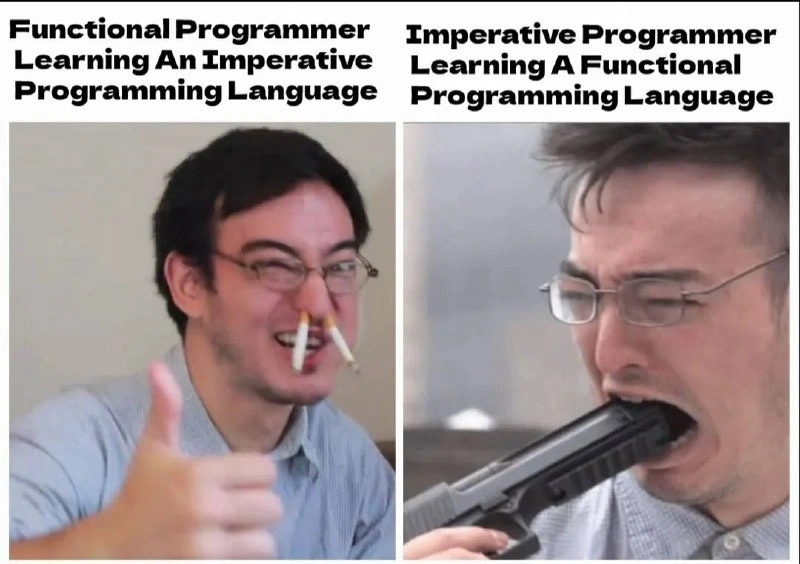
The template carries the payload perfectly. Left panel — "Functional Programmer Learning An Imperative Programming Language" — the grinning thumbs-up with two cigarettes up the nose: a person doing something objectively wrong and having a wonderful time. Right panel — "Imperative Programmer Learning A Functional Programming Language" — the same man screaming around a handgun: existential, not technical, distress.

The senior insight is that the difficulty isn't the syntax, it's the mental-model migration. An imperative programmer's instincts — accumulate in a loop, mutate the array in place, sprinkle a print to debug — are not merely unidiomatic in a pure functional language; they are frequently unrepresentable. No loops, only recursion and folds. No mutation, only new values. No casual side effects, only effects threaded through types. Every reflex returns a compiler error, and Haskell's 40-line type errors read like the compiler is disappointed in you personally. Going the other direction, the functional programmer loses guarantees but gains permissiveness — they can keep writing maps and pure functions inside Python or Java and simply tolerate the chaos around them, like a vegetarian at a barbecue who brought their own skewers.

The industry context makes the meme evergreen: imperative-first education means the right panel is the common direction of travel. And there's a quiet punchline history added later — the imperative mainstream spent two decades absorbing FP's furniture (lambdas in Java, map/filter everywhere, immutability-by-default in React state management, Option types in Rust). The screaming man's grandchildren will do functional programming without ever being told that's what it's called.

Level 4: A Monoid in the Category of Suffering

The asymmetry this meme asserts has a genuine theoretical basis: the two paradigms are not mirror images, because one is a restriction of the other. Imperative programming descends from the Turing machine — computation as a sequence of state mutations over time. Functional programming descends from the lambda calculus — computation as expression rewriting, where "variables" are bindings, not boxes. The models are equivalent in power (Church–Turing), but pedagogically they are wildly asymmetric: a functional programmer learning imperative code is being handed extra capabilities (mutation, sequencing, side effects anywhere), while an imperative programmer learning, say, Haskell is having capabilities revoked — and revoked by the type system, with receipts.

The crown jewel of the right panel's despair is the monad, the structure pure languages use to recover sequencing and effects without abandoning referential transparency. The infamous definition — "a monad is just a monoid in the category of endofunctors, what's the problem?" — is a real theorem (monads are monoids in the endofunctor category with functor composition as the tensor) repurposed as a hazing ritual. What it operationally means is gentler: IO, Maybe, and friends are values describing computations, composed with >>= so that effect order becomes data dependency. But to get there, the imperative learner must first internalize functors, then applicatives, then realize that do-notation was syntax sugar for the thing they were afraid of all along. Meanwhile the FP-to-imperative traveler discovers that x = x + 1 — a type error, a contradiction, an affront in their home calculus — is not only legal but the idiom. Nothing must be learned; only standards must be lowered. Hence the thumbs up.

Description

Two-panel meme using the Filthy Frank cigarettes-up-the-nose template. Left panel, captioned 'Functional Programmer Learning An Imperative Programming Language': a grinning man with glasses gives a thumbs up with two cigarettes stuck in his nostrils - goofy, but happy and in control. Right panel, captioned 'Imperative Programmer Learning A Functional Programming Language': the same man screams in despair with a handgun in his mouth. The meme asserts the asymmetry of paradigm switching: going from pure functional concepts (immutability, monads, recursion) to mutable imperative code feels trivially permissive, while imperative programmers confronting functors, type classes, and the absence of loops and mutation experience existential dread

Comments

2
Anonymous ★ Top Pick Going FP to imperative just means unlearning discipline; going the other way, the compiler rejects your entire mental model with a 40-line type error
  1. Anonymous ★ Top Pick

    Going FP to imperative just means unlearning discipline; going the other way, the compiler rejects your entire mental model with a 40-line type error

  2. @deadgnom32 2mo

    thing is, that functional languages allow to do imperative style, so the func-devs basically already aware of the other side. https://news.ycombinator.com/item?id=14551168 here is a good discussion

Use J and K for navigation