Every Programmer's First Rite of Passage
Why is this Juniors meme funny?
Level 1: The World Says Hello
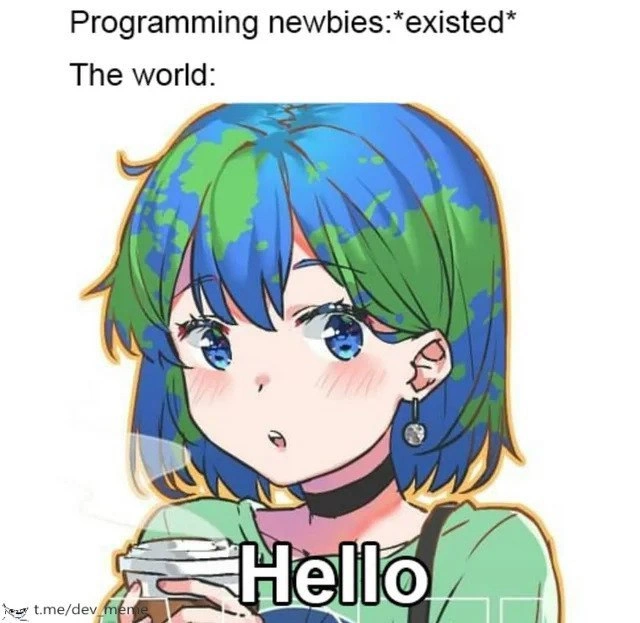
Imagine a little kid learning their first word. They say “Hello,” and suddenly the whole world waves and says “Hello” back. This meme is just like that, but for someone learning programming. When a brand-new coder writes their very first program, it usually just says hello to the world. It’s such a common first step that the joke here is the whole Earth is personified as a cute girl saying “Hello” back to the new coder. It feels like the planet is happy to see another person starting to code. In simple terms: whenever someone begins their coding journey by saying “Hello, World,” the world happily replies “Hello!” It’s a playful, warm-fuzzy way to say welcome to coding!
Level 2: Hello, World Tradition
When you’re learning to code, the Hello, World program is usually the very first thing you write. All it does is display the words “Hello, World!” on the screen. This tradition is so universal that it’s practically a handshake every new programmer has with the coding world. The meme takes that concept literally: the world (drawn as a friendly anime girl with continents in her hair) says “Hello” right back to the newbie. This is funny and adorable because normally we, the programmers, are telling the world “hello” via our code. Here, the entire Earth is portrayed as responding to the newbie’s first greeting.
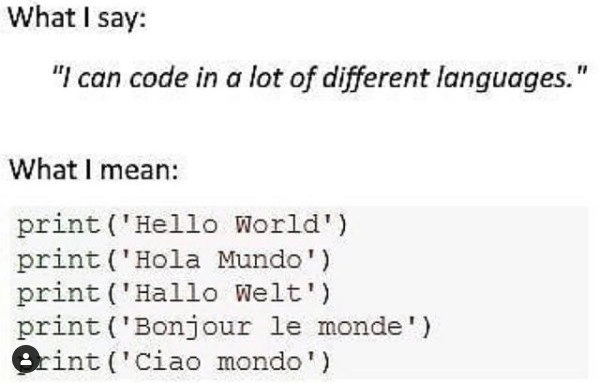
Why “Hello, World”? It’s the simplest way to show that your code works and can output text. It’s like the programming equivalent of a baby’s first word. For example, in Python you can write a one-liner:
print("Hello, World!")
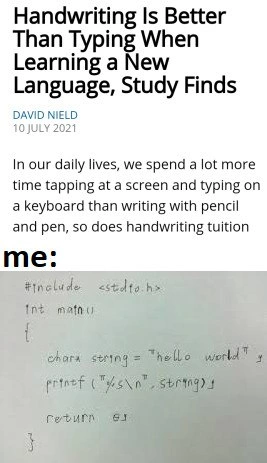
And in a language like C, a basic program might look like:
// C example
#include <stdio.h>
int main() {
printf("Hello, World!\n");
return 0;
}
No matter the programming language – be it Python, JavaScript, C++, or Java – this first exercise is almost always the same. You run your code, and if it prints out Hello, World! (or in this meme’s twist, if the world says hello back to you), it means everything is set up correctly and you’ve officially written a working program. It’s a small thing, but it feels huge when you’re a beginner. You’ve spoken to the computer (or the world), and it responded!
In the image, the world is represented as Earth-chan (a popular anime-style personification of Earth from internet culture). This character has blue and green hair like the oceans and landmasses. By using Earth-chan to say “Hello,” the meme merges coding culture with a fun anime reference. For a junior developer or someone on their LearningToCodeJourney, it’s super relatable humor: you type some code, hit run, and it’s like the whole planet acknowledges your effort with a friendly greeting. The takeaway is that doing a Hello World isn’t just a trivial tutorial step – it’s almost like a warm welcome into the developer community.
Level 3: Global Greeting Protocol
Programming newbies: *existed*
The world: Hello
This meme humorously personifies the classic “Hello, World” tradition. The top caption follows a familiar meme formula: simply by existing, programming newbies trigger an automatic response from the world. And what does the entire planet say? The beloved first program output: "Hello". The joke is that the moment a fresh programmer shows up, the whole world runs its own little script to greet them.
This plays on the fact that nearly every developer’s journey begins with writing a program that prints Hello, World!. It’s a universal rite of passage in coding. In the image, the world is depicted as an anime-style girl with Earth-like hair (a nod to the internet’s Earth-chan meme). She’s holding a coffee cup and saying “Hello” as if to welcome the new coder to the programming universe. Seasoned developers chuckle here because we’ve all been that starry-eyed newbie who just got our code to speak to the world. The entire planet cheekily saying “Hello” back is like the universe acknowledging our first triumph.
Notice how the world only says “Hello” in the image (and not “Hello, world”). That’s a clever twist: usually the program says “Hello, world” to greet everything out there. But if the world itself is doing the talking, it just says “Hello” right back to the programmer. It’s a playful inversion of the output. This juxtaposition of a time-honored coding tradition with a personified Earth creates a double-layer joke. On one layer, it’s relatable developer humor – we all recognize the canonical output. On another layer, it’s a whimsical anime reference – the globe as a cute character (complete with a friendly face and coffee, because of course the coding world runs on caffeine). The combination of these elements, tech and pop culture, is what makes the meme land so well among developers. It taps into a relatable humor: no matter if you wrote your first HelloWorld in a modern language or punched it into a 1970s mainframe, the world figuratively greeted you when that code ran. In short, the meme is winking at us, saying: “Fresh coder arrived? The whole world says Hello!” It’s an inside joke shared across generations of programmers and languages, acknowledging that very first victory in a humorous, almost heartwarming way.
Description
An anime-style meme featuring the character Earth-chan, an anthropomorphic representation of the planet Earth with blue and green hair resembling continents and oceans. The text at the top reads 'Programming newbies:*existed*' and 'The world:'. Earth-chan is shown holding a cup of coffee with a slightly surprised expression, and the word 'Hello' is written at the bottom, implying she is speaking. A watermark for 't.me/dev_meme' is in the bottom-left corner. The meme is a wholesome visual pun on 'Hello, World!', the traditional first program written by beginners when learning to code. The 'world' literally says 'Hello' to new programmers, referencing this universal starting point in a developer's journey
Comments
7Comment deleted
The junior's 'Hello, World' is a single print statement. The senior's 'Hello, World' is a three-day struggle with a YAML configuration file just to get the service to start in the Kubernetes cluster
Proof that software scales: juniors print “Hello World” in one line; seniors need 18 microservices, two Helm charts, and a post-mortem to get the same string into prod
Meanwhile, the same world after six months: "Why can't you center a div? Have you tried reading the documentation? No, not that documentation, the other one. Actually, just rewrite it in Rust."
After 20 years in the industry, I've realized 'Hello World' is the only program that's never had a breaking change, never needed a hotfix, and somehow still compiles on every platform. It's the one piece of code that's achieved true cross-generational compatibility - from COBOL mainframes to Kubernetes clusters. Perhaps the real technical debt was the friends we made along the way, starting with that first console.log
Newbies *existed* - Earth grabs coffee, knowing the tech debt singularity just got event-horizoned
Senior take: if saying hello needs a scaffold, container, sidecar, OAuth token, and a 2GB SDK, we didn’t onboard a newbie - we shipped vendor lock‑in
Welcome, newbie - “Hello, World” remains the only thing in our stack that doesn’t need OAuth, an API gateway, a service mesh, three YAMLs, and a change approval