
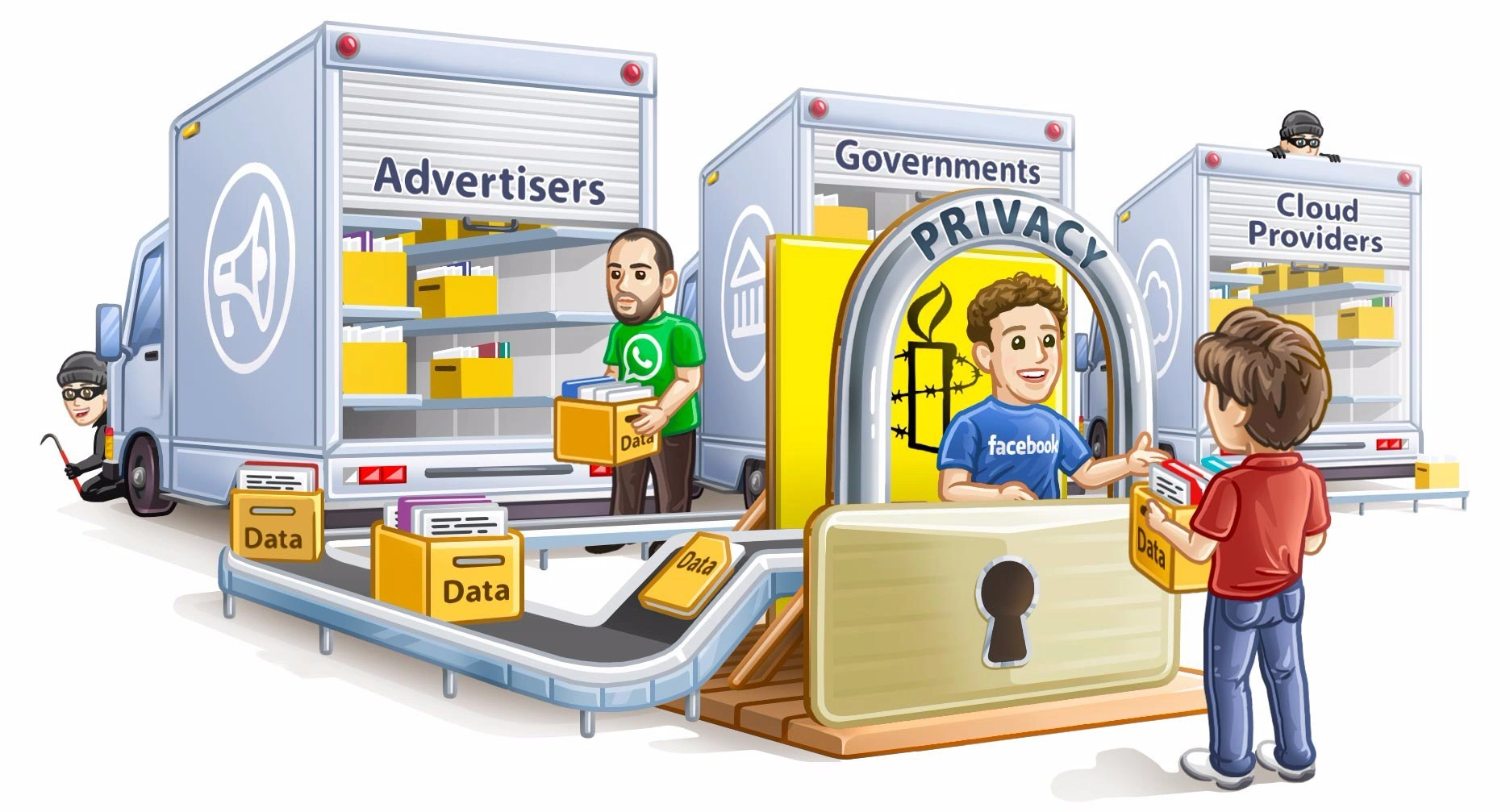
The Privacy Booth Conveyor Belt
Description
The image is a polished cartoon showing a large booth labeled `PRIVACY` with a big padlock on the front, staffed by a smiling person wearing a `facebook` shirt. A user hands over a box labeled `Data`, while conveyor belts and trucks move more `Data` boxes toward vehicles labeled `Advertisers`, `Governments`, and `Cloud Providers`; another person in a green WhatsApp shirt carries a data box, and masked thieves peek from behind the trucks. The visual joke is that a product can advertise privacy at the counter while the surrounding system quietly routes user data to commercial, governmental, cloud, and possibly criminal destinations. Technically, it points at the difference between message encryption and broader privacy exposure through metadata, account linkage, storage providers, and platform business models.


Comments
61Comment deleted
That padlock is doing excellent UI work while the conveyor belt handles the actual data architecture.
The next article is: "Why Telegram Will Never Be Secure" spoiler alert it stores user messages on its servers Comment deleted
*unencrypted messages Comment deleted
This Comment deleted
Free tip: messages are always encrypted if you have schizophasia Comment deleted
Based suggestion Comment deleted
How that works ? Comment deleted
It's a hardware accelerated encryption where the only owner of decryption keys is you Comment deleted
Their implementation of the encryption they use is not exactly audited, so it’s best assumed that nothing is safe Comment deleted
You mean the “secret chat”? Comment deleted
Yep Comment deleted
It's like hearing Microsoft talking shit about Apple Yeah sure they might have a point but just sounds cringe Comment deleted
Also, it seems funny to me when Durov talks about FBI backdoors, implying Telegram 100% backdoor free. But he can't prove it since the backend itself is not open-source, it's only the client. Comment deleted
Source code of the server side is useless in this case Comment deleted
You will never be able to verify that the production server runs the same code as what was published Comment deleted
Makes sense. Comment deleted
Yeah sure but releasing open source backend would allow you to run your own and be sure Comment deleted
Well then you either need a federated solution (matrix/XMPP), or it will just work as a corporate/local server, completely destroying the core ideas of telegram Comment deleted
Their official statement is to prevent government to run their own servers and destroy their user's privacy Which would be preventable if the whole telegram architecture was implemented as e2e, then you don't really care, if you don't count your IP as sensitive information Comment deleted
federated telegram sounds neat, ngl Comment deleted
Yeah and groups are not e2e enc like Whatsapp so a backdoor would be as simple as reading what comes through Comment deleted
What’s even the point in the general telegram encryption if you get the key from the server? Comment deleted
Well I mean I think that in 2022 ssl should be pretty much standard for everything hahaha For a chat I expect a little bit more Comment deleted
If that encryption is the transport encryption then it’s just a meme, basic https ssl at least generates different keys on every connection, and here all devices always use the same key? Comment deleted
Not sure about that, I tried to understand MTProto but failed Comment deleted
I really don't know how telegram enc is implemented, also because they use their own technology (which is extremely stupid), I do know tho than in groups the server has access to everything in clear Comment deleted
Well it seems like telegram was developed without some overlook into the contemporary technology “market” of the time Comment deleted
2013 wasn’t in 1999, there were a lot of industry standards for stuff like encryption, real-time connections etc, you didn’t have to make an overcomplicated protocol from scratch Comment deleted
In 1999? How many POPULAR and not flawed protocols were used? Just a reminder: we are talking about time when MD5 was a top notch hashing function while it always was vulnerable for collisions attacks by design Comment deleted
Telegram shared data with german authorities over 25 times. The we shared zero bytes is bullshit. Comment deleted
this is what I came here to ask about, did we ever get a conclusive answer? Comment deleted
Telegram now is more like a social network/messenger hybrid Comment deleted
But it's not by any means "private" or "secure" Comment deleted
What's next? Panama papers? Harlem shake? I'm here for the new content, not three-years-old stuff Comment deleted
Well in a couple of years Whatsapp will have to open its APIs in Europe, that will solve A LOT of problems Comment deleted
So what if this API gonna stay in Europe and will just proxy all info to american server? Comment deleted
e2e encryption saves you Comment deleted
The important message is that Whatsapp will have to open it's APIs (as for European regulation), letting other people modify the clients At that point you could very well consider Whatsapp backend an untrusted element of the chain and act accordingly Comment deleted
Without exposing a bit of real data? Comment deleted
And btw European data can't go into USA servers, it's against the GDPR Comment deleted
Do I understand correctly: you expect that some EU inspectors will go to Data centers of big tech companies then somehow extract encryption keys (for all layers, including process of freezing RAM using liquid nitrogen to extract RAM only keys) and software running on those servers and will analyse it to prove that no data goes to US from those servers? Comment deleted
Well it's already happening to some extent, in Italy Google adsense is effectively illegal Comment deleted
You can make company illegal But it’s next to impossible to verify claim that no EU data is leaked outside EU Comment deleted
Well that's exactly what happend, they banned a service which exported data into the US Comment deleted
And btw I think you're missing the point It's not that European data is staying or leaving the EU, it's just that as I'm controlling the client I can implement whatever client side security I want I can can encrypt e2e messages and metadata, I can use tor to mask my IP, I can develop whatever I want ON TOP of Whatsapp's backend Comment deleted
"including process of freezing RAM using liquid nitrogen to extract RAM only keys" You mean cold boot attack? Or I misunderstood you? Comment deleted
you can freeze RAM with liquid nitrogen to preserve data on it without giving it power iirc Comment deleted
To me that's gdpr working Comment deleted
GDPR is EU level framework How many EU countries joined that ban? Comment deleted
The Privacy Shield, as it was called, was declared illegal a good amount of years ago, I can't remember but I'm gonna say probably 2020ish Since then countries have started to declare illegal services that transmit data into the Us, adsense being one of them Idk exactly how many but that I know of it's Italy and France but all that's needed is a lawsuit from whomever directed to a particular entity which is using Google services for it to fall Comment deleted
Because as a data owner you need to ensure gdpr rules so you're liable also if one of your providers is violeting them, rightfully so Comment deleted
My point is: there’s no watchdog with capabilities of confirming or denying that data is sent over the border or not Comment deleted
Yea sure that might be true for small data, we're talking about tens of PB, it's not that hard to notice And truly that was beside the point I was making about Whatsapp Comment deleted
Article is more than 3 years old 🤔 Comment deleted
OTP is not an encryption ;). Besides, anything actually proven to be safe is good enough, like Signal or GPG over email. It’s just that Telegram has never shown that we can trust it Comment deleted
Yup, exactly. Not an encryption Comment deleted
Yeah, it’s an encryption technique for key exchange. Not an encryption Comment deleted
Because those you can compile and audit Comment deleted
I really don’t want to go into this basic security conversation. If you want to trust Telegram, that’s fine. Just try to understand why nobody on ITSec scene cannot recommend it and why nobody that actually needs to care about privacy like journalists use it for serious things Comment deleted
Because there’s a big difference between leaked by default (coz somehow stored on the 3rd party server in the way which allows decryption) and when data presented in decrypted form only on device and targeted attack required to get that data. When plain data stored by 3rd party there’s not a lot you can do to secure it When it’s stored on your device - there’s a plenty of options how to secure it. And plenty of options how to attack you too, of course. But all of them are much more complicated than asking your friend from **classified** to extract that data from service provider Comment deleted
hmmm *classified* part looks sus Comment deleted