Ternary Operator Fan Club
Why is this Languages meme funny?
Level 1: The Shortcut Sentence
This is funny because it is like someone saying, "I love making every explanation into one giant sentence." Shortcuts are useful when the idea is simple, but they become annoying when too much is packed into them. The ternary operator is the programming version of that: great for a tiny choice, painful when it turns into a puzzle.
Level 2: The Tiny If
A ternary operator is a short way to choose between two values. Instead of writing a full if statement, a developer can write the condition, the value to use when it is true, and the value to use when it is false.
For example:
const message = loggedIn ? "Welcome back" : "Please sign in";
That means: if loggedIn is true, use "Welcome back"; otherwise use "Please sign in". This can be clearer than a longer if block when the choice is simple.
The problem is that programmers sometimes overuse it. They start putting complex decisions into a single line because it feels efficient. But other people have to read that line later. If they need to slow down, count question marks, match colons, and figure out which branch belongs to which condition, the code has become harder to maintain.
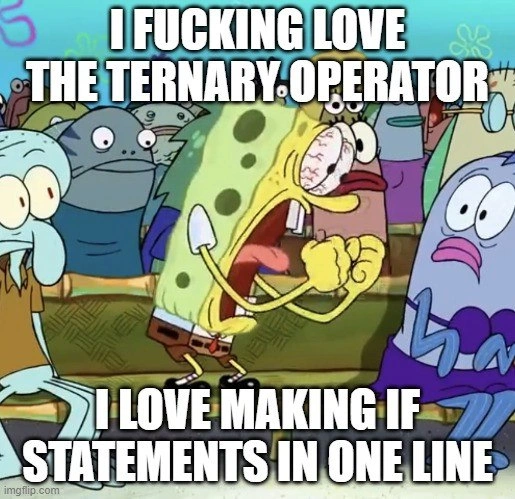
That is why the surrounding characters look uncomfortable. SpongeBob represents the developer who loves the feature. The crowd represents everyone reviewing or maintaining the code after the excitement wears off.
Level 3: Conditional Compression Addiction
The meme has SpongeBob screaming with ecstatic intensity while the surrounding characters look alarmed. The text says:
I FUCKING LOVE THE TERNARY OPERATOR
and then:
I LOVE MAKING IF STATEMENTS IN ONE LINE
That contrast is the whole code review in one image. The person using the ternary operator feels like SpongeBob: efficient, expressive, maybe even elegant. Everyone else looks like they just opened the pull request and found business logic folded into a single line with three conditions and a prayer.
The ternary operator, usually written as condition ? valueIfTrue : valueIfFalse in C-family languages and JavaScript, is not inherently bad. It is excellent for small expressions where the alternatives are symmetrical and obvious:
const label = isAdmin ? "Admin" : "User";
That line is readable because the condition is simple, both outcomes are values, and no one has to simulate a tiny decision tree in their head. The trouble starts when ConditionalLogic becomes a readability contest against the compiler:
const access = user
? user.disabled
? "blocked"
: user.roles.includes("admin")
? "admin"
: "limited"
: "anonymous";
At that point the code still works, but the human parser has been assigned unpaid overtime. This is why the meme belongs in CodeQuality, CodeReadability, and SyntaxAbuse territory. Developers often confuse compactness with clarity. A one-line if can be elegant; five decisions compressed into one expression is just a stack trace waiting for a personality.
The senior pain behind the joke is that style debates rarely stay about style. Ternaries affect debugging, test readability, logging, diff quality, and future edits. A normal if block gives each branch a place to grow. A clever one-liner dares the next developer to add one more case without making it worse. Naturally, the next developer does exactly that, because deadlines are how codebases learn bad habits.
Description
The image is a SpongeBob crowd-reaction meme with SpongeBob yelling excitedly while other characters look startled or uncomfortable. The top text reads `I FUCKING LOVE THE TERNARY OPERATOR`, and the bottom text reads `I LOVE MAKING IF STATEMENTS IN ONE LINE`, with an `imgflip.com` watermark in the lower-left corner. The developer joke is about the ternary operator turning simple conditional logic into compact one-liners that some programmers love and others find unreadable. It reflects a real code review tension: brevity can be expressive, but nested or overused ternaries quickly become syntax golf disguised as clarity.
Comments
22Comment deleted
A ternary is elegant until the third `?` turns your business rule into a CAPTCHA for maintainers.
let x = ((y * 2)**(1/2))<4 ? 2+y/2 : 2-y/2 no comment needed, code is self-explanatory Comment deleted
I like how in kotlin everything returns value, so you can do this with if-else Comment deleted
let x = ((y * 2) ** (1/2)) < 4 ? 2 + y / 2 : 2 - y / 2 would be more readable and still better than explicit if-else, IMHO, especially when clauses grow in size and complexity. Comment deleted
true Comment deleted
2 + y / sqrt(y * 2) < 4 ? 2 : -2; Comment deleted
let x = if (y * 2).sqrt() < 4 { 2 + y/2 } else { 2 - y/2 } Looks not so bad, really (Rust lang) Comment deleted
+1 Comment deleted
what is y ? Comment deleted
LITERALLY ME Comment deleted
IF THE CODE IS COMPACT, IT IS GOOD Comment deleted
Python's one is kinda sad though :( It used to feel cool, but now it's just so bloated Comment deleted
Same with list comprehensions.. Map/filter/reduce really puts python list comprehensions to shame Comment deleted
Yeaaaah! Makes even less sense now! Comment deleted
I need to finally learn Rust, it sounds really interesting Comment deleted
This is nothing, try functional point-free style. Comment deleted
Sadly there is no such thing in rust... We can just use one liner if and else... The worse thing is we still need to use brackets 😐 if bool { one } else { two } Comment deleted
Sadly there's rust Comment deleted
Although I think we going to get it without the brackets in later versions... (Already in nightly) Comment deleted
golang var x int if ((y*2)**(1/2))<4 { x = 2+y/2 } else { x = 2-y/2 } 😑😂😂😂 Comment deleted
I hate Kotlin for not supporting this from Java 😢 Comment deleted
return option1 or option2 Comment deleted