Skip to content
DevMeme
2332 of 7435
Explaining Tech Privacy: How You See Yourself vs. How Your Family Sees You
Security Post #2592, on Jan 12, 2021 in TG

Explaining Tech Privacy: How You See Yourself vs. How Your Family Sees You

Why is this Security meme funny?

Level 1: The Invisible Monster and the Helpful Hero

Imagine you discover something kinda scary that nobody else can see – let’s say there are invisible bugs that come at night to eat your snacks if you don’t put them away. You get super excited (and a little anxious) and you want to warn your family. You feel like a hero from a movie, offering them a simple choice: “Either start putting the cookies in a jar at night (so the invisible bugs can’t get them), or leave them out and risk losing all the treats!” In your head, it’s just like a scene from a story where the wise guide offers a red potion or a blue potion – one reveals the truth, the other keeps you in the dark. But to your family, who can’t see these bugs and never even knew they existed, you kind of just look like a funny crazy person making a big deal over nothing. One minute you’re talking about snack thieves, the next minute you’re saying something about tiny footprints in the kitchen, and you’ve even drawn a whole chart connecting crumbs to cabinets to mysterious disappearances. They’re scratching their heads, thinking, “Is this for real, or has she been watching too many spooky shows?” It’s a little bit silly: you’re so sure you’re helping them and explaining something important, but they just see you waving your arms, super worked-up, about these invisible snack bugs. The whole situation is funny because you’re both sincere and a tiny bit over-the-top – you want to protect the people you love, but to them it feels like you’re seeing a problem that isn’t there (or at least that they’ve never noticed). In the end, you feel like a wise protector, and they’re giggling because you sound like you’re telling a wild conspiracy story. It’s that mix of caring a lot and others not understanding that makes it amusing and relatable to anyone who’s ever tried to explain something they’re passionate about to a skeptical friend.

Level 2: Explaining the Joke (Privacy 101 Edition)

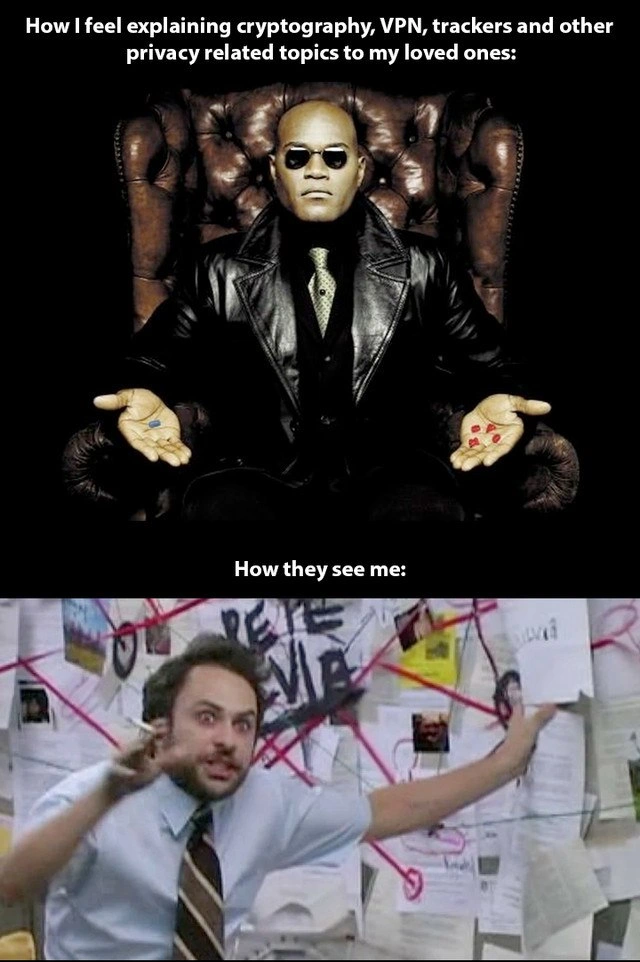
Let’s break down the meme’s two scenes and the tech concepts mentioned, in simpler terms. The top caption says: “How I feel explaining cryptography, VPN, trackers and other privacy related topics to my loved ones:” and it shows an image from The Matrix. In that famous scene, a character named Morpheus offers Neo two pills: a red pill (to learn an uncomfortable truth about reality) and a blue pill (to stay ignorant and happy). In our meme, the person explaining privacy feels like Morpheus — as if they're offering crucial knowledge and a clear choice: “Do you want to know how to stay safe online (red pill) or do you want to ignore these complicated things (blue pill)?” It’s a bit dramatic, but that’s the feeling: I’m giving you important wisdom. The topics they mention – cryptography, VPN, trackers, etc. – are all about protecting your information on the internet.

Now, what are those exactly? Cryptography is basically the science of secret codes. It’s how we encrypt data, meaning we scramble information so only someone with the right key (password or code) can read it. For instance, when you use a secure messaging app and it says “messages are end-to-end encrypted,” it’s using cryptography to make sure that only you and the person you send the message to can read it. Even if someone intercepts the message, all they’d see is gibberish, not your actual words. Pretty neat, right? This is exactly the kind of thing a tech-savvy person might excitedly share: “Hey, Mom, did you know WhatsApp uses 256-bit encryption? That means even the company can’t read our texts!” (256-bit is just a way of saying really secure, because there are an astronomically high number of possible keys – 2^256 of them).

Next, VPN stands for Virtual Private Network. That sounds fancy, but the idea is straightforward: it’s a service that creates a secure, encrypted connection for your internet traffic. Think of it like an invisible tunnel from your device to the VPN server. When you’re on a VPN, it’s as if your computer first travels through that tunnel to a safe server elsewhere, and only then goes out to the internet. This means that anyone watching the local network (say, the free Wi-Fi at a coffee shop, or even your Internet Service Provider) can’t see or log what websites you visit or what data you send; they only see that you connected to some VPN server. People use VPNs for privacy (hiding their online activity from prying eyes) and sometimes to appear as if they’re browsing from another country (for example, to access a streaming service’s other country library). So our privacy-conscious explainer is telling their family: “Please use a VPN on public Wi-Fi, it keeps you safe!” They might mention that VPNs stop trackers and ISP snooping, which for a non-tech person starts to sound like spy stuff.

Now trackers – these are little pieces of software or code on websites (often cookies, which are small files saved in your browser, or tracking pixels, which are tiny invisible images) that collect data about what you’re doing online. For instance, if you visit an online store and then later you see an ad on Facebook for the exact product you looked at, that’s done by trackers sharing information about you behind the scenes. Many websites have third-party trackers that report your visit to advertising or analytics companies. Over time, trackers build a profile of your interests, habits, and even potential demographics (age, gender, etc.) to serve you targeted ads or content. This is what our tech guru friend is warning about. They might say something like, “Every site you visit has 5 different trackers monitoring you!” (which isn’t far-fetched – a lot of sites do). To a family member, though, that can sound creepy or implausible: “Really? They’re watching everything I do? Come on…” It begins to feel like you’re telling ghost stories.

The second caption of the meme says: “How they see me:” and below it is that “conspiracy board” scene. This image is originally a funny meme from a TV show where a character has a bulletin board covered in chaotic notes and strings connecting them, and he’s frantically trying to explain a complicated conspiracy theory. In the context of our meme, this is how the loved ones view the explainer. So while the explainer feels like a wise, calm Morpheus, the audience (the family or friends) perceives them as an overzealous, maybe slightly paranoid person who’s ranting about all sorts of scary tech things. It’s a classic difference in perspective. The family might be thinking, “He started on about VPNs, then jumped to cookies, then to hackers, and now he’s saying something about government spies – he sounds like he’s connecting dots that aren’t really there!” From their point of view, the techie’s explanation isn’t clear and straightforward at all; it’s a tangled mess of jargon and fear-inducing claims, like how a conspiracy theory sounds. They might even joke, “Haha, should I get my tinfoil hat?” – implying that the person worrying about privacy is acting like someone who believes wild theories (tinfoil hats are stereotypically worn by conspiracy folks who think it blocks mind reading or signals – it’s a pop culture way to say “paranoid about unseen threats”).

This meme is really highlighting that CommunicationGap. The technical person thinks these concepts are simple and important – of course we all should care about encryption and privacy! But those who aren’t familiar with these ideas might find the explanation confusing, hard to believe, or just too much to digest at once. It’s a bit like explaining an inside joke or a complex rule set of a game to someone who’s never heard of it; you might lose them along the way without realizing. For many developers or IT folks, this scenario is common: we try to share our SecurityAwareness with others because we genuinely want to help keep them safe (that’s the DeveloperFrustration: you’re trying to do a good thing). But the way we explain it can accidentally overwhelm or even alienate people. We throw around terms – encryption, two-factor authentication, firewalls, blockchains – and before we know it, our listeners’ eyes glaze over. They might smile and nod, but inside they’re thinking, “I have no clue what this person is talking about, it sounds crazy.” The humor (and slight heartbreak) of the meme comes from that exact experience. It’s exaggerated, of course – most of us don’t literally set up a conspiracy wall in the living room – but emotionally, it captures how both sides feel. The explainer feels righteous and smart (like a hero from a movie), and the others feel like this is beyond normal and maybe a tad crazy.

For a junior developer or someone new to these concepts, it’s also a gentle reminder: when you learn cool new tech stuff, especially in CryptographyAlgorithms or security, it’s easy to get excited and want to tell everyone. But you have to remember not everyone knows the basics. They might not even know what a “tracker” really is, aside from maybe hearing the word in the news. And not everyone automatically shares the PrivacyConcerns you do; some people think “Well, I’ve got nothing to hide,” a phrase you hear a lot, which can be frustrating if you know how much personal info is actually collected. So the meme is also relatable on that level: you’ve got to gauge your audience. A bit of empathy and simple language goes a long way. Otherwise, what you intended as a helpful mini-lesson might come across as, well, a bit of a paranoid rant. And hey, we’ve all been there or seen it happen. This is why the meme resonates – it’s taking a slice of developer life (trying to educate others about security) and showing the two very different viewpoints in a funny way.

Level 3: Matrix Mentoring vs Meme Conspiracy

Every experienced developer or security engineer chuckles at this because it captures a situation we know all too well. You finally got your SecurityAwareness game on point—ready to enlighten your friends or family about online privacy—and in your mind you’re Morpheus in that leather armchair. You’re offering a simple, profound choice: “Do you want the truth about how your data is protected and tracked (the red pill) or do you want to continue thinking everything is fine and not worry (the blue pill)?” It feels so clear-cut to us: enable encryption, use a VPN, install a tracker-blocker, or at least tweak those privacy settings. To us techies, these are reasonable, even essential steps in today’s digital world. We see ourselves as the wise mentor figure calmly explaining cryptography and privacy — perhaps even with the gravitas of someone handing down Matrix-style wisdom. This is the rational guardian mindset: “I have seen how deep the rabbit hole goes with PrivacyConcerns, and I just want to protect you from the agents of surveillance.” In our own heads, we sound like we’re giving sage advice, simplifying complex concepts into a clear red-pill/blue-pill decision: secure vs insecure, private vs exposed.

But how do our loved ones often see us during these lectures? Enter the second frame of the meme – the infamous conspiracy board scene (the character Charlie from It’s Always Sunny in Philadelphia, mid-rant about a nonexistent person named Pepe Silvia, pointing at a wall covered in papers and red string). To them, we might as well be that wild-eyed guy linking everything to everything. From their perspective, the conversation spirals like: “He started with talking about Facebook tracking me, then suddenly it was about government surveillance, then he mentioned something about an algorithm and my IP address, now he’s on about encryption… and he’s drawing diagrams?!” It’s overwhelming. We intended a straightforward lesson on DataPrivacy, but it turned into an avalanche of alarming facts and jargon. This contrast is the heart of the humor: DeveloperHumor often laughs at our own inability to bridge that gap. We’ve all been that person on one side or the other – either passionately explaining and wondering why it’s not clicking, or being on the receiving end thinking “Wow, Bob has lost it with the computer stuff.”

The meme highlights a real communication gap in tech: what we see as common knowledge (like how a tracker works) comes off as esoteric or even paranoid to someone unfamiliar. In tech circles, it’s well-known that, for instance, advertising trackers really do follow your clicks and visits across sites – that’s neither sci-fi nor conspiracy, it’s literally how ad-targeting works. But try telling your non-tech friend, “There are invisible pixel images and third-party cookies monitoring your browsing,” and watch their face. It’s a mix of disbelief and “should I be worried or is this person just a bit nuts?” To the uninitiated, words like “VPN tunnel”, “two-factor authentication”, or “end-to-end encryption” can sound like hacker lingo or spycraft. As a seasoned dev or security nerd, you might even demonstrate with analogies: “Using a VPN is like putting your data in a secure envelope that snoops can’t open”, or rattle off a real-world example: “Look at the Cambridge Analytica scandal – that’s why I’m warning you about data trackers!” But those examples themselves (especially something named Cambridge Analytica, which indeed sounds like a secret society) can reinforce the conspiracy vibe if the person hasn’t heard of them.

We laugh because the meme exaggerates our inner drama and outer appearance. DeveloperFrustration accumulates when your carefully explained advice (“use a password manager, stop reusing 123456 everywhere, please!”) is met with eye-rolls or dismissive “I have nothing to hide, why do I need all that?” responses. It’s like we’re performing a one-man security seminar that nobody asked for. By the end of our passionate explainer mode, we might notice our “audience” looking at us the way the second image depicts: maybe a bit concerned for our sanity, like we just connected the toaster to the Wi-Fi to the decline of civilization.

What makes this extra chef’s-kiss funny for those in the know is that sometimes we do get a bit carried away. The meme is a gentle roast of the overzealous privacy guru in each of us. Yes, we intended to be as cool and composed as Morpheus, but perhaps we lost the room somewhere between describing block cipher modes and the evils of third-party cookies. Maybe we pulled up a slide about how Google knows your location even with your phone off, or mentioned nation-state hackers in a conversation that started with “Why you should use HTTPS”. The Matrix metaphor itself is telling: Morpheus lays out a philosophical choice in a few sentences; in real life, we tend to over-explain. We start unpacking why a VPN is needed (mentioning ISPs selling data, public Wi-Fi dangers, etc.), how cryptography secures data (maybe we even sketch a little lock icon and talk about TLS handshakes), and who is tracking you (big tech, advertisers, maybe we toss in government surveillance programs like PRISM for good measure). At some point during that enthusiastic dump of SecurityAwareness knowledge, our non-tech loved one’s expression shifts from polite interest to that concerned, glazed-eye look. That’s when you realize: I’ve become the conspiracy board guy to them.

It’s also worth noting the cultural reference depth here. The red_pill_blue_pill_meme has long been a symbol on the internet for a wake-up call or revealing hidden truth. Many tech folks half-jokingly see themselves as offering “red pills” when we try to convince friends to take privacy seriously — for instance, convincing everyone to switch from WhatsApp to Signal in early 2021 when WhatsApp announced new data-sharing policies. (Remember that? Suddenly every engineer was telling their family “Seriously, Big Tech reads your messages, come to this secure app instead”.) To us, that was a reasonable plea based on facts; to them, it might have sounded like we’d binge-watched a few too many privacy documentaries. The conspiracy_board_meme image of Charlie with wild hair and frantic gestures has similarly become shorthand for “I know this sounds crazy, but I swear it all connects!” It’s frequently used in developer humor to poke fun at situations where someone is overcomplicating an explanation or finding patterns that others don’t immediately see. In a workplace scenario, this could be that one dev who insists a bug is part of a larger architectural conspiracy—er, problem—and has a diagram that connects five microservices and Mercury in retrograde as root cause. Here, applied to privacy talks, it’s pure gold because we all know the stereotype: the overly fervent security advocate vs. the uninitiated crowd.

Ultimately, the meme lands so well with developers and IT folks because it’s a caricature of a truth: we struggle to translate our knowledge to a general audience without sounding either like a Matrix oracle or a madman. It’s poking fun at that fine line between educator and eccentric. We laugh because we’ve seen that look on relatives’ faces when we go into “tech explain mode” — and perhaps because, occasionally, we catch ourselves sounding a little bit like the guy mailing out manifestos about Wi-Fi radiation (when all we meant to say was “use a strong password”). The humor has a self-aware sting: we know the information is important, but we also see why it comes off as exaggerated. In short, the meme encapsulates a classic DeveloperHumor moment: the earnest tech guru vs. the perplexed audience, a modern Morpheus inadvertently cosplaying as a conspiracy theorist.

Level 4: Red Pill Cryptography

In the privacy and security world, explaining something like encryption often feels like revealing the Matrix’s code itself. The technical foundations behind cryptography algorithms are intensely mathematical – think large prime numbers, elliptic curves, and modular arithmetic. For example, you might excitedly delve into how RSA encryption relies on the difficulty of factoring a 2048-bit number, or how AES-256 (Advanced Encryption Standard with a 256-bit key) theoretically has more possible keys than there are atoms in the universe. To a fellow engineer or cryptographer, these details are elegant and logical: they're the guarantee that your data stays secret. The red pill/blue pill metaphor from The Matrix is actually quite apt here – choosing the “red pill” is like embracing the harsh truth that digital life is teeming with hidden mechanics (ciphers, key exchanges, digital certificates) that one must understand to be truly secure, whereas the “blue pill” is remaining blissfully unaware of how exposed one’s data might be. DataPrivacy isn’t just a slogan; it’s enforced by these mathematical guarantees. Academic papers and decades of research underpin the trust we place in encryption. Claude Shannon’s information theory established limits on what’s fundamentally needed to secure communications, and modern cryptography stands on those shoulders with concepts like one-way functions (easy to compute, nearly impossible to invert without a key). We know from complexity theory that breaking strong encryption by brute force would take an impractical amount of time (exponential in key length). So when a developer tries to teach privacy, they might start talking about these principles – how a VPN uses an encrypted tunnel (often via protocols like TLS or IPsec) to mathematically ensure no eavesdropper can read your internet traffic, or how even a simple messaging app might use Diffie-Hellman key exchange to let two people establish a secret key in public. These aren’t conspiracy theories at all – they’re hard science and algorithms.

However, from the outside, this deep dive can start to sound arcane. Describing a tracker in technical terms, for instance, involves explaining how websites embed third-party scripts or 1×1 invisible pixels to collect data on you, and how these are used to fingerprint your device or profile your behavior across sites. There’s a whole subtext of browser cookies, cross-site requests, and PrivacyConcerns that leads into discussions of regulations like GDPR or tools like NoScript and adblockers. By the time you’re enumerating how Google Analytics or Facebook pixels work, you’ve basically drawn a mental diagram of a web of surveillance – which, amusingly, might start to resemble that classic conspiracy board with red strings. The irony on a theoretical level is that privacy engineering does deal with an interconnected web of systems: network protocols, cryptographic primitives, hardware trust (like TPMs for secure key storage), and even side-channel attacks. It is a complex, interwoven field – almost a digital conspiracy of systems trying to either protect or pry into your data. A passionate security engineer may cite Kerckhoffs’s principle (the idea that a cryptographic system should be secure even if everything about it, except the key, is public knowledge) to reassure that no, you don’t have to trust a secret algorithm – only the math. But to a layperson, phrases like “public-key infrastructure” or “zero-knowledge proof” might as well be lines of Matrix code cascading down a screen. The CommunicationGap here is fundamental: cryptography and privacy technologies operate on scientific truths and logical proofs that feel as absolute as the laws of physics to those in the know, yet to others it can sound like you’re asserting wild, invisible forces at play. In essence, the meme’s core joke from a high-level standpoint is about perception vs. reality in the infosec domain: the explainer is offering a metaphorical red pill backed by solid math and computer science theory, but the audience perceives it as something almost mystical or conspiratorial because the theoretical groundwork is so far outside their daily experience.

Description

This is a two-panel 'expectation vs. reality' meme that contrasts a tech professional's self-perception with how they are perceived by non-technical loved ones. The top panel, labeled 'How I feel explaining cryptography, VPN, trackers and other privacy related topics to my loved ones:', shows Morpheus from 'The Matrix' in his iconic leather chair, offering the red and blue pills, symbolizing a wise guide revealing a profound truth. The bottom panel, labeled 'How they see me:', features the widely-used meme of Charlie Kelly from 'It's Always Sunny in Philadelphia' manically explaining a conspiracy theory in front of a messy corkboard with strings and papers. The joke hinges on the massive gap between the speaker's feeling of empowerment and knowledge and their family's perception of them as a paranoid, rambling conspiracy theorist

Comments

7
Anonymous ★ Top Pick I start by explaining TLS handshake and by the time I get to certificate authorities, my family has already agreed to the terms and conditions of three new apps and a smart toaster
  1. Anonymous ★ Top Pick

    I start by explaining TLS handshake and by the time I get to certificate authorities, my family has already agreed to the terms and conditions of three new apps and a smart toaster

  2. Anonymous

    Every time I explain end-to-end encryption at family dinner I think I’m offering the red pill of perfect forward secrecy - they just see a guy with a corkboard ranting about nonce reuse

  3. Anonymous

    After 15 years of implementing zero-knowledge proofs and explaining why 'nothing to hide' is a fallacy, you realize the real encryption challenge isn't AES-256 - it's translating 'adversarial threat modeling' into 'why you shouldn't use the same password everywhere' without sounding like you're preparing for the digital apocalypse

  4. Anonymous

    The irony is that explaining end-to-end encryption to your parents somehow requires more mental gymnastics than actually implementing it. You start with 'it's like a locked box only you have the key to' and three hours later you're drawing packet diagrams on napkins while they're still wondering why they can't just use 'password123' for everything

  5. Anonymous

    Explaining privacy to family: I lay out threat models, PKI, and why VPNs aren’t privacy pixie dust; they hear “the smart fridge is a rogue root CA” and hide the router

  6. Anonymous

    Family asks if a VPN makes them anonymous; I start with 'threat model' and end up diagramming CDN beacons, DNS leaks, and fingerprinting - aka the annual Yarn-Driven Architecture review

  7. Anonymous

    I architect perfect forward secrecy like a boss; to them, I'm just weaving the web of eternal surveillance paranoia

Use J and K for navigation