The Joy of Release vs. The Two-Year Maintenance Sentence
Why is this SDLC meme funny?
Level 1: Party’s Over, Chores Begin
Imagine you throw a big party with your friends and celebrate because you did something amazing – say, you built the tallest block tower ever. You’re all jumping up and down, proud and happy that the hard work is finished. But then an adult walks in and says, “Great job… now you have to take care of that tower and keep it standing for the next two years.” Suddenly, the fun victory turns into a long chore. You go from cheering to groaning, realizing you’ll be watching that tower every day, fixing it whenever it wobbles. The meme is funny (and a little sad) because it’s just like that: the moment of triumph quickly turns into the responsibility of upkeep, and the excited smiles turn into tired sighs.
Level 2: Release != Done
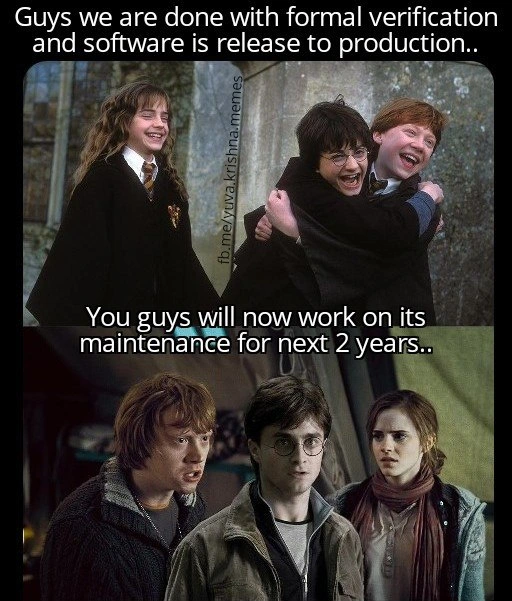
So you've spent months coding and even used super rigorous formal verification to double-check everything. Finally, you hit the big green “deploy” button – your software is now released to production, meaning real users are using it. You and your team feel on top of the world (just like Harry and friends smiling and hugging in that top picture). In a developer’s life, a successful release is like winning a championship game. Celebrations all around.
Now comes the plot twist: releasing the software doesn’t mean you get to drop your wand and relax. The meme’s bottom panel shows the reality check. Those same developers now look older and worried because they’ve been told they’ll be maintaining that software for the next two years. In simpler terms, they must stay with the project in maintenance mode. This is a normal part of the Software Development Life Cycle (SDLC) – after you build and launch a product, you often spend a long time keeping it running smoothly and adapting it to new needs.
Let’s break down a few terms here:
- Formal verification – an advanced method where you use math and logic to prove your program is correct. Think of it like an ultra-thorough test that tries every possible scenario in theory. It’s not magic, but it’s about the closest thing: if done right, it gives you high confidence there are no bugs (at least in the scenarios you’ve checked).
- Production – this is the real-world environment where your software runs for users or customers. It’s not a controlled test environment; it’s “out in the wild” on real servers, handling real data.
- Maintenance – after release, developers enter a phase where they fix any bugs that pop up, improve the software, and add small enhancements or adjustments. It’s like doing regular oil changes and repairs on a car you built.
- Technical debt – this refers to the messy code or quick-and-dirty solutions you add under pressure, which you plan to clean up later. Over two years of maintenance, a project can accumulate some technical debt as shortcuts are taken to patch issues quickly.
In the meme, the joke is that the team was ecstatic about finishing a formally verified, “perfect” piece of software, only to immediately learn they’ll be the ones handling all the real-world problems that come after. Why is that funny (and a bit painful)? Because every new developer imagines that when software is “done,” they can move on. But in reality, “done” often just means “ready for new problems”. The Harry Potter images cleverly illustrate this: the young, happy faces = just finished the hard work; the older, tired faces = two years into dealing with all the aftermath.
For a junior developer, it might be surprising that maintenance can last much longer than the initial development. Code isn’t a “set and forget” deal. Users will request changes, or someone will discover a scenario that breaks the system. Even formally verified software might need updates if, say, the requirements change (e.g., the app needs to support a new feature or a new type of data that wasn’t part of the original plan). When that happens, developers have to go back into the code and modify it – and if they were using formal methods, they’d ideally verify those changes too (which is tedious, so often they might skip some rigor to save time, introducing a bit of technical debt).
The phrase “maintenance for the next 2 years” also hints at something common in the industry: software tends to live for a long time, and the original creators often become the first line of support. Instead of starting a brand new project immediately, a dev team might be assigned to watch over this released product, ensuring it stays stable and reliable. This involves:
- Monitoring for any errors or crashes in production.
- Responding to user bug reports (like, “Feature X isn’t working on my account!”).
- Releasing updates or hotfixes (quick fixes) to address issues.
- Tweaking things for performance (maybe the app runs a bit slow when a lot of people use it, so you need to optimize).
- Periodically improving or refactoring parts of the code to prevent the accumulation of too much technical debt.
It can be a bit of a letdown if you were expecting to be “done.” The meme gets a laugh by showing such a dramatic before-and-after: from “We did it!” to “Uh oh, we’re stuck with it...” Anyone who’s deployed an application can relate to that moment when the celebration fades and you realize, “Now we have to keep this thing alive.” It’s not all bad – maintenance is how software actually delivers value over time – but it definitely ages you, as the Harry Potter characters so clearly represent. The bottom line for a new developer: a release isn’t the finish line; it’s just one milestone. The journey continues, often with the original team ensuring their software continues to work in the ever-changing real world.
Level 3: The Maintenance Curse
Every seasoned developer smirks at this scenario: the reward for finishing a big project is often an even bigger maintenance nightmare. The meme humorously captures a universal SDLC reality: you think the hard part (development and even formal proving) is over, but then comes the real grind. In the top panel, our dev team is basically shouting “Accio Production Release!” and popping Butterbeer in celebration. They’ve achieved a near-mythical feat (formally verified, bug-free at release – a true ProductionReadyCode moment). But in the bottom panel, the cold Owl Post arrives: “Congrats, now you’re on the hook for long-term support.” Cue the faces of dread. It’s as if they just got handed the cursed locket of maintenance duty – two years of bug fixes, support tickets, and TechnicalDebt accrual that they can’t disapparate from.
Formal verification might have lulled them into a false sense of finality. Senior engineers know that no matter how perfect the code is at v1.0, the real world trade-offs begin the minute users start interacting with it. Business needs shift, users do unexpected things (“Wait, our proof didn’t consider emoji input?!”), and integrations with other systems create new edge cases. The very phrase “release to production” often translates to “brace yourself for impact.” It’s a rite of passage in the SDLC: the triumphant deployment quickly leads to pager alerts and a backlog of “urgent” tweaks. In other words, maintenance mode kicks in – and it’s often a marathon, not a sprint.
The Harry Potter imagery nails this transformation. In the top image they’re first-years at Hogwarts, celebrating like the problem of evil (bugs) has been solved. By the bottom image, they look like they've been through the Battle of Hogwarts: older, sleep-deprived, 1000-yard stares. That’s basically the evolution of a developer from fresh-faced coder to battle-hardened on-call engineer. After two years wrestling an aging codebase, even the best code can start to feel like a convoluted prophecy you’re cursed to fulfill (“Neither can live while the code survives bugs…”). The humor is in that dramatic contrast – every dev team starts a project bright-eyed and optimistic, and ends up looking like they’ve been fighting Voldemort in the trenches of production support.
To put it in industry terms, “Done” is a dangerous word. Releasing software isn't the end; it's just transferring the baton to the longest phase of the software lifecycle. Seasoned devs have all experienced that post-release hangover when you realize you now own every weird issue that surfaces. Hotfixes will be needed at 3 AM. Those quick patches (often done under duress) start introducing technical debt – little compromises that keep things running but quietly violate the original pristine design. Over months, the formally verified core might get surrounded by less verified bolt-ons and band-aids. The code that was once your pride and joy slowly turns into “that beast we must feed and care for.”
No amount of prior rigor spares you from this fate. In fact, because the code was deemed “perfect,” management might be even more surprised (and annoyed) when inevitably something goes wrong or needs changing. It’s a classic RealWorldTradeoffs situation: you can prove correctness for a snapshot in time, but you can’t freeze time. Requirements change as surely as Hogwarts gets a new Defense Against the Dark Arts teacher every year. So the team that proved the software’s correctness is now stuck as the guardians of its ongoing correctness – patching, updating proofs (in theory), and basically living in maintenance_mode for the foreseeable future.
The meme strikes a chord because it’s painfully RelatableDevExperience. We’ve all been there: you finish a big release, celebrate, and then someone utters the fateful words: “Okay, now keep it running and handle all the issues for the next couple of years.” That’s when the ProductionSupportCycle truly tests your mettle. The once jubilant developers now exchange weary looks, much like Harry, Ron, and Hermione realizing the hunt for Horcruxes isn’t over just because they aced one adventure. In software, as in wizardry, the end of one quest often means the start of another, more grueling one – maintaining what you’ve built long after the initial magic has faded.
Let’s break down the expectation vs reality of this scenario in true senior-engineer fashion:
| Expectation (After the “Perfect” Release) | Reality (During Maintenance) |
|---|---|
| “Our code is provably bug-free!” **(Nothing left to fix, right?)* |
Users immediately find creative new bug scenarios that weren’t in any spec. |
| “It’s formally verified, we can scale effortlessly now.” | Unexpected load patterns in production cause performance bottlenecks requiring urgent tuning and patches. |
| Elegant, mathematically proven spec covers all features. | Ever-evolving requirements turn last month’s “complete” spec into this month’s outdated documentation. |
| “The hard part is done, time to start the next project!” | A wild feature request appears, forcing invasive changes (and possibly breaking those precious proofs). |
| Pride and peace of mind for the dev team. | On-call pager duty, MaintenanceNightmares, and living in fear of the 2 AM outage call. |
It’s funny because it’s true. That bottom panel energy – Hermione’s worried look, Harry’s exhausted stare – is basically the team lead and senior dev after a year of surprise production issues. In short, the meme winks to us: Welcome to software engineering — where every triumphant ReleaseManagement victory party is followed by a sobering maintenance morning. The magic spells (fancy proofs, perfect designs) wear off, and then it’s just you, the code, and a long list of things to fix for the next two years. Accio coffee, you’re going to need it.
Level 4: The Formal Methods Hangover
The top panel’s giddy celebration hints at successfully applying formal verification – likely using a tool like TLA+ or Coq – to mathematically prove that the software meets its specification. Formal methods are the holy grail of correctness: you model every possible state and logically ensure no forbidden state is reachable. It’s the developer equivalent of casting a powerful invariant charm that guarantees “no crashes or bugs shall pass!” The trio’s youthful exuberance is well-earned: they proved their code, perhaps using Hoare Logic or a model-checker, until the verifier said Q.E.D. (quite literally if they used Coq’s Qed. to close a proof).
But hangovers come after parties, and here the hangover is the harsh truth of computing reality. Formal verification rests on assumptions and specifications being complete. The minute something falls outside that spec, all those proofs might as well be written in vanishing ink. In theory, their system is provably correct – it might satisfy memory safety, no deadlocks, correct output for all inputs within the spec. However, the second new requirements arrive or an unmodeled scenario occurs (say, an unforeseen user behavior or an integration quirk), that proof provides zero comfort. Gödel’s incompleteness whispers that you can’t foresee every future requirement; the formal proof doesn’t magically extend to features dreamt up by Product Management six months later. As a cynical veteran would note, “Proving code correct is great, until Murphy’s Law proves your spec was missing half the real-world conditions.”
This is the paradox of formally verified code in production. It’s provably correct in a mathematical sense, but only for the original problem statement. In a live system, entropy and change are constant. Configuration tweaks, environment updates, or just the messy edge cases of real user input can violate the pristine assumptions your proof relied on. The total state space of the real world is mind-bogglingly larger than any model you checked. Formal models often abstract away details like network flakiness or hardware faults (otherwise the state-space explosion would blow up any model checker). So our ecstatic young wizards might have proven the absence of race conditions in their concurrency module, but their proof can’t predict the deployment script failing or a library update introducing a new glitch.
In formal verification terms, maintenance means re-proving things after every significant change – a herculean task teams rarely budget time for. The meme’s academic punchline is that even a formally verified system isn’t a “set it and forget it” magical artifact. Without continuous re-verification (which almost never happens in fast-paced environments), a once proven-correct codebase will inevitably drift from its proof as patches and enhancements accumulate. The gulf between the proven ideal and the operational reality is big enough to swallow entire engineering teams – leaving them looking as haggard as Harry, Ron, and Hermione in that bottom panel. Reality’s final exam has no neat Q.E.D., only an endless maintenance mode that no amount of theorem proving can entirely fend off.
Description
This two-panel meme uses scenes from the Harry Potter films to illustrate a harsh reality of the software development lifecycle. The top panel features a joyful scene of a young Harry, Ron, and Hermione celebrating, with the caption: 'Guys we are done with formal verification and software is release to production..'. This captures the immense relief and excitement of a successful launch. The bottom panel abruptly shifts the mood, showing the same characters, now older, looking shocked and dismayed. The caption reads: 'You guys will now work on its maintenance for next 2 years..'. The humor lies in this classic bait-and-switch, a relatable experience for developers who find their celebration cut short by the daunting, long-term commitment of maintaining the very system they just built
Comments
7Comment deleted
Shipping is just the sprint review where you find out the next two years of sprints are already planned, and they're all just fixing the bugs you just shipped
Formal proofs can satisfy the model checker, but they don’t satisfy the product owner asking for ‘just one tiny feature change’ every sprint of the next two years
The real Deathly Hallows of software: the legacy codebase you inherited, the two-year maintenance contract you signed, and the formal verification that everyone forgot how to update after the original team left for FAANG companies
The meme brilliantly captures what every senior engineer knows but no PM wants to acknowledge: formal verification and release to production isn't the finish line - it's mile marker 1 of a marathon where you're now on-call, patching CVEs at 3 AM, explaining to stakeholders why 'it worked in staging,' and discovering that your beautifully architected system is now held together by duct tape and prayer because the business pivoted three times but never allocated refactoring time. The real kicker? Those two years of maintenance will inevitably stretch to five, and by then you'll be the only person left who understands why that critical stored procedure has a comment that just says 'DO NOT TOUCH - DRAGONS HERE.'
Formal verification proves the code won’t deadlock; two years of maintenance proves you will
We proved the code correct; production will now spend two years falsifying our axioms one PagerDuty alert at a time
Formal verification proves termination on paper; maintenance proves the halting problem is your new reality