The Pretty Interface, The Tangled Back
Why is this CodeQuality meme funny?
Level 1: Pretty Front, Messy Back
It is like seeing a neat picture on the front of a sewing project, then turning it over and finding a tangle of thread. The joke is that people using a project see the nice picture, but the people who made it remember all the knots behind it.
Level 2: The Nice Side
In software, an interface is the part someone interacts with. That might be a graphical user interface, an API, a command-line tool, or even a library function. A good interface hides unnecessary details so people can use the thing without understanding every internal step.
The right embroidery photo is like the interface: neat, understandable, and pleasant. The left photo is like the implementation: all the internal work needed to create that result. In a codebase, that internal work can include database queries, file parsing, network calls, state management, authentication, caching, and error handling.
New developers often learn this gap when they first open a real production project. From the outside, the app may look straightforward. From the inside, one button might touch ten files and three services. That does not always mean the code is bad; it means the simple-looking feature has responsibilities hidden behind it. The challenge is keeping those hidden parts organized enough that future changes do not turn into thread archaeology.
Level 3: Frontstage, Backstage
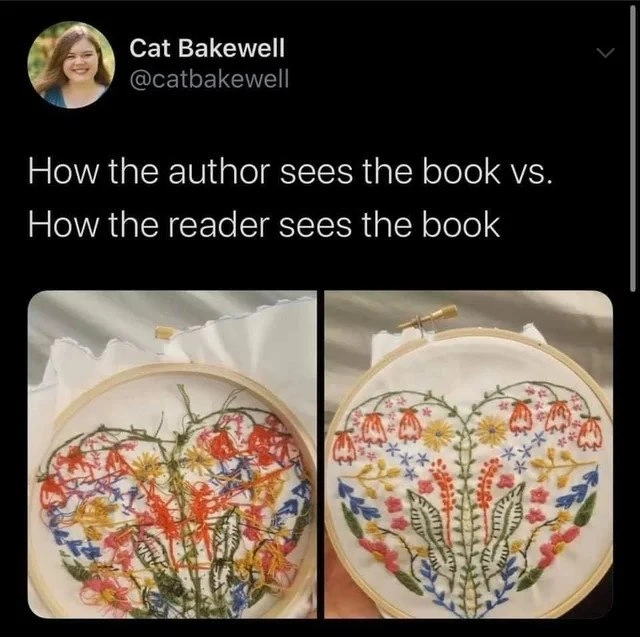
The screenshot shows a tweet by Cat Bakewell that says:
How the author sees the book vs. How the reader sees the book
Below it are two embroidery photos. The left side shows the back of a hoop: tangled threads, knots, loose strands, and crossed colors. The right side shows the front: a clean heart-shaped floral pattern with tidy stems, leaves, and flowers. The original caption is about writing, but the repost message points directly at software projects: creators see the mess behind the work, while users see the polished surface.
That makes this a strong metaphor for hidden complexity. A user experiences an application through screens, buttons, workflows, error messages, and response times. If the product works, the front side looks simple. The developer, meanwhile, sees the back: migration scripts, legacy helpers, TODO comments from three years ago, API adapters, feature flags, brittle tests, naming conventions from four different eras, and that one module everyone politely avoids unless the sprint has become morally serious.
The humor comes from the asymmetry of perception. Good software often hides its own effort. A checkout button looks obvious precisely because a lot of complicated work is concealed behind it: validation, pricing, taxes, inventory checks, payment authorization, fraud rules, retries, analytics, emails, and failure handling. Users do not see those threads, and usually should not. The whole point of abstraction is to make the front usable without exposing the back.
But the messy reverse side is not automatically bad. In embroidery, the back can be chaotic while the front remains beautiful. In software, some internal complexity is legitimate because the real world is complex. The problem begins when the back becomes so tangled that change is dangerous. That is where code maintainability enters the joke. If adding one flower on the front requires unraveling half the hoop on the back, the project has moved from “hidden implementation detail” to “technical debt invoice with interest.”
The meme also captures a psychological developer experience. Creators tend to judge their work by everything they know went wrong: the compromises, the rushed patches, the ugly integration, the weird edge case, the parts they meant to refactor. Readers and users judge the visible result. Sometimes that gap is comforting: the product feels cleaner than the process. Sometimes it is terrifying: the product looks clean only because nobody has turned the hoop around yet.
Description
The image is a dark-mode tweet screenshot from Cat Bakewell, @catbakewell, reading "How the author sees the book vs. How the reader sees the book". Below the text are two side-by-side embroidery photos: the left shows the messy back side of a floral hoop with tangled threads and knots, while the right shows the clean front side with a neat heart-shaped flower pattern. Although the caption is about writing, it maps cleanly to software: creators see the gnarly implementation details, while users see the polished result. The meme captures hidden complexity, abstraction, and the gap between internal maintenance pain and external experience.
Comments
7Comment deleted
Every elegant API has a reverse side that looks like a late-night refactor lost a knife fight with a deadline.
Backend/frontend Comment deleted
Is there a way to send suggestions? Comment deleted
try the related group → https://t.me/devs_chat. Comment deleted
Oh ! Thank You ! Comment deleted
Wow, an actual furry. Never seen one on telegram. In fact, never seen one at all. Like some mystical creatures, you hear of them only from internet legends and fairy tails. Comment deleted
X3 Comment deleted