Skip to content
DevMeme
2538 of 7435
From Pull Request to Force Push: A Developer's Descent
VersionControl Post #2813, on Mar 2, 2021 in TG

From Pull Request to Force Push: A Developer's Descent

Why is this VersionControl meme funny?

Level 1: Driving Without a Seatbelt

Imagine you normally do your homework with a friend or a parent checking it over. They help you find mistakes, and you only turn it in when it’s all correct. That’s like life being a pull request – you have support and someone reviewing what you do, so you feel safe and confident. Now picture one day you have a huge assignment, but instead of doing it carefully, you scribble down answers at the last minute and hand it in without anyone looking at it. You didn’t even check it yourself! That’s like doing a git push --force --no-verify in life. It means you just rush something through without any safety checks.

In the meme, the person compares their life to that rushed, unchecked homework. And the clown writing “Put on a HAPPY FACE” in the mirror? That’s like pretending to be happy and confident even though you know what you did was super risky. It’s as if you’re driving a car really fast without a seatbelt but smiling like everything’s okay. 😂

Why is this funny? Because it’s a goofy way to admit “Oops, I’m kind of living dangerously right now.” We all know wearing a seatbelt or checking your homework is the smart thing to do. Skipping it is a bad idea – and doing it with a big grin is just crazy! The meme is joking that sometimes life feels out of control, and all you can do is laugh like a clown and hope it works out, kind of like a stressed developer who pushes code without checking it and just crosses their fingers.

Level 2: Push and Pray

This meme uses Git commands as an analogy for life, contrasting doing things the safe/proper way versus the reckless way. If you’re a junior developer or not super familiar with Git yet, let’s break down the joke in simpler terms.

First, the two key concepts:

  • A pull request (PR) is a way to contribute code by asking others to review your changes before they go into the main project. Imagine you made some changes and you create a PR on GitHub: your teammates and automated tools will check your work. It’s collaborative; they might suggest improvements or catch mistakes. Only after approvals and passing tests is your code merged. This is considered a best practice in software teams because it maintains quality and shared understanding. It’s like saying, “Hey, I think I did this right, but can someone double-check?”.

  • git push is the command that sends your committed code changes from your local computer up to the remote repository (for example, to GitHub). Under normal circumstances, if your changes conflict with the remote or violate some checks, Git will prevent the push or warn you.

Now, what happens when you add the flags --force --no-verify to git push?

  • --force tells Git: “I know something doesn’t line up (maybe my commits don’t exist on the remote or would overwrite others), but push anyway and replace the remote history with my version.” This is typically used after you rewrite your commit history (like squashing commits or rebasing). It forces the update even if it’ll make the remote repository’s timeline of commits different. It’s powerful and a bit dangerous – kind of like forcing a puzzle piece where it doesn’t quite fit, potentially messing up the picture that others have.
  • --no-verify tells Git: “Skip any verification steps (hooks) that you normally run on push.” These Git hooks might include running tests or a linter or other checks. Normally, if tests fail, the push might be blocked or you’d at least be alerted. With --no-verify, you’re explicitly bypassing those safeguards. Think of it as telling a safety inspector to take the day off so you can do whatever you want.

In combination, git push --force --no-verify is basically the ultimate shortcut (or cheat code 😅): you’re pushing code to the main branch forcefully, rewriting history if needed, and you’re not doing any of the usual checks. It’s something you’d almost never do on a shared team project unless you really have to (and everyone’s aware), because it can easily cause problems.

Here’s a quick illustration in command form:

# Usually, you push safely to a feature branch (and then open a PR):
git push origin my-feature-branch

# The "I don't care, just do it" approach – force push directly to main, skipping tests:
git push origin HEAD:main --force --no-verify

In the second command, HEAD:main means “take what I currently have (HEAD) and push it to the main branch on origin, overwriting whatever’s there if necessary.” The --force ensures it overwrites, and --no-verify means “don’t run any tests or checks before pushing.”

Now, why is this funny and what does it have to do with life? 🤔

The meme text says: “I used to think my life was a pull request.” This implies the person used to approach life in a careful, reviewed, step-by-step way – getting feedback, making sure everything was in order (kind of like how a PR is handled). For example, maybe they used to plan things out and get advice or approval from others, feeling somewhat in control.

Then it says: “But now I realize it’s a git push --force --no-verify.” This means now their life feels like it’s just rushing changes through with no oversight or safety. In other words, “I’m just winging it and hoping for the best, even if it’s probably not okay.” The Git terms are being used metaphorically:

  • Life as a pull request = life with structure, support, and review (safe and sane).
  • Life as a force push no-verify = life with no checks, possibly chaotic or out of control (risky and insane).

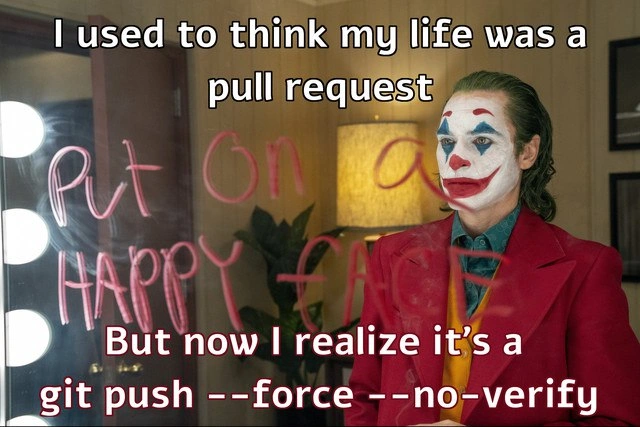
The clown image is the Joker from Batman lore (specifically, it looks like Joaquin Phoenix’s Joker from the 2019 movie). The Joker is often used in memes to represent someone on the brink of insanity or doing something wildly against the norms. The phrase written on the mirror, “Put on a HAPPY FACE,” is the Joker hyping himself up to appear happy (since clowns smile) even though he’s actually hurting inside. This is a nod to the idea of pretending to be okay when you’re not – a theme related to mental health.

So, the developer who made this meme is equating:

  • Skipping code review and tests with ignoring self-care or healthy process.
  • Force pushing code with forcing life changes or decisions without thinking.
  • Putting on a happy face (clown makeup) with acting like everything’s fine while internally struggling.

Those in tech find it relatable because many have experienced stress where they cut corners or felt out of control. Maybe a project got so pressured that they stopped doing things “the right way” and just started doing whatever it took to survive (like committing directly to main in the middle of the night). Or on a personal level, they felt so overwhelmed that they pretended everything was fine (the happy face) while internally they were one step away from a breakdown (the force push).

From a junior perspective: imagine you have a term project due tomorrow. The “pull request” approach would be you did the work in advance, asked a friend or teacher to review it, corrected mistakes, and then turned it in – you followed a good process with help. The “force push --no-verify” approach would be you procrastinated, and now at 3 AM you just throw something together and submit it without anyone checking, and you don’t even reread it yourself. You skip sleeping (skip tests), you ignore the instructions (skip verification), and you just hope it works out. Then you walk into class with a big fake smile as if you’re confident. It’s risky, and you know it might end badly, but at that moment you felt you had no choice. Developers laugh at this meme because it’s basically that feeling, but described in Git terms – which is both nerdy and spot-on.

To sum up, at Level 2 we understand that:

  • Pull Request = Good, careful, team-approved way (both in coding and as a metaphor for life decisions).
  • git push --force --no-verify = Bad, reckless, “just get it done” way (in code, and as a metaphor for personal chaos).
  • The Joker with “happy face” = Pretending everything’s fine while doing the above.

It’s funny to those in the know because it’s a little bit true. We all strive to do things the right way (in code and life), but when things get tough, sometimes we smash that metaphorical force push button and pray nothing breaks. It’s humor with a hint of truth about MentalHealthInTech – acknowledging that behind the laughter, many people feel exactly this stressed sometimes.

Level 3: Detached HEAD from Reality

At the highest level, this meme mashes up version control nerdiness with an emotionally charged pop-culture reference. It’s contrasting two extremes of developer workflow: the ideal (pull request with code review and tests) versus the chaotic (git push --force --no-verify, skipping all safety checks). For seasoned developers, the juxtaposition is immediately clear and darkly funny. We have on one side the collaborative sanity of CodeReviews, and on the other, the cowboy-like override of a force push. And to drive it home, the image channels the Joker – a character synonymous with chaos – writing “Put on a HAPPY FACE” on a mirror. It’s a dramatic visualization of a developer’s mental health slipping, masked by a forced smile, much like bypassing all checks and just shoving code out.

Let’s unpack the Git side first. In a modern team’s workflow, a pull request (PR) is a controlled, review-driven way to merge code. You create a feature branch, make your changes, then open a PR so colleagues can review your code, verify it with automated tests, and discuss improvements. It’s collaborative: multiple eyes on the code, ensuring quality and catching bugs. Merging via PR is a bit like having a co-pilot double-check your decisions. It’s the epitome of orderly development – think “measure twice, cut once.” When the meme says “I used to think my life was a pull request,” it implies life felt orderly, reviewed, and approved by others. In other words, the person felt supported and in control, as if every change in life had a safety net of feedback (friends, mentors, or just the comfort of doing things the right way).

Now, enter the villain: git push --force --no-verify. This command is infamous among Git users – it’s basically telling Git, “Shut up and take my code, I don’t care if it breaks things.” Using --force on a push will overwrite remote history if your local branch is out of sync, effectively defying the usual distributed workflow rules. It’s meant for specific cases (like cleaning up commit history or undoing a bad merge), but when misused, it can wreak havoc. For example, if someone else pushed different commits to main and then you --force push your version, you’ll wipe out their work. It’s the nuclear option of version control – quick, lethal, and usually frowned upon outside emergency situations. Then there’s --no-verify, which is like saying “also, skip all the tests and checks, please.” Normally, Git can run hooks (small scripts) on actions like commit or push – e.g., a pre-push hook might run your test suite or a linter. --no-verify bypasses those. Combined, git push --force --no-verify is the ultimate git_hooks_bypass: you force your changes upstream and ignore any pre-push safety net. It’s the equivalent of driving through every red light with your eyes closed. Developer humor often paints this as the “YOLO” command – you use it when you’re desperate or feeling a bit villainous. It’s scary because it can break the shared repo or deploy untested code.

Using the Joker analogy, --force --no-verify is chaos unleashed. It’s the kind of commit that would make your DevOps team gasp: Did they really bypass the CI and blow away main’s history? In an organization with good practices, this is heavily restricted (often branch protections won’t even allow it). So doing it feels taboo. That’s why it’s funny here: the meme writer is basically saying “My life has gone off the rails to the point I’m ignoring all the rules.” It’s relatable dev experience because many senior engineers have seen this happen (or done it themselves) under pressure. Picture a Friday 5 PM deploy gone wrong – tests are failing, the team is panicking, and someone says, “Just push the fix now and skip the tests!” 🥴 That’s a --no-verify moment. Or a time when a big feature branch had to be rebased and in the confusion you end up doing a force push to straighten things out, then nervously posting in Slack “Force-pushed to main, please fresh pull.” Everyone’s heart skips a beat reading that. We’ve been there; it’s horrifying and darkly comedic in hindsight.

The meme brilliantly ties this code review vs force push tension to personal well-being. The top text yearns for those structured, calm days (life as a PR), and the bottom text admits the current reality is messy and possibly destructive (life as a force push). The Joker, with his clown makeup and that phrase “Put on a HAPPY FACE,” symbolizes putting on an outward show while descending into madness internally. This parallels a developer’s psyche when under extreme stress: you mask your frustration or burnout with humor or feigned optimism – “No problems here, everything’s fine 😅!” – even as you cut corners or feel things spiraling. The mirror message Put on a HAPPY FACE (written in red lipstick, just like in the Joker’s dressing room scene) is especially poignant. It screams “keep smiling through the pain.” In tech, we often joke through our pain (think of the countless memes about burnout, imposter syndrome, or on-call nightmares). This image taps into that coping mechanism: laugh it off even when you’re one git push --force away from a breakdown.

To really see the contrast, consider this breakdown of life as a PR vs life as a force-push:

Life as a Pull Request (Orderly) Life as a git push --force --no-verify (Chaotic)
Collaborative – you invite feedback and help on changes. Others review your work. 🤝 Isolated – you make changes alone with no review. No one else sees or checks it first. 😶
Verified – automated checks (tests, linters, CI) run before anything is final. ✔️ Unverified – you skip tests and ignore warnings. Potential bugs or errors are unseen until it’s too late. ⚠️
Reversible & safe – mistakes can be caught and fixed in review. The history remains intact (no surprise overwrites). 📝 Risky & destructive – mistakes go straight to main. You might overwrite history, making it hard to recover what was there. 💣
Structured process – you follow steps (branch, commit, open PR, get approval). It’s methodical and planned. 📐 No process – you bypass all steps (commit directly to main, override anything). It’s improvised and seat-of-the-pants. 🎢
Healthy mindset (metaphor) – you’re open to feedback, taking care to do things right, and not alone. 😊 Burnout mindset (metaphor) – you feel on your own, just “pushing through” problems without pause, perhaps while faking a smile. 🤡

In other words: Pull requests represent stability and teamwork; force pushes represent desperation or recklessness. The meme’s humor hits hard because it’s using this well-known dichotomy from software development as an analogy for one’s mental state and life approach. It’s essentially saying, “I used to handle things carefully and with support, but now I’m just winging it and hoping nothing blows up.” That strikes a chord in tech circles. We’ve all seen how a calm, methodical project can devolve into a scramble where best practices fly out the window (usually around crunch time or a prod incident).

By invoking the Joker (a joker_meme_reference that many recognize), the meme taps into the trope of the “villain origin story” for a developer. It’s like picturing a mild-mannered coder gradually turning into a rogue agent who doesn’t care about rules (“You either die a hero, or live long enough to see yourself committing directly to main”, to paraphrase another Batman quote 😜). There’s an element of gallows humor here: joking about doing the worst possible Git practices to cope with the feeling of losing control. And that gallows humor often hides real pain points – long hours, impossible deadlines, the pressure to appear okay. It nods at the state of MentalHealthInTech: many devs feel this stress, and memes are a way to collectively acknowledge it.

In summary, this meme operates on multiple levels. Technically, it’s poking fun at a notorious Git command combination that bypasses best practices. Emotionally, it’s likening that to a personal unravelling – the kind of moment you disregard all checks and just force things, metaphorically with a grin plastered on. It’s funny because it’s extreme, and because it’s uncomfortably relatable. Every experienced developer reading it has a little chuckle of recognition (and maybe a wince), thinking “Haha, yep… been there, felt that.” It’s a perfect storm of DeveloperHumor: mixing insider Git knowledge, the contrast of code_review vs force_push norms, and an honest nod to the mental rollercoaster that coding (and life) can be.

Description

The meme shows the Joker from the 2019 film looking in a mirror where 'Put on a happy face' is written. The superimposed text creates a narrative: 'I used to think my life was a pull request, but now I realize it's a git push --force --no-verify.' This meme uses the Git version control system as a metaphor for a mental state. A 'pull request' suggests a life that is orderly, reviewed, and collaborative. In contrast, a 'git push --force --no-verify' is a destructive and reckless command that bypasses safety checks to forcibly overwrite the remote history. For senior developers, this resonates as a dark joke about abandoning best practices and embracing chaos, whether due to burnout, project pressure, or sheer nihilism

Comments

7
Anonymous ★ Top Pick My life went from 'LGTM, just address these minor comments' to 'git push --force-with-lease origin main' and disabling all branch protection rules
  1. Anonymous ★ Top Pick

    My life went from 'LGTM, just address these minor comments' to 'git push --force-with-lease origin main' and disabling all branch protection rules

  2. Anonymous

    Every branch protection rule is just theater until the clown in prod types `git push --force --no-verify` - and suddenly your SOC 2 narrative turns into an origin story

  3. Anonymous

    After 15 years in the industry, you realize the real chaos isn't in production - it's in the git reflog of that one senior engineer who treats main branch like their personal playground and somehow still has admin rights because they wrote the original authentication service in 2009

  4. Anonymous

    The evolution from 'pull request' to 'git push --force --no-verify' perfectly captures the arc of a senior engineer's career: you start believing in process, peer review, and collaborative development, but after your 47th bikeshedding session about variable naming and watching critical hotfixes languish in review for three days while production burns, you realize that sometimes the real CI/CD is the friends we bypassed along the way. Of course, we all know that engineer is now debugging why the deployment pipeline exploded at 2 AM because they skipped the pre-commit hook that would have caught their console.log() in the authentication service

  5. Anonymous

    Pull requests wait for LGTM; life just force-pushes your regrets to main

  6. Anonymous

    I thought my career was a PR; it’s actually a Friday force-push to main --no-verify, with an ADR retrofitted to make it look intentional

  7. Anonymous

    Remember: --no-verify only skips your local hooks; branch protection, CI, and tomorrow’s postmortem won’t

Use J and K for navigation