The Unstoppable Urge to Refactor: A Developer's 'Big Plans' vs. the PM
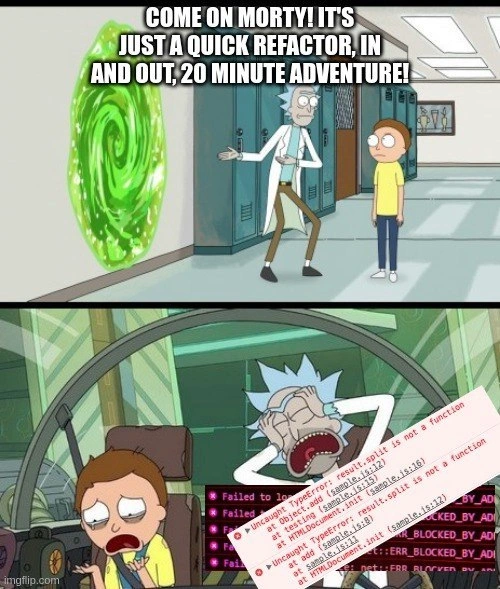
Why is this Refactoring meme funny?
Level 1: Rebuilding the Sandcastle
Imagine you just built a really cool sandcastle at the beach. You worked hard on it, and you’re finally done. Then your friend runs over, super excited, and says, “I have big plans for this sandcastle!” They want to make it much bigger and add a bunch of new towers and tunnels. That sounds fun to them, but you know it means you’ll have to break part of what you built and start rebuilding it in a different way. You’re already tired from building it the first time, so you say, “Please, no more changes, I just finished it.” But your friend isn’t listening; with wide eyes and a big grin they just repeat, “big plans!” In this story, you are like the coder who built something, and your enthusiastic friend is like the boss who always wants to change things. It’s funny because the friend only cares about their cool idea (making the castle bigger), while you’re the one who will have to do all the hard work again. The friend’s goofy “big plans” response shows that they don’t even notice how tired you are — and that silly one-track mind is exactly why we can’t help but laugh. It’s a cartoon way of showing how someone’s exciting new plan can become another person’s exhausting do-over.
Level 2: Refactoring 101
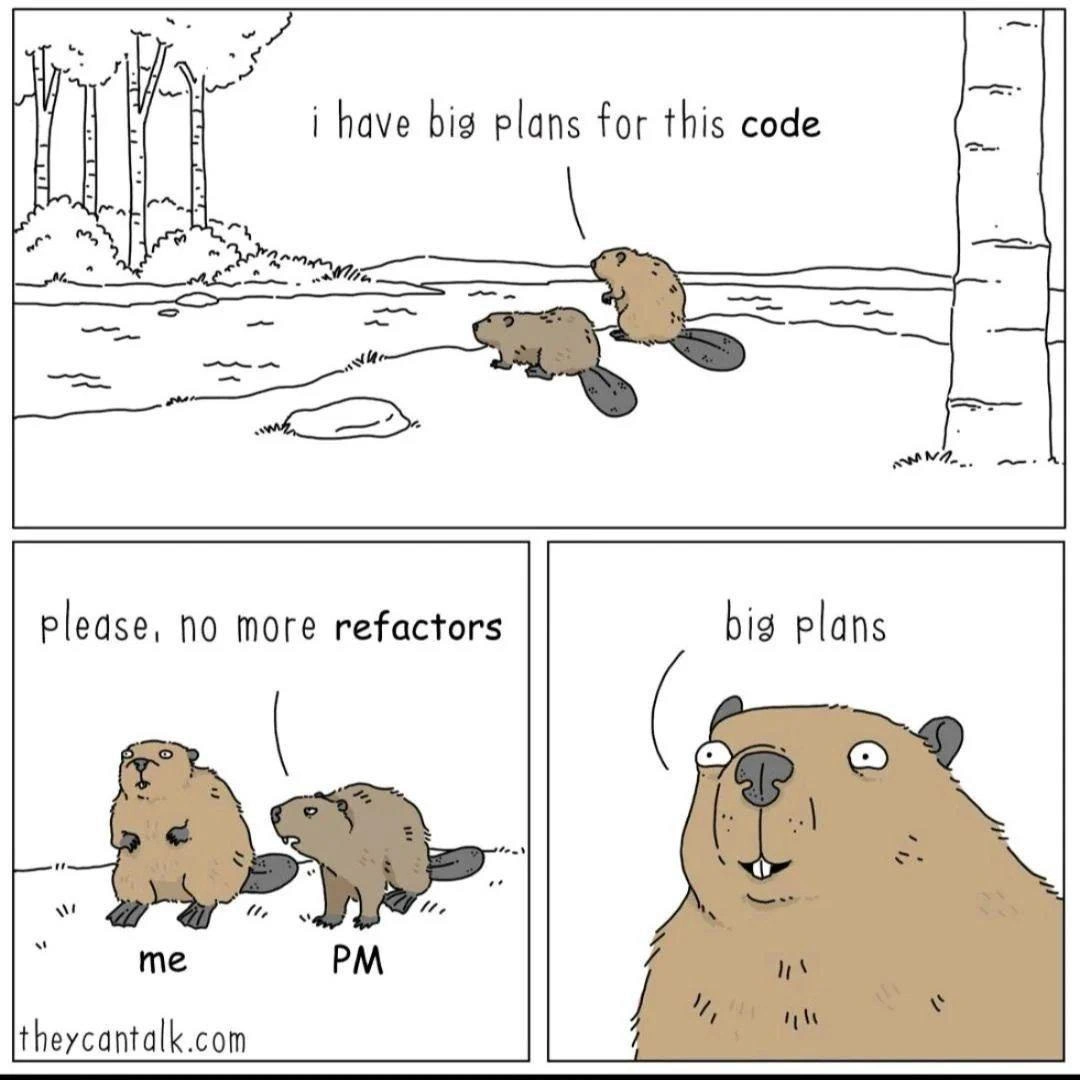
Let’s break down what’s happening in this meme in simpler terms. We have two cartoon beavers by a lake, used to represent people in a software team. The beaver labeled “me” is the developer (the person who writes and maintains the code). The other beaver labeled “PM” is the Product Manager (the person who decides what features the product should have and what the goals are). In Panel 1, the PM beaver says “I have big plans for this code.” That’s basically a manager saying, “I want to add a lot of new things or make big changes to our software.” Hearing this, the developer beaver is immediately worried. In Panel 2, the developer pleads “please, no more refactors.”
So, what is a “refactor”? In programming, Refactoring means changing the internal structure or organization of the code without changing what the code actually does for the user. It’s like reorganizing your room without buying new stuff — you’re just moving things around to make it cleaner or to fit new things. Developers refactor code to improve it: maybe to make it simpler, faster, or more able to handle new features. However, refactoring can be a big task, especially if the code is messy. The phrase “no more refactors” suggests the developer has had to rewrite or clean up the code many times already, probably whenever the PM had previous “big plans.” They’re exhausted from it. This is often due to Technical Debt.
Technical Debt is a metaphor for the cost of quick and dirty coding shortcuts. Imagine you rush a school project and leave a mess — eventually, to do a new project properly, you have to go back and clean up that mess. In coding, if developers weren’t given time to tidy the code (or had to hack things together to meet a deadline), the codebase becomes fragile. That’s technical debt: all the postponed clean-ups and poor designs that make future changes harder. Here, the dev knows the code is brittle (like a rickety dam the beavers built hastily). Every time the PM had “big plans” before, the team probably slapped on new features quickly, increasing the mess. Now any new change means paying back that debt by refactoring — essentially cleaning up and restructuring code so the new features won’t break everything. It’s tiring, time-consuming work (hence the RefactoringPain).
Another concept in this meme is Scope Creep. That’s when a project’s scope (the stuff it’s supposed to do) keeps growing and changing over time beyond what was originally planned. For example, you start building a simple app, and then someone keeps saying “Oh, let’s also add this feature... and that feature... and maybe change this function too.” The scope has crept larger. Product managers are often the ones who introduce new ideas or features — which is their job, to make the product better — but it can feel overwhelming to developers if it happens constantly. In our meme, “big plans” is basically a funny way of saying major scope change coming! The dev beaver is like, “Please, not again!” because each time the scope grew, they had to refactor the code (overhaul the dam) to support it. This leads to developer fatigue (getting really tired and frustrated).
The visual gag of the beavers is clever. Beavers build dams, just like developers build software. The PM beaver saying “I have big plans for this code” is like a project manager saying “Let’s rebuild this dam even bigger and better!” The poor dev beaver folding its paws and saying “please, no more refactors” is like a builder begging not to demolish and rebuild the house one more time. It’s a comedic way to show a very real workplace scenario. The last panel zooms in on the PM beaver’s face, with a wild stare, repeating “big plans.” This exaggerated, almost crazy expression is the comic’s punchline. It emphasizes how single-minded the PM is about their idea — they only care about the exciting new plan, seemingly ignoring the developer’s plea. This is poking fun at ManagerExpectations: sometimes managers focus on the vision and assume the engineers can just “make it happen,” not realizing (or not minding) how much work it entails behind the scenes.
For a junior developer or someone new to the field, the meme is highlighting a common situation: when the boss or product manager has an ambitious idea (like a new feature or big change), it’s the developers who must wrestle with the existing code to implement it. If the code is old or messy (legacy code full of technical debt), that often means a refactor — basically cleaning up and restructuring the old code so the new idea can fit in. Doing this once is okay. Doing it repeatedly is tough. So the dev in the comic is basically all of us when we’re tired of constantly rewriting things: “please, no more refactors.” And the PM’s oblivious “big plans” response? That’s the joke — it perfectly captures how devs feel when their concerns go unheard and another tidal wave of work is coming. It’s developer humor 101: laughing so we don’t cry about the DeveloperPainPoints we experience with ever-changing FeatureRequests.
Level 3: Infinite Refactor Loop
In every seasoned dev’s nightmare, a Product Manager chirps “I have big plans for this code.” Those words can send a shiver down any engineer’s spine. Here the PM is a wide-eyed beaver with a goofy grin, blissfully unaware that their big plans translate to another massive rewrite. The left beaver (the developer, labeled “me”) pleads “please, no more refactors” — a desperate cry familiar to anyone drowning in TechnicalDebt and endless change requests. The humor hits home because it satirizes that classic Management_PMs vs dev dynamic: the PM’s visionary enthusiasm collides head-on with the dev’s refactoring fatigue. We’ve all seen it. The codebase is already a fragile Jenga tower of hacks from last quarter’s “urgent pivot,” held together by duct tape and hope. The PM’s big plans basically mean yank out the bottom blocks and rebuild, again.
This comic exaggerates a real software development pain point: repeated Refactoring driven by shifting ScopeCreep and lofty ManagerExpectations. The dev beaver knows that each grand new feature or redesign means diving back into the guts of a brittle system — untangling spaghetti code at 3 AM, risking new bugs, and slogging through merge conflicts. Meanwhile, the PM beaver’s blank “big plans” refrain (zoomed in with that maniacal grin in Panel 3) epitomizes the oblivious optimist. It’s hilariously dark: the PM is essentially saying “We’ll build a whole new dam out of this one!” while the dev, kneeling in front of a half-chewed log pile of a codebase, is begging for mercy. The repetition of “big plans” as a catchphrase underscores how the PM isn’t listening at all — they’re a broken record of ambition. Every senior developer recognizes this moment, when FeatureRequests balloon and you realize the elegant code you wrote is about to become a “big ball of mud” to accommodate the latest idea.
Behind the laughter is a slice of truth about TechnicalDebt: quick fixes and rushed features (often driven by management’s need to ship, ship, ship) accumulate to the point where any new “plan” demands a painful refactor. Instead of incremental improvements, you get a cycle of RefactoringPain — a codebase constantly in flux, never allowed to stabilize. The meme’s beavers are a perfect metaphor too. Beavers build dams (like devs build software architecture), and a dam can only be rebuilt so many times before the river of requirements sweeps it away. The DeveloperPainPoints are real: late nights, broken builds, burned-out devs. The ManagerExpectations are also real: PMs often genuinely believe these big changes are straightforward (“We’ll just tweak the code a bit, right?”). The clash is comedic gold because it’s so common: the PM’s grand vision vs. the engineer’s dread, all delivered in two deadpan words “big plans.” It’s a weary laugh of recognition among developers — we’ve all had that one project where the plans kept getting bigger and the refactors never seemed to end.
To put it in code humor, this scenario feels like:
# Pseudocode representation of the endless refactor cycle
if product_manager.idea == "big plans":
codebase.refactor() # undertake massive rewrite to support the vision
technical_debt += 2 # technical debt ironically grows under rushed changes
developer.sanity -= 10 # each refactor drains the dev's morale
In practice, “big plans” from a PM often mean design upheaval: maybe a pivot to a new architecture, or bolting on a huge feature the system wasn’t built for. The developer’s RefactoringPain comes from knowing that these changes aren’t surgical tweaks but full-on code surgery. They’ve already endured it many times (hence the “please, no more”). The humor has that it’s funny because it’s true quality. Seasoned devs chuckle (or groan) because they recall all the sprawling refactors triggered by a manager’s “Wouldn’t it be great if…?” The comic nails that absurd yet routine scenario in tech: a weary dev staring at a pile of legacy code and a cheery PM with endless “big plans,” each plan bigger than the last. It’s an infinite refactor loop, and the punchline is how perfectly the beaver’s crazed grin captures a PM’s innocent obliviousness to the code chaos they’re about to unleash.
Description
A three-panel comic from 'theycantalk.com' featuring two beavers, illustrating the classic conflict between a developer and a Project Manager (PM). In the first panel, one beaver looks at a river scene and says, 'i have big plans for this code.' The second panel reveals the roles: a larger beaver labeled 'me' (the developer) sits next to a smaller one labeled 'PM,' with the PM pleading, 'please, no more refactors.' The third panel is a close-up on the developer beaver's face, showing a wide-eyed, determined expression as it thinks to itself, 'big plans.' The humor lies in the relatable tension between engineering's desire for code quality and architectural purity versus the business's need for stability and predictable feature delivery. Developers, much like beavers, have a natural instinct to build and improve structures. The 'big plans' represent ambitious, often necessary refactoring projects that can feel essential to the developer for long-term health but appear as disruptive, high-risk, low-reward endeavors to a PM focused on the product roadmap
Comments
7Comment deleted
The PM's definition of 'done' is when the feature is shipped. The senior engineer's definition of 'done' is when the 'big plans' are complete, which, according to the roadmap, is somewhere around the heat death of the universe
Every time the PM says ‘big plans’, I know the color-picker ticket is about to spawn a Kubernetes cluster and three new platform teams
The PM thinks I'm refactoring for code quality, but really I'm just building the perfect abstraction to finally justify rewriting the whole thing in Rust next quarter
Every senior engineer knows this exact moment: you've finally mapped out the perfect refactoring strategy to eliminate that gnarly coupling in the core service layer, maybe introduce some proper domain boundaries, extract those god objects into something resembling SOLID principles... and then the PM gently reminds you that the last three sprints were 'just refactoring' and stakeholders are asking why velocity dropped 40%. The beaver's thousand-yard stare perfectly captures that internal dialogue where you're simultaneously planning how to sneak the refactor into 'bug fixes' while knowing deep down that today's technical debt is tomorrow's P0 incident at 3 AM
PM: no more refactors; me: cool - I’ll rebrand it as “strangler-fig migration to reduce blast radius and MTTR” and ship the same 3k-line PR
Just a small refactor: a 12-week domain model rewrite tucked behind a feature flag and filed as an NFR
PM's dam empire scales infinitely; dev's refactor bandwidth caps at one log per sprint