Skip to content
DevMeme
5832 of 7435
The 'Quick 20-Minute Refactor' That Spirals Into a Debugging Nightmare
Refactoring Post #6388, on Nov 18, 2024 in TG

The 'Quick 20-Minute Refactor' That Spirals Into a Debugging Nightmare

Why is this Refactoring meme funny?

Level 1: Small Change, Big Mess

Imagine you go to tidy one small shelf in your room, thinking it’ll take just a few minutes. You pull out a book, and suddenly a whole stack of books tumbles down. While picking those up, you knock over a lamp, and now there’s glass on the floor. What was supposed to be a quick cleanup turns into an all-afternoon ordeal of cleaning and fixing. You end up tired and frustrated, because that "easy 5-minute task" became a huge mess. That's exactly the feeling this meme is joking about: something tiny that should have been simple turned into total chaos.

Level 2: Refactoring Reality Check

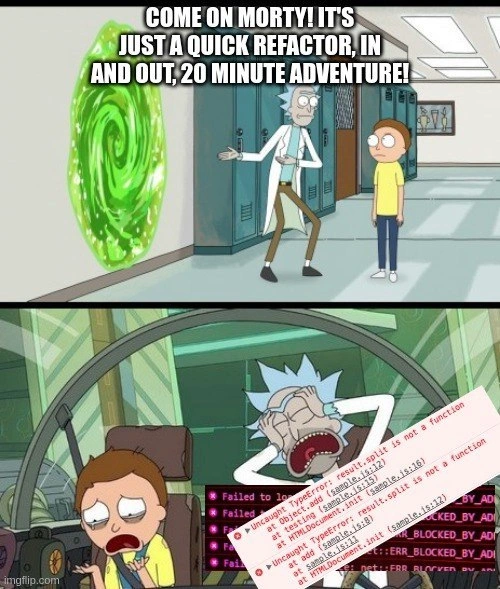
In this meme, Rick (the genius scientist grandpa from Rick and Morty) represents a developer who is way too confident about a code change, and Morty (the nervous kid) is like the junior dev or cautious buddy. Rick insists it’s going to be "a quick refactor, in and out, 20 minutes." In other words, he plans to rewrite or reorganize some code (that's what refactoring means) and he claims it will be super fast, like a trivial fix.

Reality check: Refactoring, even though it's meant to improve code without changing how it behaves, often uncovers hidden problems. Rick was overconfident – a common mistake (even experienced devs fall for this). He underestimated how complicated the codebase really was. This idea that a change will be simple is often an illusion or myth; in software, small tweaks can turn into big headaches.

In the second panel, we see the result of Rick's "20-minute adventure." Instead of a quick success, they're facing a bunch of errors. Rick is holding his head and screaming, and Morty looks completely drained. The translucent overlay with red text is the browser's developer console, which is where errors and logs appear when running a web page or app. All those red lines are error messages that popped up after the refactor. Basically, the code didn't work as expected and threw errors, so now they have to debug and troubleshoot (find and fix what went wrong). This is the part no one enjoys, especially when it was supposed to be "just a small change."

One of the errors shown is Uncaught TypeError: result.split is not a function. Let's break that down. In JavaScript, a TypeError happens when you try to do something with a value that the value's type doesn't support. The message "result.split is not a function" specifically means "I tried to use the .split() function on result, but result doesn't have that function." The .split() method exists on strings (for example, "apple".split(",") will split the string into an array of pieces). If result was supposed to be a string but isn't (say it's a number or an object instead), JavaScript gets confused and throws a TypeError. For example:

let result = 42;              // 42 is a Number, not a String
console.log(result.split(","));  // Uncaught TypeError: result.split is not a function

In the code above, result is a number, and numbers don't have a .split() method, so JavaScript throws that error. In Rick's refactor, something like this probably happened: he changed what result is (maybe the function now returns an object or a different type), but some other part of the code still assumes result is a string and tries to use split on it. Since JavaScript doesn't check variable types before running the code, you only find out when the code actually runs that there's a problem. This is a runtime error that appears in the console when things go wrong.

Another error message in the console is Failed to load resource: net::ERR_BLOCKED_BY_ADBLOCKER. That looks scary, but it's not directly caused by Rick's code change. This message means the browser tried to load some resource (like an advertisement script or another file), and an ad-blocker extension blocked it. In other words, an ad or tracking script was prevented from loading by Morty's browser. This is common if you have an ad blocker installed – the console will show errors for anything the ad blocker stops. It's not really a bug in your code at all. However, seeing these messages mixed in with real errors can be super confusing. In the meme, it just adds to the chaos: on top of the real bug (the TypeError), the console is filled with these adblocker warnings. It makes it feel like everything is falling apart at once, which is why Rick is panicking even more.

So what we have here is a refactor gone wrong. Rick thought it would be a 20-minute task, but now it's an extended debugging session. Morty’s exhausted expression and Rick’s meltdown illustrate how draining and frustrating this turned out to be. The humor comes from the contrast between the expectation and reality. It's funny (in a painful way) because most developers have experienced this: you go in thinking "I'll just tweak this one thing real quick," and soon you're knee-deep in errors, pulling your hair out. The meme is basically warning: no code change is ever as simple as you hope. For a junior developer, the takeaway is to plan for things to go wrong, test your changes, and be cautious when someone (or your inner Rick) says "it's a small change, it won't take long." Usually, that's when the real adventure begins!

Level 3: Portal to Debugging Hell

"COME ON MORTY! IT'S JUST A QUICK REFACTOR, IN AND OUT, 20 MINUTE ADVENTURE!"
(Famous last words of an overconfident developer.)

Refactoring is supposed to be a careful rewrite of code without changing what it does. But here Rick treats it like a trivial errand. Any battle-scarred engineer knows calling anything "just a quick refactor" is practically begging for unforeseen bugs. The meme plays on this overconfidence bias: Rick dragging Morty through a glowing green portal (the codebase) on a promised "20 minute adventure" is a perfect parody of the quick_refactor_myth in dev teams. Spoiler: it's never just 20 minutes.

The second panel delivers the punchline: Rick is now in his spaceship (our development environment), absolutely losing his mind as the browser's dev console lights up with blood-red error messages. Morty looks exhausted, like he's been debugging for hours. This is classic DeveloperHumor that hurts because it's true. The translucent overlay shows the exact nightmare: JavaScript runtime errors everywhere. We see Uncaught TypeError: result.split is not a function glaring in red. That error means some value (result) isn't what Rick expects it to be. Maybe his refactor changed a function to return an object or number, but somewhere else the code still does result.split(...) as if it's a string. In a statically typed world the compiler would have yelled at him, but in JavaScript you only find out at runtime (boom, TypeError!). It's the sort of DebuggingFrustration every JS dev recognizes – you run the "fixed" code and immediately hit a wall of red text.

And as if that wasn't enough, the console is also spammed with Failed to load resource: net::ERR_BLOCKED_BY_ADBLOCKER. That's the kind of misleading noise every web dev has seen: some script or image (maybe an ad or tracking pixel) got blocked by an ad-blocking extension. Probably unrelated to the refactor, but when you're in panic mode, every red line looks fatal. BugsInSoftware are bad enough; irrelevant errors make DebuggingPain even worse. The scene shows Rick clutching his head in agony amid a sea of console errors – pure dev_console_panic. Even the mad genius is overwhelmed by the cascade of failures.

By now Rick realizes his "improvement" has triggered a cascade of problems. That one tweak likely had far-reaching side effects. Without a safety net of tests (because hey, it was "just a quick change" in a module that badly needed refactoring, who writes tests for that? Not Rick), a refactor can break things in subtle ways. This is the classic illusion_of_simple_change: the codebase is an interdependent web, and a "simple" change in one corner can wreak havoc elsewhere.

Why do these 20-minute adventures blow up so often? A cynical post-mortem might note:

  • Hidden ripple effects: That one "little" code change broke assumptions in other modules you didn't even know were relying on the old behavior.
  • No safety net: Skipping comprehensive tests means you only discover the breakage when the app starts crashing in front of you (oops).
  • Dynamic typing surprises: In JavaScript, you won't know there's a type mismatch until it explodes at runtime. Calling .split on the wrong type just blows up in your face at the worst possible moment.
  • External chaos: Environmental quirks (like Morty's browser running an ad blocker) clutter the logs with unrelated errors, making it harder to spot the real issue.
  • The overconfidence curse: The more certain someone is that "nothing can go wrong," the more likely they're overlooking something critical. Rick's hubris is the real villain of this story.

In essence, this meme is a case study in Hofstadter's Law: everything takes longer than expected, even when you factor in Hofstadter's Law. The "20-minute" refactor morphs into an all-day debugging odyssey. It's hilarious (in hindsight) because every seasoned dev has lived this nightmare — the code that was "in and out" turning into a hair-pulling marathon. The Rick and Morty dramatization is absurd, but the underlying RefactoringPain is all too real.

Description

A two-panel meme based on the '20 Minute Adventure' format from the animated show Rick and Morty. The top panel shows the character Rick Sanchez confidently proclaiming to a worried Morty Smith, 'Come on Morty! It's just a quick refactor, in and out, 20 minute adventure!'. In the background is a green portal and school lockers, setting a scene of casual confidence. The bottom panel depicts a starkly contrasting scene: both characters are inside a spaceship, looking traumatized and exhausted. Rick is screaming with his hands on his head, while Morty looks on in horror. Overlaid on this image is a screenshot of a browser's JavaScript console log, filled with red error messages, prominently featuring 'Uncaught TypeError: result.split is not a function'. The technical humor stems from the universal developer experience of underestimating the complexity of a refactoring task. What seems like a simple, isolated change can often trigger a cascade of unexpected bugs and side effects in a complex codebase. The specific error, 'TypeError: result.split is not a function', is a common JavaScript bug that occurs when attempting to use a string method on a variable that is not a string (e.g., it is null or undefined), which is a classic symptom of data flow issues that refactoring can easily introduce
Comments

7
Anonymous ★ Top Pick A 'quick refactor' is developer for 'I have discovered a new and exciting way to break production.' The stack trace is just the adventure map
  1. Anonymous ★ Top Pick

    A 'quick refactor' is developer for 'I have discovered a new and exciting way to break production.' The stack trace is just the adventure map

  2. Anonymous

    Every “20-minute” JavaScript refactor is basically Schrödinger’s sprint: until you open the console, the code is both shipping tonight and throwing TypeError: .split is not a function in six unrelated micro-frontends

  3. Anonymous

    The refactor that touched three files somehow triggered a cascade failure in the payment service, broke an undocumented integration from 2016, and now legal is asking why GDPR compliance is suddenly failing in production

  4. Anonymous

    Every senior engineer knows that 'quick refactor' is the technical equivalent of 'hold my beer' - what starts as renaming a variable inevitably uncovers a Jenga tower of circular dependencies, deprecated APIs, and that one critical service still running on Node 8 that nobody dared touch. The real adventure isn't the refactor itself, it's explaining to the PM why your 20-minute task just became a three-sprint architectural overhaul with a rollback plan that requires a database migration

  5. Anonymous

    “Just a 20‑minute refactor” - also known as breaking a dozen implicit contracts, exposing temporal coupling, and discovering your TypeScript‑green test suite was integration theater when prod starts yelling “is not a function.”

  6. Anonymous

    Refactoring: Enter with one function rename, exit to a multiverse where 'x is not a function' haunts every test file

  7. Anonymous

    Translation of “in and out, 20 minutes”: you changed a helper to return an object, half the code still expects a string, mocks kept CI green, and production learned new profanity

Use J and K for navigation