Skip to content
DevMeme
2876 of 7435
The Senior Developer's Dilemma: Fewer, but Mightier Bugs
Bugs Post #3180, on Jun 2, 2021 in TG

The Senior Developer's Dilemma: Fewer, but Mightier Bugs

Why is this Bugs meme funny?

Level 1: Hide and Seek

Think of it like a game of hide-and-seek. When you’re not so good at the game (imagine you’re small and just learning), lots of friends can hide and you might make plenty of easy mistakes looking for them – maybe you forget to check behind the curtain or under the table, and you miss a bunch of the obvious hiding spots. But as you get better at hide-and-seek, you find almost everyone quickly. There are fewer friends hiding that you can’t find. However, guess what? The one friend left hiding is super good at this game. They’ve picked a hiding spot so clever and so tricky, it takes you forever to find them. You’ve improved at the game (yay, you found most of the people fast!), but now the only person you can’t find is hiding in the hardest place imaginable. It’s frustrating and kind of funny at the same time – you’re better, yet you’re spending all your time searching for that one last sneaky hider.

This meme is saying the same thing, but about writing computer programs. When you start coding, you might have lots of little bugs (mistakes) and they’re pretty easy to spot, like toys lying around a messy room. As you practice and "clean up" your coding skills, you won’t drop as many toys on the floor – meaning there are fewer mistakes. But if there is one toy or one mess left, it’s probably hidden in a really hard-to-find spot. In the end, you still have to look for it, just like that last friend in hide-and-seek who’s so well hidden. It’s a funny surprise: getting better at something doesn’t mean you never have problems, it just means the only problems left are rare and sneaky. That’s why the character in the meme (Gru) looks shocked and a bit upset in the last picture – he just realized that even when he’s a top-notch coder with hardly any errors, he'll still end up playing hide-and-seek with a very sneaky bug!

Level 2: Bugs Fight Back

At its core, this meme is saying: when you become a better programmer and make fewer mistakes, the few mistakes that do slip through will be really tricky to find. It’s a lighthearted way of explaining a little paradox in coding. Let’s break down the key parts in simple terms:

  • Programming skill: Getting better at programming means you learn how to write code more correctly and efficiently. You stop making the newbie errors you made when you started. For example, you learn not to create variables you never use, or how to properly handle different cases in your code. Essentially, you write cleaner, smarter code.

  • Code quality: This refers to how good your code is – is it well-organized, easy to read, and (most importantly) does it work correctly? High code quality usually means you’ve followed best practices (like clear logic and good testing) so your program has fewer problems.

  • Bug: A bug is a mistake or flaw in the program that causes it to behave in a way it shouldn’t. It’s called a "bug" ever since early computer engineers humorously blamed actual insects for malfunctions (in one famous case in 1947, a moth was found in a computer, and they joked that was the "bug" causing an error!). In everyday coding, a bug might be as simple as using the wrong formula so your calculation is off, or as serious as causing the program to crash.

  • Debugging (or troubleshooting): Debugging is the process of finding and fixing bugs. When something goes wrong, programmers debug by reading error messages, using tools to run the code step-by-step, or adding extra print-outs/logs to see where the code’s behavior deviates from what’s expected. It’s like detective work on your code: you know something is wrong, and you have to track down exactly where and why it’s happening.

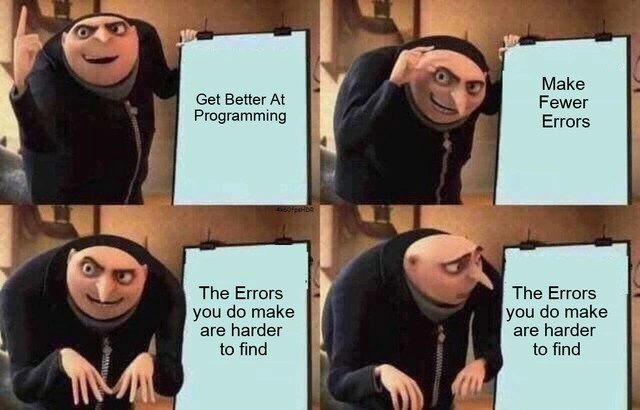
Now, what does the meme show? It uses the character Gru (from the Despicable Me movies) presenting a plan on a flip-chart. The plan starts simple: “Get better at programming”, which leads to “Make fewer errors.” Those steps make sense – of course if you improve your coding skills, you’ll make fewer mistakes in your programs. But then comes the twist on the next slide: “The errors you do make are harder to find.” Gru didn’t see that coming, and in the last panel he’s shocked by his own realization. This is the joke: you expect that writing better code would make your life completely easier (fewer bugs means less debugging, right?), but in reality it sometimes makes your life differently difficult – because any bug that still shows up is not a simple one. It’s like cleaning your house: you pick up all the easy-to-find trash, and then the only dirt left is maybe a sticky spot hidden under the couch. You have fewer things to clean overall, but now you have to search harder for that last bit of mess.

For a new programmer, most bugs are pretty straightforward. Think of common beginner mistakes:

  • Obvious bug example: You might forget to initialize a variable or misspell something, and the program crashes or throws an error like "undefined variable at line 10." That’s a clear clue – you go to line 10, see the mistake (myVar instead of myVar1, for instance), and fix it. Or maybe you accidentally divide by zero and immediately the program errors out with a message, so you know what happened. These kinds of bugs are annoying but easy to reproduce and usually easy to spot once you know where to look.
  • Another simple bug: Say you wrote a loop incorrectly, so it runs one time too many or one time too few (an off-by-one error). The output might be obviously wrong (like printing 6 items when it should print 5), and as soon as you test that part of the code, it’s clear what the problem is. You can then quickly correct the loop condition.

As you gain experience, you stop making many of these mistakes because you’ve learned from them. Your code now handles the basics correctly: it checks for bad input, it uses proper logic, and you test it with typical cases to ensure it works. So indeed, you make fewer errors day-to-day. But “fewer” doesn’t mean “zero.” It means maybe there’s one bug instead of ten – but that one bug might be hiding in a part of the code you didn’t think to test or in a scenario that hardly ever happens. These are edge-case bugs, meaning they only show up in the rare or extreme conditions at the "edges" of what’s possible. Because they’re so rare, they’re harder to find. The program mostly seems fine; there’s no obvious crash or error message pointing things out. Everything works until that one weird situation arises.

Imagine this scenario: you wrote a program that handles dates. You tested it with dates in January, in June, on your birthday, etc., and it worked great. You release it and it works fine every day... until one user tries it on February 29th, and the program suddenly misbehaves. Uh-oh! It turns out, you forgot about leap years – February 29th is an uncommon date that only comes every four years, and your code wasn’t prepared for that. This bug never showed up in your regular tests (because none of those dates were Feb 29) and it might not show up again until the next leap year. It’s a sneaky bug. When it does strike, the program might not outright crash; perhaps it subtly calculates someone’s age wrong or gives a strange output. There’s no big red arrow saying "here’s the problem." So finding this issue means you have to put on your detective hat: you’d retrace what the user did, realize the date was special, dig into that part of the code, and only then you spot the missing leap year check. It takes longer and requires careful thought to hunt it down, compared to the quick fix of a spelling error bug.

Another example: let’s say you built a chat application. It works perfectly when you test with one user, two users, even 100 users. But one day, the app starts acting odd when exactly 153 users are online (not 150, not 200, but exactly 153!). That sounds bizarre, right? Maybe there’s a bug that only reveals itself when a certain memory buffer fills up to a particular size (153 just happens to be the trigger). It’s rare and very specific. As an experienced dev, you have far fewer bugs, but this is the kind of mysterious problem you might face. You’d have to investigate logs and maybe run special tests to reproduce having exactly 153 users, which is much trickier than noticing an immediate error during normal testing.

So the meme’s message to a junior developer (or to anyone learning coding) is: yes, you will make fewer mistakes as you improve, but don’t expect to never deal with bugs again. Instead, expect that when you do encounter a bug, it will probably be an ultra-sneaky one that requires clever sleuthing to solve. In a way, it’s complimenting skilled developers – "You’re so good that the only bugs left are the really hard ones!" – and at the same time it’s poking fun at the fact that debugging is a never-ending story in programming. Even the best programmers still spend time debugging, just different kinds of bugs.

This is classic developer humor because it turns a frustrating truth into a joke we can all nod our heads at. It’s coding humor with a dash of irony. When you’re new, you might look at senior engineers and think, "Wow, their code must be flawless; they probably don’t struggle with bugs like I do." But the reality (as this meme humorously points out) is that everyone deals with bugs – it’s just that experienced folks have traded the simple, silly bugs for rare, brain-teaser bugs. They’ve essentially taught the “bugs” to hide better! It’s like the bugs have evolved or are fighting back: fewer bugs, but the ones that remain have ninja-level hiding skills.

For someone just starting out, the takeaway is both comforting and cautionary. It’s comforting to know that if you’re finding a lot of easy bugs now, that’s normal and you will outgrow many of those mistakes. Over time, you’ll naturally start making fewer obvious errors. But it’s also a bit cautionary (and funny) to realize that you’ll never be completely free of debugging. Instead of squashing dozens of little bugs, you might spend your time tracking one elusive bug through a maze of code. In other words, debugging and troubleshooting is a skill you’ll keep using no matter how advanced you get – the challenges will just look a bit different. And when that day comes, you might just remember Gru’s face in this meme and chuckle, knowing it captured the situation perfectly.

Level 3: The Last Bug Standing

This meme nails a classic experience in developer humor: the better you get at coding, the more relatable pain you feel when a rare bug surfaces and turns into a marathon debugging headache. In the four-panel Gru presentation (a popular gru_meme_template for backfiring plans), our villain proudly charts out his path to software perfection. Panel 1: “Get Better At Programming” – yes, that’s every developer’s goal, to level up their skills. Panel 2: “Make Fewer Errors” – naturally, as your skills improve, you expect to introduce fewer bugs into the code. So far, so good; Gru is smugly confident in this plan. But then Panel 3 reveals the gotcha: “The errors you do make are harder to find.” And by Panel 4, Gru is staring in dismay at the unintended consequence on the board, utterly flabbergasted by his own slide. It’s a perfect comedic portrayal of what seasoned engineers know all too well: improved code quality doesn’t mean the end of bugs – it means the few bugs that remain will be the real doozies.

Why is this so funny and true? Because just about every programmer with a few years under their belt has lived this scenario. Early in your career, your code is like a rookie boxer – it throws a lot of punches wildly, meaning you (or your team) spend a lot of time fixing obvious, easy bugs. Maybe you forgot a ; somewhere, or you mis-named a variable, causing a crash. Perhaps you wrote a loop that goes one step too far (the classic off-by-one error) and it immediately produces nonsense output that’s simple to spot. These are everyday mistakes, bugs in software that practically wave a red flag at you when they occur. Logging and error messages make them straightforward to track down. For example, an early bug might be a NullPointerException that clearly tells you which line blew up, or a web form that fails every single time a user leaves a field blank (obvious cause and effect). Fix it, push the code, done.

But as you get better, you stop making those rookie mistakes. You’ve learned defensive coding: you check for null values, you use proper data structures, you write tests for the usual cases. The result? Your program runs smoothly through all the normal scenarios. It might pass QA with flying colors... until a customer named "Null" signs up and your system interprets their name as a literal null value (yes, that actually happened in real life to some unlucky devs!). Or everything works perfectly except on February 29th of a leap year because of a date-handling oversight. Or maybe your multi-threaded server app works fine 99.9% of the time, but once in a blue moon two threads collide in just the wrong way and deadlock each other. These are the sneaky bugs that lurk in the shadows of complex logic. When they hit, it’s a bug hunting expedition of the highest order. The code doesn’t flat-out crash with a clear error – that would be too easy. Instead, it might subtly malfunction: a report shows wrong data for one user out of thousands, or an online service stops responding only under heavy load at 3 AM. You’re left scratching your head, thinking “How on earth is that even possible?!”

The meme’s punchline is painfully accurate: errors get harder to debug when they’re so infrequent and unusual that you might not even be sure at first if it’s the code or the user or the environment acting up. Imagine the debugging frustration when you can’t reproduce a bug on your development machine – the classic “Works on My Machine™” scenario. You deployed a feature that passed all tests, it works on all your test data, and even runs fine under normal production conditions... until a customer does something you never anticipated, or the system hits an edge-case timing. Suddenly you’re staring at logs at 2 AM because something went wrong with no obvious clues. Your boss or your team asks, “Why did this fail?” and you honestly respond, “I have to investigate; it’s not immediately clear.” Now you’re Gru in the last panel, dismayed that despite all your expertise, you’re in for a long night of troubleshooting a ghostly problem.

This relatable pain is often joked about because it’s a rite of passage in development. Think of it like a video game: at low levels, there are lots of weak enemies (lots of little bugs) that you can dispatch easily. As you level up, the weak foes stop spawning; instead, you occasionally encounter a boss monster – a single enemy, but ten times tougher to beat than all the small fry combined. It’s the developer growth paradox in action: your reward for making fewer mistakes is that any mistake you do make might be a boss-level bug. You’ve basically cleared out the easy problems, leaving only the hard problem, “the last bug standing,” which demands all your skill (and patience) to slay. This is why senior engineers chuckle (or sometimes groan) at this meme: they’ve sat in front of an apparently perfect system, hunting desperately for one deeply buried flaw. It’s coding’s version of finding a needle in a haystack – except you first vacuumed away all the big pieces of hay, and now the needle is the exact color of the few straws left.

One reason these remaining bugs are so challenging is the sheer complexity modern software can reach. A veteran developer often works on large, intricate systems: think distributed microservices, multi-threaded applications, or algorithms with lots of edge conditions. By the time a project reaches high maturity, entire categories of errors have been systematically removed (thanks to code reviews, automated test suites, static code analyzers, and good engineering practices). The bugs that slip through that gauntlet tend to involve multiple factors at once. For instance, a bug might only emerge when two microservices miscommunicate in a specific way and the system's state has a certain history – scenarios that are hard to imagine upfront. Or it could be something subtle like an incorrect caching behaviour: 99 times out of 100, data is fresh, but on the 100th time, an outdated value is served because a cache invalidation message arrived 0.5 seconds late. The system doesn't crash, and no obvious error is logged; it just quietly does the wrong thing that one time. Discovering such a bug means combing through distributed trace logs, timing diagrams, maybe adding special instrumentation to catch it in the act – essentially, detective work that can span days. This is a world apart from the early days of coding where you eyeball your function and immediately spot you forgot a return statement.

Let’s illustrate the contrast between "early-career bugs" and "experienced dev bugs" to see why the latter are harder:

New Developer Bug (Obvious) Experienced Developer Bug (Sneaky)
Mistyped a variable name – program crashes or won’t compile, pointing right to the line of error. Subtle math precision loss – program runs fine, but final results are off by 0.01% only on extremely large inputs. No clear crash, just slightly wrong output after a long time.
Forgot to handle an empty input – function throws a direct error as soon as it gets an unexpected null. Race condition between threads – only occurs once in a million runs when two threads coincide in just the right way, causing a freeze with no error message.
Off-by-one error in a loop – the output list misses the last item every time, easy to notice in testing. Memory leak in an edge library – only after 3 days of continuous use does the program slow down or crash, making it hard to tie back to the offending code.

The left column issues practically wave a flag saying "Here I am!" The right column issues are stealth bugs: they don’t show themselves under typical conditions and leave you few clues when they do. Hunting them is an art of patience and deduction. Seasoned developers develop a kind of sixth sense for this, a deep intuition of where something could have gone wrong even if all looks well. (Seniors might joke that after you’ve been burned once by a time zone bug that only appears during daylight savings switch, you start suspecting everything – "Did we account for DST?" becomes a reflex question.)

It’s also worth noting the psychological aspect: as you become more experienced, you trust your structure and logic more, so when a bug surfaces, it’s genuinely surprising. You think “But I did everything right!” – exactly like Gru looking stunned at his own plan. The meme is essentially portraying that moment of shock and irony. It’s coding humor drawing on our shared experience: we laugh because we’ve all had that sinking feeling of “Oh no... the only bug that could be left is one that’s going to be really hard to find.”

To cope, teams often adjust their project timelines acknowledging this reality. There’s a saying in software project management: “The first 90% of the code accounts for 90% of the development time... and the last 10% of the code accounts for the other 90% of the time.” 😉 In other words, polishing off that final bit – which largely means debugging those last stubborn bugs – often takes much longer than expected. Everyone plans for a few extra weeks of stabilization because even with extremely high code quality, there are always surprises when real users start using the product in unanticipated ways. This meme resonates because it’s exactly that scenario condensed: improvement -> fewer bugs -> one surprise bug that demands heroic debugging efforts.

In summary, Gru’s dismayed look is every developer after hours (or days) of troubleshooting a crazy bug, having the epiphany: “Great, I made hardly any mistakes, and yet here I am chasing this one bizarre issue. How is it harder now that I’m better?!” It’s a funny, ironic truth in programming: becoming proficient doesn’t mean you never struggle with bugs again – it just means when you do, you’ve leveled up to a new class of bug that requires all your skill (and then some) to squash. And oddly enough, that’s something to be proud of, even if it doesn’t feel that way in the moment. The meme turns that ironic pride-and-pain into a shared joke for all of us who’ve been there, staring at the screen like Gru, realizing our clever code still outsmarted us in the end.

Level 4: The Heisenbug Paradox

In the realm of software correctness, there's a humbling reality: as code quality improves and obvious flaws vanish, any remaining bugs tend to exhibit almost quantum-like elusiveness. This meme hints at a concept akin to the Heisenbug – a term from programming folklore for a bug that seems to disappear or alter its behavior when you try to study it (much like the observer effect in physics). When your code is clean and well-tested, the only bugs left might be those bizarre edge cases that defy easy observation. They’re the race conditions that only manifest under precise timing, or the memory corruption that only appears after hours of continuous run – issues so subtle that peering at them with a debugger can make them hide. In contrast, the straightforward bugs in software (sometimes nicknamed Bohrbugs, after Niels Bohr’s predictable atomic model) have mostly been eradicated by your improved practices. What’s left are the phantom-like Heisenbugs, lurking in non-obvious states of the system and vanishing whenever you try to pinpoint them.

Why does this happen? The answer lies in theoretical computer science and the inherent complexity of programs. As code quality rises, we eliminate entire classes of simple errors (like type mismatches, null references, off-by-one loops) through better design, static analysis, and thorough tests. Consequently, any remaining error lives in the complex interplay of components or rare conditions that weren’t covered by those tests – places where systematic detection is extraordinarily hard. In fact, fully proving a non-trivial program to be bug-free is often equivalent to solving the Halting Problem, which is famously undecidable. We can’t write an algorithm to catch every possible bug in another arbitrary program, because that would require predicting every potential behavior the code might ever have – a mathematically impossible task in the general case. So instead, real-world developers rely on partial solutions: they use strong type systems to prevent many errors, they write unit/integration tests to cover expected scenarios, and they employ tools for debugging and troubleshooting known problem patterns. These measures dramatically reduce bug counts, but they can’t cover the infinite space of "what-ifs." The upshot is an asymptotic situation: you can approach zero bugs, getting closer and closer with more skill and rigor, but you can never truly reach zero. And as you approach that limit, the effort needed to find each remaining bug grows exponentially, while the bugs themselves hide in exponentially more exotic corners of the code’s state space. It’s like Zeno’s paradox of debugging – you fix half the bugs, then half of the remainder, then half of that, ad infinitum, never fully squashing them all.

This creates what one might call the developer growth paradox: every improvement in your programming skill and process does lower the frequency of errors, yet it simultaneously raises the relative complexity of whatever elusive errors are left. It’s the Pareto principle gone meta – 80% of bugs were eliminated with the first 20% of improvements, but the last 20% of bugs demand 80% (or more) of the debugging effort. The meme distills this with Gru’s realization that "Make fewer errors" leads to "The errors you do make are harder to find." In essence, the better you get at avoiding mistakes, the more invisible and intricate the remaining mistakes become. As a result, an expert programmer’s day might shift from fixing ten trivial problems to chasing one edge-case mystery that gets harder to debug precisely because everything else appears correct. It’s a bit of cosmic irony in software engineering: you traded quantity for quality, but that quality of bug is much higher (or rather, worse from a debugging standpoint!).

From a historical perspective, this is also reflected in how far software development has come. Early computers could fail because a literal moth got stuck in a relay (giving us the term "bug"). Such a problem was tangible and easy – just remove the moth! Today, our systems are millions of times more powerful and a million times more complex. We’ve introduced memory safety, type checking, automated testing, and countless best practices to ensure code quality. We rarely deal with obvious crashes from, say, forgetting a semicolon or a simple null pointer dereference; those are caught by compilers or linters or basic test suites. Instead, we grapple with something like a distributed microservice miscommunication that happens only when network latency spikes at 12:01 AM, or a subtle arithmetic precision loss that only matters for astronomically large numbers. These sneakier bugs are the inevitable byproduct of eliminating the easy flaws – they represent the new frontier of difficulty. As one famous computer scientist, Edsger W. Dijkstra, noted: “Program testing can be used to show the presence of bugs, but never to show their absence.” No matter how much testing and debugging you do, you can never conclusively prove there are zero bugs; you can only be reasonably certain you’ve caught all the obvious ones. The meme embraces this truth with a wry smile: Gru’s grand plan to improve himself hits a wall imposed by the fundamental complexity of software. Even as errors become rarer, they also become ruthlessly clever at evading detection. This highest-level view reveals a sort of dark elegance to the problem: it’s not just bad luck, it’s practically a law of nature (or at least of computer science) that bugs will find a way to survive at the edge of what’s knowable, keeping even the best programmers on their toes.

Description

This is a four-panel meme using the 'Gru's Plan' format from the movie Despicable Me. In the first panel, the character Gru is enthusiastically presenting a plan on a white board that reads, 'Get Better At Programming'. The second panel shows him continuing his presentation with the next step, 'Make Fewer Errors', looking pleased with the logical progression. The third panel shows Gru looking down at the board with a puzzled expression, as the text reveals an unforeseen consequence: 'The Errors you do make are harder to find'. The fourth and final panel shows Gru looking back at the audience with a look of dawning horror and disappointment, with the same text repeated. The meme humorously illustrates the paradox of gaining experience in software development. As engineers become more senior, they no longer make simple syntax mistakes, but the bugs they do create are often subtle, complex, and deeply embedded in the system's logic, such as race conditions or architectural flaws, making them exponentially harder to troubleshoot

Comments

8
Anonymous ★ Top Pick The junior dev creates bugs you can find with a linter. The senior dev creates bugs that require a PhD in distributed systems, three whiteboards, and a sacrificial goat to even reproduce
  1. Anonymous ★ Top Pick

    The junior dev creates bugs you can find with a linter. The senior dev creates bugs that require a PhD in distributed systems, three whiteboards, and a sacrificial goat to even reproduce

  2. Anonymous

    You know you’ve truly “leveled up” when the only bug left is a race condition that surfaces exactly once - during a GC pause, halfway through a Kafka leader re-election, while NTP is correcting a leap second

  3. Anonymous

    The real senior developer milestone isn't writing bug-free code - it's graduating from 'undefined is not a function' to spending three days hunting a race condition that only manifests when Mercury is in retrograde and someone in Denmark opens the app on a Tuesday

  4. Anonymous

    The cruel irony of senior engineering: you finally eliminate the NullPointerExceptions and off-by-one errors, only to spend three days debugging a race condition that manifests once every 10,000 requests in production but never in your local environment. Your junior self would have crashed the app immediately and known exactly where to look. Now you're reading kernel source code at 2 AM wondering if it's a memory ordering issue on ARM64

  5. Anonymous

    Seniority: fewer bugs, but each one is a heisenbug that only reproduces at p99.999 latency when a feature flag flips during a region failover

  6. Anonymous

    Junior bugs crash loudly; senior ones silently erode SLAs over quarters

  7. Anonymous

    Seniority means your bugs graduate from syntax errors to probabilistic races that only reproduce during canary rollout when GC pauses align and the cache is warm

  8. @highhope23 5y

    👍

Use J and K for navigation