Skip to content
DevMeme
2875 of 7435
AI Predictions: From 2004's 'Computer Magic' to Today's Reality
AI ML Post #3179, on Jun 1, 2021 in TG

AI Predictions: From 2004's 'Computer Magic' to Today's Reality

Why is this AI ML meme funny?

Level 1: The Silly Fortune Teller

Imagine you go to a carnival where a fortune teller promises to show you what your favorite TV friends will look like in 20 years. You’re super excited, thinking it’s going to be like a magic window into the future. But when the fortune teller finally reveals the images, they’re just goofy, stretched-out cartoons of your friends with fake wrinkles and grey hair scribbled on. You’d probably burst out laughing, right? The big promise of seeing the future turned out to be a silly trick. That’s exactly what’s happening in this meme. Back in 2004, a computer was like that fortune teller making wild guesses – it tried to show the future, but the pictures came out ridiculous. Now that the real future is here, we can see those guesses were totally wrong, which makes it extra funny. It’s basically laughing at how a long time ago people thought a “magic computer” could predict things, but it was as believable as a bad fortune teller with a crystal ball.

Level 2: Computer Magic Unmasked

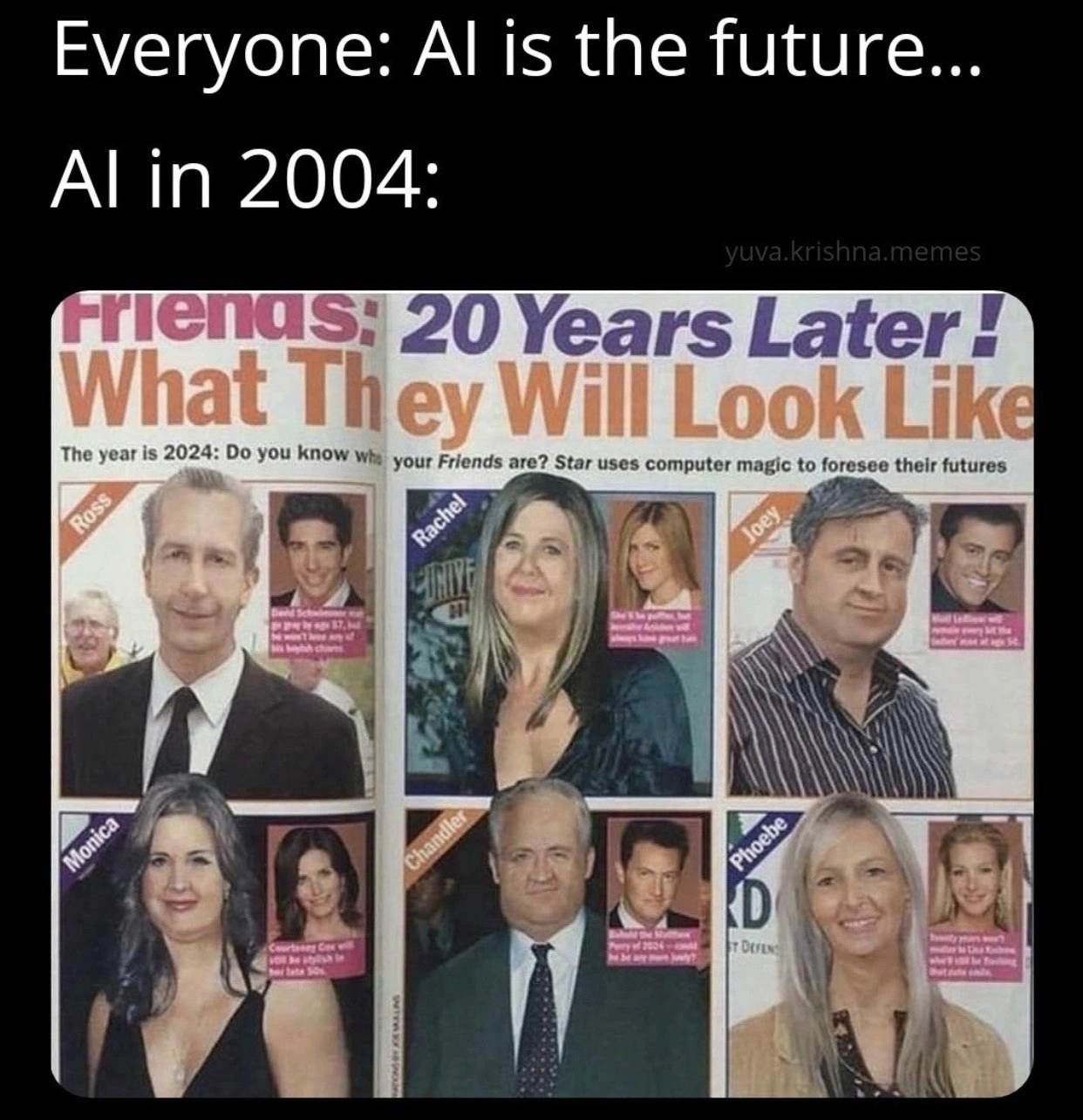
Let’s break down why this meme is amusing, in simpler terms, and what all the tech talk means. The setup says, “Everyone: AI is the future…” and then “AI in 2004:” (followed by a picture of a magazine’s attempt to age the Friends cast). The humor clicks when you understand that AI (artificial intelligence) in 2004 was nowhere near as advanced as AI today – yet people were very excited about it even back then.

First off, AI (Artificial Intelligence) basically means making computers do things that normally you’d think only a human could do, like recognize faces, understand language, or make decisions. When someone says “AI is the future,” they mean we expect AI to become super important and capable, handling many tasks for us. And indeed, in recent years, AI has gotten pretty powerful (think about face recognition unlocking your phone, or voice assistants like Alexa understanding you). That’s thanks to something called machine learning, where the computer learns from lots of examples rather than being explicitly programmed for every scenario. A popular form of machine learning uses neural networks, which are programs inspired by the way our brains work, allowing a computer to learn patterns (like what a face looks like, or how a face changes with age).

Now, back in 2004, things were different. The meme’s image comes from a magazine that, in 2004, tried to show what the cast of the TV show Friends would look like 20 years later (i.e., in the year 2024). They claimed to use a computer to do this – calling it “computer magic”. That phrase alone feels quaint now! Essentially, they were saying “we used a fancy computer program to predict the future.” For a reader in 2004, that sounds exciting: wow, a computer can magically show the future faces of the actors!

The six main characters of Friends (Rachel, Ross, Monica, Chandler, Joey, and Phoebe) each got a little side-by-side treatment: a small photo of what they looked like in the early 2000s, and a larger image supposedly showing them aged by twenty years. If you look at those “20 years later” pictures (as the meme shows, though blurred for privacy in the meme), they look… well, fake. Ross’s hair is gray and receding, and his face looks stretched oddly longer. Rachel (Jennifer Aniston’s character) is shown with a kind of puffier face and a hairstyle that almost looks like an unkempt wig. Joey has been turned into a tired-looking middle-aged guy with a heavier figure. Monica’s image has her with grayish-purple hair and more wrinkles. Chandler looks like an older businessman with a double chin, and Phoebe is given straight silver hair and a grandmotherly vibe. The changes are very exaggerated and not very flattering – it kind of looks like someone used a crude photo editing tool on each of them.

So why is that funny? Because here in the present (2021 and beyond), we know two things:

  1. The actual Friends cast did age over those years (we can see them now in real life), and surprise – they don’t look anything like those weird fake pictures. The predictions were way off. Lisa Kudrow (Phoebe) in her mid-50s still looks like Lisa Kudrow, not some completely transformed person; the magazine’s version of her was totally inaccurate. It’s a big fail in terms of prediction. This kind of failed prediction is often called a “fail” on the internet, and here it’s specifically a predictive aging fail.
  2. Our modern AI can do a much better job at tasks like this. If you’ve ever used an aging filter on a smartphone app (for example, FaceApp’s popular “old face” filter that went viral a couple years back), you’ll know the results can be spookily realistic. Today’s AI, using neural networks trained on thousands of photos of people at young and old ages, can take your photo and produce an aged version that actually looks like you, just older – with the right wrinkles, face shape changes, gray hair, the works. It might even keep your smile or expression believably. In contrast, the 2004 method was more like a one-size-fits-all approach: it would add some generic age effects that didn’t necessarily match the person. That’s why all those Friends aged pictures have a similar vibe (washed-out skin, gray hair) but miss the mark on individuality.

So the meme is basically saying: “We always get hyped about AI being super powerful, but let’s not forget that in 2004, this is what AI gave us – haha, not very impressive!” It’s using tech nostalgia — looking back at old technology — to make a joke about AI hype. The top text “Everyone: AI is the future…” represents the hype and high expectations. The bottom part “AI in 2004:” with the silly images represents the reality check, especially from a historical perspective.

To a junior developer or someone new to the field, the takeaway is also a tiny lesson in tech evolution. The term “computer magic” from that magazine is a very early-2000s way of garnishing something with tech mystique. It sounds funny now, because we wouldn’t call it magic — we’d call it an algorithm or simply say “we used software.” At the time, though, many people reading that article might have had no idea how the aging was done, so describing it as some magical computer process made it intriguing. In truth, that “magic” was probably a rudimentary piece of face morphing software. Face morphing software was popular in late 90s and early 2000s for novelties: think of tools where you could blend two faces (like “See what celebrity baby you’d have!”) or gradually turn one face into another in a animation. It wasn’t intelligent; it just followed some image warping techniques. One simple method might be: identify key points on the face (eyes, nose, mouth position), shift them around or enlarge them to mimic aging (ears get a bit bigger, nose might enlarge, jaw sags a bit), then overlay some pre-made wrinkle textures and change hair color to gray. A lot of early “aging” effects were basically like applying a preset filter — similar to how Instagram filters apply a look to your photo, but much less sophisticated than the AI filters of today. The results were often unintentionally funny or creepy, as we see with the Friends example.

Meanwhile, today’s approach with machine learning (especially deep learning) is fundamentally different. Instead of programmers deciding “put a wrinkle here, make the hair this color” with explicit code, we feed a neural network lots of examples of faces and let it learn what aging does. The network doesn’t get told “make hair gray”; it figures out on its own that hair often becomes lighter or gray by comparing older and younger faces of the same people during training. It learns that wrinkles tend to appear around eyes and mouth, that skin may sag a bit, etc., all by itself. So when you give it a new face, it applies these learned patterns in a tailored way to that face. That’s why a good AI-aged photo today still looks unmistakably like the person, just older — it’s not using a cookie-cutter template, it’s personalizing the aging.

All this progress is exactly why the meme is funny to us now. We’ve lived through the improvement. In 2004, if you saw that magazine, you might’ve thought “Cool, I guess computers can sorta age photos, neat.” In 2021, you look at the same images and think “Wow, that was bad… we’ve come a long way.” It’s a bit like looking at an old futuristic prediction (say, predictions about the year 2020 made in 1980) and chuckling at how off they were. The meme’s bold text “AI in 2004” highlights that the definition of AI was very different at the time – practically a joke compared to what we have now.

Also, since the meme involves the TV show Friends, it adds a pop culture twist that makes it more relatable. Friends was (and is) hugely popular, so most people instantly recognize those characters. Even if you’re not a developer or an AI expert, you know what Ross or Rachel should look like. That helps land the joke: you can see those predictions look nothing like how Jennifer Aniston or David Schwimmer actually aged. (In reality, as of 2021, the Friends cast aged pretty well – certainly not as drastically as the magazine’s goofy pictures.) The familiarity of the Friends cast combined with the “wow, computers were bad at this back then” realization creates a fun contrast.

In summary, this meme is giving a lighthearted history lesson. It says: Yes, AI is a big deal and everyone says it’ll change the world, but hey, remember in 2004 when AI (or what we called AI) produced this? Haha, we’ve improved a lot! It’s a mix of AI humor and tech nostalgia. The terms like AI hype or AI hype vs reality that are tagged with this meme refer to exactly that idea — people often hype up AI, but the reality can be quite different, especially in the early days. This Friends aging stunt is a perfect example of hype overshooting reality. It also implicitly celebrates how far the technology has progressed from those early attempts to now.

For a newer developer, the lesson could also be: take grand claims with a grain of salt. Today’s revolutionary tech might look quaint in a decade or two. But also, don’t dismiss the progress – what seemed almost laughable years ago laid the groundwork for what we have now. The meme manages to capture both the overconfidence of the past and the impressive advancement since then, all with a single image and a caption. And of course, it makes us laugh — because looking back at old tech predictions (especially involving our favorite sitcom characters) can be really funny when we know how things actually turned out.

Level 3: The One With the Hype Cycle

If you’ve been in tech for a while, this meme probably gives you a knowing grin. It encapsulates a classic tech hype cycle in a single image. Everyone says “AI is the future” – we’ve heard this refrain over and over, whether it was in 1985, 2004, or 2021. But then the meme slams us with reality: AI in 2004 (cue the goofy fake-aged Friends photos). The punchline lands because experienced folks remember that era, and how the lofty promises of AI didn’t quite match up to what we actually had. It’s a comedic reminder that AI hype vs reality has been a thing for a long time.

Back in the early 2000s, Industry trends were all about new frontiers – and AI was a buzzword even then. The popular press and executives loved to declare “This new AI will change everything!” (sound familiar?). In 2004 specifically, mainstream AI was mostly science fiction fodder and bold headlines. Here we have a real tabloid example: a magazine shouting “20 Years Later! What They Will Look Like” using, supposedly, computer wizardry. It was tapping into the Friends TV show fever (the series had just wrapped up in 2004, so everyone was nostalgic and curious about the cast’s future). Slapping “computer magic” onto that story was a surefire way to sell copies – it was AI hype aimed at average readers who were intrigued by both celebrities and futuristic tech.

Now, any senior developer or tech historian looking at those grainy magazine images can immediately tell how primitive that so-called AI was. The humor comes from that huge gap between what was promised and what was delivered. The headline implies some advanced predictive technology (“foresee their futures!”) – sounds almost like a crystal ball powered by silicon. The actual result: Ross with an oddly stretched face and gray skin, Chandler looking like a pasty caricature of a CEO, Phoebe with hair seemingly cut-and-paste from a granny clipart. In short, a total predictive_aging_fail. If this was the future of AI in 2004, it sure wasn’t very intelligent.

Seasoned devs have a term for this kind of thing: sprinkling magic AI dust. It means using the buzz of AI to make something seem cutting-edge, even if under the hood it’s just ordinary code. In the early 2000s, it was common to label anything remotely automated or remotely clever as “AI”. We chuckle now because we’ve seen it time and time again. This meme triggers that communal memory. It’s basically saying, “Remember when they tried to wow us with AI 17 years ago? Yeah, this is what it actually looked like.” It’s tech nostalgia served with a side of irony.

There’s also a bit of schadenfreude for developers who’ve lived through marketing-driven projects. How many times have managers or clients insisted on using the buzzword of the day? If you were coding around that era, you might have been asked to implement an “AI feature” long before the tech was truly capable. Maybe you even had to write a script to randomly generate something and hope nobody peeked behind the curtain. This meme is wink-wink, nudge-nudge to that experience.

Let’s illustrate the kind of conversation that might have happened at the magazine’s office in 2004:

Manager (circa 2004): “Our AI will show how the Friends cast looks in 20 years! It’ll be amazing for the cover story!”
Developer (circa 2004): (quietly launching a face-morphing program and crossing fingers) “Sure, boss, the computer is… uh, generating their future faces as we speak. Pure magic!”

That imagined dialogue is funny because we suspect the “computer magic” was probably just someone fiddling in Photoshop or using off-the-shelf morph software. It’s a classic scenario of tech hype overselling what the tech team can realistically do. Anyone who’s been in those shoes can relate – it’s equal parts cringe and comedy when you look back on it.

From an industry perspective, this meme also highlights how far we’ve come with AI/ML and how hype eventually catches up with reality (or sometimes reality catches up with hype). In 2004, genuinely useful AI was scarce outside of labs. Fast-forward to 2021: we actually do have accessible apps that can age a face pretty convincingly (thanks to modern machine learning). The irony is that the “AI future” everyone talked about has in some ways arrived, but roughly a decade later than the magazines predicted and with dramatically different technology. There’s a famous concept called the Gartner Hype Cycle – new technologies have a Peak of Inflated Expectations (everyone thinks it’ll do miracles), then a Trough of Disillusionment (when those miracles don’t immediately happen), and finally a Slope of Enlightenment (the tech matures and starts delivering for real). The Friends aging stunt was at that peak of early 2000s AI hype; the laughs we’re having in 2021 are from the vantage point of the enlightenment stage, where we know what AI can actually do and it’s way beyond those dinky morphs (yet we also know AI’s limitations, so we’re not too hype-blinded anymore... hopefully!).

What’s particularly delightful is that by 2021 we have the real-world outcome to compare against the 2004 prediction. The Friends cast didn’t vanish after the show – they kept appearing in public, and just recently (around when this meme was posted) they even had a high-profile reunion special on TV. So we’ve literally seen what they look like ~17 years later, and surprise: none of them ended up looking like those awkward computer predictions. For example, the magazine’s Ross looks like a squinty senior citizen version of David Schwimmer – but the real David Schwimmer in his 50s actually still looks quite recognizable and far more youthful than the “aged” image. This real-life check makes the meme even funnier. The magazine effectively tried to play fortune-teller, and in hindsight it was outrageously wrong. Monica didn’t get granny-purple hair, Joey didn’t balloon into a tired old uncle figure – the exaggerations were off.

For the veteran engineers, there’s almost a wholesome feeling seeing this meme: it’s like looking at an old yearbook photo of AI’s childhood. You cringe a bit at the hairstyle and clothes (or the pixelated wrinkles and clumsy morphs, in this case), but you also smile because it was a stepping stone to where we are now. It reminds us not to take today’s grand proclamations too seriously either. Sure, “AI is the future” – but if you’ve been around, you’ll add, “just give it time, and don’t fall for the hype until you see it working.” And if an article today claims some AI can do the impossible, well, you might recall this meme and think, “I’ll believe it when I see it – and when it doesn’t look like Chandler with a pasted-on dad bod and silver hair.”

In summary, at this level we’re laughing at the hype cycle itself. The meme captures a little piece of tech history (AI circa 2004) and uses it to poke fun at our tendency to always proclaim the next big thing. It’s the “The One Where AI’s Reach Exceeded Its Grasp” – a plotline veteran developers know all too well. And as funny as it is, it also makes us appreciate how much progress has been made since then. We went from cheesy tabloid computer magic to genuine machine learning magic – albeit with a detour through years of trial, error, and yes, hype.

Level 4: Pivot to Perceptrons

By 2004, calling something AI often meant a completely different approach than the deep learning of today. Instead of massive data-driven models, "AI" in the early 2000s typically relied on straightforward, hand-crafted algorithms. In other words, what passed for artificial intelligence was often a bunch of deterministic rules or simple filters rather than any sort of self-learning neural net. The meme highlights this stark contrast: modern AI conjures images of layered networks and big data, whereas AI in 2004 might have been nothing more than a clever image morphing trick.

To put it in context, 2004 was in a lull between major AI booms. The classic perceptron (the simplest neural network unit) had been around since the 1950s, but after some early hype it fell out of favor when researchers hit its limitations. There was even an AI winter – a period of reduced funding and interest – before new techniques revived the field. By the early 2000s, academic research on multi-layer neural networks was quietly progressing, but mainstream applications hadn’t caught up. The idea of training deep convolutional neural networks on GPUs to do complex image tasks was still emerging. So when a magazine in 2004 touted “computer magic” to age the Friends cast, it wasn’t using anything like today’s AI; it was likely using a simplistic, rule-based approach (or even manual photo editing sold as high-tech).

From a technical standpoint, aging a face believably is a hard problem. You’d need to account for subtle changes in skin texture, facial structure shifts, hairline movement, weight changes – essentially model the data distribution of aging. Modern techniques use things like Generative Adversarial Networks (GANs) for this: one neural network generates an aged face and another critiques it, refining the result until the generated older face could fool you as real. But in 2004, without such machine learning, the “aging algorithm” was probably just applying a generic transformation. It might detect a face (face detection was at a rudimentary stage then) and then overlay pre-made wrinkles, desaturate hair color to gray, and maybe shrink or widen facial features based on some fixed pattern. There was no individualized prediction — the program didn’t learn how Jennifer Aniston’s features might age differently from Courteney Cox’s; it likely just slapped the same wrinkle-and-gray template onto both.

Let’s imagine the difference in pseudo-code form between 2004’s approach and 2021’s approach to this task:

# 2004 approach: rule-based "AI" aging (simplified example)
def age_face_rule_based(face_image):
    face_image = add_wrinkle_filter(face_image)   # overlay some generic wrinkles
    face_image = add_gray_hair_filter(face_image) # turn hair gray
    face_image = sag_cheeks_filter(face_image)    # droop the cheeks a bit
    return face_image

# 2021 approach: deep learning model (trained on lots of faces) 
aged_face = deep_learning_model.generate_aged_face(original_face)
# (The model has learned from thousands of examples how faces tend to age)

In the 2004 style age_face_rule_based, everything is explicitly programmed: add this effect, then that effect – a one-size-fits-all aging recipe. The 2021 style call deep_learning_model.generate_aged_face implies a huge amount of inner complexity: a neural network that has already been trained on, say, a massive dataset of people’s photos at young and old ages. Under the hood, layers of artificial neurons are firing, having statistically learned how wrinkles form, how hair thins or grays, how jawlines and eye shapes evolve over time. The difference is night and day.

Why didn’t they use a learning model in 2004? Because the compute power and data weren’t there yet. Training a realistic age-prediction model might require millions of images and hefty processing power. In 2004, GPUs were mostly just for gaming graphics, and nobody had compiled a large aging dataset of celebrity faces (or any faces) for a computer to learn from. Concepts like large-scale image recognition were in their infancy – the famous ImageNet dataset that spurred the deep learning explosion wouldn’t be published until 2009, and the breakthrough AlexNet CNN came in 2012. So the “AI” of that tabloid was working with extremely limited tools by today’s standards. It’s like comparing a paper airplane to a modern jet: both fly, but one is a simple hand-crafted toy and the other is a complex machine engineered through decades of research.

The meme is funny on this deep technical level because it reminds us that the term Artificial Intelligence was used very loosely back then. A lot of what was branded as AI in the early 2000s was closer to straightforward programming magic tricks than any real intelligence. The fundamental science of machine learning – algorithms that improve by example – wasn’t behind that Friends aging stunt. Instead, it was likely a preset pipeline of effects (or even a graphic designer’s handiwork marketed as a computer prediction). The old system had no concept of learning or generalization; it couldn’t have surprised you with an insightful outcome, because it didn’t truly understand anything about aging. Meanwhile, the AI of today can surprise us, because it’s taught itself from data patterns (sometimes to our amazement, sometimes to our horror).

So at Level 4, the humor comes from recognizing this huge gap in AI’s evolution. It’s almost endearing, from a tech-historical perspective, to see what passed as “AI” in 2004. The magazine’s computer magic aging was deterministic and literal, whereas modern AI systems are probabilistic and inferential. We went from symbolic AI (explicit rules) to subsymbolic AI (neural networks that learn representations). The meme captures a little slice of that journey: a time when the world expected AI to be amazing, but the best we could do was a cheesy face morph. It’s a reminder of how far the field has come scientifically and a nod to the fact that our early attempts at “smart” software were often pretty dumb.

Description

A meme that contrasts the perception of AI's future with its actual capabilities in the past. The top text reads 'Everyone: AI is the future...' followed by 'AI in 2004:'. Below this is an image of a magazine page from 2004 titled 'Friends: 20 Years Later! What They Will Look Like'. The article claims to use 'computer magic' to predict the appearance of the cast of the TV show 'Friends' in the year 2024. The page displays six images, one for each main character (Ross, Rachel, Joey, Monica, Chandler, Phoebe), showing their original photo next to a comically bad, digitally aged version. The humor stems from the hilariously poor quality and inaccuracy of the 2004 'AI' prediction, which was likely just primitive photo manipulation, compared to the sophisticated generative AI models available today. It serves as a humbling reminder of how far technology has progressed and a commentary on the long-standing hype cycle of artificial intelligence
Comments

16
Anonymous ★ Top Pick The 2004 'AI' was just a Photoshop plugin called 'wrinkle_filter.dll'. The 2024 AI can generate a whole new season of Friends, but it will still make Chandler's hands have six fingers
  1. Anonymous ★ Top Pick

    The 2004 'AI' was just a Photoshop plugin called 'wrinkle_filter.dll'. The 2024 AI can generate a whole new season of Friends, but it will still make Chandler's hands have six fingers

  2. Anonymous

    2004 “AI”: a Photoshop macro that adds crow’s-feet; 2024 “AI”: a Kubernetes cluster that adds crow’s-feet to your AWS bill

  3. Anonymous

    Remember when we thought 'computer magic' in 2004 meant Photoshop filters and linear regression? Now our AI hallucinates with transformer models at scale, but at least it's wrong with 175 billion parameters of confidence

  4. Anonymous

    Ah yes, 2004's 'computer magic' - back when AI predictions looked like they were generated by a Markov chain trained exclusively on potato quality JPEGs. Twenty years later, we've progressed from hilariously bad face aging algorithms to AI that can hallucinate entire codebases with confidence. The real prediction failure here? Nobody in 2004 foresaw that by 2024, we'd be debugging AI-generated code that's somehow both syntactically perfect and architecturally nonsensical. At least these face predictions were honest about their limitations - today's LLMs will confidently tell you they nailed it while serving you a function that compiles but summons Cthulhu at runtime

  5. Anonymous

    AI's been 'the future' since 2004, yet diffusion models still render Rachel Geller as a post-singularity escapee from the latent space

  6. Anonymous

    2004 AI was a Photoshop macro: if year += 20 then add gray hair; 2024 AI is a 70B-parameter version that does the same thing and bills per token

  7. Anonymous

    2004 ‘AI’ was a tabloid intern using Liquify and gray‑hair brushes; 2024 ‘AI’ is a 200B‑param model with RLHF - same confidence level, but now it bills in GPU credits

  8. @dellism1 5y

    i mean of course, this is 2004

  9. @Mukherjee273 5y

    If you remove the extra 10 kgs of fat given to their face, its kind of close

  10. @Danich 5y

    They still have 2.5 years

  11. @NIK1357master 5y

    Who tF is AL ?

    1. @executor2077 5y

      Al Gore

      1. @NIK1357master 5y

        Algoretm¿)

  12. @MagnusEdvardsson 5y

    They made them chubbier, but it's not that far

  13. @NiKryukov 5y

    Uncanny Valley Generator?

  14. @Alamgir1444 5y

    Rose and Phoebe somewhat look like that

Use J and K for navigation