Senior Java Dev Recalls Ancient JVM Demons
Why is this Languages meme funny?
Level 1: The Balloon Pops
Imagine you’re blowing up a balloon as much as you can. You keep blowing and blowing because it’s fun and you think the balloon can just keep getting bigger. Suddenly – BANG! The balloon bursts. You jump, your heart pounds; you might even think “Whoa, what kind of scary surprise was that?!” Now your older sibling who’s been watching isn’t surprised at all. They calmly say, “The balloon popped because you put too much air in it. Balloons can only hold so much.”
In this story, you are like the new developer, and the balloon bursting is like the computer program running out of memory. The new developer was pushing the program to hold more and more data (blowing air into the balloon), not realizing there’s a limit. When the program crashes, it feels shocking – like something totally unexpected or even mysterious happened. That’s why the junior developer in the meme says, “What is this new devilry?” which is a fancy way of saying “What on earth just happened?!”. They’re as startled as a kid with a popped balloon.
The older sibling in our analogy is like the senior developer. They’ve seen balloons pop many times (they’ve seen programs run out of memory before). So instead of being scared, they recognize exactly what happened and explain, “Yep, it’s an old problem – you just overfilled it.” In the meme, Gandalf (the wise old wizard) is that experienced developer saying the error is “a demon of the ancient world,” meaning it’s a well-known old monster. In simple terms, he’s telling the juniors: “This is nothing magical or new – you just tried to use more memory than you had, and the system couldn’t handle it.”
So, the funny part of the meme is like a kid thinking a popping balloon is a scary new monster, while the older person knows it’s just the same old issue of too much stuff in a limited space. It’s showing how experience makes a big difference: what seems like a crazy, devilish problem to a newbie is actually a common, predictable thing to someone who’s been around. In real life, just remember – whether it’s balloons or computer programs, if you overfill them, they’re going to pop! And there will always be someone who’s seen it happen before and can help explain it.
Level 2: What New Devilry Is This?
This meme uses an epic Lord of the Rings scene to illustrate a very relatable programming problem. Let’s break it down in simple terms. In programming, especially with languages like Java or Kotlin, your program runs on a engine called the JVM (Java Virtual Machine). The JVM has a limited area called the heap where it stores all the objects and data your program creates (imagine a big basket for your stuff). Now, a java.lang.OutOfMemoryError (often shortened to OutOfMemoryError or OOM) is an error that happens when that basket is completely full and the program tries to add one more item. Essentially, the program ran out of memory space.
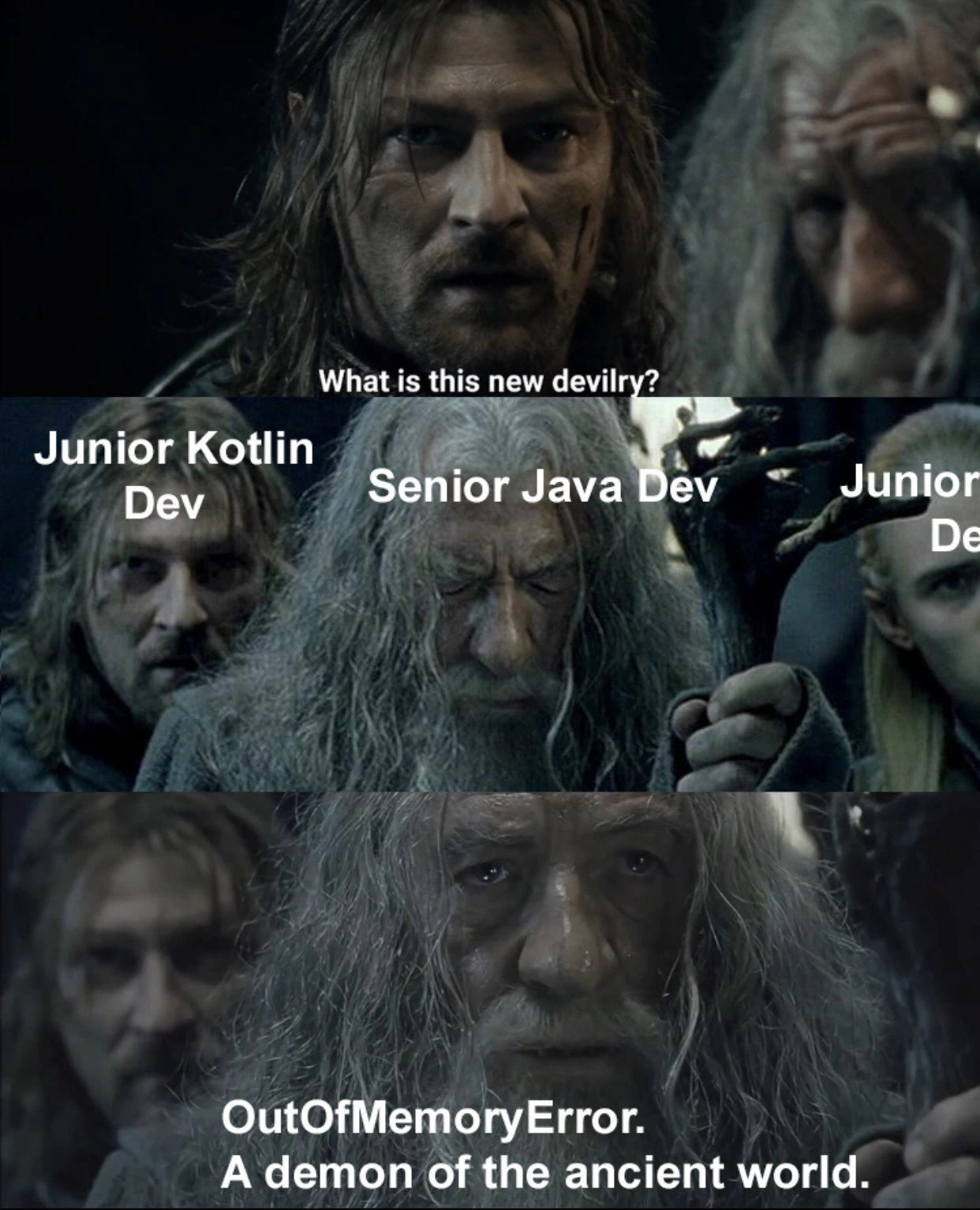
In the meme, they personify this error as a terrifying demon. The first panel shows a junior developer (labelled “Junior Kotlin Dev”) seeing the error for the first time and exclaiming “What is this new devilry?” — which is a fancy way of saying “What kind of new evil is this?” This is exactly how it feels for a new developer who has never encountered this error: the program crashed in a way they’ve never seen before, and the message looks scary and foreign. The junior might have been happily coding in Kotlin (a modern language that runs on the JVM), thinking everything would be smooth. Kotlin often abstracts away a lot of Java’s boilerplate, but it cannot escape the JVM’s reality: if you use too much memory, the JVM will throw the same old OutOfMemoryError. So our Junior Kotlin Dev is caught off guard by this runtime error.
Right next to that junior in the second panel is Gandalf labeled “Senior Java Dev”. He represents an experienced developer who has worked with Java (and JVM languages) for many years. This senior developer isn’t shocked at all; in fact, he recognizes the error instantly. In the third panel, Gandalf has a knowing look and calls it “A demon of the ancient world.” In plain terms, the senior dev is saying: “Ah, I know this problem. It’s an old one.” He’s comparing the OutOfMemoryError to an ancient demon, as if it’s a legendary monster that’s been around forever. That’s the joke: what seems like a brand-new, baffling crisis to the junior dev is actually a well-known issue that old-timers have seen many times (hence it’s “ancient”).
This scenario is common in software development teams:
- Junior developers (newer, less experience) often encounter certain bugs or errors for the first time and might panic or be confused. They might not even know what causes an OutOfMemoryError. For example, a junior dev might write code that tries to load an entire huge file into memory or keeps adding data to a list without limit. The program runs fine with small tests, but in production (with large real-world data), suddenly it crashes with this error. To the junior, it feels like a mysterious event – the program just died with some devilish message!
- Senior developers (experienced folks) have spent years debugging and fixing such problems. The senior probably immediately suspects, “We likely ran out of memory – maybe there’s a memory leak or the data is too large.” They’ve likely debugged memory issues before, using tools to check memory usage or reading logs. So while the junior is in frantic mode, the senior is already identifying the cause.
Let’s clarify a few technical terms:
- Java Heap: This is the pool of memory that Java (and Kotlin on the JVM) uses to store objects. It’s like a sandbox with a fixed size. If the sandbox is full, you can’t add more castles.
- Garbage Collection: Java has a built-in process that automatically frees up memory by removing objects that are no longer in use (think of a cleaning crew that throws away toys you’re done playing with, to make room in the sandbox). This usually keeps memory from filling up. But if objects are still referenced (meaning the program is still holding onto them) or if you create new objects faster than the garbage collector can clean, the heap can fill up anyway.
- OutOfMemoryError: This is a specific kind of error (different from an Exception) that the JVM throws when it cannot find space to create a new object. It typically stops the program (it’s a serious error, not something you normally catch and continue). The message often looks like
java.lang.OutOfMemoryError: Java heap spacewhich literally means “there’s no more space in the Java heap”. It’s not saying your entire computer is out of memory necessarily, but that the Java program hit its allowed limit. Sometimes the limit is the actual physical memory, or sometimes it’s a configured max for the JVM. - Kotlin vs Java: Kotlin is a newer programming language that many juniors use nowadays (popular especially in Android app development). It runs on the same platform as Java, so it uses the JVM and the heap as well. A Junior Kotlin Dev might not have much experience with Java’s history, so encountering a JVM error feels new and unexpected to them. The Senior Java Dev, on the other hand, likely has been working with Java since before Kotlin even existed, so they’ve seen all the classic pitfalls, including OutOfMemoryErrors, many times.
The meme labels one character as “Junior Kotlin Dev” and another simply as “Junior Dev” (possibly meaning another junior using perhaps Java or another language). This emphasizes that multiple newbies are freaking out. They probably represent any inexperienced dev facing a production bug. The Senior Java Dev (Gandalf) in the middle is effectively the mentor who has to step in. It’s a humorous take on a mentoring moment: the senior dev is basically saying, “Calm down. This is an OutOfMemoryError – an old kind of problem we know how to deal with.” Just as Gandalf in LOTR has knowledge of ancient creatures, the senior developer has knowledge of old-school errors and how to fight them (e.g., by troubleshooting the memory usage).
Visually, using Lord of the Rings is part of the joke. The scene is dark and epic: Boromir (the junior) looks frightened, Gandalf (the senior) looks serious and determined. In the movie, they were facing a Balrog (a fiery demon). In the meme, that Balrog is labeled as the OutOfMemoryError. It makes the mundane act of a program running out of memory feel like an encounter with a mythic beast. For developers, it’s funny because it does sometimes feel dramatic when a critical server crashes – alarms go off, people scramble, and the seasoned dev has to “slay” the bug. But at the end of the day, an OutOfMemoryError is just a known technical issue. The senior dev likely knows it might be solved by, say, optimizing the code (freeing memory or using streaming to handle data in chunks) or increasing the heap size configuration. The juniors learn a valuable lesson: even with modern languages and powerful computers, memory isn’t unlimited. The meme captures that learning moment with a bit of cinematic flair.
Level 3: Old Demon, New Devs
In this meme’s three-panel Lord of the Rings parody, the drama of an epic fantasy battle is superimposed on a routine developer crisis. We see a Junior Kotlin Dev and another Junior Dev reacting in panic – Boromir’s captioned line “What is this new devilry?” perfectly captures the junior engineers’ alarm when a Java program crashes with an unfamiliar runtime error. Front and center, Gandalf stands as the Senior Java Dev, face lined with the weary recognition of an old foe. He solemnly names it: “OutOfMemoryError. A demon of the ancient world.” This juxtaposition is hilarious to experienced programmers because we’ve all seen bright-eyed newcomers stunned by a Java OutOfMemoryError, while the old hands nod knowingly (perhaps rolling their eyes) because, well, here we go again.
Why is this funny? It’s the contrast in experience. The Kotlin junior likely believed their modern language and shiny new code could not possibly produce such a heinous crash. Kotlin, after all, feels sleeker than Java. But surprise! Underneath Kotlin’s pretty syntax lives the JVM – the same engine, the same heap, and the same potential for memory nightmares. The senior Java developer (much like Gandalf facing the Balrog) immediately recognizes the error as an age-old adversary. The meme taps into that shared industry trope: Junior vs Senior during a production incident. The juniors are essentially asking “WTF is happening?!” while the senior, though perhaps internally screaming “Not this again!”, has the clarity to identify the root cause at a glance. The humour comes from dramatizing a mundane scenario (a server running out of memory) as if it were a scene from an epic saga. To a battle-hardened dev, an OutOfMemoryError is indeed a legendary beast that has terrorized countless apps through history.
Real-world scenario? Picture a newbie backend developer deploying their first Java/Kotlin service. Everything runs fine with test data, but on launch day, real usage soars. Suddenly, response times crawl, alerts fire, and finally the app crashes with an ominous stack trace mentioning java.lang.OutOfMemoryError. The junior devs are bewildered: “Our code worked in staging, what is this gibberish? It says something about heap space?” They might even initially suspect an exotic bug or a JVM quirk they’ve never heard of (hence “new devilry”). Meanwhile, the senior engineer has seen this pattern 100 times – perhaps the process hit the default memory limit, or a forgotten memory leak is ballooning. The senior dev likely mutters, “Probably a leak or heavy load – the JVM’s run out of heap.” They know to check garbage collection logs, memory graphs, or pull a heap dump for analysis. It’s practically muscle memory: when an app dies without explicit error messages apart from OutOfMemoryError, an experienced Java dev immediately recognizes the ancient demon behind the chaos.
This dynamic often plays out in crisis calls at odd hours. The meme’s Gandalf might as well be that veteran developer on a 3 AM bridge call, calmly explaining to frantic juniors that the service simply exhausted its memory. There’s dark humor in the situation: everyone treats Java’s automatic memory management as a blessing – no manual free() calls! – until they realize you can still shoot yourself in the foot by allocating like there’s no tomorrow. As the saying goes in dev circles, “Java manages memory for you... until it can’t.” The senior dev knows that any language on the JVM inherits Java’s quirks: the dreaded OutOfMemoryError, the equally notorious NullPointerException, etc. These are the Balrogs and orcs lurking in every large-scale Java/Kotlin application, ancient monsters that have slain many a process.
The LOTR reference amplifies the humor with a dash of melodrama. In Tolkien’s lore, the Balrog (a demon of fire) was awakened when the dwarves dug too deep in Moria. In the meme, the juniors delved too deep into memory usage (perhaps by loading a massive dataset or failing to release objects) and awakened the Balrog of the JVM. The senior dev (our Gandalf) isn’t surprised because he remembers the old tales: he’s likely battled memory leaks in legacy Java applications, tuned garbage collector parameters, and scoured heap dumps for leaks. To him, OutOfMemoryError is a known villain — “a demon of the ancient world” — nothing mystical, just dangerous if unchecked. Seniors also know that taming this demon can be tricky: you might increase the heap size with a JVM flag (e.g. -Xmx to allocate more RAM), or hunt down the code causing the bloat. But either way, it’s a battle of attrition: trace the leak, optimize memory usage, or add more hardware. Notice the meme labels one junior specifically as a Kotlin Dev and the senior as a Java Dev. It cheekily implies that despite using a hip new language, the junior is forced to confront Java’s ancient memory constraints. Veteran Java folks often smirk at this – many of us have seen trends come and go (from Java to Scala to Kotlin), yet when a service crashes, the JVM internals don’t care what syntax you wrote; an OOM in Kotlin is the same beast as an OOM in pure Java.
The shared pain and comedic recognition in this meme runs deep in developer culture. Everyone remembers their first OutOfMemoryError: the confusion, the scramble to figure out why the app died, maybe frantically Googling the error. It’s practically a rite of passage (akin to Gandalf facing the Balrog on the bridge). And everyone remembers working with that one senior dev who had “seen it all” — they diagnose the OOM from just a Slack screenshot of the error. The senior’s reaction in the meme carries that exact energy: a mix of exasperation (“Oh, this again, the ancient bane of our servers”) and resolve (“Time to slay this monster...”). The juniors’ fearful question “What is this?” versus the senior’s grim naming of the error encapsulates the mentor-mentee moment: turning panic into understanding. The humor hits home because it’s true — even the scariest, most cryptic runtime errors become almost cliché to a veteran developer. Today’s juniors discovering an OutOfMemoryError are like new adventurers stumbling on a dragon they thought only existed in stories, only to have the old-timer say, “Yep, it’s real. And I’ve got just the spell (heap dump analysis) to deal with it.”
Level 4: Delved Too Greedily
In the depths of the Java Virtual Machine (JVM), memory is a finite treasure. The meme’s "demon of the ancient world" — java.lang.OutOfMemoryError — is born when a program delves too greedily and too deep into the heap, consuming more bytes than the JVM can offer. This is no ordinary bug; it’s a fundamental limitation of computing. The JVM allocates a fixed-size heap (the area of memory for dynamic allocations). If the application keeps hoarding objects and the heap fills up without relief, the garbage collector frantically scurries to free space, but even GC magic has limits. Eventually, the JVM raises an OutOfMemoryError like a Balrog rising in flame: a signal that it cannot allocate any more memory.
Under the hood, the JVM’s memory management is designed around generational garbage collection. Most objects are short-lived (living in the "young generation"), while longer-lived objects are tenured to the "old generation". The garbage collector (GC) regularly cleans up dead objects, but if your code continuously creates new objects or holds onto them (think static caches or endlessly growing lists) without letting them die, the heap usage ratchets upward. When even full GC cycles reclaim trivial space – because live data has bloated beyond the heap’s capacity – the JVM capitulates with an OutOfMemoryError. It’s the runtime’s equivalent of “You shall not pass (another allocation)!”
This error is an ancient demon indeed, as old as memory itself in computing. Long before Java, in lower-level languages like C or C++, running out of memory often meant a crash or a segmentation fault. At least Java’s approach throws a descriptive error instead of just corrupting memory. The very name OutOfMemoryError lives under the java.lang.Error family – errors so serious that typical code isn’t expected to handle them (catching one is as futile as catching a falling Balrog). If you encounter a Java heap space OOM error, it usually means the JVM tried to grow the heap to satisfy an allocation but hit the max heap size (-Xmx limit) or the OS simply said “no more”. In other words, the JVM’s appetite for RAM has surpassed what it’s allowed to eat.
From a theoretical perspective, this is inevitable: real-world machines have finite memory. There’s no free lunch, and no infinite heap. The irony is that modern high-level languages like Java and Kotlin abstract away manual memory management, so newcomers can write code without ever thinking of malloc or free. Memory feels like an endless, automatically cleaned pool... until it isn’t. When a junior dev naively loads a 10GB file into RAM or accidentally keeps every user session in memory, they unwittingly summon this latent beast. Computer Science 101 teaches that any algorithm with unbounded memory growth will eventually hit a wall; the OutOfMemoryError is that wall slamming the process. It’s the JVM’s ancient safeguard saying “Enough!”. As the meme humorously suggests, only seasoned wizards (senior devs) truly understand that this error isn’t new devilry at all, but an ages-old consequence of limited resources, described in epic terms for comedic effect.
Description
A three-panel meme using the 'Council of Elrond' scene from Lord of the Rings. In the first panel, the character Boromir looks concerned, with the caption, 'What is this new devilry?'. The second panel expands the view to include Gandalf at the center, looking down with a weary expression. Text overlays identify the characters: 'Junior Kotlin Dev' and 'Junior Dev' on the sides, and 'Senior Java Dev' over Gandalf. In the final, dramatic close-up panel, Gandalf looks up with grave understanding and says, 'OutOfMemoryError. A demon of the ancient world.' The humor contrasts the experience of a veteran Java developer with that of junior developers using more modern languages like Kotlin. For the senior, an OutOfMemoryError isn't just a bug; it's a legendary, soul-crushing problem that evokes memories of painful debugging sessions, heap dump analysis, and JVM tuning from a time when memory management was a more frequent and brutal challenge

Comments
9Comment deleted
A junior dev asks, 'Why did it crash?' The senior Java dev replies, 'The garbage collector decided to unionize and go on strike for better working conditions.' It was an OutOfMemoryError
Watching juniors fix an OutOfMemoryError by doubling -Xmx is like fighting the Balrog by widening the bridge - congrats, you just made it easier for the monster to follow you into prod
After 20 years in the industry, you realize the real Balrog isn't in the Mines of Moria - it's the production JVM that's been running since 2008 with -Xmx512m because 'nobody wants to touch it and risk breaking the quarterly batch job.'
The OutOfMemoryError: that ancient adversary every senior Java dev has fought at 3 AM in production, armed only with heap dumps, profilers, and the desperate hope that '-Xmx8g' will be enough this time. Meanwhile, Kotlin devs discover it exists and think it's a new problem, not realizing it's been terrorizing JVM engineers since before Stack Overflow existed to tell them to 'just increase the heap size.'
Juniors call it new devilry; seniors know it's the JVM's polite way of saying 'your architecture needs more heap, less hubris'
Kotlin juniors trust null‑safety; seniors know one stray Java platform type turns the !! into a Balrog summoning spell
Modernizing to Kotlin didn’t slay the Balrog; it just gave OutOfMemoryError a data class
More like DAEMON Comment deleted
IIRC JVM still can't recognize cgroup memory limits Comment deleted