Skip to content
DevMeme
1288 of 7435
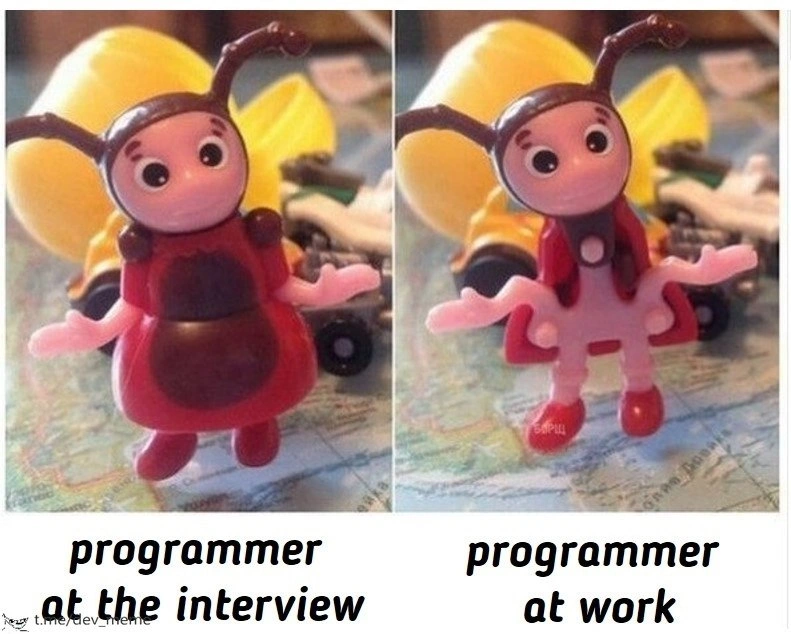
Programmer Persona: Interview vs. Reality
Career HR Post #1442, on Apr 29, 2020 in TG

Programmer Persona: Interview vs. Reality

Why is this Career HR meme funny?

Level 1: Hiding the Mess

Imagine you have a big school presentation, so you dress up in your best outfit and comb your hair nicely – you want to look perfect. That’s like the left picture: the programmer at the interview is showing their neat, shiny side. Now think about when you’re back home in your room: you’ve got toys all over the floor, clothes tossed on the chair, maybe a half-eaten snack on the desk – a total mess that you wouldn’t want guests to see. That’s the right picture: the programmer at work with everything chaotic and jumbled. The meme is funny because it’s like a friend who looks very tidy and formal at school (like a cute ladybug with a closed shell), but when you visit them at home, their room explodes with stuff everywhere (like the ladybug opened up with crazy tentacles popping out!). In short, it’s showing the difference between looking perfect for show and what’s really going on behind the scenes – and we laugh because we all do this a little in our own way.

Level 2: Neat Outside, Messy Inside

This meme shows a side-by-side comparison of expectations versus reality for programmers. On the left, there’s a toy ladybug figure looking perfectly put together: its red shell is closed and symmetrical, with cute antennae up. The caption says “programmer at the interview.” This represents how a developer appears during a job interview – organized, polished, and all put-together. Just like that tidy ladybug, the programmer in an interview projects their best self: they discuss coding best practices, show off well-structured portfolio projects, and appear confident and methodical. In other words, they only show the neat, shiny exterior – no hint of any mess.

On the right, we see the same toy ladybug but in a very different state. Its outer shell is cracked open, and suddenly a bunch of weird pink plastic limbs are sticking out all over the place, almost like an octopus came out of a ladybug costume! The caption here reads “programmer at work.” This dramatic change symbolizes what a programmer’s life is like once they’re actually on the job. The orderly shell is gone; now you see the hidden complexity. Those pink limbs look chaotic and tangled — which is exactly like a lot of real-world codebases that developers deal with every day. This is a visual metaphor for “spaghetti code.” In software slang, spaghetti code means code that is tangled and twisted in a messy way, hard to follow — kind of like a pile of spaghetti noodles. So the toy’s crazy tangle of limbs perfectly represents the messiness of a real program’s internals when things get complicated or when a project has been hastily patched over and over.

So, why is this funny to developers? It’s the classic expectations vs. reality joke. In the InterviewProcess, everyone tries to look as good as possible. Think of a programmer going for a job: they’ll talk about using elegant design patterns, like the Facade pattern (which, funnily enough, is about hiding complex details behind a simple interface – much like the ladybug’s smooth outside hiding all those limbs!). They might mention how they keep code structured, follow all the latest best practices, and so on. That’s the “neat outside” part – the facade or outward appearance.

But in DeveloperReality, software development can be messy. Once that same person is hired and starts working on a real codebase, they might encounter a lot of hidden codebase chaos. For example, perhaps the project’s code has grown over years with many different contributors, and now it’s one big jumbled mess – that’s technical debt and spaghetti code creeping in. Deadlines can force programmers to write quick fixes that aren’t so clean. They might end up multitasking on fixing bugs, adding new features, and handling urgent issues all at once – like an octopus with arms in every direction, which is exactly what the right image looks like. The “messy inside” is the implementation behind the scenes that outsiders don’t see during the interview.

The meme uses the ladybug toy to make this point in a very visual way. The left image’s ladybug is the facade – it’s like how a developer shows only the nice, clean parts of their knowledge when talking to interviewers or managers. The right image’s exposed tentacles are the implementation details – the reality of the code and tasks that are usually hidden from view because, frankly, they’re not so pretty. The contrast between the two panels is exaggerated (a ladybug turning into a mini-octopus!), which makes it funny. But it resonates because it’s based on truth: InterviewHumor like this makes light of the fact that what we promise or present (neat, perfect code) isn’t always what we actually have when we’re coding under pressure.

In simpler terms, the meme is about DeveloperExpectationsVsReality. The expectation: a programmer is always organized and their code is clean (like the left picture). The reality: programming work often becomes messy and complicated (like the right picture). Anyone who has gone from studying or interviewing into a real developer job quickly learns that the real world demands a lot of improvisation and quick fixes. It’s a nod to CorporateCulture too – companies often see the “ladybug” version of you in interviews, but then you join and find out the codebase is full of “tentacles” that you have to wrangle. The humor comes from recognizing that difference and laughing at it, because every developer has been there. It’s a lighthearted way to say: “We know you pretended to be all neat, but don’t worry, everyone’s code gets a little messy in the real world!”

Level 3: Shiny Shell, Spaghetti Code

This meme captures a painful truth in tech: the polished facade developers wear during interviews versus the tentacled chaos of real-world coding. On the left, we have a cute ladybug toy all closed up – everything looks orderly, like a coder confidently reciting SOLID principles and leetcode solutions in a whiteboard interview. On the right, the same toy’s shell has popped open to reveal a mess of pink, octopus-like limbs. This is us on the job: juggling legacy systems, writing quick // TODO fixes, and fighting fires as they erupt. The humor hits home because experienced engineers know that the tidy narratives we present to hiring managers often conceal a codebase that’s one big ball of mud behind the scenes.

In an interview, a programmer might appear symmetrical and flawless – just like that glossy ladybug shell. They’ll talk about clean architecture, unit tests, and using the latest frameworks as if everything they touch is well-encapsulated and bug-free. It’s a perfect façade (in fact, the meme inadvertently visualizes the Facade Pattern: a simple outward interface hiding complex subsystems). But crack open that shell in the real world and out spill the unruly tentacles of reality – the accumulated technical debt and ad-hoc solutions that keep the product barely running. Seasoned devs chuckle (or cringe) because we’ve all seen code that was supposed to be “well structured” turn into a tangle of functions that call other functions in a god-object of a class. The right image’s chaotic limbs perfectly represent spaghetti code: logic so tangled it might as well have eight arms flailing in all directions.

This stark contrast speaks to CorporateCulture and the gaps in the InterviewProcess. Companies often hire based on polished personas: the candidate who can calmly reverse a binary tree on a whiteboard, discuss Big-O like an algorithmic poet, and tout their side projects with perfectly formatted README files. Yet when that same person joins the team, they inherit a hidden codebase chaos that no one mentioned – half-documented APIs, rushed patches from last quarter’s crunch, and a Jenkins pipeline held together by duct tape. The new hire who confidently solved a Fibonacci problem in 15 minutes might now be on-call at 3 AM, debugging why the microservice suddenly behaves like a kraken unleashed. The meme nails this irony: Interview expectations vs. developer reality.

Why is this so relatable? Because under pressure, even the best engineers write code that isn’t pretty. Deadlines loom, product managers demand features “yesterday,” and before you know it, that elegant design you described in the interview devolves into a creature with arms in every module. It’s not that developers are dishonest in interviews – it’s that DeveloperReality is messy and complex. The ladybug’s neat exterior is the theoretical life where every function is pure and every bug is caught early; the tentacled interior is the production environment, where outages, legacy code, and “temporary permanent” fixes reign.

To put it bluntly, the meme is funny (and a bit dark) because it exposes the disconnect we often experience: InterviewHumor with a dash of truth. Everyone in tech has witnessed the newcomer with a shiny resume get dropped into a messy repo and sprout a few metaphorical tentacles trying to handle it all. It’s a gentle roast of the entire system – where DeveloperExpectationsVsReality isn’t just a meme tag, but a daily struggle. The image exaggerates it brilliantly, turning the innocent ladybug into a spaghetti-armed monster, just as a calm interviewee can turn into a frantic multi-tasker when prod is on fire. And that contrast, my friends, is chef’s kiss – painfully accurate and hilarious at the same time.

Interviewer: “Do you always write clean, well-documented code?”
Candidate: “Absolutely, I pride myself on it.”
Reality: shell opens, eight limbs of bugFix() functions flop out, hotfix scripts named final_final_v2.py wiggle around – hidden_codebase_chaos unleashed.

Seasoned devs laugh (or groan) at this meme because we’ve lived it. The next time someone boasts in an interview about their flawless coding habits, remember the ladybug: even the neatest outside can hide a mess of tentacles inside.

Interview Persona (what we promise) On-the-Job Developer (what really happens)
“I follow all best practices and write clean code.”
Polished like a ladybug shell.
Struggling with a legacy big ball of mud codebase,
adding one more if in a 5000-line function at 2 AM. Tentacles everywhere.
Shows impeccable GitHub projects with perfect README.
Neat and shiny presentation.
Code in production has comments like // TODO: fix this hack,
and half the logic lives in an old script named workaround_final.rb.
Calmly solves algorithm puzzles on a whiteboard.
One problem at a time, under ideal conditions.
Frantically multitasks on eight different bugs and feature requests simultaneously,
debugging with print statements and prayer in the real world.
Talks about SOLID principles and design patterns confidently.
Everything in theory is modular.
Inherits a monolithic app where one class does everything.
Ends up writing code like a spaghetti monster just to get the job done by the sprint deadline.

The humor here has bite because it’s true: under the glossy veneer of an interview star can lurk the tentacled beast of real programming life. DeveloperHumor often thrives on this kind of insiders’ wink – we laugh, then sigh, knowing we’ve all been that bug.

Description

A two-panel meme contrasting the appearance of a programmer in different professional contexts. On the left, under the caption 'programmer at the interview', there is a photograph of a fully assembled plastic toy of a cute, cartoonish ladybug. It is neat, complete, and well-presented. On the right, under the caption 'programmer at work', the same toy is shown, but it is partially disassembled with its internal support structure twisted and exposed, making it look chaotic and broken. The meme humorously illustrates the 'expectation vs. reality' trope, suggesting that developers present a polished, perfect version of themselves during interviews, while their actual day-to-day work life is messy, complex, and involves dealing with the chaotic internals of systems
Comments

7
Anonymous ★ Top Pick In the interview, you describe your elegant, event-driven, microservice-based architecture. At work, you're just trying to figure out which of the 200 undocumented environment variables is causing the staging server to crash
  1. Anonymous ★ Top Pick

    In the interview, you describe your elegant, event-driven, microservice-based architecture. At work, you're just trying to figure out which of the 200 undocumented environment variables is causing the staging server to crash

  2. Anonymous

    Interview: “I’m strict about single-responsibility.” Prod: behold `GodClass` - eight public APIs, forty-two private helpers, and a constructor that quietly boots a Kafka consumer because…historical reasons

  3. Anonymous

    Just like how we promise microservices architecture in the interview but end up maintaining a monolith with 47 different authentication mechanisms, each added by a different contractor who 'had a better way' - eventually you're just the skeletal remains of your former optimistic self, held together by coffee and git blame

  4. Anonymous

    The classic interview paradox: You spend weeks grinding LeetCode to prove you can reverse a binary tree in O(log n) time, only to spend your first month on the job trying to figure out why the staging environment works differently than prod, deciphering a 10-year-old monolith with zero documentation, and attending meetings that could have been Slack messages. Turns out 'culture fit' really meant 'can you maintain composure while everything around you is on fire?'

  5. Anonymous

    Interviews: Immutably professional pure function. Work: Mutable state with endless side effects

  6. Anonymous

    Interview: “clean, stateless microservices.” Work: an eight‑armed façade wrangling three legacy monoliths, a flaky vendor API, and a cron named do_not_delete.sh - somehow marketed as “eventual consistency.”

  7. Anonymous

    At the interview I balance red-black trees; at work I balance OKRs, on-call, Jira triage, Slack interrupts, a SOC2 spreadsheet, and the 'temporary' cron that became a payment gateway

Use J and K for navigation