The Myth Of First-Try Code
Why is this Debugging Troubleshooting meme funny?
Level 1: Magic Homework
This is like someone saying they do math homework and every answer is perfect before checking it. Everyone laughs because that almost never happens. Programmers laugh for the same reason: code usually needs fixing before it works, so getting it right on the first try sounds like magic.
Level 2: The First Try Trap
Debugging means finding and fixing problems in code. A bug is any behavior that is wrong, unexpected, or broken. Code execution is what happens when the program actually runs, which is different from how correct it looked while being written.
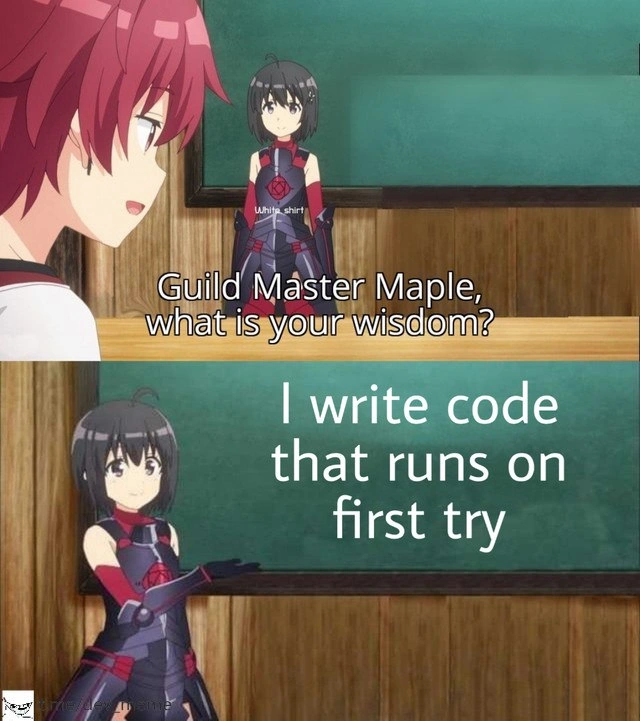
The image shows one character asking for wisdom, and the other pointing at the statement “I write code that runs on first try.” That feels absurd because most code needs at least one round of correction. A missing semicolon, wrong import, typo, bad path, failed test, or unexpected input can stop the first attempt quickly.
For junior developers, this meme is reassuring. If your code does not run immediately, that does not automatically mean you are bad at programming. It means you are doing the normal loop: write, run, read the error, adjust, run again. Over time, better habits reduce the number of mistakes, but they do not remove reality from the process.
Level 3: First-Run Sorcery
Guild Master Maple, what is your wisdom?
I write code that runs on first try
The two-panel anime setup treats “code that runs on first try” as forbidden knowledge from a guild master. That is exactly why it works. The claim is not merely “I am a good programmer”; it is “I have bypassed the entire debugging economy.” For anyone who writes software regularly, first-run success feels less like competence and more like the build system briefly losing track of reality.
Experienced developers know that code fails on the first try for reasons that have little to do with intelligence. Syntax errors are the polite failures. The real ones come from wrong assumptions: a nullable field that was “never null,” an API response shaped differently in production, a stale migration, a missing environment variable, a dependency version mismatch, a timezone edge case, or a test fixture that quietly lies. The first execution is often not a verdict on skill; it is the first time the code meets the world outside the developer’s head.
The meme also pokes at developer expectations versus reality. Beginners often imagine senior engineers write flawless code directly from thought to editor. Seniors know the opposite: good engineering is usually fast feedback, small changes, useful tests, readable errors, and enough humility to assume the first draft is suspicious. The craft is not avoiding every bug; it is building a workflow where bugs reveal themselves cheaply.
There is a darker workplace angle too. Teams sometimes reward the appearance of effortless certainty, so people hide the messy middle: failed runs, console prints, temporary assertions, confused searches, and “why is this undefined” moments. The meme is funny because it exaggerates first-try execution into a superpower, but the healthier lesson is that debugging is not failure. Debugging is the conversation where the code explains what the plan forgot.
Description
A two-panel anime meme shows a red-haired character asking a dark-haired armored character, "Guild Master Maple, what is your wisdom?" In the first panel, a small label on the armored character's torso appears to read "white shirt." In the second panel, the same character gestures toward a chalkboard-like green background with large white text saying "I write code that runs on first try." The joke treats bug-free first execution as near-mythical developer wisdom, because most real work involves syntax errors, missing assumptions, environment drift, and debugging before anything behaves.
Comments
1Comment deleted
Code that runs on the first try is not done; it is evidence you have not reached the integration boundary yet.