It's Not a Bug, It's Unsupervised Learning
Why is this Bugs meme funny?
Level 1: Cooking with Fire (An Everyday Analogy)
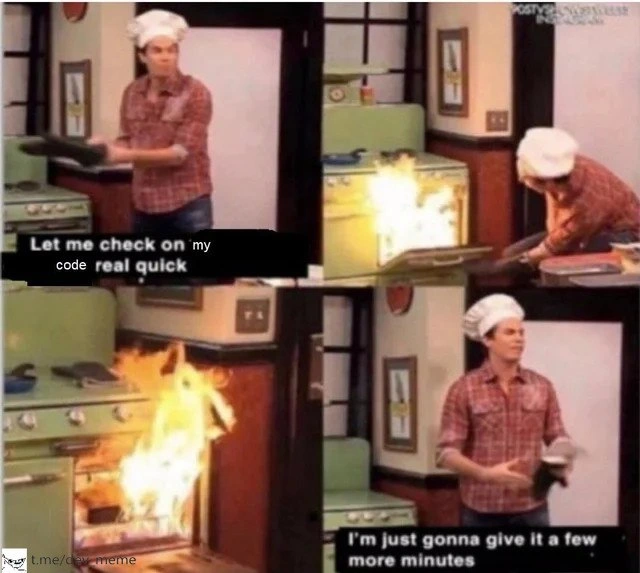
Imagine you’re baking cookies in the oven. You smell something funny and open the oven door to check – uh oh, flames are starting to flicker around the cookie tray! The cookies are catching fire. In a normal situation, you’d yell for help or grab a fire extinguisher, right? But now picture this: instead of putting out the fire, you just shrug and say, “Hmm, I’ll let them bake a little longer; maybe the fire will go out on its own and the cookies will turn out okay.”
Sounds silly, doesn’t it? If you ignore a fire, it usually just gets bigger. Those cookies aren’t going to un-burn themselves, and your kitchen could actually catch fire if you wait. That’s exactly why the meme is funny: the developer is acting like a person who sees something clearly burning but decides to do nothing and just hope everything will be fine.
In the meme’s little story, the developer’s code is like those cookies in the oven. It started to “burn” (meaning the program started breaking badly), and the developer jokes that he’ll leave it for a few more minutes. It’s funny because it’s the opposite of what we’d normally do. It’s like watching a friend put a pot on the stove, flames start leaping out of it, and your friend goes, “I’ll just let it cook a bit more, it’s probably fine!” You’d probably laugh (after making sure everyone’s safe) because it’s so ridiculous.
So the simple idea is: when something is clearly going wrong, pretending it’s okay is both funny and foolish. We laugh at the meme because we know nobody in their right mind would let a fire keep burning in the kitchen – and yet, sometimes people do ignore problems hoping they'll fix themselves. It’s a joke reminding us: if your “cookie” (or code) is on fire, don’t just stand there – do something!
Level 2: When Your Code Catches Fire
Imagine you’re a junior developer who just deployed an update to a website. You proudly say, “Let me check on my code real quick,” just like the chef opening the oven in the first panel. Now, what do you find? Instead of a nicely baked feature, you discover flames – in tech terms, your application is crashing and throwing errors all over the place. In the meme, flames literally pour out of the retro-green oven. In real life, “flames” might be figurative: an error alert popping up, the site becoming unresponsive, or your logging system spitting out exception messages non-stop. This is what developers call a production issue or a production incident – something has gone very wrong in the live system (a bug slipped through) and it’s as urgent as a kitchen fire.
Now, what should a responsible developer do here? Normally, you’d grab the nearest “fire extinguisher” by:
- Rolling back the new code (deploying the older, stable version of the app).
- Investigating the logs to see what error caused these flames.
- Triggering any backup systems or failover mechanisms (like switching traffic to a healthy server).
- Basically, you start debugging and troubleshooting immediately to put out the fire.
But the punchline of the meme is that our developer doesn’t do any of that yet. In panel 4, he stands calmly with a burnt oven tray and says, “I’m just gonna give it a few more minutes.” In other words, he decides to wait and do nothing, even though the oven (code) is on fire. This is a humorous exaggeration of a real-life tendency among developers, especially when we’re new or feeling overwhelmed: sometimes we ignore a problem, hoping it will fix itself. Maybe you’ve experienced this as a beginner — your program throws a weird error and you think, “Huh, maybe if I run it again or wait a bit, the error will go away.” It’s like hearing a strange noise in your car and deciding not to investigate because maybe it’ll stop on its own. Spoiler: it usually doesn’t.
Let’s break down some terms and elements here:
- Bug: A mistake or flaw in the code that causes unexpected problems. In the meme, the “bug” is so bad it’s represented as a fire.
- On-call: Some developers take turns being “on-call,” which means if something breaks in production (the live site/app), they get alerted (often by a pager or text) to fix it. It’s like being a firefighter for software. If you’re on-call and your code catches fire (has a major bug), you’re expected to jump in and fix it, even if it’s late at night.
- Production: This refers to the environment where real users use your software (as opposed to your local computer or a test environment). A production issue is a problem affecting the live system. In the meme’s analogy, the oven is production – it’s where the real baking (running the actual app) happens. A fire in the oven = a serious problem in production.
- Firefighting: Developers often use “firefighting” to describe dealing with urgent production bugs. It means quickly working to resolve incidents, much like putting out a fire. In the meme, the developer literally encounters a fire. In day-to-day coding, you might say “I spent all morning firefighting that outage in our payment service.”
- Debugging: The process of finding out why the code is broken (why the fire started) and fixing it. Debugging a production issue might involve checking error messages, reviewing recent code changes, or replicating the problem. It’s kind of like a detective investigation on your code.
So why would the developer “give it a few more minutes” instead of debugging right away? The joke exaggerates a real psychology: sometimes developers are in denial or they hope a glitch might be temporary. For example, imagine your website is suddenly very slow because one server is acting up. Instead of immediately restarting that server, you might wait a minute to see if it “recovers” on its own (maybe it was a spike in traffic or a one-time error). In some cases, systems do recover without intervention – e.g., a brief network hiccup can resolve itself. But in many cases, waiting just lets the problem get worse, like a fire spreading.
For a junior developer, this meme is a playful warning. It’s telling you: don’t ignore obvious signs of trouble. If your oven is on fire (or your app is crashing), don’t just stand there hoping it will magically un-burn itself. Take action, even if it’s scary to dive in. Yes, debugging production can be daunting – especially if you fear you might make it worse – but doing nothing is usually the worst choice. At best, you’re delaying the inevitable fix; at worst, you’re allowing a small flame to grow into a full-on blaze that might bring down more of your system.
One especially relatable scenario for new devs is the “works on my machine” moment. You tested your code carefully on your own machine (or in a test environment) and everything looked good. Then you deploy to production, and suddenly it’s as if gremlins possessed your app – errors everywhere! It feels shocking and you might be tempted to think, “That’s odd… maybe it’s just acting up for a second. I’ll wait.” This meme basically pokes fun at that exact moment. The truth is, production environments have differences and greater scale, so issues can appear that you didn't catch in testing. Seasoned devs have learned (sometimes the hard way) to respect those first signs of smoke.
In simpler terms, Level 2 tells us: if you see a problem in your code, especially in production, face it head-on sooner rather than later. The longer you ignore it, the more debugging frustration you (or your teammates or your users) will experience. The meme uses humor – a chef nonchalantly letting his food burn – to highlight that ignoring problems is kinda silly. It’s a lighthearted nudge to be proactive. And if you ever do catch yourself thinking “maybe I’ll just wait a bit” while errors are flying, remember the image of that oven fire and consider taking action instead!
Level 3: The "Let It Cook" Anti-Pattern
In the top panel of this meme, a developer (dressed as a chef) opens an oven to "check on my code real quick". By the second panel, we see bright orange flames erupting—the code is literally on fire. The developer's horrified crouch says it all: something in the program has gone disastrously wrong. In real life, this would correspond to a critical production issue: maybe an unhandled exception blowing up the logs, a memory leak causing servers to thrash, or some bug setting the whole system ablaze (figuratively, we hope).
Now, any seasoned on-call engineer has seen this scenario and felt that sinking stomach. It's 3 AM, the pager is blaring, dashboards flashing red like an oven fire. Best practice dictates you jump in with fire extinguisher in hand (read: start debugging immediately, roll back that buggy deployment, or at least restart the service). But what does our intrepid developer-chef do in panel 4? He stands up with a charred tray, straight-faced, saying "I’m just gonna give it a few more minutes." This is the dark comedy of the meme: the developer is blatantly ignoring a raging production fire, hoping it will just… magically resolve itself.
Why is this so funny to experienced developers? Because it lampoons a very real anti-pattern in software teams: denial and delay in the face of on-call issues. We’ve all encountered colleagues (or caught ourselves) doing the software equivalent of closing the oven and whistling casually as smoke pours out. Maybe the error is intermittent, a so-called "transient error" that might disappear on the next retry. Maybe it’s an unknown bug in a legacy system (notice the oven’s 1970s retro-green color – a cheeky nod to legacy code from another era) and nobody wants to touch it for fear of making things worse. Or perhaps it's pure alert fatigue: after endless nights of alarms, you half-joke to yourself, “Let’s just give it a few minutes; perhaps the system will heal itself.” Spoiler: it rarely does.
This meme perfectly captures that mixture of panic and procrastination. The image of an oven engulfed in flames is an exaggerated stand-in for a server meltdown or a critical microservice throwing exceptions left and right (a real "burning production" scenario). The developer’s nonchalant line in the last panel (“just a few more minutes”) is dripping with irony. It’s the kind of gallows humor a Cynical Veteran on the ops team might mutter after deploying a fix that didn’t fix anything: “It’s fine, just give the code some time to warm up.” Meanwhile, everyone else sees the system is FUBAR.
From an engineering standpoint, ignoring a fire is obviously a terrible idea. Yet the meme resonates because it’s uncomfortably relatable. There’s a long-standing joke that when confronted with a weird production glitch, many devs will first say, “Have you tried waiting a minute? It might resolve.” We know we should dive in and troubleshoot – check logs, stack traces, metrics, maybe trigger a failover – but the human side of DevOps sometimes leads us to hesitation. Perhaps we’re hoping the issue is a one-off fluke (like a hiccup in a cloud provider) and will self-correct. Perhaps we’re in deep denial. After all, admitting your code is bursting into flames is hard; it means an uncomfortable debugging session or an incident report. So, like this chef-developer, we stall: “Hmm, maybe just a few more minutes…”
The humor also comes from the contrast between expectation and reality. In theory, developers are like firefighters when ProductionIncidents occur: we’re supposed to rush in, hoses (or hotfixes) blazing. In reality, sometimes we act more like that meme dog in the burning house saying “This is fine.” Here the developer literally sees fire and still effectively says “This is fine (let’s cook it a bit longer).” Every experienced engineer has stories of on-call war rooms where someone initially downplayed a severe bug: “Let’s not wake the senior dev yet, it might clear up.” Only to find an hour later that things have exploded far worse – user data burnt to a crisp, error queues overflowing, and now it’s all hands on deck to douse the flames.
There’s also a nod to the common practice of swallowing exceptions in code. That’s when a developer catches an error and then does absolutely nothing about it, like:
try {
// Attempt a risky operation
runCriticalJob();
} catch (Exception e) {
// Suppress the error and hope for the best
// (This is fine, just give it a few more minutes...)
}
This snippet is essentially saying “I saw something go wrong, but I’m choosing to ignore it,” which is exactly what our oven-checking developer does. In real life, silently ignoring errors leads to debugging frustration later – the problem smolders and spreads, much like an unchecked kitchen fire. Seasoned devs have been burned (pun intended) by this enough times that they now treat even small fires seriously. But the meme pokes fun at that initial instinct to look the other way, a habit born of either overconfidence (“maybe it’s nothing!”) or sheer mental exhaustion.
In summary, at the senior level this meme is a sarcastic commentary on ProductionFirefighting gone wrong. It highlights the gap between best practices and actual behavior under pressure. We laugh (perhaps a bit bitterly) because we recognize the “let it cook” attitude as a flawed coping mechanism – funny in a meme, but harrowing during a 2 AM outage. It’s a cautionary tale served with a side of humor: if you ever catch yourself thinking “Just a few more minutes” while your code base is figuratively on fire, remember this meme… and grab the extinguisher instead.
Description
A four-panel meme using a scene from the TV show iCarly, featuring the character Spencer in a kitchen. In the first panel, Spencer, wearing a chef's hat, says, 'Let me check on my code real quick.' The second panel shows him opening a mint-green oven to reveal a raging fire inside. The third panel is a closer shot of the fire erupting from the oven. In the final panel, Spencer calmly closes the oven door and walks away, saying, 'I'm just gonna give it a few more minutes.' The meme humorously depicts a common developer behavior: discovering a catastrophic problem (a 'dumpster fire') in their code or system and choosing to ignore it, hoping it will magically resolve itself. This resonates with senior engineers who have witnessed denial or procrastination in the face of critical bugs, failing deployments, or production incidents
Comments
7Comment deleted
The CI/CD pipeline isn't 'on fire,' it's just performing some emergent, self-documenting thermal testing
Canary’s screaming, Grafana’s gone full Christmas tree, but we’ve still got 21.6 minutes left in the 99.95% error budget - so leadership says, “let it cook.”
The same instinct that made me wait 47 minutes for that flaky integration test to pass on retry number 12 instead of just checking the logs like a rational person
The senior engineer's approach to production incidents: observe the cascading failures with the same calm detachment as watching a slow-motion train wreck, convinced that given enough time, the system will either self-heal or the monitoring alerts will stop once everything's completely dead. It's not denial - it's 'strategic patience' while you mentally calculate whether rolling back will cause more damage than letting it burn through to completion
SRE strategy: spot the prod fire, up the alerting threshold, whisper 'just five more minutes' while sipping coffee
Prod’s a literal smoke test - apply exponential backoff and call it Kubernetes self-healing
Open prod, see a five-alarm blaze, and call it cache warm-up - burn five more minutes of the error budget and hope eventual consistency puts it out