Skip to content
DevMeme
6221 of 7435
Senior dev spirit: the lion writes flawless code, refuses to debug
Debugging Troubleshooting Post #6821, on May 28, 2025 in TG

Senior dev spirit: the lion writes flawless code, refuses to debug

Why is this Debugging Troubleshooting meme funny?

Level 1: Even the King Makes Mistakes

Imagine a kid in school who bragged, “I never need to check my homework or study because I’m always right.” That sounds pretty bold, right? They turn in assignments without even glancing over their answers. Now, one day, that kid makes a big mistake on a test – something they would have caught if they double-checked their work. Suddenly it’s clear: nobody is perfect, and everyone needs to review and fix their mistakes sometimes.

This meme is joking about the same kind of idea, but with a computer programmer as the “bragger.” It uses a lion – often called the king of the jungle – to represent a super confident programmer who claims they never have to look for errors in their code. The funny part comes from us knowing the truth: everyone makes mistakes, even kings (or lions, or very good programmers). So saying “the lion does not debug” is like saying “this person is too perfect to ever be wrong,” which we all recognize is a silly thing to believe. The reason it’s funny is because it’s an obvious exaggeration. It’s as if a chef said they never taste their own food because it’s always exactly right – we’d chuckle because we know even the best chef needs to adjust the seasoning sometimes. In the end, the big lesson (and the joke) is that no one is so mighty that they can avoid fixing their goof-ups. Even a lion, or the most senior coder, will eventually have to clean up a mess they made – it’s just part of life, and that truth makes us smile.

Level 2: Everyone Debugs Eventually

Let’s break down the joke in simpler terms. In software, a bug is a mistake or error in the code that causes a program to behave in unexpected or wrong ways. Debugging is the act of finding and fixing these bugs – it's like being a detective for code problems. Now, the meme shows a lion (the big, confident king of the jungle) with the caption "The lion does not debug." Here, the lion represents a senior developer – someone very experienced in programming. The caption humorously suggests that this senior dev writes such perfect code that they never have to debug it. It’s as if they’re saying, “I never make mistakes, so I don’t need to troubleshoot anything.” This is the DeveloperHumor: we’re laughing because in reality, no matter how good you are, you'll eventually have to fix something unexpected.

The phrase "debug in production" that often accompanies this meme means checking or fixing code in the production environment – that is, on the real servers or live app that users are currently using. Usually, developers prefer to debug in a controlled setting (like on their own computer or in a test/staging environment) where they won't disrupt real users. The joke “If he did, he’d do it in production” is exaggerating the lion-like developer’s boldness: even if this super-senior programmer had to debug, he’d do it live on the main system with users watching, rather than admitting a flaw or taking a safer, quieter route. It’s a tongue-in-cheek way to say this person is too proud or perhaps too reckless.

For a junior developer or someone just starting out, the meme is highlighting an irony in developer culture. Beginners often look up to seniors and might think “Wow, experts probably write code perfectly on the first try.” But the truth is, even veteran coders deal with software bugs all the time. They might have more knowledge of common pitfalls and a better debugging toolbox (like using a debugger tool, reading log files, or writing tests), but they absolutely still have to troubleshoot when things go wrong. In fact, experienced devs are often better at debugging because they've encountered so many issues over the years. The humor here comes from pretending that there’s an almost mythical programmer (the 10x developer legend) who is so above everyone else that normal rules (like testing and debugging your code) don’t apply to him. It’s funny because every developer knows that’s not realistic – everyone has to debug, from newbie to CTO, when a bug pops up.

So, this meme is basically a lighthearted jab at any overly proud programmer attitude. It’s categorized under DebuggingAndTroubleshooting and DeveloperExperience_DX because it deals with the process of debugging and the shared experience (and frustration) developers have with bugs. And it’s tagged RelatableDeveloperExperience for good reason: nearly every coder has had that moment of “why isn’t this working?!” The image of a lion proclaiming he doesn’t debug is a fun, exaggerated way to say, “ha, wouldn’t it be nice if we never had to deal with bugs?” But we do, and that’s just part of a developer’s life. Remember, “works on my machine” – meaning the code ran fine on my computer – doesn’t guarantee it will work everywhere. When it eventually doesn’t, even the mighty lion will be stepping through a stack trace or adding print statements to figure out what's wrong! 🐞

Level 3: Bravado vs Bugs

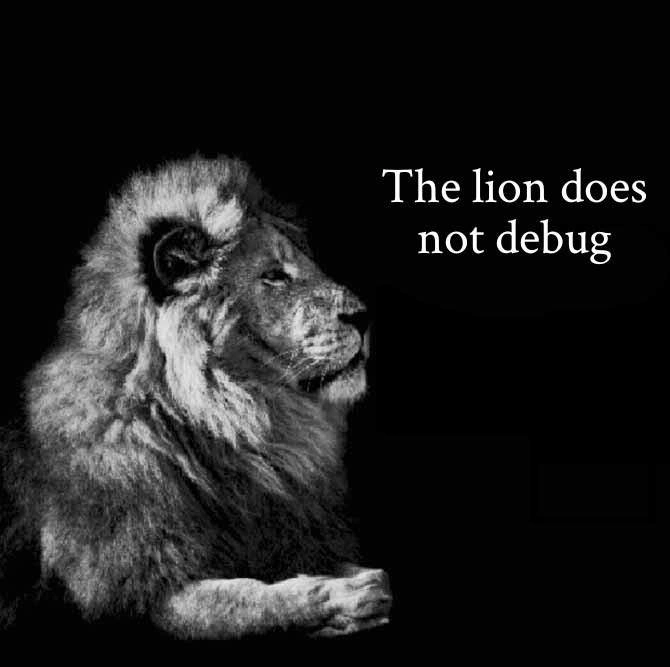
"The lion does not debug."

So declares the meme in bold white serif letters beside a majestically reclining lion, mimicking a faux-inspirational poster. In our developer savannah, the lion is an allegory for a senior engineer or the mythical 10x developer – the apex coder who supposedly writes flawless code. The humor sinks in because this lion-like dev exudes supreme confidence (or arrogance): he ships code with the kingly assumption that debugging is beneath him. After all, real apex predators don’t chase mice; by this logic, a code "lion" doesn’t chase bugs.

Experienced developers are smirking because we've all encountered this bravado. It's a playful jab at the folklore of the industry: the rockstar programmer who supposedly writes bug-free implementations in one shot. Developer humor often teases this "I never make mistakes" attitude exactly because reality proves otherwise on a daily basis. No matter how seasoned you are, sooner or later you're going to be on the hunt for a bug in the tall grass of a codebase. The meme’s punchline nails this irony: even the mightiest "king of code" eventually gets humbled by a misbehaving feature or a nasty stack trace. In other words, even an apex predator has to troubleshoot when the production error logs start roaring.

The caption is also poking fun at a certain toxic swagger. Some self-proclaimed "senior ninjas" act like debugging is for the weak – their code works first time, every time. This image flips that into a satirical motto: “The lion does not debug.” It's basically a snarky dev mantra akin to saying "My code is never wrong; the universe is at fault." Seasoned engineers recognize this as pure hubris. In truth, writing software is as much about fixing problems as building features. The best engineers aren’t those who never debug – they’re the ones who debug efficiently and learn from bugs to avoid future ones.

And then comes the extra zinger, often added in responses or the meme’s subtext: “And even if he did, he’d do it in production.” This line is dripping with irony. Debugging in production is the ultimate cowboy move – it means fixing or investigating issues directly on the live system where real users are affected. It's generally a DeveloperExperience_DX nightmare and a cardinal sin in reliable processes (imagine a surgeon operating in the middle of a crowded mall). But the meme suggests that our proud lion, if forced to stoop so low as to debug, would do it in the wildest way possible. It's a nod to those engineers who skip the safety of staging environments or proper testing – either out of overconfidence or crunch-time desperation – and start editing code on live servers because "it worked on my machine." The veteran voices among us chuckle and cringe simultaneously, because we've seen how often that ends in real-world DebuggingFrustration and emergency hotfixes.

In essence, the meme combines DeveloperIrony with a bit of role-play: it humorously deifies a programmer into a lion – king of the dev jungle – only to undercut that god-complex with the reality that no one escapes bugs. It's a lighthearted critique of any senior dev who pretends their code never fails. The experienced crowd knows the truth: pride goes before a segfault. Even the most alpha coder will, at some point, be pawing through log files at 3 AM, hunting that elusive bug with the same humility as the rest of us. The relatable developer experience here is that everyone eventually has to debug, no matter how legendary their status. The difference is, the real pros debug proactively (and preferably not in prod at 2 AM on a Friday).

# Pseudo-code illustrating the lion-like attitude
def deploy_code(change):
    try:
        release_to_production(change)
        print("Deployed without a hitch, as usual.")
    except Exception as e:
        # The lion does not debug; forward the problem
        raise  # just rethrow, someone else can deal with it

Above is a tongue-in-cheek snippet: the “lion” deploys code and if anything goes wrong, he simply rethrows the exception, essentially saying “Not my problem.” This captures the meme’s satirical spirit. In reality, a responsible dev would catch errors and debug them, but our lofty lion acts like runtime issues are beneath his notice. It's a caricature, of course – a senior dev refusing to debug is about as practical as a lion refusing to eat. Eventually hunger (or severe bug reports) will change their mind! So the meme gets a knowing laugh from seasoned engineers: we recognize the absurdity and maybe even recall a phase early in our careers when we wished we were so good that bugs dared not cross our path. Then a particularly nasty production bug taught us otherwise. 🦁🐛

Description

The monochrome image shows a side-profile of a majestic lion resting on a pitch-black background. In the empty space to the right, white serif text reads: "The lion does not debug." The stark contrast and stoic posture mimic a motivational poster, but the caption twists the genre with developer humor - suggesting an almost mythical engineer who allegedly ships code so perfect that runtime issues are beneath them. For experienced engineers, it playfully critiques the bravado that sometimes accompanies seniority or ‘10x developer’ folklore, highlighting the inevitable reality that even apex predators eventually step through a stack trace

Comments

13
Anonymous ★ Top Pick Sure, the lion doesn’t debug - he just writes prod-only asserts and calls it "observability."
  1. Anonymous ★ Top Pick

    Sure, the lion doesn’t debug - he just writes prod-only asserts and calls it "observability."

  2. Anonymous

    After 20 years in the industry, I've learned the real secret: the lion doesn't debug because it pushed straight to production on Friday at 5pm and turned off Slack notifications for the weekend

  3. Anonymous

    The lion doesn't debug because it writes Rust - the compiler already caught everything. Meanwhile, the rest of us gazelles are still stepping through JavaScript at 2 AM, wondering why 'undefined is not a function' when we clearly saw it working in dev five minutes ago

  4. Anonymous

    Senior mode: the lion doesn’t step through code; he wraps it in a feature flag, ships a canary, and lets the metrics do the hunting

  5. Anonymous

    Senior edition: the lion does not debug - he rolls back, adds tracing, and lets the bug confess

  6. Anonymous

    Lions don't debug - they've been promoted to management, watching juniors chase their 'features' through the savanna of prod logs

  7. @Hamed_Ansari_Sh 1y

    or behind the bars in a the zoo

  8. @leandrofriedrich 1y

    The lion pushes untested breaking changes to prod

  9. Deleted Account 1y

    Wait, what

  10. Deleted Account 1y

    Uhh, i think i broke it.

  11. @ZgGPuo8dZef58K6hxxGVj3Z2 1y

    You debug in production. Everybody knows that. There is literally a term for it "A/B Testing"

    1. @ZgGPuo8dZef58K6hxxGVj3Z2 1y

      This definitely never ever backfired

  12. @c_3ax 1y

    clion does

Use J and K for navigation